Automating Attachment Forwarding with n8n & LangChain
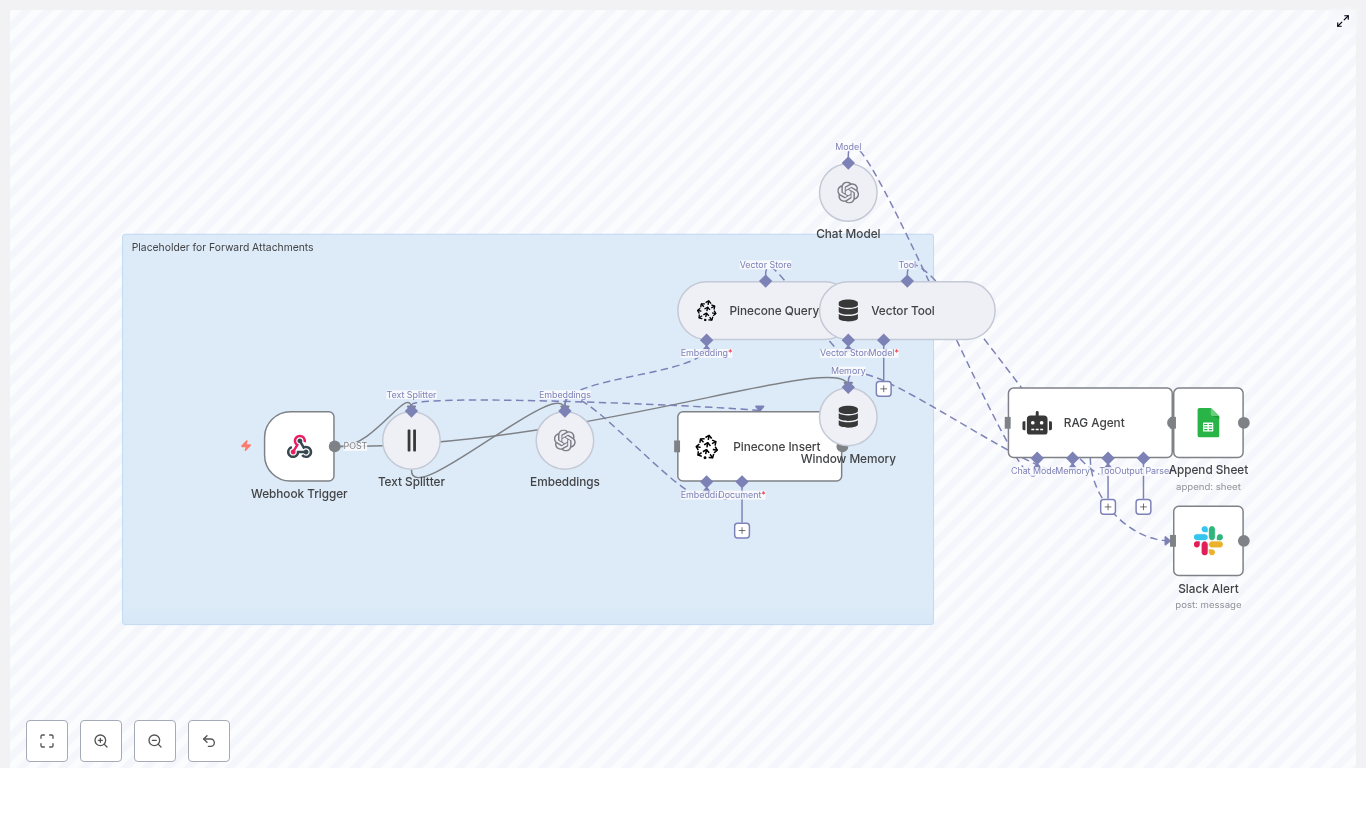
This guide walks you through an n8n workflow template that automatically forwards, indexes, and tracks attachments using LangChain components, OpenAI embeddings, Pinecone, Google Sheets, and Slack. You will learn not just how to install the template, but also how the logic works, why each tool is used, and how to adapt it for your own automation needs.
What you will learn
By the end of this tutorial, you will be able to:
Set up an n8n workflow that receives attachments or text through a webhook.
Split long documents into chunks that are suitable for embeddings.
Create OpenAI embeddings and store them in a Pinecone vector index.
Use a LangChain RAG Agent in n8n to retrieve relevant context and generate responses.
Log workflow activity to Google Sheets and send error alerts to Slack.
Apply best practices for chunking, metadata, cost control, and security.
Concept overview: How the workflow fits together
Why use this workflow?
This automation pattern is designed for teams that receive many attachments or text documents and want:
A searchable archive backed by vector search.
Automatic logging of what was processed and when.
Alerts when something goes wrong, without manual monitoring.
To achieve this, the workflow combines several specialized tools:
n8n Webhook to receive incoming files or text.
LangChain Text Splitter to normalize and chunk long content.
OpenAI embeddings (text-embedding-3-small) for semantic search.
Pinecone as a vector database for fast similarity search.
LangChain RAG Agent and a Chat Model for context-aware reasoning.
Google Sheets to log processing results.
Slack to send alerts when the workflow fails.
High-level architecture
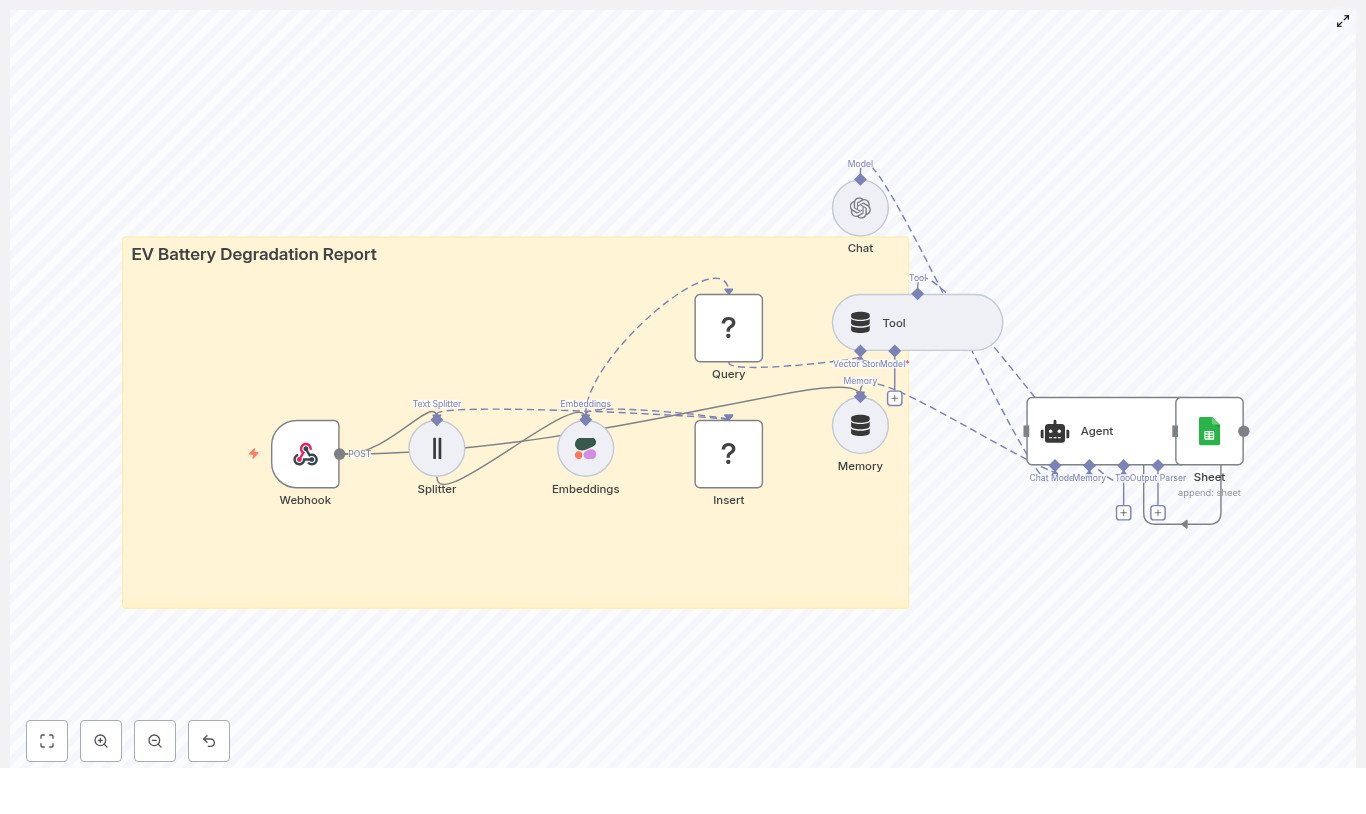
Here is the core flow in simplified form:
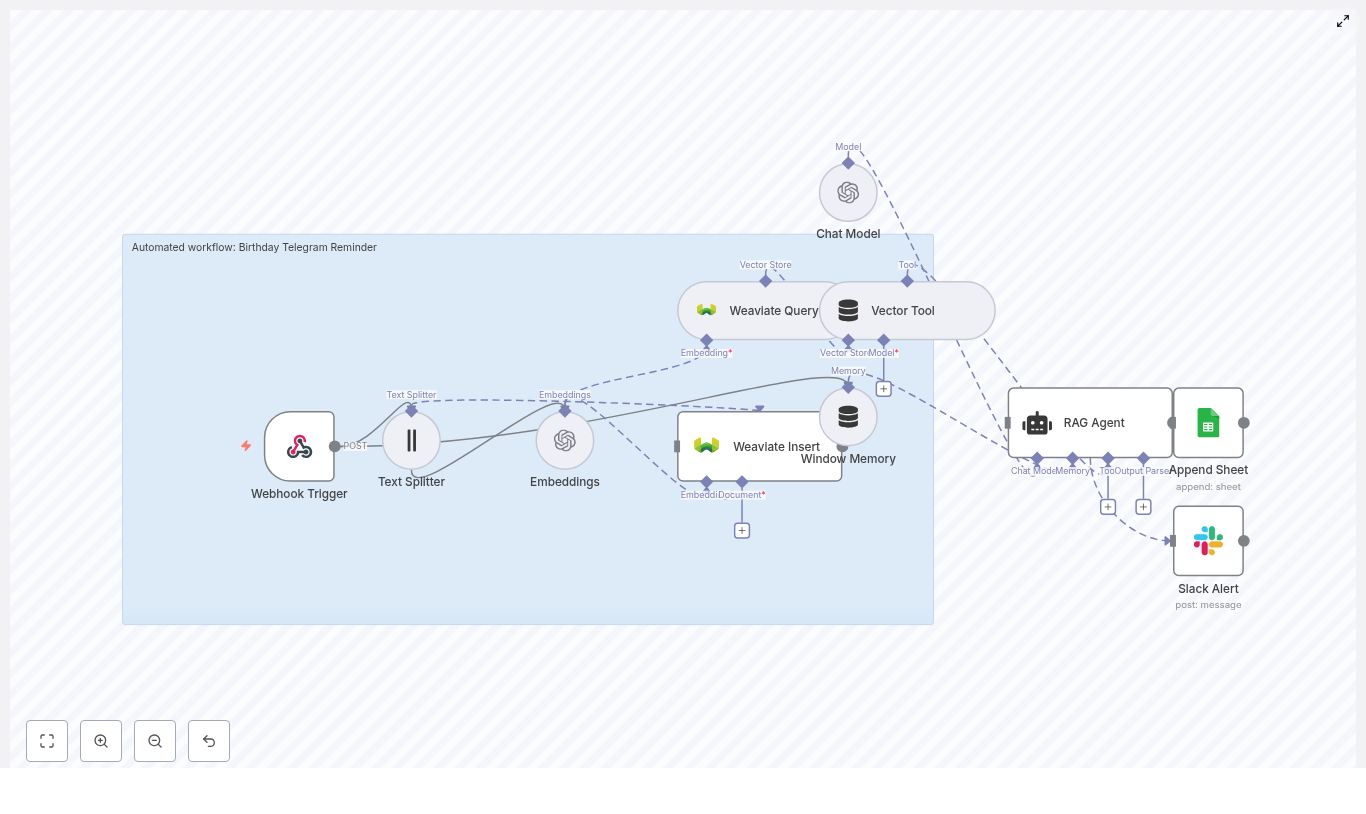
A Webhook Trigger node receives a POST request that contains attachments or raw text.
A Text Splitter node chunks the content into manageable pieces.
An Embeddings node sends each chunk to OpenAI using the text-embedding-3-small model.
A Pinecone Insert node stores the resulting vectors and metadata in a Pinecone index called forward_attachments.
A Pinecone Query node, wrapped by a Vector Tool, allows the RAG Agent to retrieve relevant chunks later.
Window Memory provides short-term conversation memory to the agent.
A Chat Model and RAG Agent generate outputs (such as summaries or classifications) using retrieved context and memory.
An Append Sheet node logs the outcome in a Google Sheet named Log.
A Slack Alert node posts to #alerts when the workflow encounters errors.
Prerequisites and credentials
Required accounts and keys
Before you configure the n8n template, make sure you have:
OpenAI API key for embeddings and the chat model.
Pinecone API key and environment with an index named forward_attachments.
Google Sheets OAuth2 credentials with edit access to the target spreadsheet (you will need its SHEET_ID).
Slack Bot token with permission to post messages to the alerts channel (for example #alerts).
Creating the Pinecone index
For Pinecone, ensure that:
The index is named forward_attachments.
The vector dimension matches the embedding model you use. For OpenAI models, check the official documentation for the correct dimensionality of text-embedding-3-small or any alternative you choose.
You select pod types and configuration that match your expected throughput and storage needs.
Step-by-step: Setting up the n8n workflow
Step 1: Import or create the workflow in n8n
You can either import the provided workflow JSON template into n8n or recreate it manually. Once imported, open the workflow to review and adjust the node configuration.
Step 2: Configure the Webhook Trigger
The webhook is the entry point for all incoming attachments or text.
Node: Webhook Trigger
HTTP Method:POST
Path:forward-attachments
When you send a POST request to this path, the payload (including attachments or text) will start the workflow.
Step 3: Set up the Text Splitter
The Text Splitter node breaks large content into smaller chunks so that embeddings and the context window remain efficient.
Node: Text Splitter
chunkSize:400
chunkOverlap:40
The template uses 400 tokens per chunk with 40 tokens overlap. This is a balance between:
Keeping enough context in each chunk.
Avoiding very long inputs that increase token usage.
You can adjust these values later based on the nature of your documents.
Step 4: Configure the Embeddings node
The Embeddings node sends each chunk to OpenAI to produce vector representations.
Node: Embeddings
Model:text-embedding-3-small (or another OpenAI embedding model)
Credentials: your OpenAI API key configured in n8n
Each chunk from the Text Splitter becomes a vector that can be stored and searched later.
Step 5: Insert vectors into Pinecone
Next, the workflow stores embeddings in Pinecone along with useful metadata.
Node: Pinecone Insert
Index name:forward_attachments
When configuring this node, add metadata fields to each record, for example:
filename
source (such as email, form, or system)
timestamp
This metadata allows you to filter and understand results when you query the index.
Step 6: Set up Pinecone Query and Vector Tool
To support retrieval-augmented generation (RAG), the agent needs a way to query Pinecone.
Node: Pinecone Query
Wrapper: Vector Tool (used by the RAG Agent)
The Vector Tool encapsulates the Pinecone Query node so the agent can request similar vectors based on a user query or internal reasoning. This is how the agent retrieves context relevant to a particular question or task.
Step 7: Configure Window Memory
Window Memory gives the agent short-term memory of recent messages or actions.
Node: Window Memory
Attach this memory to the agent so it can maintain continuity across multiple steps, while still staying within context limits.
Step 8: Set up the Chat Model and RAG Agent
The RAG Agent is the reasoning engine of the workflow. It combines:
The Chat Model (OpenAI or another supported model).
The Vector Tool for retrieval from Pinecone.
Window Memory for short-term context.
Key configuration details:
System message:You are an assistant for Forward Attachments
Tools: include the Vector Tool so the agent can fetch relevant chunks.
Memory: attach Window Memory for a short history of interactions.
The agent can then generate structured outputs such as summaries, classifications, or log entries based on the retrieved document chunks.
Step 9: Log results to Google Sheets
To keep a record of each processed attachment or text payload, the workflow logs to a Google Sheet.
Node: Append Sheet (Google Sheets)
Spreadsheet ID:SHEET_ID of your document
Sheet name:Log
Map the fields from your workflow to columns such as:
Status (for example, success or error)
Filename
ProcessedAt (timestamp)
This gives you an auditable history of all processed items.
Step 10: Configure Slack alerts for errors
Finally, the workflow includes a Slack node that notifies you when something fails.
Node: Slack Alert
Channel:#alerts (or another monitoring channel)
Message template: include the error details and any useful context, such as filename or timestamp.
In n8n, connect this node to your error paths so that any failure in the agent or other nodes triggers a Slack message.
How the processing flow works in practice
Once everything is configured, a typical request flows through the workflow like this:
Receive input A client sends a POST request with attachments or text to the /forward-attachments webhook.
Split content The Text Splitter node divides long documents into overlapping chunks to avoid context window issues and improve retrieval quality.
Create embeddings Each chunk is passed to the Embeddings node, which calls OpenAI and returns a vector representation.
Store in Pinecone The Pinecone Insert node stores vectors plus metadata such as filename, source, and timestamp in the forward_attachments index.
Retrieve relevant context When the RAG Agent needs information, it uses the Vector Tool and Pinecone Query to fetch the most similar chunks.
Generate output The agent calls the Chat Model with the retrieved context and Window Memory, then produces structured outputs (for example summaries, classifications, or other custom responses).
Log and alert On success, the Append Sheet node writes a log entry to the Log sheet. If any error occurs, the Slack Alert node posts a message to #alerts with the error details.
Best practices and tuning tips
1. Text chunking
The choice of chunkSize and chunkOverlap has a direct impact on both cost and search quality.
Typical ranges: chunkSize between 200 and 800 tokens, chunkOverlap between 20 and 100 tokens.
Larger chunks: fewer vectors and lower storage cost, but less precise retrieval.
Smaller chunks: more precise retrieval, but more vectors and higher embedding costs.
Start with the template values (400/40) and adjust based on your document length and the type of questions you expect.
2. Metadata strategy
Good metadata makes your vector search results actionable. Consider including:
Source filename or document ID.
URL or origin system.
Uploader or user ID.
Timestamp or version.
Use these fields later to filter search results or to route documents by category or source.
3. Vector namespaces and index hygiene
For multi-tenant or multi-source environments:
Use namespaces in Pinecone to isolate data by team, client, or project.
Regularly remove stale vectors that are no longer needed.
If you change embedding models, consider reindexing your data to maintain consistency.
4. Rate limits and batching
To keep your workflow stable and cost effective:
Batch embedding calls where possible instead of sending one chunk at a time.
Observe OpenAI and Pinecone rate limits and add exponential backoff or retry logic on failures.
Monitor usage and adjust chunk sizes or processing frequency if you approach rate limits.
Security and compliance considerations
When processing attachments, especially those that may contain sensitive data, keep these points in mind:
Avoid logging raw secrets or sensitive content in plain text logs.
Use n8n credential stores and environment variables instead of hard coding keys.
Encrypt data in transit and at rest, especially if documents contain PII or confidential information.
Apply retention policies for both the vector store and original attachments.
Restrict access to the Google Sheet and Slack channel to authorized team members only.
Troubleshooting common issues
Blank vectors or strange embedding output Check that the model name is correct and that the returned vector dimension matches your Pinecone index dimension.
Pinecone insertion errors Verify the index name (forward_attachments), API key, region, and dimension. Mismatched dimensions are a frequent cause of errors.
Irrelevant RAG Agent responses Try increasing the number of retrieved chunks, adjusting chunkSize/chunkOverlap, or improving metadata filters. Verify that the correct namespace or index is being queried.
Workflow failures in n8n Ensure the Slack Alert node is enabled. Check the error message posted to #alerts and inspect the failing node in n8n for more details.
Cost management
Embedding, chat, and vector storage all have associated costs. To keep them under control:
Use smaller embedding models like text-embedding-3-small when quality is sufficient.
Avoid re-embedding unchanged data. Only re-embed when the content actually changes or when you intentionally switch models.
Apply retention policies, and delete old or unused vectors from Pinecone.
Extending and customizing the workflow
Once the base template is running, you can extend it to fit your specific use cases:
Add file parsing nodes to convert PDFs, images (with OCR), and Office documents into text before they reach the Text Splitter.
Use the Chat Model for advanced classification or tagging, and store labels back in Pinecone metadata or Google Sheets.
Expose a separate search endpoint that queries Pinecone, allowing users to search the indexed attachments directly.
Use role-based namespaces in Pinecone to separate data by team or permission level.
Consistent, high quality follow-up is central to effective sales, onboarding, and customer success. Doing this manually does not scale, is difficult to standardize, and is prone to delays or errors. This article presents a production-ready n8n workflow template that automates follow-up emails using embeddings, Weaviate as a vector database, and a Retrieval-Augmented Generation (RAG) agent.
You will see how the workflow is structured, how each n8n node is configured, and how to integrate external services such as OpenAI, Anthropic, Google Sheets, and Slack. The goal is to help automation professionals deploy a robust, auditable follow-up system that is both context-aware and scalable.
Why automate follow-ups with n8n, embeddings, and Weaviate
By combining n8n with semantic search and a vector database, you can move from generic follow-ups to context-rich, personalized outreach that is generated automatically. The core advantages of this approach are:
Context retention – Previous emails, meeting notes, and CRM data are stored as embeddings and can be retrieved later to inform new messages.
Relevant personalization at scale – Vector search in Weaviate identifies the most relevant historical context for each recipient, which feeds into the RAG agent.
Reliable orchestration – n8n coordinates triggers, transformations, and external API calls in a transparent and maintainable way.
End-to-end auditability – Activity is logged to Google Sheets, and Slack alerts notify the team about failures or issues.
This architecture is suitable for teams that handle large volumes of follow-ups and require consistent, traceable communication flows integrated with their existing tooling.
High-level workflow architecture
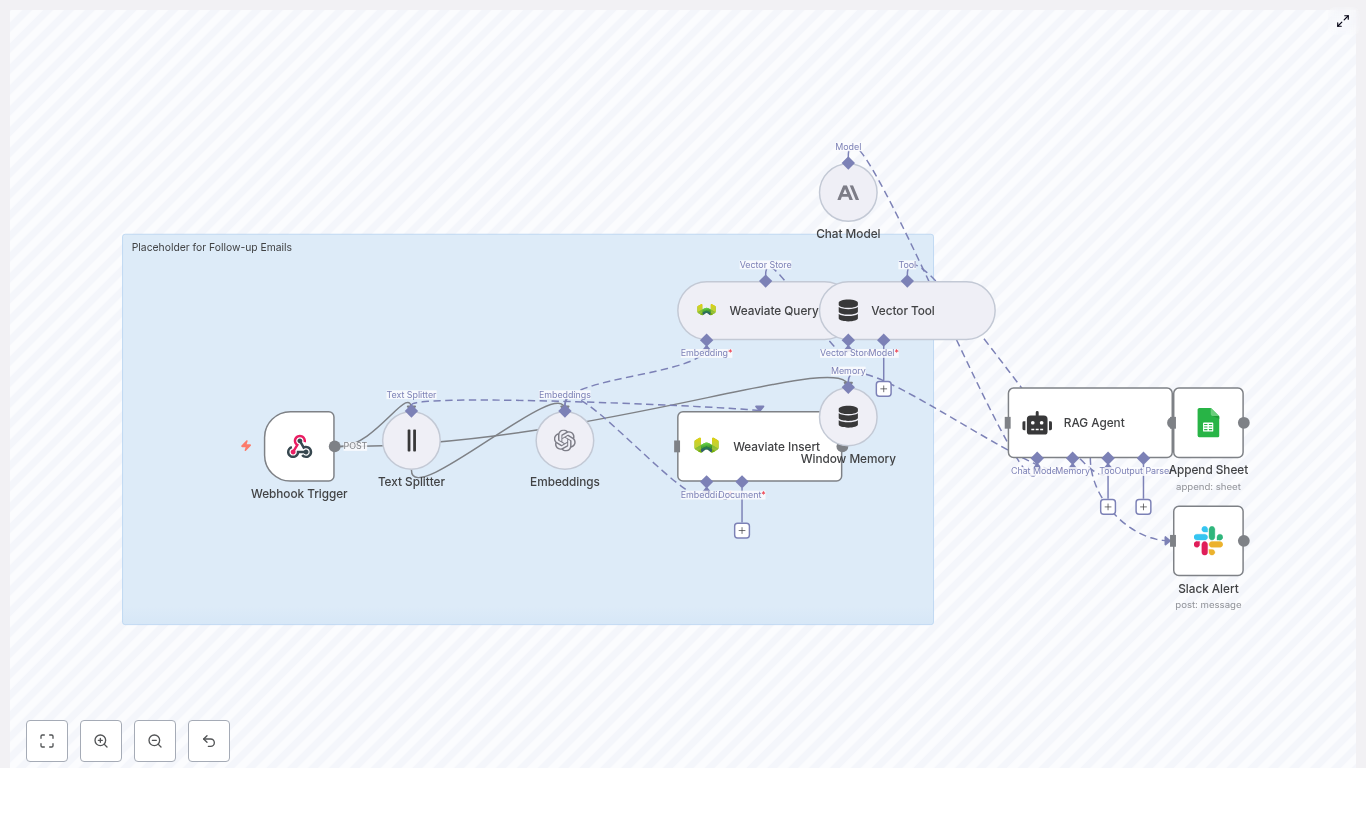
The n8n workflow follows a clear sequence from inbound request to generated email and logging:
Additional fields (such as internal IDs or CRM references) can be added as needed. To secure this endpoint, use one or more of the following:
Query parameters with API keys.
HMAC signatures validated in n8n.
n8n’s built-in authentication options.
Securing the webhook is essential when integrating with external CRMs or public forms.
Preparing context: chunking and embeddings
2. Text Splitter for context chunking
Before generating embeddings, the workflow splits the incoming context into smaller pieces. This improves retrieval quality and keeps embedding costs predictable. The Text Splitter node is configured with:
chunkSize: 400
chunkOverlap: 40
A 400-character chunk size with 40-character overlap is a practical baseline. It preserves local context across chunks while avoiding excessively large vectors. You can tune these parameters based on the type of content you process:
Long narrative emails can tolerate larger chunk sizes.
Short, structured notes may benefit from smaller chunks.
3. Generating embeddings with OpenAI
After splitting, each chunk is sent to an Embeddings node. The template uses OpenAI’s text-embedding-3-small model, which is cost-effective for high-volume use cases. Any compatible embedding provider can be substituted, as long as the output is compatible with Weaviate.
Key considerations:
Store the OpenAI API key in n8n’s credential manager, not in plain text.
Batch embedding requests when possible to reduce overhead and control costs.
Monitor usage to ensure the chosen model aligns with your budget and latency requirements.
Persisting and retrieving context with Weaviate
4. Storing embeddings in Weaviate
The next step is to persist the embeddings in Weaviate. The workflow uses a dedicated index, for example:
follow-up_emails
For each chunk, the Weaviate Insert node stores:
The embedding vector.
The original text content.
Metadata such as:
recipient_id or email.
source (CRM, meeting notes, call summary, etc.).
timestamp.
Optional tags or categories.
Rich metadata enables filtered queries, avoids noisy matches, and supports later analysis. As your index grows, this structure becomes critical for maintaining retrieval quality.
5. Querying Weaviate and exposing a Vector Tool
When a new follow-up is requested, the workflow generates an embedding for the new context and queries Weaviate for the most similar stored chunks. The Weaviate Query node typically retrieves the top-k results (for example, the top 5 or 10), which are then passed into a Vector Tool node.
The Vector Tool node exposes these retrieved chunks as tools or context items for the RAG agent. This pattern ensures that the language model does not rely solely on its internal knowledge but instead grounds its output in your specific historical data.
Key configuration points:
Set an appropriate top-k value to balance context richness with token usage.
Use metadata filters (for example, by recipient_id or company) to avoid cross-recipient leakage of context.
Regularly review query performance and refine metadata schema as needed.
Generating the follow-up: RAG agent and memory
6. Window Memory, Chat Model, and RAG orchestration
The core of the email generation is a RAG agent backed by a chat model. In this template, Anthropic is used as the Chat Model, but the pattern applies to other LLM providers as well.
The RAG pipeline in n8n typically includes:
Window Memory – Maintains short-term conversational state, which is useful if you extend the workflow to multi-turn interactions or iterative refinement.
Chat Model (Anthropic) – Receives:
A system instruction.
The retrieved context from Weaviate (via the Vector Tool).
A user prompt with recipient details and desired tone.
An example system prompt used in the workflow is:
System: You are an assistant for follow-up emails. Use the retrieved context to personalize the message. Keep it concise, clear, and action-oriented.
The user prompt then includes elements such as the recipient name, company, high-level context, and a clear call to action. This separation of system and user instructions helps ensure consistent behavior in production.
Prompt design for RAG-based follow-ups
Prompt structure has a direct impact on the quality and consistency of generated emails. A recommended pattern is:
Short, explicit system instruction that defines the role and constraints.
Bullet-pointed context extracted from Weaviate.
Recipient-specific metadata such as:
Name and company.
Last contacted date.
Desired tone and objective (for example, book a demo, confirm next steps).
System: You are an assistant for follow-up emails.
Context: • Follow-up note 1  • Meeting highlight: interested in feature X
Recipient: Jane from Acme Inc, last contacted 5 days ago
Tone: Friendly, professional
Goal: Ask for next steps and offer a short demo

Compose a 3-4 sentence follow-up with a clear call-to-action.
Keeping prompts structured and consistent simplifies debugging, improves reproducibility, and makes it easier to iterate on the workflow as requirements evolve.
Logging, monitoring, and error handling
7. Logging to Google Sheets
For visibility and non-technical review, the workflow logs each generated follow-up to a Google Sheet using the Append Sheet node. A sheet named Log can store:
Recipient email and name.
Generated email content.
Timestamp.
Status (for example, success, failed, retried).
Relevant metadata such as the source of the request.
This provides an accessible audit trail for sales, customer success, and operations teams, and supports quality review without requiring direct access to n8n or Weaviate.
8. Slack alerts on workflow errors
To ensure operational reliability, configure an onError branch from critical nodes (particularly the RAG agent and external API calls) to a Slack node. The Slack node should send a message to an appropriate team channel that includes:
A short description of the error.
The n8n execution URL for the failed run.
Key identifiers such as recipient email or request ID.
This pattern enables fast incident response and helps teams diagnose issues before they affect a large number of follow-ups.
Configuration best practices
To make this workflow robust and cost-effective in production, consider the following guidelines:
Security – Protect the webhook with HMAC validation, API keys, or n8n authentication. Avoid exposing unauthenticated endpoints to public traffic.
Embedding strategy – Adjust chunk size and overlap based on content type. Test retrieval quality with real data before scaling.
Index design – Add metadata fields in Weaviate such as recipient_id, source, and tags. Use these fields for filtered queries to reduce noise.
Cost control – Batch embedding requests, limit top-k retrieval results, and monitor token usage in the chat model. Align your configuration with expected volume and budget.
Monitoring – Combine Slack alerts with the Google Sheets log to track volume, failures, and content quality over time.
Testing – Use tools like Postman to simulate webhook payloads. Validate that the retrieved context is relevant and that the generated emails match your brand tone before going live.
Scaling and reliability considerations
As the number of follow-up requests and stored interactions grows, plan for scale at both the infrastructure and workflow levels:
Vector database scaling – Use autoscaled Weaviate hosting or a managed vector database to handle larger indexes and higher query throughput.
Rate limiting and retries – Implement rate limiting and retry strategies in n8n for external APIs such as OpenAI, Anthropic, and Slack to avoid transient failures.
Index maintenance – Periodically re-index or remove stale follow-up records that are no longer relevant. This can improve retrieval quality and control storage costs.
Example webhook request for testing
To validate your setup, you can issue a test request to the webhook endpoint after configuring the workflow:
POST https://your-n8n.example/webhook/follow-up-emails
Content-Type: application/json

{  "recipient_email": "jane@example.com",  "name": "Jane",  "company": "Acme Inc",  "context": "Spoke about timeline; she loved feature X and asked about integration options.",  "last_contacted": "2025-08-20"
}
Inspect the resulting n8n execution, verify that embeddings are stored in Weaviate, confirm that the generated email is logged to Google Sheets, and check that no Slack alerts are triggered for successful runs.
From template to production
This n8n and Weaviate pattern provides a resilient, context-aware follow-up automation framework that scales with your customer interactions and knowledge base. It helps teams deliver timely, relevant outreach without adding manual workload or sacrificing auditability.
To deploy this in your environment:
Clone the n8n workflow template.
Configure credentials for OpenAI, Anthropic (or your chosen LLM), Weaviate, Google Sheets, and Slack.
Adapt metadata fields and prompts to your CRM schema and brand voice.
Run test webhooks with representative data and iterate on configuration.
Call-to-action: Clone the template, connect your API keys, and run a set of test webhooks today. Once validated, integrate the webhook with your CRM or form system and subscribe for more n8n automation patterns and best practices.
Build a Flight Price Drop Alert with n8n, Weaviate, and OpenAI
If you have ever refreshed a flight search page so many times that your browser started to feel judged, this guide is for you. Manually monitoring flight prices is the digital equivalent of watching paint dry, except the paint sometimes gets more expensive.
Instead of wasting hours checking fares, you can let an automated flight price drop alert do the boring work for you. In this walkthrough, you will use n8n, OpenAI embeddings, and a Weaviate vector store to build a workflow that:
Receives flight price updates from your scraper or API
Stores historical prices in a vector database
Uses a lightweight agent with memory to decide when a drop is worth shouting about
Logs everything to Google Sheets for easy auditing and trend analysis
You get the fun part (catching deals), and your workflow gets the repetitive part (staring at numbers all day).
Why bother with a flight price drop alert?
Whether you are a frequent flyer, a travel agency, or that friend who always finds suspiciously cheap flights, timing is everything. A good flight price monitoring system helps you:
Catch price drops fast so you can book before the deal disappears
Keep historical context and see how prices move over time
Automate notifications and logging instead of doing manual spreadsheet gymnastics
Avoid missed opportunities because you forgot to check prices for one day
In short, you trade in repetitive manual checks for a smart n8n workflow that quietly works in the background.
What this n8n workflow does (high-level overview)
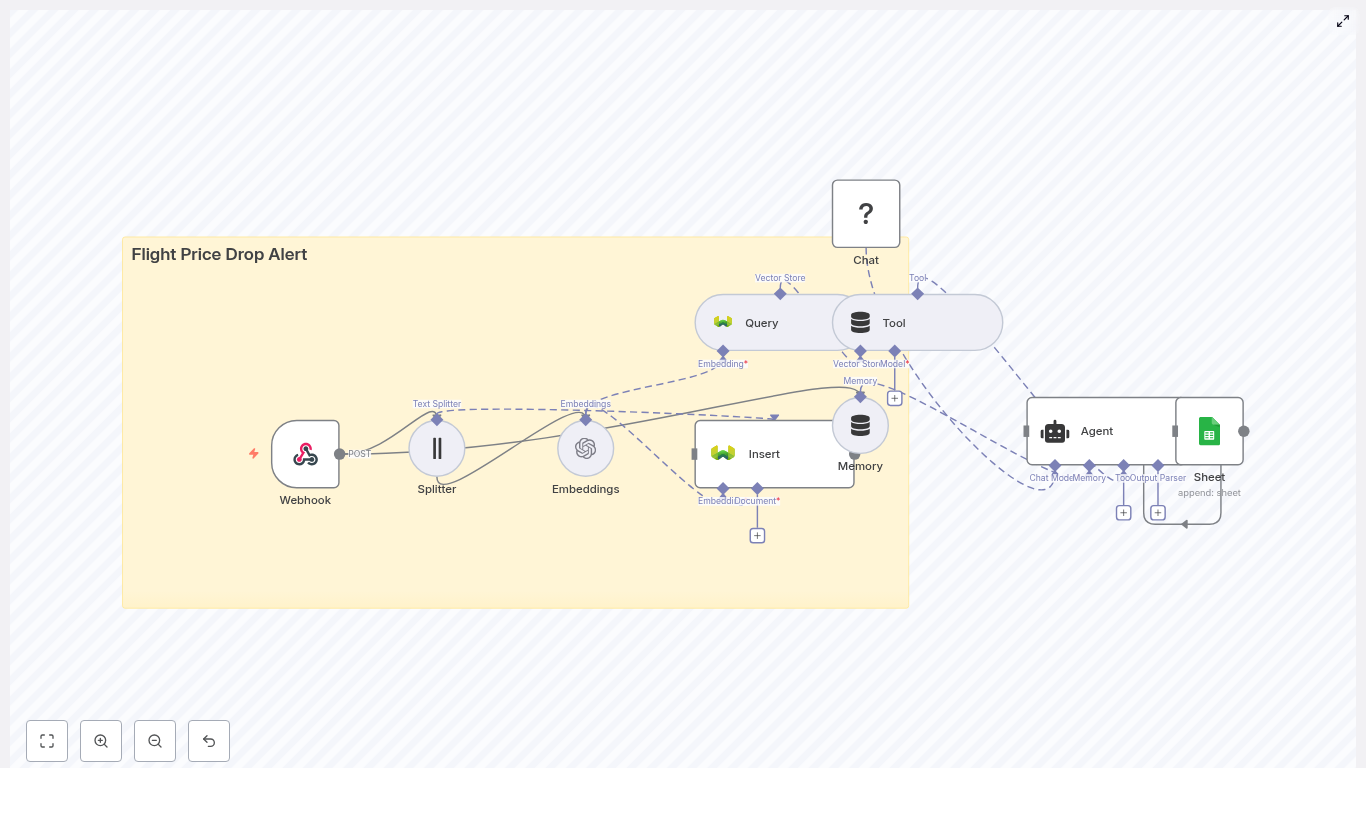
This template uses n8n as the orchestrator that connects all the moving parts. Here is the basic architecture of your flight price drop alert:
Webhook – receives flight price updates via POST from your scraper or a third-party API
Text Splitter – breaks longer text into chunks that are easier to embed
OpenAI Embeddings – converts text into numeric vectors for similarity search
Weaviate Vector Store – stores and queries those vectors efficiently
Memory + Agent – maintains short-term context and decides when to trigger alerts
Google Sheets – logs alerts and events for auditing and analysis
This combo lets you quickly prototype a robust flight price monitoring workflow in n8n, then scale it later without changing the core logic.
Core automation flow in plain English
Here is what happens when a new price comes in:
Your scraper or API sends a JSON payload with flight details to an n8n Webhook.
The workflow normalizes and splits any longer text fields into chunks.
Each chunk goes through OpenAI embeddings, turning text into vectors.
The vectors get stored in Weaviate under an index like flight_price_drop_alert.
The workflow queries Weaviate for similar past entries on the same route.
An agent, using short-term memory and query results, decides if the new price counts as a meaningful drop.
If yes, the workflow logs the alert in Google Sheets and can later be extended to send messages via email, SMS, Slack, and more.
You get an automated, data-backed decision system instead of guessing whether a $20 drop is actually a good deal.
Keywords to keep in mind
If you care about SEO or just like buzzwords, this workflow revolves around:
Let us walk through the main steps to build this flight price alert n8n template. You will keep all the original logic but in a more human-friendly order.
Step 1 – Receive flight price updates via Webhook
First, you need a way to get flight data into n8n.
Create a Webhook node in n8n.
Set it to accept POST requests with JSON payloads.
Configure your scraper or third-party API to send flight metadata to that webhook URL.
This is the raw material that everything else in the workflow uses to detect price drops.
Step 2 – Normalize and split content for embeddings
Next, you prepare the data for vectorization. If your payload includes longer descriptions or extra metadata, you do not want to embed a giant blob of text in one go.
Add a Text Splitter node after the Webhook.
Configure it to break text into chunks, for example:
Chunk size: around 400 characters
Overlap: around 40 characters
This keeps enough overlap so context is preserved, while keeping vectors compact and efficient for the Weaviate vector store.
Step 3 – Generate OpenAI embeddings
Now you turn text into something your vector database can understand.
Add an OpenAI Embeddings node.
Pass each chunk from the splitter into this node.
Include key fields alongside the text, such as:
Route (origin and destination)
Price
Timestamp or departure date
The embeddings represent your text as vectors, which makes similarity search fast and flexible. This is the backbone of your flight price monitoring automation.
Step 4 – Insert and query data in Weaviate
With embeddings ready, you can now store and compare them using Weaviate.
Add an Insert operation to your Weaviate node.
Use an index name like flight_price_drop_alert to keep things organized.
Store:
The embedding vectors
Route identifiers
Timestamps
Raw prices and any other useful metadata
To figure out whether the latest price is a bargain or just mildly less disappointing, you:
Run a Query on the same Weaviate index.
Filter by route and a relevant time window, for example the last 30 days.
Retrieve similar historical records so you can compare current prices against past ones.
Weaviate returns similar entries quickly, which lets your agent make smarter decisions instead of just reacting to every tiny fluctuation.
Step 5 – Use short-term memory and an agent to decide when to alert
Now comes the brain of the operation. Instead of hard-coding every rule, you combine:
A small in-memory buffer that stores recent interactions and context
An agent (LM-driven) that uses:
Current price
Historical prices from Weaviate
Defined thresholds
The agent can apply logic such as:
Compare the current price with the average and minimum over the last 30 days
Only trigger an alert if the drop meets a minimum threshold, for example at least 10 percent lower
Enrich the alert message with route details and booking links
The result is a more intelligent n8n flight alert workflow that avoids spammy notifications and focuses on meaningful price drops.
Step 6 – Log alerts to Google Sheets
Once the agent decides that a price drop is worth celebrating, you log it for future reference.
Add a Google Sheets node.
Configure it to append a new row whenever an alert is triggered.
Your sheet might include columns such as:
Timestamp
Route (origin and destination)
Previous lowest price
Current price
Percent change
Booking link
This gives you a simple audit log and a handy resource for trend analysis without manually updating spreadsheets at odd hours.
Decision logic and best practices for fewer false alarms
Not every tiny drop deserves an alert. You do not want your workflow pinging you every time a fare moves by a few cents.
Use meaningful thresholds
Combine absolute and relative rules so your alert system behaves like a calm adult, not a panicked stock trader. For example:
Require at least a $50 drop
And at least a 10 percent lower price than the recent average
This reduces noise and ensures alerts highlight genuinely interesting deals.
Compare prices over time windows
Flight prices are seasonal and sometimes chaotic. To keep things realistic:
Compare prices across configurable windows, such as:
7 days
14 days
30 days
This helps your flight price monitoring workflow adapt to normal fluctuations and typical fare swings.
Store rich metadata with vectors
When inserting data into Weaviate, do not store just the vectors. Include:
Route identifiers (origin, destination)
Timestamps or departure dates
Raw prices and currency
This makes filtering by route and date faster and keeps your queries flexible as you refine your alert logic.
Scaling your flight price monitoring workflow
If your use case grows from a few routes to a full-blown travel analytics system, the same architecture still works. You just need a few upgrades.
Batch insert embeddings and use asynchronous workers to handle large volumes of price updates
Shard vector indices by region or market to speed up lookups
Apply rate limiting and retries for upstream scrapers and APIs so you do not break anything during peak times
Use persistent storage like Postgres or S3 to keep raw payloads alongside your vector store
With these in place, your n8n flight price drop alert can comfortably handle larger workloads without falling apart.
Testing and validation before trusting the bot
Before you let automation loose on real bookings, you should test the workflow with controlled data.
Create synthetic price histories that include:
Clear price drops
Slow, gradual declines
Sudden spikes
Log intermediate outputs such as:
Similar records returned by Weaviate
Computed averages
Percent changes
This lets you verify that your thresholds and agent logic behave as expected before you rely on it for real travel decisions.
Security and cost considerations
Automation is great until someone pastes an API key into the wrong place. A few simple precautions go a long way:
Sanitize incoming webhook data so you do not process unexpected or malicious input
Store API keys securely using n8n credential stores or environment variables
Monitor OpenAI embedding usage and Weaviate storage so costs do not quietly creep up
Cache frequent queries if you notice repeated patterns in your searches
This keeps your flight price alert automation stable, secure, and budget friendly.
Example n8n node flow at a glance
If you like to see the big picture, here is how the main nodes line up in the template:
Webhook (POST) – receives incoming price updates
Splitter – chunks payload text for embeddings
Embeddings – converts text chunks into vectors with OpenAI
Insert – stores embeddings in Weaviate using the flight_price_drop_alert index
Query – searches recent similar vectors for the same route
Tool or Agent – uses memory and query results to decide whether to trigger an alert
Sheet – appends an audit row to Google Sheets when an alert fires
This is the full loop that turns raw price data into actionable alerts.
Example alert message
When the agent decides a price drop is worth your attention, it can generate a message like:
Short, clear, and straight to the point, so you can book quickly instead of decoding a cryptic log entry.
Next steps and customization ideas
Once you have the core n8n flight price drop alert workflow running, you can level it up with a few extras:
SMS or email notifications using Twilio or SendGrid so you get alerts on the go
Slack or Telegram integration for team travel deals and shared alerts
User preference management with custom thresholds per user or route
Dashboards and KPIs to visualize trends and monitor performance
The underlying architecture with n8n, OpenAI embeddings, and Weaviate is flexible, so you can keep extending it as your needs grow.
Wrapping up
By combining n8n, vector embeddings, and a Weaviate vector store, you get a powerful, extensible system for flight price drop alerts. The workflow balances fast similarity search with LM-driven decision making, which is ideal for catching fleeting fare opportunities without drowning in noise.
Ready to stop manually refreshing flight pages? Export the n8n workflow template, plug in your OpenAI and Weaviate credentials, and point your scraper to the webhook. In a short time, you will have a fully automated travel alert system quietly working in the background.
Call to action: Export the workflow, test it with around 50 synthetic entries, and fine tune your thresholds until the alerts feel just right. If you want a ready-made starter or hands-on help, reach out for a walkthrough or a custom integration.
On a rainy Tuesday morning, Alex, a fleet operations manager, stared at a cluttered spreadsheet that refused to cooperate. Fuel logs from different depots, telematics exports, and driver notes were scattered across CSV files and emails. Leadership wanted weekly fuel efficiency insights, but Alex knew the truth: just preparing the data took days, and by the time a report was ready, it was already out of date.
That was the moment Alex realized something had to change. Manual fuel reporting was not just slow, it was holding the entire fleet back. This is the story of how Alex discovered an n8n workflow template, wired it up with a vector database and AI, and turned messy telemetry into automated, actionable fuel efficiency reports.
The problem: fuel reports that never arrive on time
Alex’s company ran a growing fleet of vehicles across several regions. Every week, the same painful routine played out:
Downloading CSV exports from telematics systems
Copying fuel consumption logs into spreadsheets
Trying to reconcile vehicle IDs, dates, and trip notes
Manually scanning for anomalies like excessive idling or suspiciously high fuel usage
Small mistakes crept in everywhere. A typo in a vehicle ID. A missing date. A note that said “fuel spike, check later” that never actually got checked. The team was constantly reacting instead of proactively optimizing routes, driver behavior, or maintenance schedules.
Alex knew that the data contained insights about fuel efficiency, but there was no scalable way to extract them. What they needed was:
Near real-time reporting instead of weekly spreadsheet marathons
Consistent processing and normalization of fuel and telemetry data
Contextual insights from unstructured notes and logs, not just simple averages
A reliable way to store and query all this data at scale
After a late-night search for “automate fleet fuel reporting,” Alex stumbled on an n8n template that promised exactly that: an end-to-end workflow for fuel efficiency reporting using embeddings, a vector database, and an AI agent.
Discovering the n8n fuel efficiency template
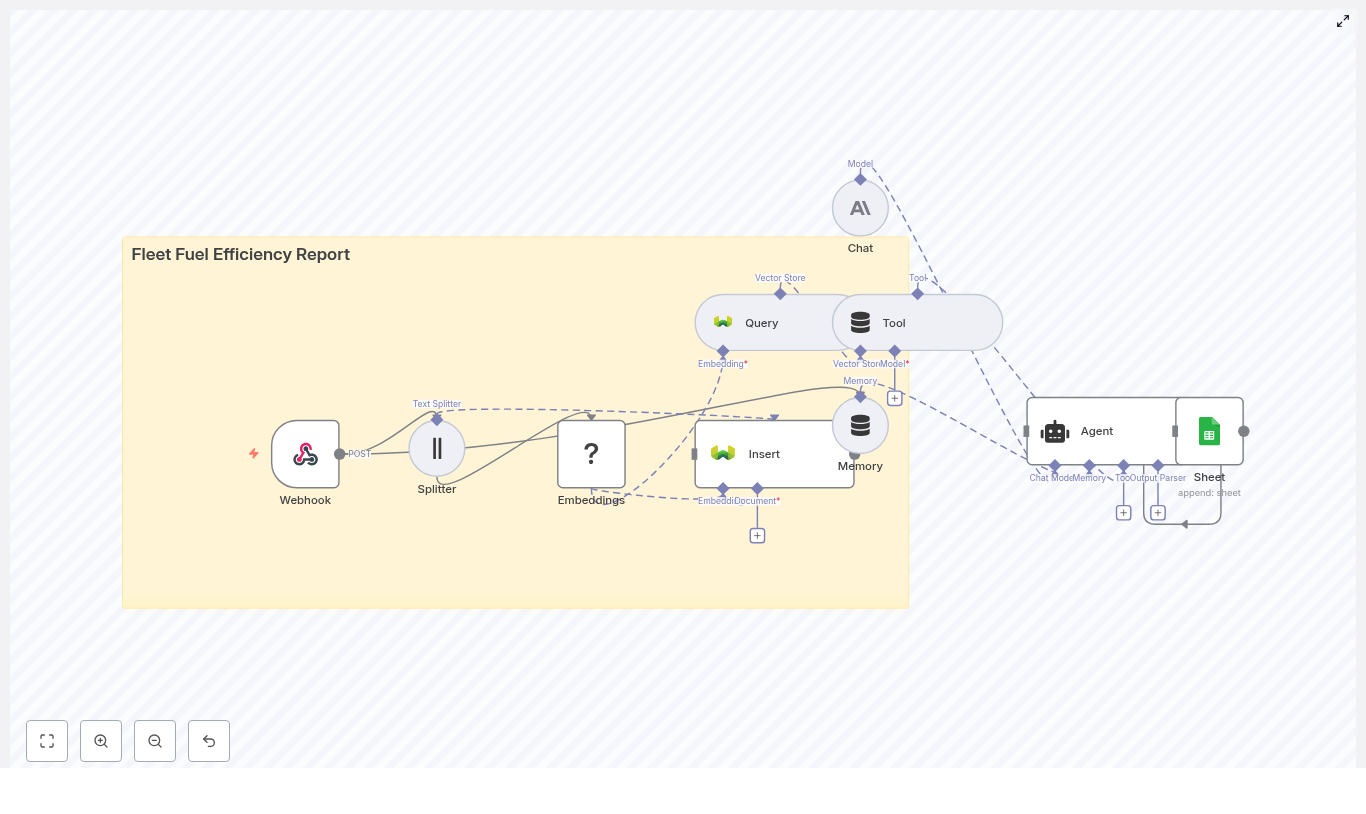
The template Alex found was not a simple script. It was a full automation pipeline built inside n8n, designed to:
Capture raw fleet data via a Webhook
Split long logs into manageable chunks
Generate semantic embeddings for every chunk with a Hugging Face model
Store everything in a Weaviate vector database
Run semantic queries against that vector store
Feed the context into an AI agent that generates a fuel efficiency report
Append the final report to Google Sheets for easy access and distribution
On paper, it looked like the missing link between raw telemetry and decision-ready insights. The only question was whether it would work in Alex’s world of noisy data and tight deadlines.
Setting the stage: Alex prepares the automation stack
Before turning the template on, Alex walked through an implementation checklist to make sure the foundations were solid:
Provisioned an n8n instance and secured it behind authentication
Deployed a Weaviate vector database (you can also sign up for a managed instance)
Chose an embeddings provider via Hugging Face, aligned with the company’s privacy and cost requirements
Configured an LLM provider compatible with internal data policies, such as Anthropic or OpenAI
Set up Google Sheets OAuth credentials so n8n could append reports safely
Collected a small sample of telemetry data and notes for testing before touching production feeds
With the basics in place, Alex opened the n8n editor, loaded the template, and started exploring each node. That is where the story of the actual workflow begins.
Rising action: wiring raw telemetry into an intelligent pipeline
Webhook (POST) – the gateway for fleet data
The first piece of the puzzle was the Webhook node. This would be the entry point for all fleet data: telematics exports, GPS logs, OBD-II data, or even CSV uploads from legacy systems.
Alex configured the Webhook to accept POST requests and worked with the telematics provider to send data directly into n8n. To keep the endpoint secure, they added authentication, API keys, and IP allow lists so only trusted systems could submit data.
For the first test, Alex sent a batch of logs that included vehicle IDs, timestamps, fuel usage, and driver notes. The Webhook received it successfully. The pipeline had its starting point.
Splitter – making long logs usable
The next challenge was the nature of the data itself. Some vehicles produced long, dense logs or descriptive notes, especially after maintenance or incident reports. Feeding these giant blocks directly into an embedding model would reduce accuracy and make semantic search less useful.
The template solved this with a Splitter node. It broke the incoming text into smaller chunks, each around 400 characters with a 40-character overlap. This overlap kept context intact across chunk boundaries while still allowing fine-grained semantic search.
Alex experimented with chunk sizes but found that the default 400/40 configuration worked well for their telemetry density.
Embeddings (Hugging Face) – turning text into vectors
Once the data was split, each chunk passed into an Embeddings node backed by a Hugging Face model. This is where the automation started to feel almost magical. Unstructured notes like “Vehicle 102 idled for 40 minutes at depot, fuel spike compared to last week” were transformed into high-dimensional vectors.
Alongside the embeddings, Alex made sure the workflow stored important metadata:
Raw text of the chunk
Vehicle ID
Timestamps and trip IDs
Any relevant tags or locations
The choice of model was important. Alex selected one that balanced accuracy, latency, and cost, and that could be deployed in a way that respected internal privacy rules. For teams with stricter requirements, a self-hosted or enterprise model would also work.
Insert (Weaviate) – building the vector index
With embeddings and metadata ready, the next step was to store them in a vector database. The template used Weaviate, so Alex created an index with a descriptive name like fleet_fuel_efficiency_report.
Weaviate’s capabilities were exactly what this workflow needed:
Semantic similarity search across embeddings
Filtering by metadata, such as vehicle ID or date range
Support for hybrid search if structured filters and semantic search needed to be combined
Every time new telemetry arrived, the workflow inserted fresh embeddings into this index, gradually building a rich, searchable memory of the fleet’s behavior.
The turning point: from raw data to AI-generated reports
At this stage, Alex had a robust ingestion pipeline. Data flowed from telematics systems to the Webhook, got split into chunks, converted into embeddings, and stored in Weaviate. The real test, however, was whether the system could produce meaningful fuel efficiency reports that managers could actually use.
Query & Tool – retrieving relevant context
When Alex wanted a report, for example “Vehicle 102, last 7 days,” the workflow triggered a semantic query against Weaviate.
The Query node searched the vector index for relevant chunks, filtered by metadata like vehicle ID and date range. The Tool node wrapped this logic so that downstream AI components could easily access the results. Instead of scanning thousands of rows manually, the system returned the most relevant snippets of context: idling events, fuel spikes, unusual routes, and driver notes.
Memory – keeping the AI grounded
To help the AI reason across multiple interactions, the template included a buffer memory node. This short-term memory allowed the agent to keep track of recent queries and results.
If Alex asked a follow-up question like “Compare last week’s fuel efficiency for Vehicle 102 to the previous week,” the memory ensured the AI did not lose context and could build on the previous analysis instead of starting from scratch.
Chat (Anthropic / LLM) – synthesizing the report
The heart of the reporting step was the Chat node, powered by an LLM such as Anthropic or another compatible provider. This model took the retrieved context and transformed it into a concise, human-readable fuel efficiency report.
Alex adjusted the prompts to focus on key fuel efficiency metrics and insights, including:
Average fuel consumption in MPG or L/100km for the reporting period
Idling time and its impact on consumption
Route inefficiencies, detours, or patterns that increased fuel usage
Maintenance-related issues that might affect fuel efficiency
Clear, actionable recommendations, such as route changes, tire pressure checks, or driver coaching
Agent – orchestrating tools, memory, and logic
The Agent node acted as a conductor for the entire AI-driven part of the workflow. It coordinated the vector store Tool, memory, and the LLM.
When Alex entered a structured request like “vehicle 102, last 7 days,” the agent interpreted it, triggered the right vector queries, pulled in the relevant context, and then instructed the LLM to generate a formatted report. If more information was needed, the agent could orchestrate additional queries automatically.
Sheet (Google Sheets) – creating a living archive
Once the AI produced the final report, the workflow appended it to a Google Sheet using the Google Sheets node. This turned Sheets into a simple but powerful archive and distribution hub.
Alex configured the integration with OAuth2 and made sure only sanitized, high-level report data was stored. Sensitive raw telemetry stayed out of the Sheet. From there, reports could be shared, used as a data source for dashboards, or exported for presentations.
The results: what the reports actually looked like
After a few test runs, Alex opened the Google Sheet and read the first complete, automated report. It included all the information they used to spend hours assembling by hand:
Vehicle ID and the exact reporting period
Average fuel consumption in MPG or L/100km
A list of anomalous trips with unusually high consumption or extended idling
Specific recommendations, such as:
“Inspect tire pressure for Vehicle 102, potential underinflation detected compared to baseline.”
“Optimize route between Depot A and Client X to avoid repeated congestion zones.”
“Provide driver coaching on idling reduction for night shifts.”
For the first time, Alex had consistent, contextual fuel efficiency reports without spending half the week building them.
Fine-tuning the workflow: how Alex optimized the template
Chunk size and overlap
Alex experimented with different chunk sizes. Larger chunks captured more context but blurred semantic granularity. Smaller chunks improved precision but risked losing context.
The template’s default of 400 characters with a 40-character overlap turned out to be a strong starting point. Alex kept it and only adjusted slightly for specific types of dense logs.
Choosing the right embeddings model
To keep latency and costs under control, Alex evaluated several Hugging Face models. The final choice balanced:
Accuracy for fuel-related language and technical notes
Response time under typical load
Privacy and deployment constraints
Teams with stricter compliance requirements could swap in a self-hosted or enterprise-grade model without changing the overall workflow design.
Index design and metadata
Alex learned quickly that clean metadata was crucial. They standardized vehicle IDs, timestamps, and trip IDs so filters in Weaviate queries worked reliably.
Typical filters looked like:
vehicle: "102" AND date >= "2025-08-01"
This made it easy to scope semantic search to a specific vehicle and period, which improved both accuracy and performance.
Security and governance
Because the workflow touched operational data, Alex worked closely with the security team. Together they:
Protected the Webhook endpoint with API keys, mutual TLS, and IP allow lists
Redacted personally identifiable information from logs where it was not required
Audited access to Weaviate and Google Sheets
Implemented credential rotation for all connected services
Cost management
To keep costs predictable, Alex monitored embedding calls and LLM usage. They added caching so identical text would not be embedded twice and batched requests where possible. This optimization kept the system efficient even as the fleet grew.
Looking ahead: how Alex extended the automation
Once the core workflow was stable, ideas for extensions came quickly. Alex started adding new branches to the n8n template:
Push notifications – Slack or email alerts when high-consumption anomalies appeared, so the team could react immediately
Dashboards – connecting Google Sheets or an analytics database to tools like Power BI, Looker Studio, or Grafana to visualize trends over time
Predictive analytics – layering time-series forecasting on top of the vector database to estimate future fuel usage
Driver performance scoring – combining telemetry with maintenance records to generate per-driver efficiency KPIs
The n8n workflow went from a simple reporting tool to the backbone of a broader fleet automation strategy.
Limitations Alex kept in mind
Even as the system evolved, Alex stayed realistic about its boundaries. Semantic search and AI-generated reports are extremely powerful for unstructured notes and anomaly descriptions, but they do not replace precise numerical analytics.
The vector-based pipeline was used to augment, not replace, deterministic calculations for fuel usage. For critical operational decisions, Alex made sure that LLM outputs were validated and cross-checked with traditional metrics before any major changes were implemented.
Resolution: from chaos to clarity with n8n
Weeks later, the weekly fuel report meeting looked very different. Instead of apologizing for late or incomplete data, Alex opened the latest automatically generated reports and dashboards. Managers could see:
Fuel efficiency trends by vehicle and route
Patterns in idling and driver behavior
Concrete recommendations already queued for operations and maintenance teams
What used to be a reactive, spreadsheet-heavy process had become a proactive, data-driven workflow. The combination of n8n, embeddings, Weaviate, and an AI agent turned raw telemetry into a continuous stream of insights.
By adopting this n8n template, Alex did not just automate a report. They built a scalable system that helps the fleet make faster, smarter decisions about fuel efficiency with minimal manual effort.
Take the next step
If Alex’s story sounds familiar, you might be facing the same reporting bottlenecks. Instead of wrestling with spreadsheets, you can plug into a vector-enabled architecture in n8n that handles ingestion, semantic storage, and AI-assisted report generation for you.
Try the fleet fuel efficiency reporting template in n8n, adapt it to your own data sources, and start turning messy telemetry into clear, actionable insights. For teams with more complex needs, a tailored implementation can extend this workflow even further.
Stay ahead of fuel costs, driver performance, and route optimization by automating what used to be the most painful part of the job. With the right n8n template, your next fuel efficiency report can practically write itself.
Pulling data from a fitness API every week, trying to summarize it, then turning it into something useful for your team or users can feel like a chore, right? If you’re doing it by hand, it’s easy to miss trends, forget a step, or just run out of time.
This is where the Fitness API Weekly Report workflow template in n8n steps in. It handles the whole pipeline for you: it ingests your weekly data, turns it into embeddings, stores those vectors in Supabase, runs a RAG (retrieval-augmented generation) agent to create a smart summary, then logs everything in Google Sheets and pings Slack if something breaks.
In this guide, we’ll walk through what this template does, when it’s worth using, and how to get it running in your own n8n setup, without going into dry, textbook mode. Think of it as a practical walkthrough with all the technical details preserved.
Let’s start with the big picture. The workflow takes a weekly payload from your fitness API, processes it with AI, and stores the results in a way that’s easy to track over time.
Here’s the core flow, simplified:
Webhook Trigger – receives the JSON payload from your fitness data source.
Text Splitter – breaks long text or logs into manageable chunks.
Embeddings (Cohere) – converts those chunks into numeric vectors.
Supabase Insert – stores vectors in a dedicated vector table.
Supabase Query + Vector Tool – retrieves relevant chunks when the AI needs context.
Window Memory – keeps short-term context during the conversation or report generation.
RAG Agent – uses the vector store and a chat model to generate a weekly report.
Append Sheet – adds the final report as a new row in Google Sheets.
Slack Alert – sends a message to Slack if something goes wrong.
The result: every week, you get a consistent, AI-generated summary of fitness activity, stored in a sheet you can search, chart, or share.
Why automate weekly fitness reports in the first place?
You might be wondering: is it really worth automating this? In most cases, yes.
Save time – no more manual copying, pasting, or writing summaries.
Reduce human error – the workflow runs the same way every time.
Stay consistent – weekly reports actually happen every week, not “when someone gets to it.”
Highlight trends – fitness data is all about patterns, outliers, and progress over time.
This is especially helpful for product teams working with fitness apps, coaches who want regular insights, or power users tracking their own performance. Instead of spending energy on data wrangling, you can focus on decisions and improvements.
When to use this template
This n8n workflow template is a great fit if:
You receive weekly or periodic fitness data from an API or aggregator.
You want summaries, insights, or recommendations instead of raw logs.
You need a central log of reports, like a Google Sheet, for auditing or tracking.
You care about alerts when something fails instead of silently missing a week.
If your data is irregular, very large, or needs heavy preprocessing, you can still use this template as a base and customize it, but the default setup is optimized for weekly reporting.
How the workflow is structured
Let’s walk through the main pieces of the pipeline and how they fit together. We’ll start from the incoming data and end with the final report and alerts.
1. Webhook Trigger: the entry point
The workflow starts with a Webhook Trigger node. This node listens for incoming POST requests from your fitness API or from a scheduler that aggregates weekly data.
Key settings:
Method: POST
Path: something like /fitness-api-weekly-report
Security: use a secret token, IP allow-listing, or both.
The webhook expects a JSON payload that includes user details, dates, activities, and optionally notes or comments.
Sample webhook payload
Here’s an example of what your fitness data aggregator might send to the webhook:
{  "user_id": "user_123",  "week_start": "2025-08-18",  "week_end": "2025-08-24",  "activities": [  {"date":"2025-08-18","type":"run","distance_km":5.2,"duration_min":28},  {"date":"2025-08-20","type":"cycle","distance_km":20.1,"duration_min":62},  {"date":"2025-08-23","type":"strength","exercises":12}  ],  "notes":"High HR during runs; hydration may be low."
}
You can adapt this structure to match your own API, as long as the workflow knows where to find the relevant fields.
2. Text Splitter: prepping content for embeddings
Once the raw JSON is in n8n, the workflow converts the relevant data into text and passes it through a Text Splitter node. This is important if you have long logs or multi-day summaries that would be too big to embed in one go.
Typical configuration:
Chunk size: 400 characters
Chunk overlap: 40 characters
These values keep each chunk semantically meaningful while allowing a bit of overlap so context is not lost between chunks.
3. Embeddings with Cohere: turning text into vectors
Next, the workflow uses the Embeddings (Cohere) node. Each chunk of text is sent to Cohere’s embed-english-v3.0 model (or another embeddings model you prefer) and transformed into a numeric vector.
Setup steps:
Store your Cohere API key in n8n credentials, not in the workflow itself.
Select the embed-english-v3.0 model or an equivalent embedding model.
Map the text field from the Text Splitter to the embeddings input.
These vectors are what make similarity search possible later, which is crucial for the RAG agent to find relevant context.
4. Supabase as your vector store
Once embeddings are created, they’re stored in Supabase, which acts as the vector database for this workflow.
Supabase Insert
The Supabase Insert node writes each vector into a table or index, typically named:
fitness_api_weekly_report
Along with the vector itself, you can store metadata such as user_id, dates, and raw text. This makes it easier to filter or debug later.
Supabase Query
When the RAG agent needs context, the workflow uses a Supabase Query node to retrieve the most relevant vectors. The query runs a similarity search against the vector index and returns the top matches.
This is what lets the agent “remember” previous activities or notes when generating a weekly summary.
5. Vector Tool: connecting Supabase to the RAG agent
To make Supabase usable by the AI agent, the workflow exposes it as a Vector Tool. This tool is what the agent calls when it needs extra context.
Typical configuration:
Name: something friendly, like Supabase
Description: clearly explain that this tool retrieves relevant fitness context from a vector store.
A clear name and description help the agent understand when and how to use this tool during report generation.
6. Window Memory: short-term context
The Window Memory node keeps a limited history of recent messages and summaries so the agent can maintain a sense of continuity during the workflow run.
This is especially useful if the workflow involves multiple internal steps or if you extend it later to handle follow-up questions or multi-part reports.
7. RAG Agent: generating the weekly report
Now comes the fun part: the RAG Agent. This agent combines:
A system prompt that defines its role.
Access to the vector tool backed by Supabase.
Window memory for short-term context.
For example, your system prompt might look like:
You are an assistant for Fitness API Weekly Report.
The agent uses this prompt, plus the retrieved vector context, to generate a concise weekly summary that typically includes:
A short recap of the week’s activities.
Status or notable changes, such as performance shifts or unusual metrics.
Example output from the RAG agent
Here’s a sample of the kind of report you might see:
Week: 2025-08-18 to 2025-08-24
User: user_123
Summary: The user completed 2 cardio sessions (run, cycle) and 1 strength session. Running pace was slower than usual with elevated heart rate; hydration flagged.
Recommendations: Reduce intensity on next run, increase hydration, schedule mobility work.
You can customize the prompt to change tone, structure, or level of detail depending on your use case.
8. Append Sheet: logging reports in Google Sheets
Once the RAG agent generates the weekly report, the Append Sheet node writes it into a Google Sheet so you have a persistent record.
Typical setup:
Sheet name: Log
Columns: include fields like Week, User, Status, Summary, or whatever fits your schema.
Mapping: map the RAG agent output to a column such as Status or Report.
This makes it easy to filter by user, date, or status, and to share reports with stakeholders who live in spreadsheets.
9. Slack Alert: catching errors quickly
If something fails along the way, you probably don’t want to discover it three weeks later. The workflow routes errors to a Slack Alert node that posts a message in a channel, for example:
#alerts
The message typically includes the error details so you can troubleshoot quickly. You can also add retry logic or backoff strategies if you want to handle transient issues more gracefully.
Best practices for this workflow
To keep this automation reliable and cost-effective, a few habits go a long way.
Secure your webhook: use HMAC signatures or a token header so only your systems can call it.
Tune chunk size: if your data is very short or extremely long, try different chunk sizes and overlaps to see what works best.
Watch embedding costs: embedding APIs usually bill per token, so consider batching and pruning if volume grows.
Manage vector retention: you probably don’t need to store every vector forever. Archive or prune old ones periodically.
Respect rate limits: keep an eye on limits for Cohere, Supabase, Google Sheets, and Slack to avoid unexpected failures.
Troubleshooting common issues
If things don’t look quite right at first, here are some quick checks.
RAG agent is off-topic: tighten the system prompt, give clearer instructions, or add examples of desired output.
Embeddings seem poor: confirm you’re using the correct model, and pre-clean the text (strip HTML, normalize whitespace).
Google Sheets append fails: verify the document ID, sheet name, and that the connected Google account has write access.
Slack alerts are flaky: add retries or exponential backoff, and double-check Slack app permissions and channel IDs.
Scaling and operational tips
As your usage grows, you might want to harden this setup a bit.
Dedicated Supabase project: use a separate project or database for vectors to keep query performance snappy.
Observability: log runtimes and errors in a monitoring tool or central log sink so you can spot issues early.
Offload heavy preprocessing: if you hit n8n execution-time limits, move heavy data prep to a background worker or separate service.
Per-user quotas: control API and embedding costs by limiting how many reports each user can generate in a given period.
Security and privacy considerations
Fitness data is personal, so treating it carefully is non-negotiable.
Store secrets in n8n credentials: never hardcode API keys in workflow JSON.
Use HTTPS everywhere: for the webhook, Supabase, Cohere, Google Sheets, and Slack.
Minimize PII: mask or omit personally identifiable information before storing vectors, especially if you need to comply with privacy regulations.
Limit access: restrict who can view the Supabase project and the Google Sheets document.
How to get started quickly
Ready to try this out in your own n8n instance? Here’s a simple setup checklist.
Import the workflow JSON into your n8n instance using the built-in import feature.
Configure credentials for:
Cohere (or your chosen embeddings provider)
Supabase
OpenAI (or your preferred chat model)
Google Sheets
Slack
Create a Supabase table/index named fitness_api_weekly_report to store vectors and metadata.
Secure the webhook and point your fitness API aggregator or scheduler to the webhook URL.
Send a test payload and confirm:
A new row appears in your Google Sheet.
The generated summary looks reasonable.
Slack receives an alert if you simulate or trigger an error.
Wrapping up: why this template makes life easier
With this n8n template, your weekly fitness reporting goes from “manual, repetitive task” to “reliable background automation.” Embeddings and a vector store give the RAG agent enough context to generate meaningful summaries, not just generic text, and Google Sheets plus Slack keep everything visible and auditable.
If you’ve been wanting to add smarter reporting to your fitness product, coaching workflow, or personal tracking, this is a practical way to get there without building everything from scratch.
Imagine never having to flip through notebooks, texts, or random spreadsheets to remember when a tractor needs its next oil change. Pretty nice, right? With this n8n workflow template, you can turn all those scattered maintenance notes into a smart, automated reminder system that actually keeps up with your fleet for you.
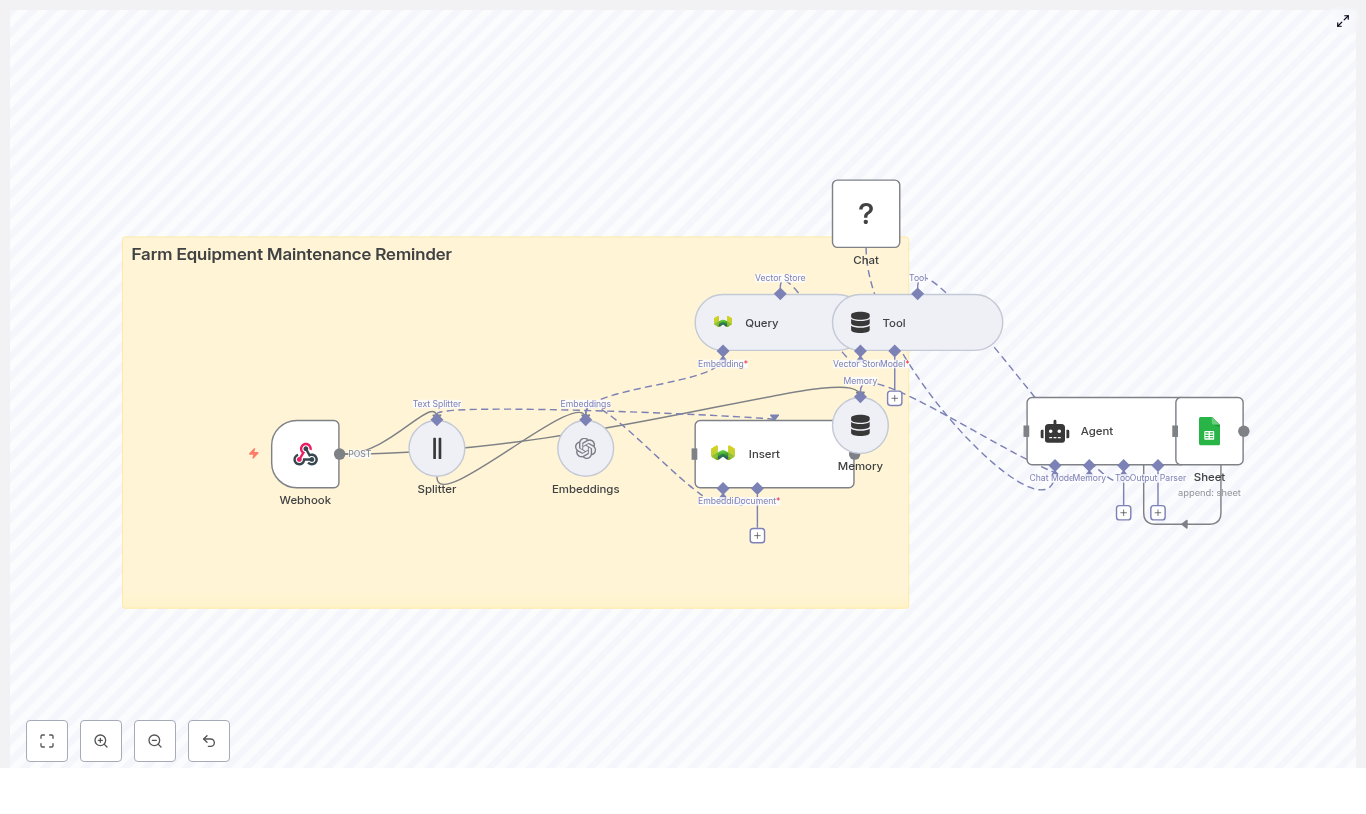
In this guide, we will walk through how the farm equipment maintenance reminder template works, what problems it solves, and how to set it up step by step. We will also look at how it uses n8n, Weaviate, vector embeddings, and Google Sheets together so you get a complete, searchable maintenance history that can trigger reminders automatically.
If you have more than a couple of machines, manual tracking gets messy fast. Automating your maintenance reminders with n8n helps you:
Cut downtime and repair costs by catching service needs before they turn into breakdowns
Keep consistent service intervals across tractors, combines, sprayers, and other equipment
Maintain a clear history of what was done, when, and on which machine for compliance and audits
Lay the groundwork for predictive maintenance using historical data and telemetry trends
Instead of relying on memory or scattered notes, you get a system that quietly tracks everything in the background and taps you on the shoulder only when something needs attention.
How the workflow is structured
The template uses a clean, modular pipeline that is easy to extend later. Here is the core flow:
Webhook – receives incoming maintenance records or telemetry via HTTP POST
Splitter – breaks long text into smaller chunks that are easier to embed
Embeddings – converts each chunk into a vector representation
Insert (Weaviate) – stores vectors in a Weaviate index for fast semantic search
Query + Tool – retrieves related records when the system is asked about a piece of equipment
Memory – keeps short-term context for the agent while it reasons
Agent (Chat + Tools) – uses vector results and tools to decide on reminders or logs
Sheet (Google Sheets) – appends final reminder entries to a log sheet
How all the components work together
Let us walk through what happens with a typical maintenance event.
Say your telemetry or farm management system sends this kind of note to the workflow:
{  "equipment_id": "tractor-001",  "type": "oil_change",  "hours": 520,  "notes": "Oil changed, filter replaced, inspected belt tension. Next recommended at 620 hours.",  "timestamp": "2025-08-31T09:30:00Z"
}
Here is what n8n does with it:
Webhook The JSON payload arrives at your configured webhook endpoint, for example /farm_equipment_maintenance_reminder.
Splitter The notes field is split into chunks so the embedding model gets clean, context-rich text to work with.
Embeddings Using an OpenAI embeddings model (or another provider), the text is turned into vectors that capture the meaning of the maintenance note.
Insert into Weaviate Those vectors, along with metadata like equipment_id, timestamp, type, and hours, are stored in a Weaviate index named farm_equipment_maintenance_reminder.
Query + Agent Later, when you or a scheduled job asks something like “When is Tractor-001 due for its next oil change?”, the Query node performs a semantic similarity search in Weaviate. The Agent gets those results plus any relevant context from Memory, then reasons through them.
Google Sheets logging If a reminder is needed, the Agent outputs a structured entry that the Google Sheets node appends to your “Log” sheet. That log can then drive email, SMS, or other notifications using additional n8n nodes.
Key configuration values in the template
You do not have to guess the settings, the template comes with sensible defaults:
Splitter: chunkSize = 400, chunkOverlap = 40 Good balance between context and token limits for most maintenance notes.
Embeddings node: model = "default" Use the default embeddings model or pick the one available in your OpenAI (or compatible) account.
Insert / Query: indexName = "farm_equipment_maintenance_reminder" A single, centralized Weaviate vector index for all your maintenance records.
Google Sheets: operation set to append on a “Log” sheet Each reminder or maintenance decision becomes a new row, which makes reporting and integration easy.
How to query the system and schedule reminders
Once the data is flowing in, the Agent becomes your maintenance assistant. It is configured with a language model plus tools that let it search the vector store and write to Google Sheets.
You can use it in a few different ways:
Ask about a specific machine Example: “When does Tractor-001 require the next oil change?” The Agent looks up past oil change records, checks the recommended interval (like “Next recommended at 620 hours”), compares it with current hours, then creates a reminder if you are getting close.
Get a list of overdue equipment Example: “Show all equipment with overdue servicing.” The Agent runs a semantic query over maintenance intervals and timestamps, then flags anything that is past due.
Run checks automatically You can schedule the Agent in n8n to run daily, evaluate new telemetry, and append reminders to Google Sheets. From there, you can plug in SMS, email, or messaging integrations to notify mechanics or operators.
Quick setup: implementation steps
Ready to get this running? Here is the short version of what you need to do.
Deploy n8n Set up an n8n instance and configure credentials for:
OpenAI or Hugging Face (for embeddings and the Agent)
Weaviate (for vector storage and search)
Google Sheets (for logging reminders)
Import the template Bring the farm equipment maintenance reminder template into your n8n workspace.
Configure the Webhook Set the webhook path, for example /farm_equipment_maintenance_reminder, and apply your preferred security (see tips below).
Choose your embeddings model In the Embeddings node, select the model you have access to and connect your OpenAI (or compatible) credentials.
Set up Weaviate Provision a Weaviate instance and create or allow the index farm_equipment_maintenance_reminder. Make sure the schema can store metadata like equipment_id, type, hours, and timestamp.
Test with a sample payload Send a POST request to your webhook using JSON like the example above. Then check:
That the record appears in Weaviate
That the Agent can find it
That a new row is appended in your Google Sheets “Log” tab
Best practices and tuning tips
Once the basics are working, you can tune the workflow to match your fleet and data volume.
Adjust chunk size The default chunkSize = 400 and chunkOverlap = 40 work well for typical maintenance notes. – Use smaller chunks for short notes. – Use larger chunks if you are ingesting long manuals or detailed inspection reports.
Pick a good embeddings model Choose a model that handles technical language well, especially if your notes include specific part names or diagnostic codes.
Design a helpful vector store schema Store metadata like:
equipment_id
timestamp
type (oil change, belt inspection, etc.)
hours or odometer readings
This makes it easier to filter queries, for example “oil changes in the last 200 hours” or “only tractors in field A.”
Keep a long history Do not throw away old records. A rich history helps with trend analysis, cost per machine calculations, and future predictive maintenance.
Security and operational considerations
You are dealing with operational data, so it is worth locking things down properly.
Secure the webhook Use a secret token header or HMAC signature so only trusted systems can POST maintenance data.
Restrict access to Weaviate and Sheets Use service accounts, IP allowlists, and least-privilege permissions wherever possible.
Handle sensitive information carefully If your payloads include any personally identifiable information, consider redacting or encrypting those fields before they are stored.
Watch API usage and costs Monitor embeddings and model call volume. If usage grows, you can batch events, skip trivial telemetry, or cache embeddings for repeated text.
Monitoring and troubleshooting
If something feels off, here are a few common issues and how to approach them.
Missing rows in Google Sheets – Double check that your Sheets credentials are valid and have write access. – Confirm that the Agent is outputting data in the expected format. – Review the n8n execution logs to see if any nodes are failing.
Search results do not look relevant – Experiment with different chunk sizes and overlaps. – Try a different embeddings model that might better capture your domain language. – Add more high quality maintenance notes so the vector store has richer context.
Costs are higher than expected – Batch or downsample telemetry events before embedding. – Avoid re-embedding identical text, use caching where possible. – Set budgets or rate limits for embeddings API calls.
Scaling to a larger fleet
As your operation grows, the same workflow can scale with you, with a few tweaks.
Partition your vector store if needed For very large fleets, you can split Weaviate indexes by region, equipment type, or business unit, or simply scale up Weaviate resources.
Use incremental ingestion Only embed new or changed notes instead of reprocessing everything.
Filter noisy telemetry Add an orchestration step that drops trivial or low value events before they hit the embeddings node, which keeps both costs and noise under control.
Real-world ways to use this template
Not sure how this fits into your day to day? Here are some practical examples.
Automatic alerts for mechanics When hours or usage thresholds are reached, the workflow can trigger email or SMS reminders to your maintenance team.
On-demand assistant for field technicians A technician can ask, “When was the last belt inspection on Combine-002?” and the Agent answers using Weaviate-backed context.
Analytics and reporting Since every reminder and log is stored in Google Sheets, it is easy to connect that sheet to BI tools and analyze lifetime cost per machine, failure patterns, or service intervals.
Next steps
If you are ready to reduce downtime and keep your farm running smoothly, this template gives you a solid starting point. Import it into n8n, connect your OpenAI or Hugging Face account, hook up Weaviate and Google Sheets, then send a sample JSON payload to the webhook to see your first automated maintenance log in action.
If you would like some help tailoring it, you can:
Define a webhook payload schema that matches your exact equipment and telemetry fields
Refine the Agent prompt so it creates the right kind of SMS or email reminders
Tune embeddings and vector storage settings to keep costs predictable
Share what systems you use now (telemetry provider, preferred messaging channels, and approximate fleet size), and you can map out concrete next steps to make this workflow fit your operation perfectly.
A semantic, vector backed maintenance reminder system can dramatically cut reactive repairs and help you focus on running your farm instead of chasing service dates.
Build an EV Charging Station Locator with n8n and Vector Embeddings
Designing a high quality EV charging station locator requires more than a simple keyword search. With n8n, vector embeddings, and a vector database such as Supabase, you can deliver fast, contextual, and highly relevant search results for drivers in real time. This guide explains the architecture, key n8n nodes, and recommended practices for building a production ready EV charging station locator workflow.
Why Vector Embeddings for EV Charging Station Search
Users rarely search with exact keywords. Instead, they ask questions like:
“fastest DC charger near me with CCS”
“stations on my route with free parking”
Traditional text or SQL filters struggle with these conversational queries. Vector embeddings solve this by converting station descriptions, metadata, and features into numerical vectors. A similarity search in a vector store can then retrieve the most relevant stations even when the query does not match stored text exactly.
Using embeddings with a vector database enables:
Semantic search across descriptions, tags, and amenities
Robust handling of natural language queries
Flexible ranking that combines semantics, distance, and business rules
Solution Architecture
The n8n workflow integrates several components to support both data ingestion and real time user queries:
Webhook node – entry point for station data and user search requests
Text Splitter – prepares text chunks for embedding
Hugging Face Embeddings – converts text into dense vectors
Supabase Vector Store – persists vectors and metadata for similarity search
Anthropic Chat + Memory (optional) – conversational agent that interprets queries and formats responses
Google Sheets – logging, auditing, and analytics for queries and results
This architecture supports two primary flows:
Batch ingestion – import and index new or updated charging station data
Real time search – process user queries and return ranked results
Core Workflow Design in n8n
1. Data and Query Ingestion via Webhook
The workflow starts with an n8n Webhook node, for example at POST /ev_charging_station_locator. This endpoint can accept either station records or user search requests. For station ingestion, a typical JSON payload might look like:
{  "station_id": "S-1001",  "name": "Downtown Fast Charge",  "lat": 37.7749,  "lon": -122.4194,  "connectors": ["CCS", "CHAdeMO"],  "power_kW": 150,  "price": "0.40/kWh",  "tags": "fast,public,24/7",  "description": "150 kW DC fast charger near city center. Free parking for 2 hours."
}
Typical fields include:
station_id – unique identifier
name, address
lat, lon – coordinates for geospatial filtering
connectors – array of connector types, for example CCS, CHAdeMO
power_kW, price, availability_note
description, tags – free text for semantic search
For user queries, the same webhook can receive a query string, user coordinates, and optional filters such as connector type or minimum power.
2. Preparing Text with a Text Splitter
Long text fields, such as detailed descriptions or multi station CSV content, are routed through a Text Splitter node. The splitter divides content into smaller chunks that are compatible with embedding models, for example:
chunkSize around 400 tokens
chunkOverlap around 40 tokens
This chunking strategy keeps embeddings both accurate and efficient and avoids truncation issues on large documents.
3. Generating Embeddings with Hugging Face
Each text chunk is sent to a Hugging Face Embeddings node. The node converts the text into a vector representation suitable for semantic search.
Key considerations:
Select an embedding model optimized for semantic similarity search.
Ensure the model license and hosting setup align with your compliance and latency requirements.
Keep the vector dimension consistent with your Supabase vector index configuration.
4. Persisting Vectors in Supabase
The resulting vectors and associated metadata are written to a Supabase Vector Store. Typical metadata includes:
station_id
lat, lon
connectors, power_kW, price
Original text content (description, tags, name)
Create an index, for example ev_charging_station_locator, and configure it to match the embedding dimension and similarity metric used by your Hugging Face model. This index supports fast approximate nearest neighbor searches.
5. Running Similarity Queries and Returning Results
For user searches, the workflow uses a Query node to execute similarity queries against Supabase. The node retrieves the top k candidate vectors that are most similar to the user query embedding.
The results are then passed through a Tool node into an AI Agent, typically implemented with Anthropic Chat and Memory. The agent can:
Interpret the user query and extract filters (for example connector type, minimum power, radius).
Apply business logic, such as prioritizing free parking or specific networks.
Format the final response for the frontend, including station details and map links.
6. Optional Conversation Handling and Logging
To support multi turn interactions, combine Anthropic Chat with an n8n Memory node. This allows the system to remember:
User vehicle connector type
Preferred charging speed
Previously selected locations or routes
In parallel, a Google Sheets node can log incoming queries, agent responses, and key metrics for auditing and analytics. This is useful for monitoring performance, debugging, and improving ranking rules over time.
Key Implementation Considerations
Geolocation and Distance Filtering
Vector similarity identifies stations that are conceptually relevant, but EV drivers also care about distance. For queries such as “nearest CCS charger”, combine:
Semantic similarity from the vector store
Geospatial filtering and ranking by distance
Store latitude and longitude as metadata in Supabase. Then:
Pre filter by bounding box around the user coordinates to reduce the candidate set.
Compute great circle distance (for example Haversine formula) in the agent logic or in a separate function node.
Re rank the candidate stations by a combination of distance and relevance score.
Connector Compatibility and Power Rules
To ensure that recommendations are usable for the driver, maintain structured metadata for:
connectors as an array of strings
power_kW as a numeric field
The agent or a dedicated filter node can then enforce rules such as:
Connector type must include the user requested connector.
power_kW must be greater than or equal to a user specified minimum.
Batch Ingestion vs Real Time Updates
Most production deployments need both scheduled and real time data updates:
Batch ingestion Use a scheduled workflow or external ETL job to pull data from public datasets or internal systems, chunk the content, generate embeddings, and perform bulk inserts into Supabase.
Real time ingestion For admin updates or user contributed stations, call the webhook to insert or update a single station record and regenerate its embeddings.
Best Practices for Performance and Reliability
Model selection Choose an embeddings model that balances quality, latency, and cost. Smaller models are cheaper and faster but may provide less nuanced results.
Chunking strategy Keep chunkSize around 300-500 tokens with modest overlap. Excessive overlap increases storage and query cost without significant quality gains.
Vector index configuration Align Supabase vector index settings (for example HNSW, pgvector parameters) with your embedding dimension and query volume. Tune parameters for recall vs speed trade offs.
Geospatial pre filtering Before running similarity search, restrict candidates by a latitude/longitude radius or bounding box. This reduces query time and improves result relevance.
Security Protect the webhook with API keys or OAuth, validate incoming payloads, and sanitize user inputs to prevent injection or malformed data issues.
Troubleshooting Common Issues
1. Missing or Low Quality Matches
If users receive irrelevant or empty results:
Review chunking parameters to ensure that important context is not split incorrectly.
Verify that all critical metadata (especially coordinates and connectors) is present.
Experiment with different embedding models or adjust top_k and similarity thresholds.
2. Slow Query Performance
When queries are slow under load:
Apply geospatial pre filtering before vector similarity to limit candidate sets.
Ensure your vector index is properly configured and indexed.
Scale up Supabase or your vector DB resources as needed, and tune ANN index parameters for your workload.
3. Duplicate Station Records
To avoid duplicates in search results:
Use station_id as a unique key and perform upserts instead of blind inserts.
Optionally compare coordinates and station names to detect near duplicates.
Update existing records and regenerate embeddings when station data changes.
Example End to End Query Flow
Consider the user query: “Find DC fast chargers with CCS within 5 km”. A typical n8n flow is:
The user query and location are sent to the webhook.
The agent interprets the request and extracts:
Connector type = CCS
Charging type = DC fast
Radius = 5 km
The workflow pre filters stations by a bounding box around the user coordinates.
Vector similarity search runs on the filtered set, then results are re ranked by actual distance and connector/power constraints.
The agent returns the top 3-5 stations with name, distance, connectors, power rating, and a link or identifier for map navigation.
Deployment and Scaling Strategies
You can deploy the n8n workflow in several ways:
Docker for self hosted setups
n8n Cloud as a managed service
Kubernetes for larger scale or enterprise environments
Use Supabase or another managed vector database with autoscaling to handle traffic spikes. For static or slowly changing datasets, precompute embeddings and cache frequent queries to reduce latency and cost.
Security and Privacy Considerations
As with any location based service, security and privacy are critical:
Store API keys securely and avoid hard coding them in workflows.
Secure webhook endpoints with authentication and rate limiting.
If you collect user location, email, or identifiers, comply with applicable privacy regulations.
Where possible, anonymize analytics data and provide clear privacy notices to users.
Next Steps and Template Access
To accelerate implementation, you can start from a ready made n8n template and adapt it to your data sources and business rules.
Get started:
Deploy the workflow in your preferred n8n environment.
Connect your Hugging Face and Supabase credentials.
Send a few sample station payloads to the webhook and verify that embeddings are generated and stored correctly.
Iterate on model choice, chunking, and ranking logic based on real user queries.
If you want a starter package with a downloadable n8n template, deployment checklist, and sample dataset, subscribe to our newsletter. For implementation support or architecture reviews, reach out to our engineering team.
Keywords: EV charging station locator, n8n workflow, vector embeddings, Supabase vector store, Hugging Face embeddings, Anthropic chat, geolocation search
Automate Birthday Reminders To Telegram With n8n, Weaviate & OpenAI
Ever forgotten a birthday you really meant to remember? It happens. The good news is, you can completely offload that mental load to an automation that quietly does the work for you.
In this guide, we will walk through a ready-to-use n8n workflow template that:
Captures birthday data via a webhook
Uses OpenAI embeddings and Weaviate for smart, fuzzy lookups
Generates personalized birthday messages with a RAG agent
Sends reminders to Telegram and logs everything in Google Sheets
Alerts you in Slack if something goes wrong
Think of it as your always-on birthday assistant that never forgets, never gets tired, and even remembers that your friend “loves coffee and vintage books.”
What This n8n Birthday Reminder Workflow Actually Does
Let us start with the big picture. This workflow takes structured birthday info from your app or form, enriches it with context, and turns it into a friendly, human-sounding Telegram message. Along the way it:
Stores birthday-related context in a Weaviate vector index for future lookups
Uses OpenAI to generate embeddings and birthday messages
Keeps an audit trail in Google Sheets
Sends Slack alerts if the RAG agent encounters an error
Once you plug it into your system, new birthday entries are handled automatically. No more manual reminders, no more last-minute scrambling.
When You Should Use This Template
This workflow is a great fit if you:
Run a community, membership site, or customer-facing product where birthdays matter
Want personalized messages instead of generic “Happy Birthday!” texts
Use Telegram as a main communication channel (or want to start)
Like the idea of having logs and alerts so you can trust your automation
In short, if you are tired of spreadsheets, sticky notes, or trying to remember dates in your head, this workflow will make your life much easier.
How The Workflow Is Built: High-Level Architecture
Here is what is happening behind the scenes, step by step, in n8n:
Webhook Trigger – Receives birthday data via a POST request on a path like birthday-telegram-reminder.
Text Splitter – Breaks long notes or context into smaller chunks so they can be embedded efficiently.
Embeddings (OpenAI) – Uses an OpenAI embeddings model to convert each text chunk into vectors.
Weaviate Insert – Stores those vectors in a Weaviate index named birthday_telegram_reminder.
Weaviate Query + Vector Tool – Later retrieves relevant context for a given person or birthday.
Window Memory – Keeps recent context available so the agent can maintain continuity.
Chat Model (OpenAI) – Generates the actual birthday message text.
RAG Agent – Coordinates the retrieval and generation to create a well-informed message.
Append Sheet (Google Sheets) – Logs every generated message in a “Log” sheet.
Slack Alert – Sends a message to Slack if the RAG agent hits an error.
If you want, you can add a Telegram node at the end so the message is sent directly to the person’s Telegram account using their telegram_id.
What You Need Before You Start
Before importing the template, make sure you have:
An n8n instance (cloud or self-hosted)
An OpenAI API key for embeddings and chat
A Weaviate instance (cloud or self-hosted) plus an API key
A Telegram bot (optional, but required if you want to send messages directly from n8n)
A Google Sheets account and a Sheet ID for logs
A Slack workspace and a bot token for alerts
End-To-End Flow: What Happens When A Birthday Is Added
To make this concrete, here is how the workflow behaves when your app sends a new birthday payload.
Your app sends a POST request to the n8n webhook URL.
The Webhook Trigger node receives the payload and passes it to the Text Splitter.
The Text Splitter breaks long notes into chunks, and the Embeddings node turns those chunks into vectors.
Weaviate stores these vectors in the birthday_telegram_reminder index, along with metadata like name or Telegram ID.
When it is time to generate a reminder, the RAG Agent queries Weaviate via the Vector Tool, pulls relevant context, and sends it to the Chat Model.
The Chat Model generates a personalized message, for example: “Happy Birthday, Jane! Hope you have an amazing day, maybe treat yourself to a great cup of coffee!”
The final message is appended to your Google Sheet for logging.
If any part of the RAG step fails, the onError path triggers the Slack Alert node and posts details to #alerts.
Optionally, a Telegram node can send that message directly to the stored telegram_id.
Once configured, the whole process runs quietly in the background while you focus on everything else.
Step-By-Step Setup In n8n
1. Import The n8n Template
Start by importing the JSON workflow into your n8n instance. The template includes all the nodes and their connections, so you do not have to build it from scratch.
After importing:
Open the workflow
Click into each node
Set the credentials and adjust parameters where needed
2. Configure Your Credentials
Next, connect the template to your actual services:
OpenAI – Add your API key and assign it to both the Embeddings node and the Chat Model node.
Weaviate – Set your Weaviate endpoint and API key. Make sure the index birthday_telegram_reminder exists or allow the insert node to create it.
Google Sheets – Configure OAuth credentials, then update the Append Sheet node with your SHEET_ID.
Slack – Add a bot token and set the channel (for example #alerts) in the Slack Alert node.
3. Map The Webhook Payload
The Webhook Trigger exposes a POST endpoint at the path birthday-telegram-reminder. A typical request body might look like:
Send notes through the Text Splitter and Embeddings so they are stored in Weaviate for future context.
Pass name, date, timezone, and telegram_id directly into the RAG Agent prompt to generate a personalized message right away.
Feel free to adapt the payload format to match your app, as long as you update the node mappings accordingly.
4. Tune Chunking & Embeddings
The Text Splitter and Embeddings are where you control how much context is stored and how it is processed.
Text Splitter – Default values are chunkSize = 400 and chunkOverlap = 40.
Embeddings – The default model is text-embedding-3-small, which offers a good cost-quality balance.
If your notes are usually short, you might reduce chunk size. If you have richer notes or more detailed histories, you can keep or increase the chunk size. Need higher semantic accuracy? Switch to a larger embeddings model, keeping in mind that costs will increase.
5. Customize The RAG Agent Prompt
The RAG Agent is where the “personality” of your birthday messages lives.
By default, the system message is:
You are an assistant for Birthday Telegram Reminder
You can edit this to match your use case. For example:
More formal: “Generate polite birthday messages for professional contacts.”
More casual: “Create friendly short messages suitable for Telegram.”
You can also adjust tone, length, or formatting. Want short messages only? Add that. Want the message to reference specific interests from the notes? Mention that in the prompt.
6. Set Up Logging & Error Handling
Two things help you trust an automation: logs and alerts. This workflow includes both.
Google Sheets logging – Successful outputs are appended to your chosen Google Sheet, in a sheet named Log. This gives you an easy audit trail of what was sent and when.
Slack error alerts – If the RAG Agent fails, the onError branch sends a detailed message to the Slack Alert node, which posts in your selected channel (for example #alerts).
You can extend this by adding more channels, email notifications, or even an incident-handling workflow if you want a more robust setup.
Best Practices For This Birthday Reminder Workflow
To keep your automation reliable, cost-effective, and privacy-conscious, keep these tips in mind:
Be careful with PII – Store only non-sensitive context in Weaviate if possible. If you have to store personally identifiable information, consider encrypting it and make sure you comply with your privacy policies.
Watch your OpenAI usage – Embeddings and chat calls can add up. Batch operations where possible and monitor usage regularly.
Version your prompts – When you tweak the RAG prompt, keep a simple changelog in your repo or documentation so you can track how tone and output evolve.
Clean up the vector store – Use a retention policy in Weaviate to remove or archive outdated entries. This keeps your index relevant and can improve retrieval performance.
Troubleshooting Common Issues
If something is not working as expected, here are some quick checks you can run:
No data appears in Weaviate Confirm your API credentials, endpoint, and that the index name is exactly birthday_telegram_reminder.
RAG outputs are low quality Try refining your prompt, increasing the amount of retrieved context, or using a more capable chat model.
Google Sheets append fails Make sure your OAuth token has write access and that the SHEET_ID and sheet name are correct.
Slack alerts do not show up Check bot permissions, verify the channel name, and confirm the bot is actually in that channel.
Ideas To Extend This Workflow
Once you have the basic reminder working, you can take it further. Here are some practical extensions:
Direct Telegram delivery – Add a Telegram node after the RAG Agent and send the generated message straight to the user’s telegram_id.
Admin dashboard – Build a simple dashboard that lists upcoming birthdays by querying Weaviate and presenting the data in a UI or a Google Sheet.
Scheduled reminders – Use a scheduled trigger to run daily checks and send reminders the day before or on the birthday.
Multi-language support – Add logic in the prompt so the RAG Agent generates messages in the recipient’s language, based on a language field in your payload.
Security & Privacy Checklist
Since this workflow touches user data and external services, it is worth hardening it a bit.
Rotate API keys regularly and store them as environment variables, not in plaintext inside nodes.
Minimize the amount of PII stored in vector databases. If you must store it, encrypt sensitive fields and decrypt only when needed.
Limit access to your Google Sheet to service accounts or specific users, and keep share permissions tight.
Ready To Put Birthday Reminders On Autopilot?
If you are ready to stop worrying about forgotten birthdays, here is a simple way to get started:
Import the workflow template into your n8n instance.
Set your OpenAI, Weaviate, Google Sheets, Telegram (optional), and Slack credentials.
Replace the SHEET_ID in the Append Sheet node.
Send a test POST request to /webhook/birthday-telegram-reminder with a sample payload.
From there, you can tweak the tone of the messages, refine the prompts, and gradually add features like scheduling or multi-language support.
Get started now: import the workflow, plug in your API credentials and Sheet ID, and send a test birthday payload to your webhook. You will have your first automated Telegram birthday reminder in minutes.
Need help tailoring this to your team or product? Reach out any time. You can extend this template with scheduled triggers, direct Telegram delivery, or multi-language messaging, and we are happy to guide you through it.
Every time you manually download images, zip them, and upload them to cloud storage, you spend a little more energy on work that a workflow could handle for you. Over a week or a month, those minutes add up and quietly slow you down.
Automation is your chance to reclaim that time and refocus on work that really moves the needle. In this guide, you will walk through a simple but powerful n8n workflow that downloads images, compresses them into a ZIP file, and uploads that archive directly to Dropbox. It is a small automation with a big message: you can offload more than you think, and this template is a practical first step.
By the end, you will not only have a working n8n template, you will also have a clear pattern you can reuse for backups, asset packaging, and future automations that support your growth.
From repetitive tasks to reliable systems
Think about how often you:
Download images from different URLs
Bundle them into a ZIP archive
Upload the archive to Dropbox or another storage service
Doing this manually is tedious, easy to forget, and prone to mistakes. Automating it turns a fragile habit into a reliable system. Once this workflow is in place, you can:
Run consistent backups without thinking about them
Package assets in a repeatable, predictable way
Learn how n8n handles binary files so you can build more advanced automations later
This is not just about saving time on one task. It is about shifting your mindset from “I have to remember to do this” to “my system already takes care of it.”
Why this n8n workflow is a powerful starting point
This template is intentionally simple, yet it showcases some of the most important automation building blocks in n8n:
HTTP Request nodes to download files from remote URLs
The Compression node to bundle multiple binary files into a single ZIP
The Dropbox node to upload and store that ZIP in the cloud
Once you understand this pattern, you can extend it to:
Automate periodic backups of images or design assets
Prepare files for distribution or deployment in a consistent way
Handle any binary data in your workflows, not just images
Think of this as a foundational automation. You can use it as-is, or you can build on top of it as your needs grow.
The journey at a glance: how the workflow works
The workflow consists of five nodes connected in sequence:
Manual Trigger – starts the workflow on demand
HTTP Request – downloads the first image as binary data (workflow_image)
HTTP Request1 – downloads the second image as binary data (logo)
Compression – combines both binaries into images.zip
Dropbox – uploads images.zip to a Dropbox path such as /images.zip
Simple on the surface, yet powerful in practice. Let us walk through each step so you can confidently configure and customize it.
Step 1 – Trigger the workflow on your terms
Manual Trigger node
Start by dragging a Manual Trigger node onto the n8n canvas. This lets you run the workflow whenever you click “Execute”. It is perfect for:
Testing the workflow as you build
Running one-off backups or exports
Later, when you are ready to scale this into a hands-off system, you can replace the Manual Trigger with a Cron or Schedule Trigger node to run it hourly, daily, or weekly.
Step 2 – Download images with HTTP Request nodes
Next, you will add two HTTP Request nodes. Each node will fetch one image and store it as binary data that flows through the rest of the workflow.
Configure each HTTP Request node
For both HTTP Request nodes, use these key settings:
Method: GET
Response Format: File (this ensures the response is treated as binary data)
Data Property Name: set a clear, descriptive name that will be used later by the Compression node
In this template, the two nodes are configured as:
First HTTP Request node:
Data Property Name: workflow_image
Example URL: https://docs.n8n.io/assets/img/final-workflow.f380b957.png
Second HTTP Request node:
Data Property Name: logo
Example URL: https://n8n.io/n8n-logo.png
You can replace these URLs with any publicly accessible image URLs or with private endpoints that support GET and return file binaries. The important part is that each HTTP Request node outputs a binary file under a specific property name.
This is where your automation mindset starts to grow. Instead of manually downloading files, you let n8n fetch exactly what you need, on demand or on a schedule.
Step 3 – Compress everything into a single ZIP
Compression node
Once both images are available as binary data, it is time to bundle them into a single archive. Add a Compression node and connect it after the HTTP Request nodes.
Configure the Compression node with:
Operation: compress
Output Format: zip
File Name: images.zip
Binary Property Name: specify the binary properties to include, for this template:
workflow_image
logo
When configured correctly, the Compression node gathers the input binaries and produces a new binary file, images.zip, on its output. This ZIP file is then available to any following node as a single binary property.
This step is a great example of how n8n handles binary data across nodes. Once you are comfortable with this pattern, you will be ready to automate more complex file workflows.
Step 4 – Upload the ZIP to Dropbox
Dropbox node
Finally, you will send the compressed archive to Dropbox so it is stored safely in the cloud.
Add a Dropbox node after the Compression node and configure it as follows:
Operation: upload
Binary Property: reference the ZIP output from the Compression node
Path: choose a destination path in Dropbox, for example:
/images.zip
or a folder path like /backups/images-{{ $now.toISOString() }}
Make sure you have configured your Dropbox credentials in n8n with sufficient permissions to upload files. You can use an access token or OAuth credentials, managed securely through n8n’s credential system.
With this final step, your workflow closes the loop: from remote image URLs to a ready-to-use ZIP archive in your Dropbox, all without manual effort.
Best practices to keep your workflow robust and clear
Use meaningful binary property names
Clear naming makes your workflows easier to understand and extend. When passing binary data between nodes, use descriptive names like logo, workflow_image, or screenshot_1. The Compression node relies on these names to know which files to include in the archive.
Handle errors and add retries
Network requests can fail, and resilient automations plan for that. To make your workflow more reliable:
Use the HTTP Request node’s built-in retry options
Consider adding an error workflow to handle failures gracefully
Optionally add a Set node before the Compression node to filter out failed or missing binaries
These small improvements help your automation run smoothly over time, not just once during testing.
Schedule your workflow instead of running it manually
Once you trust the workflow, replace the Manual Trigger with a Cron or Schedule Trigger node. This is ideal for:
Daily or weekly image backups
Recurring asset packaging for reports or campaigns
Scheduling turns your workflow into a quiet background system that consistently supports your work.
Use dynamic filenames and versioning
To avoid overwriting the same ZIP file and to keep a clear history of backups, use expressions to generate dynamic filenames. For example:
This pattern makes it easy to see when each archive was created and to roll back if needed.
Work confidently with private endpoints
If your images live behind authentication, you can still use this workflow. Configure the HTTP Request nodes with the correct authentication method, such as:
Bearer token
Basic Auth
OAuth
Add any required headers, then test each HTTP Request node individually to confirm that it returns binary content. Once it works, the rest of the workflow can stay exactly the same.
Ideas to extend and elevate this workflow
This template is a solid foundation, but you do not have to stop here. As you get more comfortable with n8n, you can extend this workflow to support more of your process. For example, you could:
Add an image optimization step, such as an external API that compresses or converts image formats before creating the ZIP
Send a Slack or email notification when the upload completes, including a Dropbox shared link
Branch the workflow after the Compression node to upload the same ZIP to multiple destinations like Dropbox, Google Drive, or Amazon S3
Store metadata such as source URLs, timestamps, and file sizes in a database or Google Sheet for auditing and reporting
Each enhancement nudges you further into a more automated, less manual way of working, where n8n handles the busywork and you focus on strategy and creativity.
Troubleshooting: keep your automation on track
If something does not work as expected, use this quick checklist:
No file in the Compression output?
Confirm each HTTP Request node returns binary data
Check that the dataPropertyName values match exactly what you configured in the Compression node
Dropbox upload fails?
Verify your Dropbox credentials and permissions
Make sure the path is valid and the node points to the correct binary property
Files are corrupt after download?
Ensure the HTTP Request node’s Response Format is set to File
Confirm the remote server supports direct binary download
Most issues come down to a small configuration mismatch. Once fixed, the workflow will continue to run reliably.
Security: protect your credentials as you scale
As you build more automations, security becomes more important. Keep your workflows safe by:
Using n8n’s credential system instead of hard-coding API keys or tokens
Avoiding secrets inside Set or Function nodes
Preferring short-lived tokens or regularly rotating credentials for private endpoints
This lets you grow your automation library without compromising sensitive data.
Bringing it all together
This n8n template gives you a clear pattern for downloading multiple binary files, packaging them into a ZIP, and uploading that archive to Dropbox. It is a simple workflow, yet it unlocks real benefits:
Less time on repetitive file handling
More consistent backups and asset bundles
A deeper understanding of how n8n works with binary data
Most importantly, it shows what is possible when you start to automate the small tasks that quietly drain your focus. From here, you can continue to refine, expand, and combine workflows into a system that supports your business or personal projects every day.
Your next step: experiment, adapt, and grow
Try it now: Import the provided workflow into your n8n instance, connect your Dropbox credentials, replace the sample image URLs with your own, and click Execute. Watch your ZIP file appear in Dropbox and notice how much faster and smoother the process feels.
Then, take it further:
Schedule it for regular backups
Add notifications or additional storage destinations
Use this pattern as a blueprint for other file-based workflows
Every workflow you build is a step toward a more focused, automated way of working. Start with this one, learn from it, and keep iterating.
Call to action: Import this workflow, test it, and share how you extended it. Your improvements might inspire the next person to automate a little more and reclaim a little more time.
Automating EV Battery Degradation Reports with n8n
Electric vehicle (EV) fleet operators and battery engineers require consistent, repeatable insights into battery health. This reference guide describes a production-ready EV battery degradation report workflow template in n8n. The automation ingests telemetry and diagnostic text through a webhook, splits and embeds content for semantic search, persists vectors in Redis, and generates human-readable reports with an AI agent. The design emphasizes reproducibility, auditability, and integration with Google Sheets for logging and downstream analysis.
1. Workflow Overview
This n8n workflow automates the full lifecycle of EV battery degradation reporting, from raw input to logged report output:
Receive battery telemetry and diagnostic notes via an HTTP Webhook (POST).
Segment long text into smaller chunks using a Text Splitter node.
Generate semantic embeddings for each text chunk using Cohere.
Insert embeddings into a Redis vector index named ev_battery_degradation_report.
On report generation, query Redis for the most relevant chunks and expose them to an AI Agent as a tool.
Use an LLM-based Agent to assemble a structured, human-readable degradation report.
Append the generated report and key metadata to a Google Sheet for logging and audit.
The template is suitable for both small pilot deployments and large-scale fleet scenarios where many vehicles stream telemetry and diagnostic information.
2. Architecture & Data Flow
2.1 High-level Architecture
Ingress: Webhook node receives JSON payloads from devices or upstream ingestion services.
Pre-processing: Text Splitter node normalizes and chunks diagnostic text.
Vectorization: Cohere Embeddings node converts each chunk into a vector representation.
Storage: Redis node stores vectors and associated metadata in a vector index.
Retrieval: Redis Query node retrieves semantically similar chunks for a given query.
Reasoning: Agent node combines Redis results, short-term memory, and prompt logic to generate a report using an LLM.
Logging: Google Sheets node appends report summaries and key metrics for audit and downstream processing.
2.2 Data Flow Sequence
Incoming request: A POST request hits the Webhook endpoint with telemetry and technician notes.
Text extraction: The workflow extracts relevant textual fields (for example, technician_notes or free-form diagnostic logs).
Chunking: The Text Splitter splits large text into overlapping segments to preserve context.
Embedding generation: Each chunk is passed to Cohere, which returns a high-dimensional embedding vector.
Vector insertion: Embeddings and metadata are inserted into Redis under the index ev_battery_degradation_report.
Report request: When the workflow needs to generate a report, it uses Redis to retrieve the most relevant context for the current vehicle or query.
Agent execution: The Agent node consumes:
Retrieved context from Redis (via a Tool interface).
Conversation state from a Memory node.
Prompt instructions for structuring the EV battery degradation report.
Report logging: The final report and selected fields (vehicle ID, timestamp, key metrics) are appended as a new row in Google Sheets.
3. Node-by-Node Breakdown
3.1 Webhook (Trigger)
The Webhook node is the entry point of the workflow. It is configured to accept HTTP POST requests, typically with a JSON body that includes both structured telemetry and unstructured diagnostic text.
Path: Example path /ev_battery_degradation_report.
Method: POST.
Typical payload:
vehicle_id – Unique identifier of the EV.
timestamp – ISO 8601 timestamp indicating when measurements were taken.
telemetry – Object containing metrics such as cycle count, state of health (SOH), maximum temperature, average voltage, and other relevant parameters.
technician_notes – Free-text notes describing observed issues, degradation patterns, or test results.
Integration points include direct device uploads, existing ingestion services, or internal APIs that forward telemetry to the webhook. For production, you can secure this endpoint with tokens, IP allowlists, or gateway-level authentication.
3.2 Text Splitter (Text Chunking)
The Text Splitter node prepares unstructured text for embedding by dividing it into smaller segments.
Input: Fields such as technician_notes or full diagnostic logs.
Chunk size: 400 characters.
Chunk overlap: 40 characters.
This configuration strikes a practical balance between semantic completeness and embedding cost. Overlap ensures that information that spans boundaries is not lost. For longer technical reports, you can adjust chunkSize and chunkOverlap based on average document length and the level of detail required in retrieval.
3.3 Embeddings (Cohere)
The Cohere Embeddings node converts each text chunk into a numerical vector suitable for semantic search.
Provider: Cohere.
Input: Array of text chunks from the Text Splitter node.
Output: Embedding vectors for each chunk, typically a high-dimensional float array.
These embeddings allow the workflow to perform similarity search over technical content, so the AI Agent can retrieve relevant historical notes, similar failure modes, or comparable degradation profiles when generating new reports.
The node requires a valid Cohere API key configured as n8n credentials. Rate limits and model selection are managed through the Cohere account, so ensure that the chosen model is suitable for technical language and the expected volume.
3.4 Insert (Redis Vector Store)
The Redis node (Insert mode) persists embeddings in a vector index that supports approximate nearest neighbor queries.
Index name: ev_battery_degradation_report.
Data stored:
Embedding vector for each text chunk.
Associated metadata such as vehicle_id, timestamp, and possibly a summary of telemetry values.
Original text chunk for later retrieval and display.
Redis acts as a fast, scalable vector database. The index configuration (for example, vector type, dimension, and distance metric) is handled in Redis itself and must match the embedding model used by Cohere. If the index is not correctly configured, inserts may fail or queries may return no results.
3.5 Query & Tool (Vector Retrieval)
When the workflow needs to generate a report, it uses a Redis Query node to retrieve the most relevant chunks.
Query input: Typically a text query derived from the current vehicle context, telemetry values, or analyst request.
Retrieval: The node searches the ev_battery_degradation_report index for nearest neighbors based on the embedding space.
Results: A set of text chunks and metadata that are most semantically similar to the query.
These results are then exposed to the Agent as a Tool. The Tool wrapper makes Redis retrieval accessible during the LLM reasoning process, so the Agent can explicitly call the vector store to fetch context rather than relying solely on the prompt.
3.6 Memory (Buffer Window)
The Memory node provides short-term conversational context, usually implemented as a buffer window.
Purpose: Preserve recent user inputs and agent outputs across multiple workflow runs or iterative queries.
Use case: When an analyst refines a report, asks follow-up questions, or requests additional detail, the Agent can reference prior exchanges without re-ingesting all data.
This memory is especially useful for incremental reporting workflows, where an engineer may run several iterations on the same vehicle or dataset.
3.7 Chat & Agent (OpenAI / LLM)
The Chat node and Agent node work together to generate the final natural-language degradation report.
LLM provider: OpenAI or any compatible LLM API configured in n8n.
Inputs to Agent:
Context retrieved from Redis via the Tool interface.
Recent conversation history from the Memory node.
Prompt template that defines the desired structure of the EV battery degradation report.
Output: A structured, human-readable report that summarizes degradation status, key metrics, possible causes, and recommended actions.
The Agent orchestrates calls to tools (Redis), merges retrieved context with current telemetry, and applies the prompt logic to ensure a consistent report structure. The Chat node handles the actual LLM interaction, including passing messages and receiving the generated text.
3.8 Sheet (Google Sheets Logging)
The Google Sheets node provides persistent logging for each generated report.
Operation: Append row.
Data logged (typical):
Vehicle identifier.
Timestamp of the analysis.
Key telemetry values (SOH, cycle count, maximum temperature, average voltage).
High-level report summary or full report text.
This log acts as a simple audit trail for engineering teams. It can also trigger downstream workflows, such as alerts, dashboards, or further analysis pipelines.
4. Configuration & Setup
4.1 Prerequisites
An n8n instance (cloud or self-hosted).
A Cohere API key for generating embeddings.
A Redis instance with vector search capabilities enabled.
An OpenAI or compatible LLM API key for natural-language generation.
A Google account with the Sheets API enabled and a target spreadsheet created.
4.2 Node Configuration Steps
Webhook
Create a Webhook node.
Set the path, for example /ev_battery_degradation_report.
Configure the HTTP method as POST.
Text Splitter
Connect the Text Splitter node directly after the Webhook.
Set chunkSize to approximately 400 characters.
Set chunkOverlap to approximately 40 characters.
Point the node to the field that contains diagnostic or technician text.
Cohere Embeddings
Add the Cohere Embeddings node after the Text Splitter.
Configure Cohere credentials with your API key.
Map the array of text chunks to the node input.
Redis Vector Store (Insert)
Configure a Redis node for vector insertion.
Set the index name to ev_battery_degradation_report or a project-specific variant.
Ensure metadata such as vehicle_id and timestamp is included alongside each vector.
Redis Query
Add a Redis Query node for retrieval.
Use the same index name as the insert node.
Configure it to return the top N most similar chunks for a given query.
Agent & Chat
Configure the Agent node to:
Use the Chat node with your OpenAI (or compatible) credentials.
Register the Redis Query as a Tool.
Connect the Memory node to maintain context.
Set a prompt template that specifies report sections, such as metrics, degradation assessment, causes, and recommendations.
Google Sheets
Add a Google Sheets node at the end of the workflow.
Configure credentials and select the target spreadsheet and worksheet.
Map the Agent output and key metadata fields to the appropriate columns.
5. Sample Webhook Payload & Output
5.1 Example POST Payload
You can test the workflow by sending the following JSON payload to the configured webhook path:
Given this input, the Agent typically returns a structured degradation report that includes:
High-level assessment – For example, indication of accelerated degradation due to frequent fast charging or elevated temperature exposure.
Key metrics – Cycle count, SOH, maximum temperature, average voltage, and any notable trends.
Possible causes and recommendations – Potential root causes such as repeated fast charging, plus suggested actions like pack balancing, cell-level diagnostics, or changes in charging strategy.
Contextual references – Mentions of similar historical events or patterns retrieved from the Redis vector store.
The full report text is then logged to Google Sheets alongside the raw metrics, enabling quick review and cross-vehicle comparison.
6. Best Practices & Tuning
6.1 Chunk Size & Overlap
Use chunk sizes in the range of 200 to 500 characters to maintain semantic granularity.
Set overlap to roughly 10 percent of the chunk size to avoid splitting critical context across boundaries.
For very long diagnostic reports, consider slightly larger chunks to reduce total embedding calls, while monitoring accuracy.
6.2 Embedding Model Selection
Choose a Cohere embedding model that balances cost, latency, and performance on technical language.
For highly domain-specific terminology, evaluate specialized or fine-tuned models if available in your Cohere plan.
Monitor vector quality by spot-checking retrieval results for relevance.
6.3 Indexing Strategy in Redis
Store metadata such as:
vehicle_id for per-vehicle retrieval.
timestamp to filter by time range.
Optional telemetry summaries (for example, cycle count bucket) to support more targeted queries.