Sync Asana to Notion with n8n (Step-by-Step Guide)

Keeping Asana and Notion aligned is a common requirement in mature automation environments. This guide explains how to implement a robust, production-ready Asana to Notion synchronization using n8n so that updates to Asana tasks automatically create or update corresponding pages in a Notion database.

Use case and architecture overview

Asana is typically the operational system of record for task management, while many teams rely on Notion as a central knowledge base and lightweight reporting layer. Synchronizing selected Asana task data into Notion allows stakeholders who work primarily in Notion to access key task metadata, such as Asana GID and deadlines, without context switching.

n8n provides the orchestration layer for this integration. It listens to Asana webhooks, processes and deduplicates events, enriches them with full task data, and then maps them into a Notion database. The workflow is designed to be idempotent, API-efficient and easy to extend.

What the n8n workflow automates

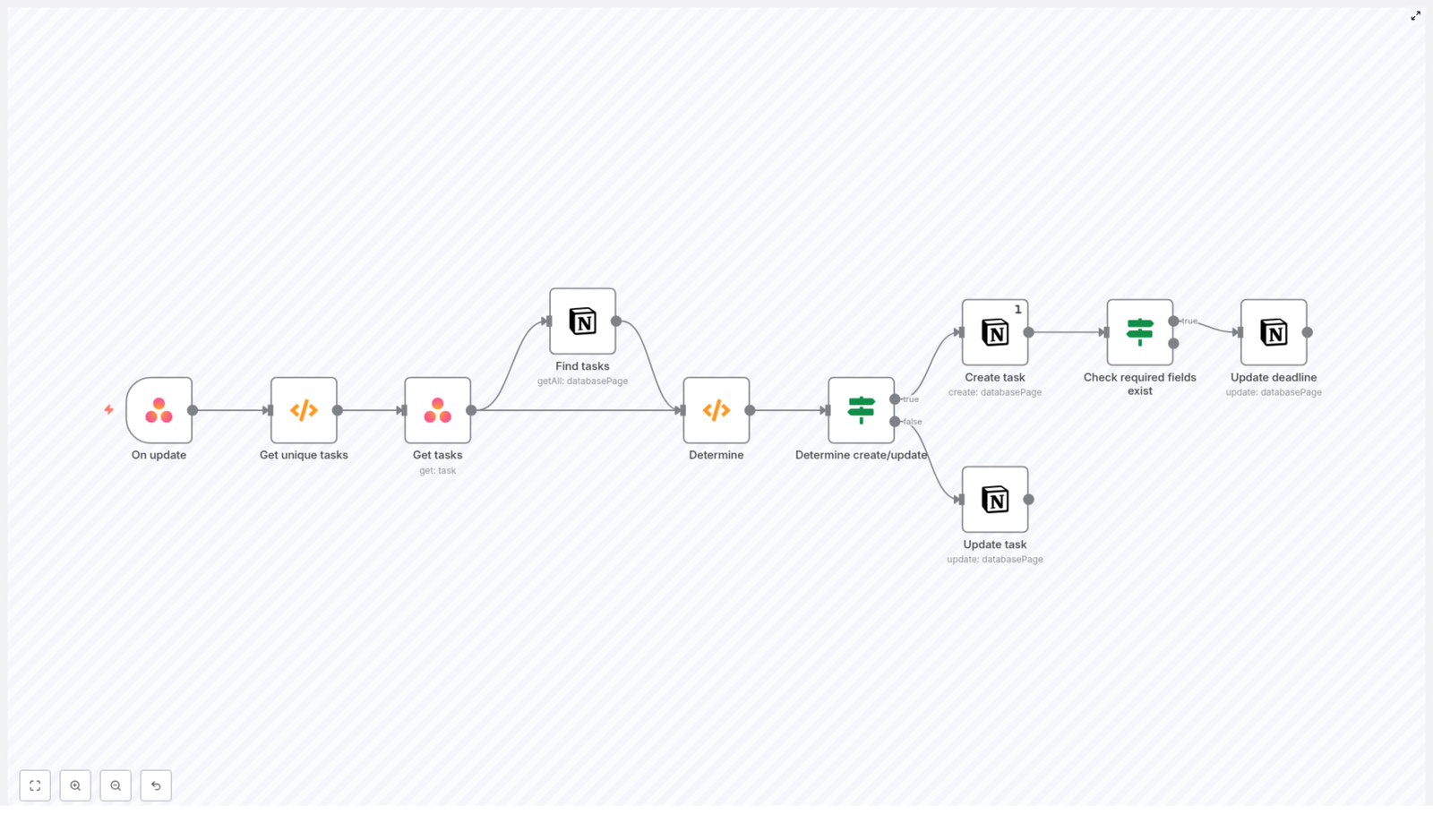
The workflow implements the following end-to-end logic:

  • Subscribe to Asana task updates via an Asana Trigger node (webhook based).
  • Extract and deduplicate task GIDs from the webhook payload.
  • Fetch full task details from Asana for each unique GID.
  • Query a Notion database for existing pages that reference the same Asana GID.
  • Determine whether to create a new Notion page or update an existing one.
  • On create, populate required properties, including the Asana GID and optional deadline.
  • On update, push changes such as updated due dates into Notion while respecting data completeness checks.

Prerequisites and required components

Before implementing the workflow, ensure the following components are in place:

  • An n8n instance, either self-hosted or n8n cloud.
  • An Asana account with API credentials configured in n8n.
  • A Notion integration with API token and access to the relevant database.
  • A Notion database configured with at least:
    • A numeric property named Asana GID.
    • A date property, for example Deadline, to store the Asana due date.

High-level workflow design in n8n

The workflow can be conceptually divided into four stages:

  1. Event ingestion and normalization Capture Asana webhook events and extract unique task identifiers.
  2. Data enrichment Retrieve complete task data from Asana for each unique task GID.
  3. Lookup and decision logic Query Notion for existing records and decide between create or update.
  4. Write operations and validation Create or update Notion pages and apply field-level checks such as presence of due dates.

Node-by-node implementation details

1. Asana Trigger node – Task update events

The workflow starts with an Asana Trigger node configured to listen for task updates. This node creates a webhook subscription in Asana for the specified workspace and resource scope.

Key considerations:

  • Configure the resource type to receive task-related events.
  • Specify the correct workspace or project context.
  • Be aware that a single webhook payload can contain multiple events, possibly for the same task or for non-task resources.

The downstream logic must therefore handle deduplication and resource-type filtering.

2. Function node – Extract and deduplicate task GIDs

The next step is a Function node that parses the webhook payload and produces a clean list of unique task GIDs. It also constructs a reusable Notion filter for each GID.

Typical responsibilities of this node:

  • Filter events to only include items where resource_type === "task".
  • Convert Asana GIDs to numeric values for consistent comparison with Notion’s number field.
  • Remove duplicate GIDs within the same webhook batch.
  • Build a Notion filter JSON that targets the Asana GID numeric property.
// simplified logic from the Function node
const gids = [];
for (item of items) {  const gid = parseInt(item.json.resource.gid);  const resource_type = item.json.resource.resource_type;  if (!gids.includes(gid) && resource_type === 'task') gids.push(gid);
}
return gids.map(gid => ({  json: {  gid,  notionfilter: JSON.stringify({  or: [  {  property: 'Asana GID',  number: { equals: gid },  },  ],  }),  },
}));

The output of this node is a list of items, each containing a single GID and a Notion filter string used later in the Notion query node.

3. Asana node – Retrieve full task details

For each unique GID, an Asana node is used to fetch the complete task object. This step enriches the event data with fields that are not included in the webhook payload.

Commonly used Asana fields:

  • name – mapped to the Notion page title.
  • due_on – mapped to the Notion Deadline date property.
  • gid – stored in the Asana GID numeric property.
  • Any additional custom fields required for reporting or downstream processes.

4. Notion node – Search for existing task pages

Next, a Notion node queries the target Notion database using the filter JSON prepared earlier. The goal is to identify whether a page for the given Asana task already exists.

Configuration points:

  • Set the database ID to the correct Notion database.
  • Use the JSON filter input referencing the Asana GID numeric property.

The node will typically return either:

  • No results, which indicates that a new Notion page should be created.
  • A single page, which indicates that an update operation is required.

5. Function node – Decide between create and update

A second Function node centralizes the decision logic. It compares Asana GIDs from the enriched task data with the pages returned by the Notion query and annotates each item with an action property.

// determine.js (conceptual)
const existingGids = $items('Find tasks').map(i => parseInt(i.json.property_asana_gid));

for (const item of $items('Get tasks')) {  const gid = parseInt(item.json.gid);  if (existingGids.includes(gid)) {  item.json.action = 'Update';  // attach Notion page ID for the update operation  } else {  item.json.action = 'Create';  }
}
return $items('Get tasks');

By the end of this step, each item clearly indicates whether it should follow the create path or the update path, and update candidates carry the associated Notion page ID.

6. If node – Route to create or update branches

An If node evaluates the action property and routes items into two separate branches:

  • Create branch for items with action = "Create".
  • Update branch for items with action = "Update".

This separation keeps the workflow maintainable and makes it easier to apply different validation rules or mappings for each scenario.

7A. Create branch – Notion “Create page” node

In the create branch, a Notion node is configured to create a new page in the database. At minimum, the following mappings are recommended:

  • Notion title property ← Asana name.
  • Asana GID (number) ← Asana gid (converted to number).
  • Deadline (date) ← Asana due_on if available.

Additional fields, such as project references, assignee names or custom fields, can be added as needed. This is the ideal place to define your canonical mapping between Asana and Notion.

7B. Update branch – Notion “Update page” node

In the update branch, another Notion node updates the existing page identified in the decision step. Typical updates include:

  • Synchronizing the Deadline property with Asana’s due_on.
  • Refreshing the title or other metadata if they have changed.

8. If node – Validate required fields before updating

Asana tasks do not always have a due date. To avoid overwriting valid Notion data with null values, an additional If node can be placed before the update operation to check whether due_on is present.

Only when the Asana task has a valid due date should the Notion Deadline property be updated. This pattern helps maintain data integrity across systems.

Implementation best practices

API efficiency and rate limits

  • Both Asana and Notion enforce API rate limits. Deduplicating GIDs in the Function node before calling the Asana and Notion APIs significantly reduces unnecessary traffic.
  • Design the workflow so each Asana task is processed only once per webhook payload.

Idempotency and duplicate prevention

  • Store the Asana GID in a dedicated numeric property (Asana GID) in Notion.
  • Always query by this numeric field when checking for existing pages. This avoids accidental duplicates and simplifies troubleshooting.

Error handling and resilience

  • Use n8n’s Continue On Fail option where partial failure is acceptable, for example when a single task update fails but others should continue.
  • Log errors or route them to a separate error-handling workflow for retries or notifications.

Field mapping and data consistency

  • Maintain a clear mapping strategy, for example:
    • Asana name → Notion title
    • Asana due_on → Notion Deadline
    • Asana gid → Notion Asana GID (number)
  • Document the mapping so future changes to either schema are easier to manage.

Timezone and formatting considerations

  • Asana often represents due dates as YYYY-MM-DD without time information.
  • Ensure the format is compatible with Notion date properties and adjust for timezones if your reporting depends on specific time boundaries.

Key code snippets for reuse

Two Function node patterns are particularly reusable across similar workflows.

Deduplicating Asana task GIDs

This snippet, shown earlier, filters webhook events to tasks and returns a unique list of numeric GIDs together with a Notion filter definition:

// simplified logic from the Function node
const gids = [];
for (item of items) {  const gid = parseInt(item.json.resource.gid);  const resource_type = item.json.resource.resource_type;  if (!gids.includes(gid) && resource_type === 'task') gids.push(gid);
}
return gids.map(gid => ({  json: {  gid,  notionfilter: JSON.stringify({  or: [  {  property: 'Asana GID',  number: { equals: gid },  },  ],  }),  },
}));

Determining create vs update actions

This conceptual example illustrates how to compare Asana tasks with existing Notion pages and label each item with the appropriate action:

// determine.js (conceptual)
const existingGids = $items('Find tasks').map(i => parseInt(i.json.property_asana_gid));
for (const item of $items('Get tasks')) {  const gid = parseInt(item.json.gid);  if (existingGids.includes(gid)) {  item.json.action = 'Update';  // attach notion page id where needed  } else {  item.json.action = 'Create';  }
}
return $items('Get tasks');

In a production workflow, extend this logic to include the Notion page ID and any additional metadata you need for updates.

Testing and validation strategy

Before deploying the workflow broadly, validate it in a controlled environment:

  1. Update an Asana task (for example change its name or due date) in a test project.
  2. Confirm that the Asana webhook delivers events to n8n and that the Asana Trigger node fires as expected.
  3. Inspect the Get unique tasks Function node to ensure it extracts the correct GIDs and filters out non-task resources.
  4. Verify that items are correctly routed into the Create or Update branches based on the decision logic.
  5. Check the Notion database to ensure:
    • A page is created when no existing record is found.
    • An existing page is updated when a matching Asana GID is present.
    • The Asana GID is stored as a numeric value and deadlines are synchronized correctly.

Common pitfalls and how to avoid them

  • Incorrect Notion property names Property keys in the Notion node must match your database properties exactly, including case. Mismatches will result in missing or silently ignored updates.
  • Mixing numeric and string GIDs Store Asana GIDs as numbers in Notion and convert them consistently in n8n. This ensures the Notion number filter behaves reliably.
  • Processing non-task webhook events Asana webhooks can include events for other resource types. Always filter by resource_type === "task" before proceeding with task-specific logic.

Conclusion and next steps

By using n8n as the orchestration layer, you can implement a reliable Asana to Notion synchronization that avoids duplicates, respects rate limits and keeps critical task metadata aligned across tools. The core pattern is straightforward and extensible:

  • Deduplicate webhook events.
  • Fetch full task data from Asana.
  • Search for existing records in Notion by Asana GID.
  • Decide whether to create or update.
  • Apply changes with appropriate field checks.

This same approach can be expanded to include additional Asana fields such as assignees, custom fields or project information, or adapted to support more advanced scenarios like two-way synchronization.

If you would like support, I can:

  • Provide a downloadable n8n workflow JSON that follows the structure described above.
  • Help you map additional Asana fields (assignees, custom fields and more) into your Notion schema.
  • Walk you through authentication setup for Asana and Notion in your n8n instance.

Call to action: Implement this workflow in a test workspace first, validate the mappings and behavior, then iterate toward your production configuration. If you need a customized version with extended field mappings, attachment handling or two-way sync logic, reach out with your Notion database schema and requirements.
n8n HTTP Request Node: Guide & Best Practices

n8n HTTP Request Node: Technical Guide & Best Practices

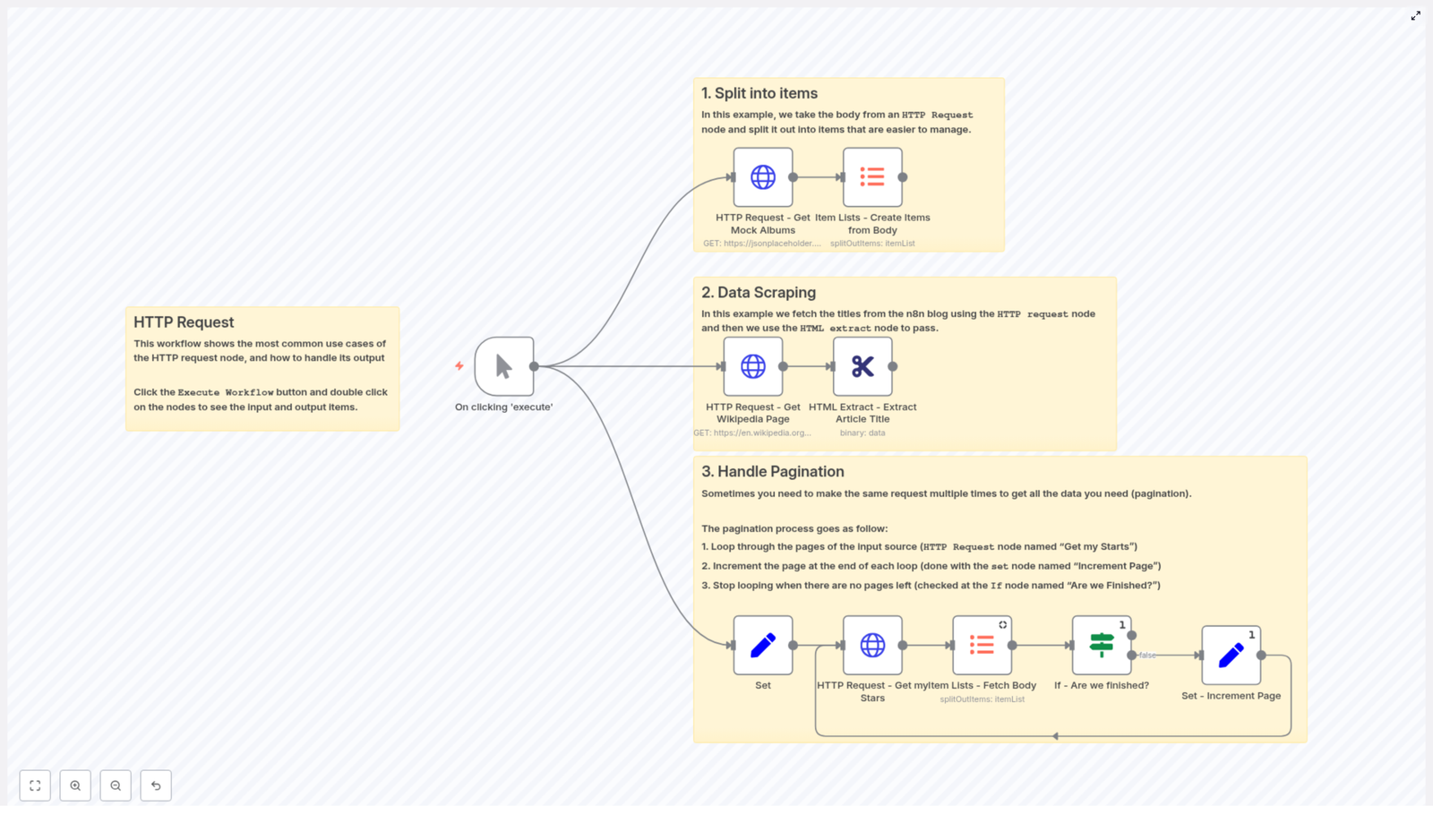
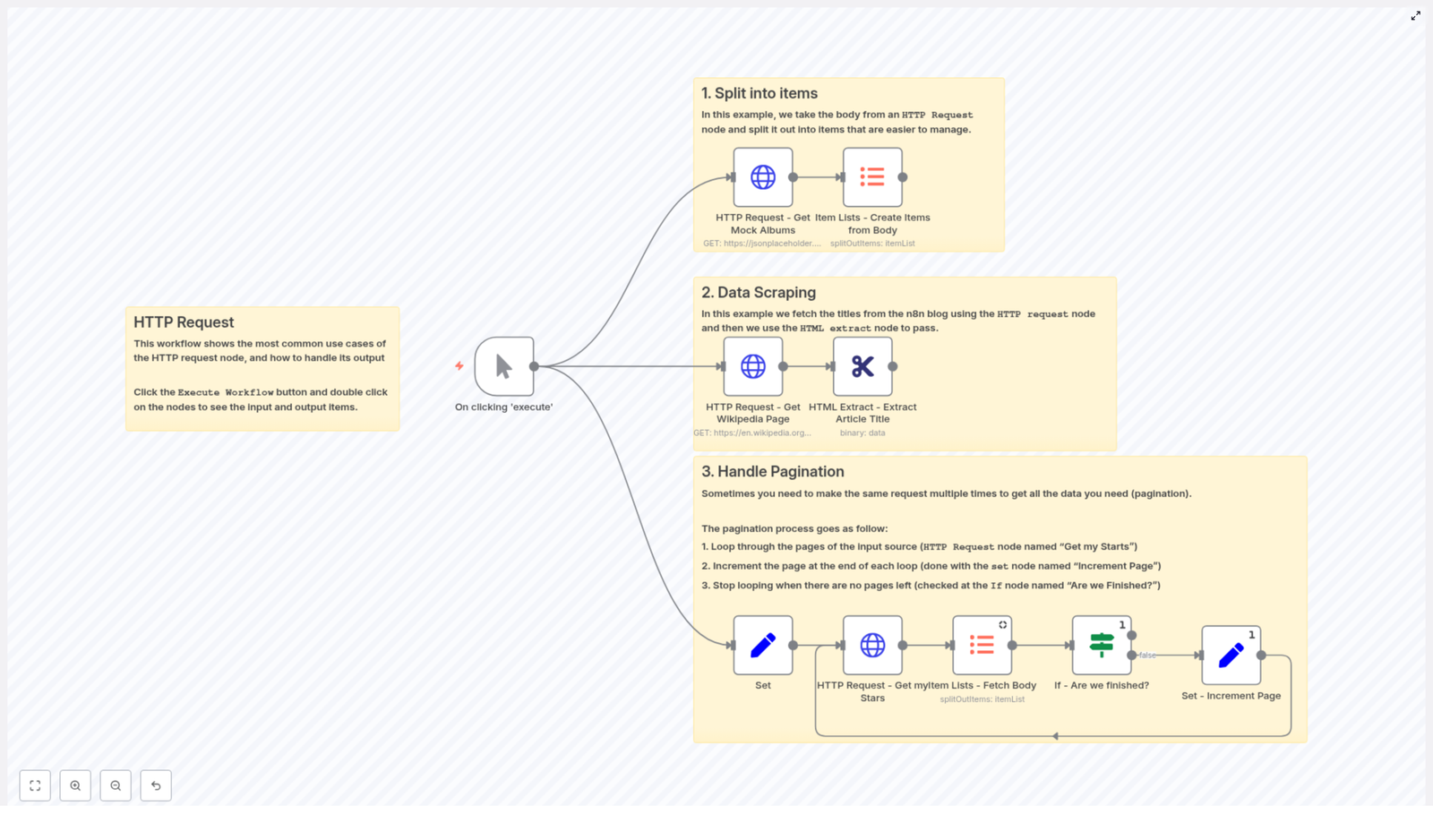
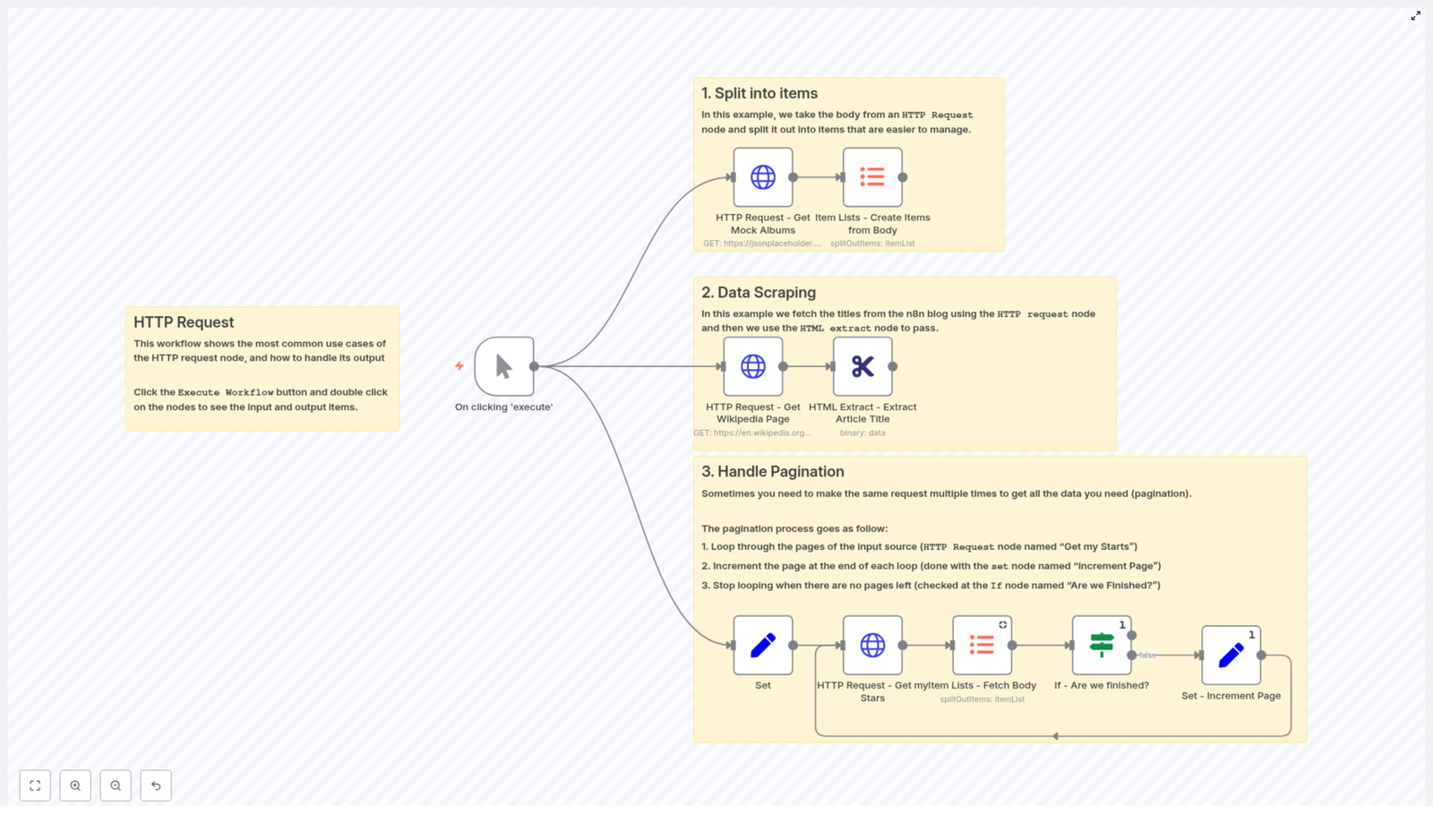
The HTTP Request node in n8n is a core building block for any advanced automation workflow. It enables you to call arbitrary HTTP endpoints, integrate with REST APIs that do not yet have native n8n nodes, fetch HTML for scraping, and handle binary payloads such as files or images. This guide walks through a reference workflow template that demonstrates three key implementation patterns: splitting API responses into individual items, scraping HTML content with HTML Extract, and implementing pagination loops.

1. Workflow Overview

The example workflow template is designed as a compact reference for common HTTP Request node usage patterns in n8n. It covers:

  • Array response handling – Fetch JSON from an API, then convert the array in the response body into separate n8n items for downstream processing.
  • HTML scraping – Request a web page in binary format, then extract structured data from the HTML using the HTML Extract node.
  • Paginated API access – Iterate over multiple pages of results from an API (for example, GitHub starred repositories) by looping until no further results are returned.

All examples are built around the same core node: the HTTP Request node. The workflow demonstrates how to parameterize URLs, control query parameters, manage authentication, and work with full HTTP responses.

2. Architecture and Data Flow

At a high level, the workflow is composed of three logical sections that can be reused or adapted independently:

2.1 Array response to item list

  • An HTTP Request node queries an API endpoint that returns JSON, for example a list of albums from a mock API.
  • An Item Lists – Create Items from Body node converts the JSON array found in the response body into multiple n8n items.
  • Each resulting item is now processed individually by any downstream nodes.

2.2 HTML scraping pipeline

  • An HTTP Request node downloads a web page, such as a random Wikipedia article.
  • The response format is configured as file / binary so the HTML is stored as a binary property.
  • An HTML Extract node processes that binary HTML and extracts specific elements, for example the article title.

2.3 Pagination loop for APIs

  1. A Set node initializes pagination and API-specific variables, such as page, perpage, and a githubUser identifier.
  2. An HTTP Request node fetches a single page of results, in the example case a list of GitHub starred repositories.
  3. An Item Lists – Fetch Body node converts the JSON array in the response body into multiple items.
  4. An If node checks whether the current page returned any items. This node answers the question “Are we finished?”.
  5. If there are items, a Set – Increment Page node increases the page value and the workflow loops back to the HTTP Request node.
  6. If the page is empty, the If node stops the loop and the workflow exits the pagination sequence.

This architecture keeps the workflow modular. You can clone and adapt each section depending on the target API or website.

3. Node-by-Node Breakdown

3.1 Initial Set node – pagination and parameters

The first Set node defines variables that are reused across HTTP requests. Typical fields include:

  • page – Starting page number, usually 1.
  • perpage – Number of results per page, for example 15 or 50, depending on the API limits and performance needs.
  • githubUser – A username or other resource identifier, used to build the request URL.

These values are stored in the node output and accessed later via n8n expressions. This approach keeps the workflow configurable and reduces hard-coded values.

3.2 HTTP Request node – core configuration

The HTTP Request node is responsible for interacting with external services. Important configuration parameters are:

  • URL: Use expressions to build dynamic URLs. For example, for GitHub starred repositories:
    =https://api.github.com/users/{{$node["Set"].json["githubUser"]}}/starred
  • Query parameters: Map pagination parameters to the values from the Set node:
    • per_page set to {{$node["Set"].json["perpage"]}}
    • page set to {{$node["Set"].json["page"]}}
  • Response format:
    • JSON for typical REST APIs that return structured data.
    • file or binary when fetching HTML pages, images, or other binary resources.
  • Full response:
    • Disabled by default if you only need the parsed body.
    • Enabled when you need HTTP headers, status codes, or raw metadata (for example, rate limiting headers or pagination links).
  • Authentication (if used):
    • Configured via the node’s credentials section, such as OAuth2 or API key headers.
    • Alternatively, custom headers can be added manually, for example Authorization: Bearer <token>.

For HTML scraping, the same HTTP Request node is configured with a URL pointing to a web page, response format set to binary, and no JSON parsing.

3.3 Item Lists nodes – splitting response bodies

The workflow uses two Item Lists patterns:

  • Item Lists – Create Items from Body: Takes a JSON array from the HTTP response body and creates a separate n8n item for each element. This is typically used when fetching a list of objects, such as albums from a mock API.
  • Item Lists – Fetch Body: Extracts and normalizes items from the JSON body in the pagination example, ensuring that each element is available as a dedicated item for further processing.

As an alternative, you can use the SplitInBatches node to process large arrays in smaller chunks. In this template, the Item Lists node is used to keep the example focused and straightforward.

3.4 If node – termination condition for pagination

The If node evaluates whether the current page of results is empty. Typical logic includes:

  • Checking the length of the JSON array returned by the HTTP Request node.
  • Verifying that the Item Lists node produced at least one item.

If the condition indicates no items (empty response), the workflow follows the “finished” branch and exits the loop. If items exist, it follows the “continue” branch, which leads to the page increment step.

3.5 Set – Increment Page node

This Set node calculates the next page number for the pagination loop. It:

  • Reads the current page value from the previous Set node output or the current item.
  • Increments it by 1 and writes the new value back into page.

The workflow then routes back to the HTTP Request node, which uses the updated page value in its query parameters. This continues until the If node detects an empty page.

3.6 HTML Extract node – scraping HTML content

For the scraping example, the HTML Extract node is configured to read the HTML from the binary property of the HTTP Request node output. A common configuration is:

  • Input property: The binary property that contains the HTML document.
  • CSS selector: For a Wikipedia article title, use #firstHeading.

The node returns the extracted content as structured data, which can then be stored, analyzed, or passed to other nodes.

4. Detailed Configuration Notes

4.1 Pagination strategies in n8n workflows

The template implements page-based pagination, but the same HTTP Request node can support several patterns:

  • Page-based pagination:
    • Increment a page query parameter using a Set node.
    • Common for APIs that expose page and per_page parameters, as in the GitHub example.
  • Offset-based pagination:
    • Use an offset parameter that increases by perpage each iteration.
    • Replace the page variable with offset in the Set node and HTTP Request query parameters.
  • Cursor-based pagination:
    • Read a next_cursor or similar token from the response body or headers.
    • Store the cursor in a Set node and pass it as a query parameter for the next HTTP Request.
    • Termination is often based on the absence of a next cursor rather than an empty page.

In all cases, the If node logic should match the API’s actual behavior, for example checking for a missing next link instead of relying solely on empty arrays.

4.2 Authentication and credentials

When calling real APIs, secure authentication is essential:

  • API keys and bearer tokens:
    • Configure credentials in n8n and select them in the HTTP Request node.
    • Alternatively, use the Headers section to set Authorization: Bearer <token>.
  • OAuth-based APIs:
    • Use n8n’s OAuth credentials if supported for the target API.
    • The HTTP Request node will attach the tokens automatically once configured.

Avoid hard-coding secrets directly in node parameters. Use n8n credentials or environment variables to keep workflows secure and portable.

4.3 Rate limits and error handling

For production-grade automations, consider the following:

  • Rate limits:
    • When Full response is enabled, inspect headers such as GitHub’s X-RateLimit-Remaining.
    • Use Wait or similar nodes to throttle requests if you approach the limit.
  • Error handling:
    • Configure the HTTP Request node’s error behavior if available in your n8n version.
    • Implement an If node and retry pattern to handle transient failures, for example network timeouts or 5xx responses.
    • Decide whether to stop the workflow, skip failing items, or retry with backoff based on your use case.

4.4 Binary vs JSON responses

Select the response format according to the target endpoint:

  • JSON:
    • Default choice for REST APIs.
    • Response body is available directly as parsed JSON in the node output.
  • File / binary:
    • Use for HTML pages, images, PDFs, or other file content.
    • Required for the HTML Extract node to parse the HTML document.

Enable full responses only when you need access to headers or status codes. Keeping it disabled reduces memory usage and simplifies item structures.

5. Example: Extracting a Wikipedia Article Title

The template includes a simple scraping pattern you can adapt:

  1. Configure an HTTP Request node to fetch a random Wikipedia page. Set the response format to binary so the HTML is stored as a file.
  2. Add an HTML Extract node that reads the binary HTML output from the HTTP Request node.
  3. Use the CSS selector #firstHeading to extract the article title element.

The result is a structured item containing the page title, which can be logged, stored in a database, or combined with other scraped data for content aggregation workflows.

6. Debugging and Inspection Techniques

To troubleshoot HTTP Request flows and pagination logic:

  • Open each node to inspect the input and output items after running the workflow.
  • Insert temporary Set nodes to log intermediate values such as page, perpage, or tokens from responses.
  • Enable the HTTP Request node’s fullResponse option temporarily to inspect headers when diagnosing authentication, rate limits, or pagination links.

Iterate with small perpage values while developing to reduce noise and speed up testing.

7. Security and Compliance Considerations

When using the HTTP Request node in production:

  • Do not hard-code API keys or secrets in node parameters. Use n8n credentials or environment variables.
  • Respect external API terms of service and usage policies.
  • When scraping HTML, limit request frequency and respect robots.txt and site terms to avoid overloading servers.

8. Practical Best Practices

  • Use n8n expressions extensively to keep URLs, query parameters, and headers dynamic.
  • Design pagination checks that match the actual API behavior, for example checking for a next link rather than only relying on empty pages.
  • Keep full responses disabled unless you explicitly need headers or status codes.
  • Start with smaller perpage values when building and debugging workflows, then increase them once the logic is stable.

9. Using the Template and Next Steps

The provided template illustrates how to:

  • Split JSON arrays into individual items with Item Lists.
  • Scrape HTML content with the HTML Extract node.
  • Implement looping pagination using Set, HTTP Request, Item Lists, and If nodes.

To get started in your own n8n instance:

  1. Import the workflow template.
  2. Run a single HTTP Request without the pagination loop to verify connectivity and response structure.
  3. Inspect the node outputs and adjust selectors, URLs, and parameters as needed.
  4. Enable or refine the pagination loop once the basic call works as expected.
  5. Optionally, duplicate the workflow and replace the API URL to practice integrating different services.

10. Call to Action

If you are ready to extend your automations with custom HTTP integrations, import this n8n template and run it in your environment. Adapt the nodes to your own APIs, experiment with pagination strategies, and build scraping or data aggregation flows tailored to your use case. For more n8n automation patterns and HTTP Request node best practices, subscribe for future tutorials or share your questions and workflows in the comments.

Mastering n8n HTTP Request: Split, Scrape, Paginate

Mastering the n8n HTTP Request Node: Splitting, Scraping, and Pagination at Scale

The HTTP Request node is a foundational component in n8n for building robust, production-grade automations. It acts as the primary interface between your workflows and external systems, whether you are consuming REST APIs, scraping HTML pages, or iterating through large, paginated datasets.

This article walks through a practical n8n workflow template that demonstrates three advanced patterns with the HTTP Request node:

  • Splitting JSON API responses into individual items for downstream processing
  • Scraping and extracting structured data from HTML pages
  • Implementing reliable pagination loops for multi-page endpoints

The goal is to move beyond simple requests and show how to combine HTTP Request with nodes like Item Lists, HTML Extract, Set, and If to create maintainable, scalable automations.

The Role of the HTTP Request Node in n8n Architectures

From a system design perspective, the HTTP Request node is your general-purpose integration gateway. It supports:

  • Standard HTTP methods such as GET, POST, PUT, PATCH, and DELETE
  • Authenticated calls using headers, API keys, OAuth, and more
  • Flexible response handling, including JSON, text, and binary data such as HTML or files

When combined with complementary nodes, it enables:

  • Item-level processing using Item Lists, Set, and Function nodes
  • Conditional logic and branching using If nodes
  • Advanced parsing and extraction using HTML Extract for web pages

The workflow template described below illustrates how to orchestrate these capabilities in a single, coherent automation.

Workflow Template Overview

The reference workflow, available as an n8n template, is organized into three distinct sections, each focused on a common integration pattern:

  1. Split API responses into items using HTTP Request and Item Lists
  2. Scrape and extract HTML content using HTTP Request and HTML Extract
  3. Implement pagination loops using Set, HTTP Request, Item Lists, and If

Each section is independent, so you can reuse the patterns individually or combine them in your own workflows. The following sections break down each pattern, configuration details, and best practices for automation professionals.

Pattern 1: Splitting JSON API Responses into Items

Use Case: Processing Arrays Returned by APIs

Many APIs return data as an array of objects in the response body. To process each object independently in n8n, you should convert that array into separate items. This enables item-by-item transformations, conditionals, and integrations without manual scripting.

In the template, this pattern is demonstrated with a simple GET request to a mock API:

  • https://jsonplaceholder.typicode.com/albums

The HTTP Request node retrieves a JSON array of album objects, and the Item Lists node is then used to split that array into individual workflow items.

Node Configuration: HTTP Request → Item Lists

  • HTTP Request node
    • Method: GET
    • URL: https://jsonplaceholder.typicode.com/albums
    • Response Format: JSON
    • If you require headers, status codes, or raw body, enable the Full Response option.
  • Item Lists node (Create Items from Body)
    • Operation: Create Items from List (or equivalent option in your n8n version)
    • Field to split: typically body or a JSON path to the array, for example body if the response is a top-level array
    • Result: each element of the array becomes a separate item for downstream nodes

Why Splitting into Items is a Best Practice

Splitting arrays early in the workflow promotes a clean, item-centric design:

  • Mapping fields in Set or other integration nodes becomes straightforward
  • If nodes can evaluate conditions per record, not per batch
  • Function nodes can operate on a single item context, reducing complexity

This approach aligns well with n8n’s data model and improves maintainability for large or evolving workflows.

Pattern 2: Scraping and Extracting Data from HTML Pages

Use Case: Structured Data from Websites without APIs

In many real-world scenarios, the data you need is only exposed via HTML pages, not via a formal API. n8n can handle this by retrieving the HTML as binary data and then applying CSS or XPath selectors to extract specific elements.

The template uses a random Wikipedia article as a demonstration target:

  • https://en.wikipedia.org/wiki/Special:Random

The workflow fetches this page and then extracts the article’s title element using the HTML Extract node and the selector #firstHeading.

Node Configuration: HTTP Request → HTML Extract

  • HTTP Request node
    • Method: GET
    • URL: https://en.wikipedia.org/wiki/Special:Random
    • Response Format: File or Binary so that the HTML is handled as binary data
  • HTML Extract node
    • Input: binary HTML data from the HTTP Request node
    • Selector type: CSS selector or XPath
    • Example selector: #firstHeading to extract the main article title on Wikipedia
    • Output: structured fields containing the text or attributes you selected

Operational Best Practices for Web Scraping

  • Compliance: Always review and respect the target site’s robots.txt file and terms of service. Unauthorized scraping can be disallowed.
  • Rate limiting: Use Wait nodes or custom throttling logic to space out requests and avoid overloading the site.
  • Headers and user agents: Set appropriate headers, such as a descriptive User-Agent string, to identify your integration transparently.
  • Selector validation: Test CSS or XPath selectors in your browser’s developer tools before finalizing them in n8n.

By encapsulating scraping logic in a dedicated sub-workflow or segment, you can reuse it across multiple automations while keeping compliance and performance under control.

Pattern 3: Implementing Robust Pagination Loops

Use Case: Iterating Through Multi-page API Responses

Most production APIs limit the number of records returned per request and expose a pagination mechanism. To retrieve complete datasets, your workflow must iterate until there are no more pages available. The template includes a simple yet reliable loop that illustrates this pattern.

The example scenario uses GitHub’s starred repositories endpoint with typical page-based parameters:

  • per_page to control the number of items per page
  • page to specify the current page index

Core Loop Structure

The pagination loop in the workflow uses the following nodes:

  1. Set – Initialize Page: defines initial variables such as page, perpage, and githubUser
  2. HTTP Request: sends a request for the current page using these variables in the query string
  3. Item Lists: splits the response body into individual items
  4. If node: checks whether the response is empty and decides whether to continue or stop
  5. Set – Increment Page: increases the page number and loops back to the HTTP Request node

Step-by-step Configuration

  1. Initialize page state using a Set node:
    • page = 1
    • perpage = 15
    • githubUser = 'that-one-tom'
  2. Build the request URL in the HTTP Request node using n8n expressions, for example:
    ?per_page={{$node["Set"].json["perpage"]}}&page={{$node["Set"].json["page"]}}
  3. Extract items with the Item Lists node so each element from the response body becomes an individual item.
  4. Evaluate continuation in an If node:
    • Condition: check whether the HTTP response body is empty or contains no items
    • If empty: terminate the loop
    • If not empty: proceed to increment the page
  5. Increment page in a Set node, for example:
    • page = $json["page"] + 1 or equivalent expression

This pattern creates a controlled loop that continues until the API stops returning data.

Common Pagination Strategies and How to Handle Them

Not all APIs use the same pagination model. Typical approaches include:

  • Page-based pagination
    • Parameters: page and per_page or similar
    • Implementation: similar to the GitHub example, increment page until no data is returned
  • Cursor-based pagination
    • API returns a cursor or token such as next_cursor in the response
    • Workflow stores this cursor in a Set node and passes it back in the next HTTP Request
  • Link header pagination
    • Next and previous URLs are provided in the HTTP Link header
    • Use the HTTP Request node with Full Response enabled to read headers and follow the next link until it is no longer present

Implementation and Reliability Tips

  • Stop conditions: base loop termination on explicit signals, such as an empty body, missing next link, or null cursor, rather than assumptions.
  • Rate limits: honor provider limits by:
    • Adding delays between pages
    • Implementing exponential backoff on 429 or 5xx responses
    • Inspecting rate limit headers such as X-RateLimit-Remaining when available
  • Observability: log key metrics such as current page, item counts, and error messages to support debugging and partial re-runs.

Advanced HTTP Request Techniques and Troubleshooting

For production workflows, you often need more control over authentication, error handling, and response formats. The following practices help harden your HTTP-based integrations.

  • Authentication
    • Use built-in n8n credentials for OAuth, API keys, or token-based auth where possible.
    • Set custom headers (for example, Authorization, X-API-Key) directly in the HTTP Request node if needed.
  • Error handling and retries
    • Use the Error Trigger node for centralized failure handling.
    • Implement If nodes around HTTP Request to branch on status codes or error messages.
    • Add retry logic or backoff patterns for transient failures.
  • Choosing between JSON and binary
    • Use JSON for structured API responses that you want to map and transform.
    • Use Binary for HTML pages, files, or other non-JSON payloads that will be processed by nodes such as HTML Extract or Binary data transformers.
  • Full Response mode
    • Enable Full Response when you need access to status codes, headers, or raw body data for advanced logic, such as pagination using headers or conditional branching based on HTTP status.
  • Interactive debugging
    • Run the workflow step-by-step and inspect node input and output to validate expressions, selectors, and transformations.
    • Use sample items to refine mapping before scaling the workflow.

Sample n8n Expression for Page-based Queries

The following snippet illustrates how to construct a GitHub API request using n8n expressions for page-based pagination:

// Example: page-based query parameters in n8n expression
https://api.github.com/users/{{$node["Set"].json["githubUser"]}}/starred?per_page={{$node["Set"].json["perpage"]}}&page={{$node["Set"].json["page"]}}

This pattern generalizes to many APIs that accept similar query parameters for pagination.

Conclusion: Building Production-ready HTTP Integrations in n8n

By combining the HTTP Request node with Item Lists, HTML Extract, Set, and If, you can construct highly flexible workflows that:

  • Split API responses into granular items for detailed processing
  • Scrape and extract structured data from HTML pages when no API is available
  • Iterate safely through paginated endpoints until all records are retrieved

Use the template as a reference implementation: start with splitting responses, then layer in HTML extraction and pagination logic as your use cases demand. Validate each segment independently, then integrate them into your broader automation architecture.

If you are integrating with APIs such as GitHub, Stripe, or Shopify, you can adapt these patterns directly by adjusting URLs, parameters, and authentication settings.

Call to action: Open n8n, import or recreate this workflow, and test each node step-by-step. For a downloadable version of the template or assistance tailoring it to your specific APIs and infrastructure, reach out for expert support.

n8n HTTP Request Guide: Split, Scrape & Paginate

n8n HTTP Request Guide: Split, Scrape & Paginate

Ever copied data from a website into a spreadsheet for 3 hours straight and thought, “There has to be a better way”? You are right, there is. It is called automation, and in n8n that often starts with the HTTP Request node.

This guide walks through a practical n8n workflow template that shows how to:

  • Split a big API response into individual items
  • Scrape HTML content like titles or links
  • Handle paginated API responses without losing your mind

We will keep all the useful tech bits, but explain them in a friendly way so you can actually enjoy setting this up.

Why the HTTP Request node is a big deal

APIs and websites are where most of the interesting data lives now. The HTTP Request node is your “fetch data from the internet” button. It lets you:

  • Call APIs
  • Download web pages
  • Collect data that comes in multiple pages

Once you have the data, n8n’s other nodes can transform it, store it, or send it somewhere else. The workflow in this guide focuses on three real-world patterns that you can reuse, remix, and generally show off to your coworkers as “magic”.

What this n8n workflow template actually does

The template is built around a single trigger that kicks off three different use cases:

  • Split into items – Take an HTTP response that returns an array and turn each element into its own item.
  • Data scraping – Fetch a web page and extract specific HTML elements with the HTML Extract node.
  • Handle pagination – Loop through paginated API responses until there are no more results.

The workflow is visually grouped into these sections, so you can run everything from one manual trigger and then inspect each part to see how the data flows.

Quick start: how to use the template

  1. Open your n8n instance.
  2. Import the workflow template or recreate it using the nodes described below.
  3. Run the workflow with a Manual Trigger.
  4. Open each node, check its input and output, and follow the data as it moves through splitting, scraping, and paginating.

Once you understand the patterns, you can plug in your own API URLs, parameters, or websites and let the automation handle the tedious parts.


Use case 1: Split API responses into individual items

Scenario: an API returns a big array of records, and you want to process each record separately instead of treating them as one giant blob. This is where “split into items” comes in.

Nodes used in this section

  • HTTP Request
    • Method: GET
    • URL: https://jsonplaceholder.typicode.com/albums
    • Response format: JSON (default)
  • Item Lists – Create Items from Body

How the split works

  1. Call the JSON API
    Configure the HTTP Request node to call a JSON endpoint. In our example, we use:
    GET https://jsonplaceholder.typicode.com/albums

    The response is an array of album objects, and n8n reads this as JSON by default.

  2. Convert the array into individual items
    Add an Item Lists node and set:
    • fieldToSplitOut to body (or to the exact path of the array inside the response)

    This makes the node emit one item per array element. Each album becomes its own item, which is much easier to filter, map, transform, or send to a database.

You can also use nodes like SplitInBatches or a Function node for more advanced control, but Item Lists is a simple starting point when the response is a clean array.

Result: instead of wrestling with a giant JSON array, you now have individual album objects ready for downstream nodes to process in a clean, predictable way.


Use case 2: Scrape web pages with HTML Extract

Scenario: you want to pull specific information from a web page, like titles, headings, or links, without manually copying and pasting. The combo of HTTP Request plus HTML Extract turns you into a polite, structured web scraper.

Nodes used in this section

  • HTTP Request
    • Method: GET
    • Target: a web page URL
    • responseFormat: file (binary)
  • HTML Extract
    • Selectors: CSS selectors
    • sourceData: binary

How to scrape with HTML Extract

  1. Fetch the HTML as a file
    In the HTTP Request node:
    • Set the URL to the page you want to scrape.
    • Change Response Format to file.

    This stores the HTML as binary data, which is exactly what the HTML Extract node expects.

  2. Extract specific elements with CSS selectors
    Configure the HTML Extract node:
    • Set sourceData to binary.
    • Add your extraction rules using CSS selectors.

    Example: to grab the main article title from a Wikipedia page, you can use:

    #firstHeading

The HTML Extract node lets you pull out exactly what you need, without writing custom parsing code. Use it for things like:

  • Blog post titles
  • Product information
  • Structured elements like lists, headings, or links

Result: you get clean data from messy HTML, ready to push into a database, spreadsheet, or another part of your workflow.


Use case 3: Handle pagination like a pro

Scenario: you call an API and it kindly responds, “Here are your results, but only 15 at a time. Please keep asking for the next page.” Manually clicking through pages is annoying. Automating that loop in n8n is not.

Nodes used in this section

  • Set – initialize parameters like page, perpage, and githubUser
  • HTTP Request – call the GitHub API for starred repositories
  • Item Lists – Fetch Body and split out results into items
  • If – check whether the response is empty
  • Set – increment the page number

Step-by-step pagination loop

  1. Initialize your pagination variables
    Use a Set node to define:
    • page (for example, 1)
    • perpage (for example, 15)
    • githubUser (the GitHub username you want to query)
  2. Configure the HTTP Request for a paginated endpoint
    In the HTTP Request node, use n8n expressions to build the URL and query parameters dynamically. For GitHub starred repositories, you can use:
    =https://api.github.com/users/{{$node["Set"].json["githubUser"]}}/starred
    
    Query parameters:
    - per_page = {{$node["Set"].json["perpage"]}}
    - page  = {{$node["Set"].json["page"]}}

    Each time the loop runs, the page value will update.

  3. Split the response body into items
    Add an Item Lists (or similar) node to create individual items from the response body array. This lets you process each starred repository separately.
  4. Check if you reached the end
    Insert an If node to test whether the HTTP response body is empty:
    • If the body is empty, there are no more results and pagination is done.
    • If the body is not empty, you still have more pages to fetch.
  5. Increment the page and loop
    When the response is not empty, send the flow to another Set node that:
    • Increments page by 1

    Then route the workflow back to the HTTP Request node so it can request the next page.

The loop continues until the If node detects an empty response. At that point, the pagination branch ends and you have collected all pages of data.

Tips for safer, smarter pagination

  • Respect rate limits: many APIs limit how often you can call them. Use delays or authenticated requests to stay within allowed limits.
  • Use built-in metadata when available: if the API returns total pages, next-page URLs, or similar hints, prefer those over simply checking for an empty response.
  • Log progress: store or log the current page so you can debug or resume more easily.
  • Smaller batches: if your downstream processing is heavy, keep perpage smaller to avoid huge loads in a single run.

General best practices for n8n HTTP Request workflows

Once you start wiring HTTP Request nodes into everything, a few habits will save you time and headaches.

  • Use credentials
    Store API keys, tokens, and OAuth details in n8n credentials instead of hardcoding them in nodes. It is safer, easier to update, and more reusable.
  • Pick the right response format
    Choose the correct response type for your use case:
    • JSON for structured API responses
    • file for HTML or binary data you want to pass to HTML Extract or other nodes
    • fullResponse if you need headers or status codes for debugging or conditional logic
  • Handle errors gracefully
    Use error triggers or the Execute Workflow node to retry failed requests or branch into error-handling flows.
  • Transform early
    As soon as you get a response, normalize or split it into a predictable shape. Your downstream nodes will be much simpler and easier to maintain.

Example automation ideas with this template

Once you understand splitting, scraping, and paginating, you can build a surprising amount of real-world automation. For example:

  • Export all your GitHub stars across multiple pages into a database or spreadsheet.
  • Scrape article titles from a list of URLs for a content audit or SEO review.
  • Bulk fetch product listings from an API, split them into individual items, and enrich them with other data sources.

These are all variations on the same patterns you just learned: HTTP Request to get the data, Item Lists or similar nodes to split it, HTML Extract when dealing with HTML, and a simple loop for pagination.


Next steps: put the template to work

The combination of HTTP Request, Set, Item Lists, HTML Extract, and a basic If loop covers a huge portion of everyday automation tasks. Once you get comfortable with these, most APIs and websites start looking very manageable.

To try it out:

  • Open n8n.
  • Import the example workflow or recreate the nodes described in this guide.
  • Click Execute and inspect each node’s input and output to see exactly how the data moves.

If you want, you can also work from the template directly:

Call to action

Give this workflow a spin in your own n8n instance. If you have a specific API or website in mind, share the endpoint or HTML structure and I can help with a tailored workflow or sample expressions to plug into this pattern.

Happy automating, and may your repetitive tasks be handled by workflows while you do literally anything more interesting.

n8n Unpaid Invoice Reminder Workflow Guide

Build an Automated Unpaid Invoice Reminder in n8n

If you are tired of chasing unpaid invoices by hand, you are not alone. Following up is important, but it is also repetitive, easy to forget, and honestly, not the most fun part of running a business. That is where this n8n workflow template comes in.

In this guide, we will walk through a ready-made n8n automation that sends smart, contextual unpaid invoice reminders using Webhooks, text splitting, vector embeddings, Weaviate, a RAG (retrieval-augmented generation) agent, Google Sheets, and Slack. Think of it as a polite, always-on assistant that never forgets to nudge your clients and keeps your accounting log tidy at the same time.

What this n8n template actually does

This workflow takes invoice data from your system, looks up relevant context like past emails or notes, and then uses a language model to write a friendly, personalized reminder. It also logs what happened to a Google Sheet and pings your Slack channel if something fails.

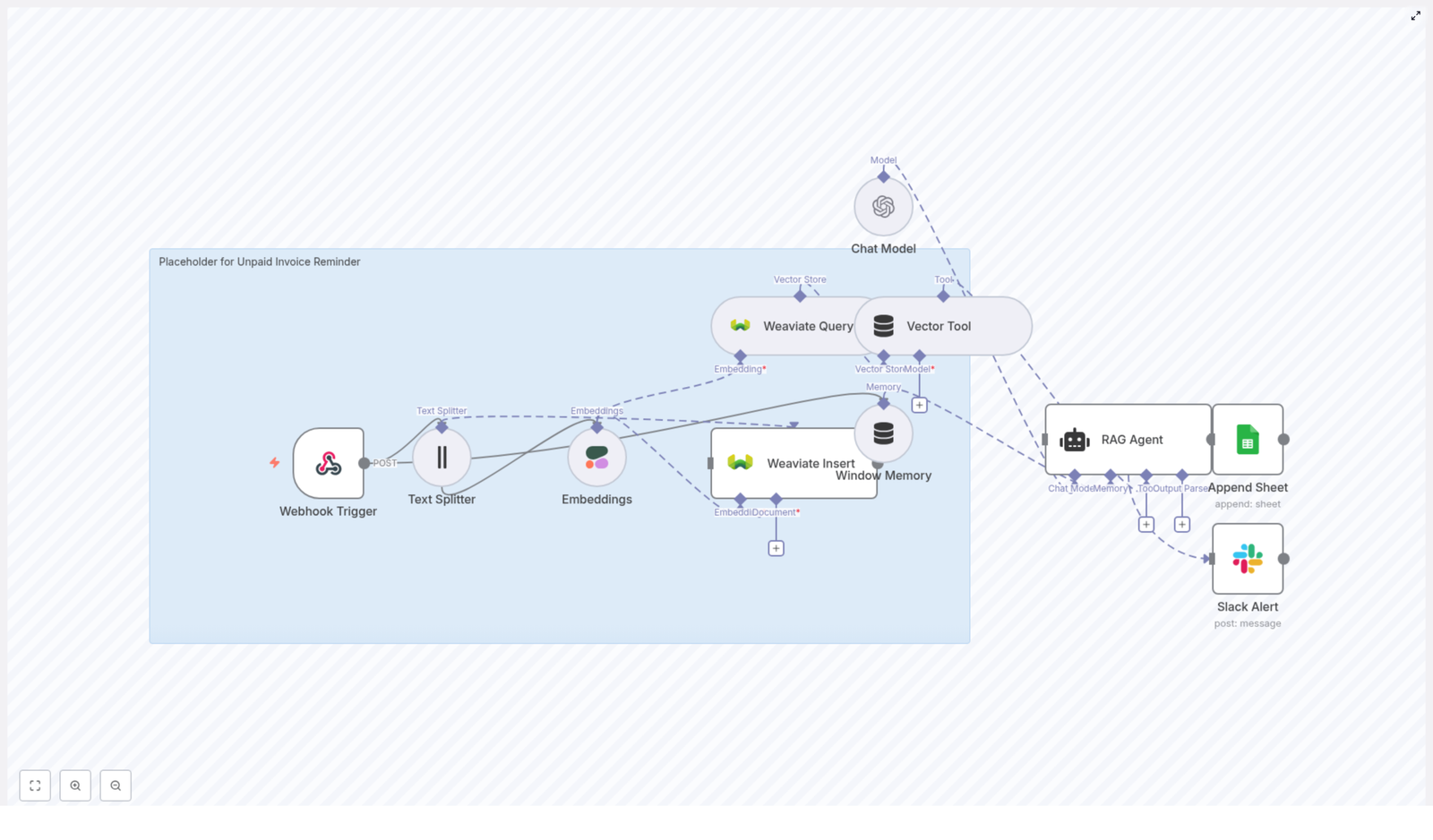
Here is a quick look at the main building blocks inside the template:

  • Webhook Trigger – entry point that receives invoice data or a scheduled event at POST /unpaid-invoice-reminder.
  • Text Splitter – breaks long notes or message histories into smaller chunks.
  • Embeddings (Cohere) – turns each text chunk into a vector embedding for semantic search.
  • Weaviate Insert & Query – stores and retrieves those embeddings and their metadata.
  • Vector Tool – formats the retrieved documents so the RAG agent can use them effectively.
  • Window Memory – short-term memory that keeps recent context available during processing.
  • Chat Model (OpenAI) – the language model that actually writes the reminder message.
  • RAG Agent – coordinates retrieval from Weaviate, memory, and the LLM to produce a contextual reminder.
  • Append Sheet (Google Sheets) – logs reminder status and any extra info you want to track.
  • Slack Alert – sends an alert to your #alerts channel if something goes wrong.

When should you use this workflow?

This template is a great fit if you:

  • Regularly send invoices and sometimes forget to follow up.
  • Want reminders that sound human, not robotic.
  • Need a traceable log of every reminder sent for accounting or reporting.
  • Already use tools like Google Sheets, Slack, and an invoicing system that can hit a webhook.

Instead of manually writing, copying, and pasting the same type of email again and again, you can let n8n handle it and only step in when something special comes up.

Why automate invoice reminders in the first place?

Manual follow-ups are easy to delay or skip, and the tone can vary a lot from one message to the next. Automation fixes that.

With an automated unpaid invoice reminder workflow in n8n, you:

  • Save time by eliminating repetitive follow-up tasks.
  • Reduce late payments with consistent, timely nudges.
  • Keep your cash flow healthier with less effort.
  • Maintain a polite, professional tone every single time.
  • Capture all activity in a log so you know exactly what was sent and when.

The extra twist here is the use of vector search and a language model. Instead of sending a generic reminder, the workflow can pull in invoice history, previous payment promises, or special terms and use that to write a more thoughtful, contextual message.

How the workflow pieces fit together

Let us walk through what happens behind the scenes when an unpaid invoice triggers this n8n automation.

1. Webhook receives invoice data

Everything starts with the Webhook Trigger. Your invoicing system or a scheduled job sends a POST request to /unpaid-invoice-reminder with details like:

  • Invoice ID
  • Client name or ID
  • Due date
  • Amount due
  • Notes or previous communication

This payload becomes the raw material for the rest of the workflow.

2. Long text is split and embedded

If you have long notes or email threads, the Text Splitter node breaks them into smaller, overlapping chunks so they can be embedded cleanly. For example, you might use:

  • chunkSize: 400
  • chunkOverlap: 40

Those chunks are then passed into a Cohere Embeddings node, using a model such as embed-english-v3.0. Each chunk is converted into a vector representation that captures the meaning of the text, not just the exact words.

3. Weaviate stores your invoice context

The embeddings and associated metadata are sent to a Weaviate Insert node. Here you store:

  • The text chunk itself.
  • The embedding vector.
  • Metadata like invoice ID, date, client ID, or any tags you want.

This turns your invoice notes and communication history into a searchable knowledge base that you can query later using semantic similarity instead of simple keyword matching.

4. Relevant context is retrieved when needed

When it is time to generate a reminder for a specific unpaid invoice, the workflow uses a Weaviate Query node. It queries Weaviate with invoice details or client information to find the most relevant stored documents.

The results from Weaviate are then passed through a Vector Tool node, which formats and prepares the retrieved context in the way your RAG Agent expects. This might include trimming, concatenating, or structuring the snippets so the agent can use them effectively.

5. Short-term memory and the LLM come into play

To keep everything coherent within a single run, the workflow uses Window Memory. This acts as short-term memory that holds recent context, such as what has already been processed or any intermediate decisions.

The Chat Model (OpenAI) is wired in as the language model that will write the actual reminder text. The RAG agent sends it a combination of:

  • System instructions (how to write).
  • Retrieved context from Weaviate.
  • Current invoice details and memory.

6. The RAG agent orchestrates everything

The RAG Agent is the conductor. It takes in:

  • The documents returned by Weaviate.
  • The short-term context from Window Memory.
  • Your system prompt that defines tone, structure, and required fields.

For example, a typical system instruction might look like:

System: You are an assistant for Unpaid Invoice Reminder; produce a short, polite reminder including invoice number, amount due, due date, and call-to-action to pay.

The agent then calls the Chat Model (OpenAI) with all of that information and gets back a polished, human-friendly reminder message that acknowledges any important notes, such as previous promises to pay.

7. Logging and error alerts

Once the reminder is generated, the workflow writes a log entry using a Google Sheets Append node. You can use a sheet called something like Log and include columns such as:

  • Status
  • Invoice ID
  • Client name
  • Reminder date
  • Any other fields you want to track

If anything fails along the way, an onError path routes the problem to a Slack node. This sends a message to your #alerts channel so your team can quickly jump in and fix the issue, instead of silently missing reminders.

Step-by-step: setting up the n8n template

Now let us go through the setup in a more practical, node-by-node way. You can follow this checklist while configuring the template.

1. Create and configure the Webhook

  • Add a Webhook node in n8n.
  • Set the HTTP method to POST.
  • Use a path like /unpaid-invoice-reminder.
  • Connect your invoicing app or scheduler so it sends unpaid invoice data to this endpoint.

2. Split long text and create embeddings

  • Add a Text Splitter node and connect it to the Webhook output.
  • Configure it with a chunk size and overlap, for example:
    • chunkSize: 400
    • chunkOverlap: 40
  • Attach a Cohere Embeddings node using a model such as embed-english-v3.0.
  • Map the text chunks from the Text Splitter to the Embeddings node input.

3. Store your vectors in Weaviate

  • Add a Weaviate Insert node and connect the output of the Embeddings node.
  • Configure your Weaviate credentials and class/schema.
  • Store:
    • Original text chunk.
    • Embedding vector.
    • Metadata like invoice ID, client ID, date, or tags.

4. Query Weaviate for related context

  • Add a Weaviate Query node for the reminder generation path.
  • Build a query based on the invoice or client details.
  • Return the top relevant documents for the specific unpaid invoice.
  • Feed the results into a Vector Tool node to shape the data in the format expected by your RAG Agent.

5. Configure Window Memory and the Chat Model

  • Add a Window Memory node to maintain short-term context across steps.
  • Set up a Chat Model (OpenAI) node with your chosen model and API key.
  • Ensure the RAG Agent uses this Chat Model for generating the reminder text.

6. Set up the RAG Agent orchestration

  • Add a RAG Agent node.
  • Connect:
    • Retrieved documents from the Vector Tool node.
    • Context from Window Memory.
    • Invoice details from the Webhook or earlier nodes.
  • Provide a clear system instruction, for example:
    You are an assistant for Unpaid Invoice Reminder; produce a short, polite reminder including invoice number, amount due, due date, and call-to-action to pay.

7. Log activity and send Slack alerts

  • Add a Google Sheets Append node after the RAG Agent.
  • Point it to your accounting or logging spreadsheet and a sheet like Log.
  • Include at minimum a Status column and any other fields you want to track.
  • From the RAG Agent (or a central part of the workflow), configure an onError branch that leads to a Slack node.
  • Set the Slack node to notify your #alerts channel about failures or exceptions.

Prompt templates for consistent reminders

Clear prompts help the language model stay on-brand and avoid awkward wording. You can customize these, but here is a solid starting point.

System prompt example

Use a system message that defines tone, structure, and required fields:

System: You are an assistant that writes unpaid invoice reminders. Keep tone polite and professional. Include invoice number, amount due, due date, and payment link. If there are previous payment promises or notes, acknowledge them briefly.

User prompt example

Then pass a user prompt that includes the current invoice and any retrieved context. For example:

User: Compose a reminder for Invoice #12345 for Acme Co., amount $2,350, due 2025-10-10. Relevant notes: [retrieved documents].

In the actual workflow, [retrieved documents] is filled in by the Vector Tool and RAG Agent with the relevant snippets from Weaviate.

Best practices and security tips

Since this workflow touches external services and potentially sensitive data, it is worth locking it down properly.

  • Store all API keys for Cohere, Weaviate, OpenAI, Google Sheets, and Slack using n8n credentials or environment variables.
  • Protect your webhook with authorization tokens, IP allowlists, or other access controls.
  • Validate and sanitize incoming data so malicious content does not end up in your logs or prompts.
  • Monitor usage costs, since embeddings and LLM calls can add up. Batch operations where it makes sense.
  • Version your Weaviate schema and keep backups of vector data to avoid accidental loss.

Testing and troubleshooting your n8n automation

Instead of turning everything on at once, it is easier to test in stages.

  1. Start with the Webhook: Send a sample payload and verify that n8n receives it correctly.
  2. Add logging: Temporarily log intermediate outputs so you can see exactly what each node is doing.
  3. Enable Text Splitter and Embeddings: Confirm that chunks are generated and embeddings are created without errors.
  4. Test Weaviate Insert and Query: Make sure data is stored and can be retrieved with meaningful results.
  5. Turn on the RAG Agent: Once context retrieval looks good, enable the agent and inspect the generated reminders.

If the reminder text looks off or irrelevant, check:

  • Which documents are coming back from Weaviate.
  • Whether your query filters or similarity thresholds need tweaking.
  • Whether the system and user prompts are clear about what you want.

Use cases and easy extensions

Once you have the core unpaid invoice reminder workflow running, you can build on it quite a bit. Here are some ideas:

  • Follow-up sequences: Create multiple reminder stages, such as:
    • A soft nudge shortly after the due date.
    • A firmer reminder after a set number of days.
    • A final escalation message before collections.
  • Multichannel delivery: Add email or SMS nodes so reminders go out through the channel your clients respond to fastest.
  • Deeper personalization: Include client name, payment history, or custom payment terms to make messages more compelling and relevant.
  • Analytics and reporting: Use your Google Sheets log as the data source for a dashboard that tracks days-to-pay, response rates, and follow-up efficiency.

Wrapping up

By combining n8n with Cohere embeddings, Weaviate vector search, and a RAG agent powered by OpenAI, you get more than a simple reminder script. You get an intelligent unpaid invoice reminder system that is:

Build a Mortgage Rate Alert with n8n & Pinecone

Build a Mortgage Rate Alert System with n8n, LangChain & Pinecone

This guide walks you through an n8n workflow template that automatically monitors mortgage rates, stores them in a vector database, and triggers alerts when certain conditions are met. You will learn what each node does, how the pieces work together, and how to adapt the template to your own use case.

What you will learn

By the end of this tutorial, you will be able to:

  • Understand how an automated mortgage rate alert system works in n8n
  • Configure a webhook to receive mortgage rate data
  • Split and embed text using OpenAI embeddings
  • Store and query vectors in Pinecone
  • Use an Agent with memory to decide when to raise alerts
  • Log alerts to Google Sheets for audit and analysis
  • Apply best practices for production setups and troubleshooting

Why automate mortgage rate alerts?

Mortgage rates change frequently, and even a small shift can impact both borrowers and lenders. Manually tracking these changes is time consuming and error prone. An automated mortgage rate alert system built with n8n, LangChain, OpenAI embeddings, and Pinecone can:

  • Continuously monitor one or more rate sources
  • Notify internal teams or clients as soon as a threshold is crossed
  • Maintain a searchable history of alerts for compliance, reporting, and analytics

The workflow template described here gives you a starting point that you can customize with your own data sources, thresholds, and notification channels.

Concept overview: how the n8n workflow is structured

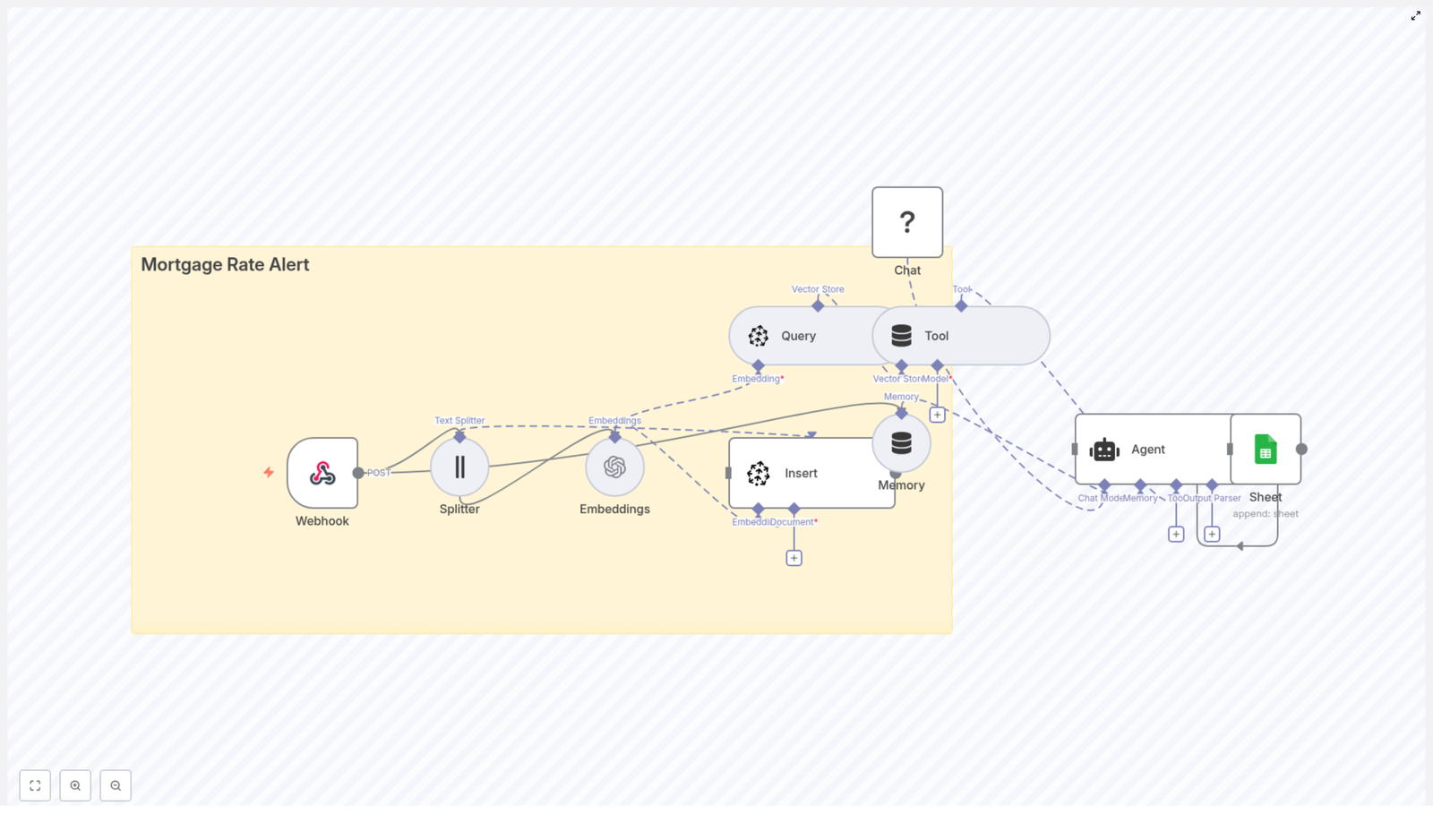
The sample workflow, named “Mortgage Rate Alert”, is made up of several key components that work together:

  • Webhook (n8n) – receives incoming mortgage rate data via HTTP POST
  • Text Splitter – breaks long or complex payloads into smaller chunks
  • Embeddings (OpenAI) – converts text chunks into vector representations
  • Pinecone Insert – stores embeddings in a Pinecone vector index
  • Pinecone Query + Tool – retrieves similar historical context when new data arrives
  • Memory + Chat + Agent – uses a language model with context to decide if an alert is needed
  • Google Sheets – logs alerts and decisions for later review

Think of the flow in three stages:

  1. Ingest – accept and prepare mortgage rate data (Webhook + Splitter)
  2. Understand & store – embed and index data for future retrieval (Embeddings + Pinecone)
  3. Decide & log – evaluate thresholds and record alerts (Agent + Sheets)

Step-by-step: building the workflow in n8n

Step 1: Configure the Webhook node (data intake)

The Webhook node is your entry point for mortgage rate updates. It listens for HTTP POST requests from a data provider, internal service, or web crawler.

Key setup points:

  • Method: Set to POST
  • Authentication: Use an API key, HMAC signature, IP allowlist, or another method to secure the endpoint
  • Validation: Add checks so malformed or incomplete payloads are rejected early

The webhook should receive a JSON body that includes information like source, region, product, rate, and timestamp. A basic example is shown later in this guide.

Step 2: Split the incoming text (Text Splitter)

If your webhook payloads are large, contain multiple products, or include descriptive text, you will want to split them into smaller, meaningful pieces before sending them to the embedding model.

In this template, a character text splitter is used with the following parameters:

  • chunkSize: 400
  • chunkOverlap: 40

This configuration helps maintain semantic coherence in each chunk while keeping the number of vectors manageable. It is a balance between:

  • Embedding quality – enough context in each chunk for the model to understand it
  • Index efficiency – not generating more vectors than necessary

Step 3: Create embeddings with OpenAI

Each text chunk is then converted into a vector using an OpenAI embeddings model. These embeddings capture the semantic meaning of the content so you can later search for similar items.

Configuration tips:

  • Use a modern embedding model (the template uses the default configured model in n8n)
  • Batch multiple chunks into a single API request where possible to reduce latency and cost
  • Attach rich metadata to each embedding, for example:
    • timestamp
    • source
    • original_text or summary
    • rate
    • region or lender identifier

This metadata becomes very useful for filtering and analysis when you query Pinecone later.

Step 4: Insert embeddings into Pinecone

Next, the workflow uses a Pinecone node to insert vectors into a Pinecone index. In the template, the index is named mortgage_rate_alert.

Best practices for the insert step:

  • Use a consistent document ID format, for example:
    • sourceId_timestamp_chunkIndex
  • Include all relevant metadata fields so you can:
    • Filter by region, product, or source
    • Filter by time range
    • Reconstruct or audit the original event

Once stored, Pinecone lets you run fast similarity searches over your historical mortgage rate data. This is useful both for context-aware decisions and for spotting near-duplicate alerts.

Step 5: Query Pinecone and expose it as a Tool

Whenever new rate data arrives, the workflow can query Pinecone to find similar or related past entries. For example, you might look up:

  • Recent alerts for the same region or product
  • Past events with similar rate changes

The template includes a Query step combined with a Tool node. The Tool wraps Pinecone as a retrieval tool that the Agent can call when it needs more context.

In practice, this means the Agent can ask Pinecone things like “show me recent events for this product and region” as part of its reasoning process, instead of relying only on the current payload.

Step 6: Use Memory, Chat model, and Agent for decisions

The heart of the alert logic is handled by an Agent node that uses:

  • A chat model (the example diagram uses a Hugging Face chat model)
  • A Memory buffer to store recent conversation or decision context
  • The Pinecone Tool to retrieve additional information when needed

The Agent receives:

  • The new mortgage rate data
  • Any relevant historical context retrieved from Pinecone
  • Prompt instructions that define your business rules and thresholds

Based on this, the Agent decides whether an alert should be raised. A typical rule might be:

  • Trigger an alert when the 30-year fixed rate moves more than 0.25% compared to the most recent stored rate

You can implement threshold checks directly in the Agent prompt or by adding pre-check logic in n8n before the Agent runs.

Step 7: Log alerts to Google Sheets

If the Agent decides that an alert is warranted, the workflow uses a Google Sheets node to append a new row to a designated sheet.

Typical fields to log include:

  • timestamp of the event
  • rate and product type (for example 30-year fixed)
  • region or market
  • threshold_crossed (for example “delta > 0.25%”)
  • source of the data
  • agent_rationale or short explanation of why the alert was raised

This sheet can serve as a simple audit trail, a data source for dashboards, or a handoff point for other teams and tools.

Designing your threshold and alert logic

The question “when should we alert?” is ultimately a business decision. Here are common strategies you can encode in the Agent or in n8n pre-checks:

  • Absolute threshold:
    • Alert if the rate crosses a fixed value, for example:
      • if rate >= 7.0%
  • Delta threshold:
    • Alert if the rate changes by more than a certain number of basis points within a given time window, for example:
      • if |current_rate - last_rate| >= 0.25% in 24 hours
  • Relative trends:
    • Use moving averages or trend lines and alert when the current rate breaks above or below them

You can store historical points in Pinecone and/or Google Sheets, then use similarity queries or filters to find comparable recent events and guide the Agent’s reasoning.

Best practices for running this in production

When you move from testing to production, consider the following guidelines.

Security

  • Protect the Webhook with API keys, IP allowlists, or signed payloads
  • Keep Pinecone and external API credentials scoped and secret
  • Rotate keys periodically and restrict who can access the workflow

Rate limits and batching

  • Batch embedding requests to OpenAI where possible to reduce overhead
  • Respect rate limits of OpenAI, Hugging Face, and any other external APIs
  • Implement retries with exponential backoff to handle transient errors

Cost control

  • Monitor how many embeddings you create and how large your Pinecone index grows
  • Tune chunkSize and chunkOverlap to reduce the number of vectors while keeping retrieval quality high
  • Consider archiving or downsampling older data if cost becomes an issue

Observability and logging

  • Log incoming payloads, embedding failures, and Agent decisions
  • Use the Google Sheet as a basic audit log, or integrate with tools like Elasticsearch or DataDog for deeper monitoring
  • Track how often alerts are triggered and whether they are useful to stakeholders

Testing before going live

  • Simulate webhook payloads using tools like curl or Postman
  • Test edge cases such as missing fields, malformed JSON, or unexpected rate values
  • Review sample Agent outputs to confirm that it interprets thresholds correctly

Troubleshooting common issues

If you run into issues with the mortgage rate alert workflow, start with these checks:

  • Duplicate inserts:
    • Verify that your document ID scheme is unique
    • Add deduplication logic on ingest, for example by checking if a given ID already exists before inserting
  • Poor similarity results from Pinecone:
    • Experiment with different embedding models
    • Adjust chunkSize and chunkOverlap
    • Normalize text before embedding, for example:
      • Convert to lowercase
      • Strip HTML tags
      • Remove unnecessary formatting
  • Agent hallucinations or inconsistent decisions:
    • Constrain the prompt with explicit rules and examples
    • Always provide retrieved context from Pinecone when asking the Agent to decide
    • Use deterministic checks in n8n (for example numeric comparisons) to validate threshold decisions made by the Agent

Extending and customizing the workflow

The base template logs alerts to Google Sheets, but you can expand it into a more complete alerting system.

  • Client notifications:
    • Use Twilio to send SMS alerts
    • Use SendGrid or another email provider to notify clients by email
  • Internal team notifications:
    • Connect Slack or Microsoft Teams to notify sales or risk teams in real time
  • Scheduled trend analysis:
    • Add a scheduler node to snapshot rates daily or hourly
    • Compute moving averages or other trend metrics
  • Dashboards:
    • Feed the Google Sheet or Pinecone data into BI tools to visualize rate history, trends, and active alerts

Example webhook payload

When sending data to your n8n Webhook node, use a clear and consistent JSON structure. A simple example looks like this:

{  "source": "rate-provider-1",  "region": "US",  "product": "30-year-fixed",  "rate": 6.75,  "timestamp": "2025-09-25T14:00:00Z"
}

You can extend this with additional fields such as lender name, loan type, or internal identifiers, as long as your workflow is updated to handle them.

Quick recap

To summarize, the mortgage rate alert template in n8n works as follows:

  1. Webhook receives new mortgage rate data.
  2. Text Splitter breaks large payloads into chunks.
  3. OpenAI Embeddings convert chunks into vectors with metadata.
  4. Pinecone Insert stores these vectors in the mortgage_rate_alert index.
  5. Pinecone Query + Tool retrieve related historical context when new data arrives.
  6. Memory + Chat + Agent evaluate the new data plus context to decide if an alert is needed.
  7. Google Sheets logs alerts and reasoning for audit and analysis.

Start by getting data into the system and logging it. Then gradually add embeddings, vector search, and more advanced Agent logic as your needs grow.

Frequently asked questions

Do I need embeddings and Pinecone from day one?

No. You can begin with a simple workflow that ingests data via Webhook and logs it directly to Google Sheets. Add embeddings and Pinecone when you want context-aware reasoning, such as comparing new events to similar

Automate Instagram Posts with n8n, Google Drive & AI

Automate Instagram Posts with n8n, Google Drive & AI Captions

Automating Instagram publishing with n8n enables marketing teams, agencies, and creators to run a scalable, auditable content pipeline. This workflow connects Google Drive, OpenAI, Google Sheets, and the Facebook Graph API so that new assets dropped into a folder are automatically captioned, logged, and published to Instagram with minimal manual intervention.

This article explains the end-to-end architecture, details each n8n node, and outlines best practices for reliability, security, and compliance with platform limits.

Business case for Instagram automation

Consistent posting is a key driver of reach and engagement on Instagram, yet manual workflows rarely scale. A well-designed n8n automation helps teams to:

  • Save several hours per week on repetitive upload and publishing tasks
  • Maintain a predictable posting cadence across multiple accounts
  • Standardize captions, hashtags, and calls to action with AI assistance
  • Maintain a structured content log in Google Sheets for auditing and reporting

By centralizing the process in n8n, you gain a single source of truth for media assets, captions, and publishing status, which is critical for professional content operations.

Solution architecture overview

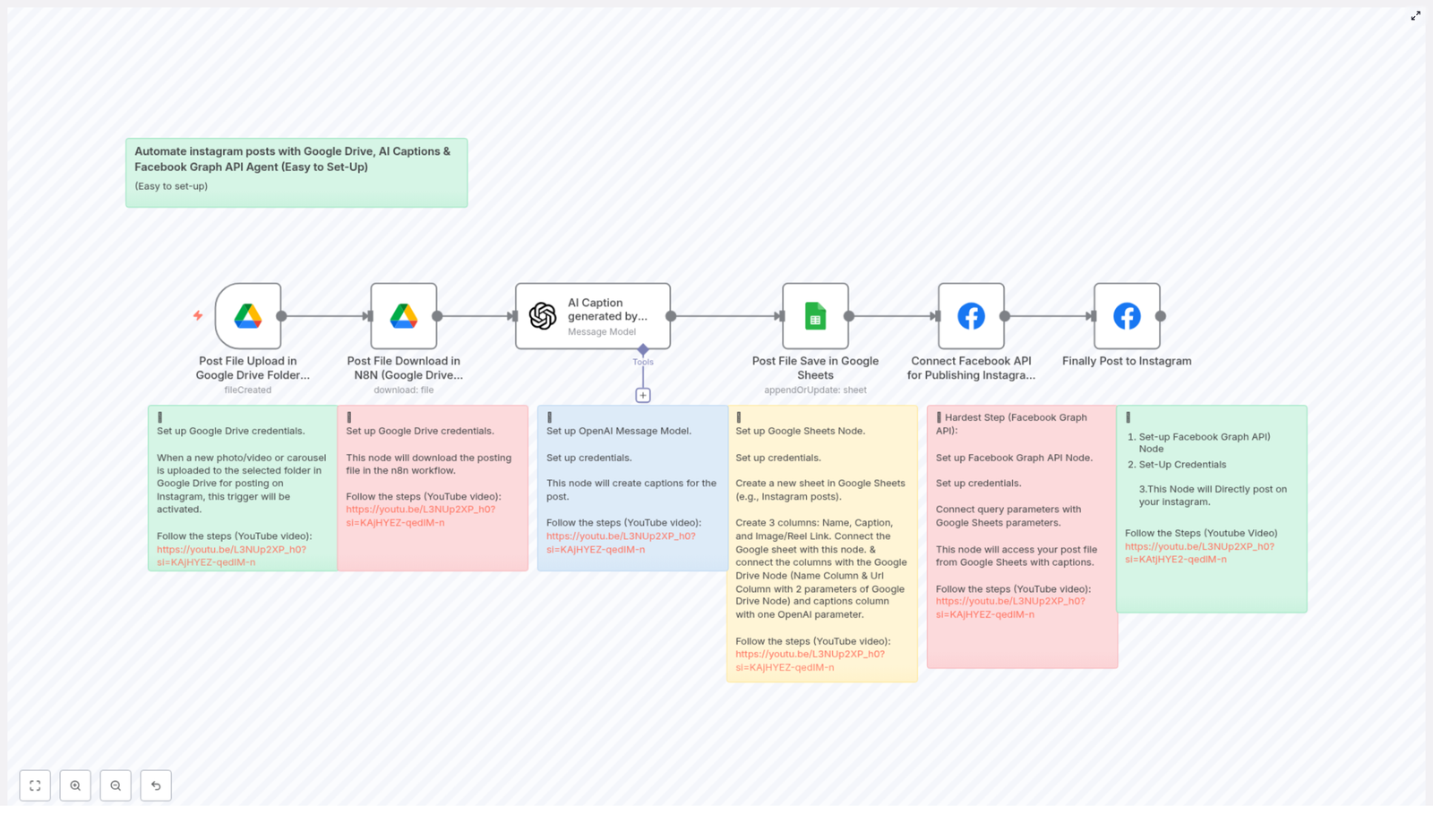
The workflow uses a simple but robust architecture built around Google Drive as the content intake point. The high-level flow is:

  1. Ingestion: A Google Drive Trigger watches a specific folder for new media files.
  2. Media retrieval: The file is downloaded into the n8n runtime using the Google Drive node.
  3. Caption generation: OpenAI generates an Instagram-ready caption based on the file context.
  4. Bookkeeping: Google Sheets stores metadata such as file name, caption, and URLs.
  5. Media creation: The Facebook Graph API creates an Instagram media container for the image or video.
  6. Publishing: The created media is published to Instagram using the media_publish endpoint.

The following sections walk through each part of this pipeline in detail and describe how to configure the corresponding n8n nodes.

Core workflow in n8n

1. Triggering on new assets in Google Drive

Google Drive Trigger (fileCreated)

The workflow begins with a Google Drive Trigger configured to respond to the fileCreated event. This trigger monitors a specific folder that your team uses as a “drop zone” for Instagram-ready images and videos.

Key configuration points:

  • Select the relevant folder that will receive uploads from creators or stakeholders.
  • Define a polling interval, for example every minute, or adjust according to your operational needs.
  • Use an OAuth credential in n8n that has read access to the target folder.

When a new file is detected, the trigger emits the file metadata, including the file id, which downstream nodes will use to fetch the actual media.

2. Downloading media from Google Drive

Google Drive (download file)

Next, a standard Google Drive node downloads the media file referenced by the trigger. Configure this node to:

  • Use the file id from the trigger output as the input parameter.
  • Store the binary data of the image or video in the n8n execution.
  • Optionally capture Google Drive links such as webViewLink and thumbnailLink for logging and reporting.

This step ensures the media is available to both the AI caption node and the Facebook Graph API node, and also preserves useful links for your Google Sheets log.

3. Generating AI captions with OpenAI

OpenAI (caption generation)

To standardize and accelerate caption creation, the workflow uses OpenAI to generate an Instagram caption. In n8n, you can use either a message model or a text completion style node, depending on your OpenAI configuration.

Typical prompt design can include instructions such as:

  • Write 2-3 concise, engaging sentences, optionally including emojis.
  • Add 3-5 relevant hashtags aligned with the content.
  • Include a clear call to action, for example “Follow for more” or “Save this post”.
  • Keep the total length under a defined character limit, for instance 150 characters.

You can pass the file name and any short description or campaign context as variables into the prompt. Store the model output in the node’s JSON payload so it can be:

  • Written to Google Sheets as part of your content log.
  • Used directly as the caption parameter when creating the Instagram media object.

4. Logging content in Google Sheets

Google Sheets (append or update)

Google Sheets serves as a lightweight content database and audit trail. Configure a Google Sheets node to append or update a row for each processed file.

Recommended columns include:

  • Name – original file name or post identifier
  • Caption – AI generated or final approved caption
  • Reel Urls – links to the published Instagram media or related resources
  • Reel Thumbnail – thumbnail URL or Drive thumbnailLink
  • Optional fields such as publish date, status, or reviewer

Ensure the Google Sheets credential in n8n has edit access to the spreadsheet. Over time, this log becomes invaluable for tracking what was posted, when it was published, and which captions were used.

5. Creating Instagram media containers

Facebook Graph API (media creation)

With the media and caption ready, the next step is to create an Instagram media container using the Facebook Graph API. In n8n, configure a Facebook Graph API node to call the appropriate /media edge.

Key considerations:

  • For reels or video posts, use the graph-video host such as https://graph-video.facebook.com.
  • Provide parameters like:
    • video_url for video assets or image_url for images
    • caption using the AI generated text
    • image_url for a thumbnail if applicable
  • Authenticate with a valid access token associated with your Instagram Business or Creator account that is linked to a Facebook Page.

The response from this call includes a creation_id, which is required to publish the media in the next step.

6. Publishing the media to Instagram

Facebook Graph API (media_publish)

The final operational step is to publish the created container. Configure a second Facebook Graph API node to call the media_publish endpoint.

Configuration details:

  • Use the same authenticated account and token as the media creation node.
  • Pass the creation_id returned from the previous step as a parameter.
  • Use a POST request to initiate publishing.

On success, the media is live on Instagram and you can optionally capture the returned post id or permalink and write it back into Google Sheets for full traceability.

Prerequisites, setup checklist, and permissions

Before running this workflow in production, verify that all required services and permissions are in place:

  • Google Drive: OAuth credential in n8n with read access to the upload folder.
  • OpenAI: Valid API key or message model credentials configured in n8n.
  • Google Sheets: OAuth credential with edit access to the target spreadsheet.
  • Facebook Graph API:
    • Instagram Business or Creator account connected to a Facebook Page.
    • Long lived Page access token or app token with appropriate publish permissions.
  • n8n instance: Properly secured, with credentials stored using n8n’s credential management and access restricted to authorized users.

Operational best practices for a robust workflow

Validate inputs before publishing

To avoid failed posts and API errors, validate media files early in the workflow. Typical checks include:

  • File size within Instagram limits
  • Supported file types (image or video formats)
  • Aspect ratio and resolution within Instagram’s accepted ranges

If a file does not meet requirements, you can either route it to a resizing step or notify the uploader instead of attempting to publish.

Handle rate limits and errors gracefully

The Facebook Graph API enforces rate limits and can return transient errors. In n8n, implement:

  • Retry logic for HTTP 429 and similar responses
  • Exponential backoff or delays between retries
  • Error logging to Google Sheets or a monitoring channel for quick diagnosis

Capturing error messages from the Graph API responses helps you identify issues such as unsupported media, invalid parameters, or permission problems.

Control caption quality with approvals

While AI captions can significantly speed up publishing, some teams require editorial review. You can introduce a human-in-the-loop step by:

  • Writing AI generated captions to Google Sheets with a status column.
  • Requiring a human reviewer to mark a “Ready” or “Approved” flag.
  • Conditionally executing the Facebook Graph API nodes only when the flag is set.

This hybrid model keeps the benefits of automation while maintaining brand voice and compliance.

Secure credentials and access

Security is critical in production automations. Follow these practices:

  • Never store API tokens or secrets in plain text within workflow nodes.
  • Use n8n’s credential store and environment variables for all sensitive data.
  • Rotate Facebook and OpenAI keys periodically and restrict scopes to the minimum required.
  • Limit access to the n8n instance and workflow configuration to trusted users only.

Troubleshooting common issues

  • Missing media errors: Confirm that the file id from the Google Drive Trigger is correctly passed to the download node and that the download completes successfully.
  • Caption not appearing: Inspect the OpenAI node output and verify that your subsequent nodes reference the correct JSON path, for example $json.choices[0].message.content or the direct output field used by your model.
  • Facebook Graph API authentication failures: Check that your access token is valid, not expired, and has the necessary permissions. Ensure the Instagram Business account is correctly linked to a Facebook Page.
  • Publishing failures: Review the Graph API response for user friendly error messages, such as unsupported formats, caption length limits, or invalid URLs, then adjust your media or parameters accordingly.

Advanced enhancements and scaling ideas

Once the basic workflow is stable, you can extend it to support more sophisticated content operations:

  • Scheduled publishing: Insert a scheduler or wait node that holds the media until a specified publish timestamp, enabling planned content calendars.
  • Automated image processing: Integrate an image processing node or external service to generate thumbnails, apply branding, or resize assets to Instagram’s recommended dimensions before upload.
  • Multi account support: Maintain a mapping table in Google Sheets that links specific Google Drive folders to corresponding Instagram accounts and tokens, allowing a single workflow to manage multiple brands.

Conclusion and next steps

This n8n workflow provides a structured, scalable pipeline for Instagram publishing. Google Drive serves as the intake layer, OpenAI automates caption generation, Google Sheets maintains an auditable record, and the Facebook Graph API handles the final publishing step.

With the right credentials, input validation, and error handling, this pattern works well for individual creators, agencies, and larger marketing teams that need predictable and repeatable content operations.

To adopt this in your environment, start with a test setup: use a dedicated Drive folder, small sample files, and a test Instagram Business account to validate the end to end behavior before moving to production.

Call to action: If you want a ready to import n8n workflow and a one page setup checklist, click the link below or share your email to receive the workflow ZIP and a step by step video guide.

n8n: Sync Contacts to Autopilot (Step-by-Step)

n8n: Sync Contacts to Autopilot (Step-by-Step)

Consistent, automated contact synchronization is essential for accurate reporting, effective segmentation, and reliable campaign execution. This guide explains how to implement an n8n workflow that interacts with the Autopilot API to create a list, upsert contacts, enrich them with additional properties, and retrieve the resulting contact set for inspection or downstream processing.

The workflow uses native Autopilot nodes in n8n and is designed for automation professionals who want a reusable pattern for syncing leads from any source, such as CRMs, form tools, or custom applications.

Why integrate Autopilot with n8n?

Autopilot is a marketing automation platform that manages customer journeys, email campaigns, and engagement workflows. n8n is an open source workflow automation tool that connects APIs and systems with minimal custom code. Combining the two provides a flexible integration layer between Autopilot and your broader data ecosystem.

Key advantages of automating Autopilot operations with n8n include:

  • Automated list management – Create and maintain Autopilot lists programmatically, aligned with campaigns or segments.
  • Reliable upsert behavior – Ensure contacts are created or updated as needed, without duplicates, using Autopilot’s upsert capability.
  • Centralized observability – Use n8n for logging, monitoring, and error handling across all integrations touching Autopilot.
  • Reusable integration patterns – Standardize one workflow and reuse it across teams, brands, or environments with minimal changes.

Use case overview

The example workflow is tailored for scenarios such as onboarding new leads from an external system, validating the resulting list in Autopilot, and enriching contact data. Typical sources include:

  • Web forms or landing page tools
  • CRMs and sales platforms
  • Spreadsheets or CSV imports
  • Custom applications via webhooks or APIs

At a high level, the workflow performs four core operations in sequence:

  1. Create a new list in Autopilot.
  2. Upsert a contact into that list.
  3. Upsert the same or another contact with an additional Company property.
  4. Retrieve all contacts that belong to the created list.

This pattern can be extended for production use cases, such as campaign-specific lists, periodic syncs from a CRM, or migration projects.

Workflow architecture in n8n

The workflow is built entirely with Autopilot nodes, each configured for a specific resource and operation. Below is a simplified JSON representation of the node configuration to illustrate the structure:

{  "nodes": [  {  "name": "Autopilot",  "type": "autopilot",  "parameters": {  "resource": "list",  "operation": "create"  }  },  {  "name": "Autopilot1",  "type": "autopilot",  "parameters": {  "resource": "contact",  "operation": "upsert",  "additionalFields": {  "autopilotList": "={{$json[\"list_id\"]}}"  }  }  },  {  "name": "Autopilot2",  "type": "autopilot",  "parameters": {  "resource": "contact",  "operation": "upsert",  "additionalFields": {  "Company": "n8n"  }  }  },  {  "name": "Autopilot3",  "type": "autopilot",  "parameters": {  "resource": "contactList",  "operation": "getAll",  "listId": "={{$node[\"Autopilot\"].json[\"list_id\"]}}"  }  }  ]
}

This JSON is illustrative. In practice, you configure each node through the n8n UI, including credentials, parameters, and expressions.

Preparation: Configure Autopilot credentials in n8n

Before assembling the workflow, configure secure access to Autopilot:

  • Navigate to Settings → Credentials in n8n.
  • Create a new credential of type Autopilot API.
  • Provide your Autopilot API key and any additional required account details.
  • Use the built-in test option to verify that n8n can successfully authenticate against Autopilot.

Ensure that the same Autopilot credential is selected on every Autopilot node you add to the workflow.

Building the workflow in n8n

1. Create a list in Autopilot

Start by adding the first Autopilot node that will provision a new list:

  • Resource: list
  • Operation: create
  • Fields: specify a list name and optionally a description that reflects its purpose (for example, “New Leads – Website”).

When executed, this node returns a list object that includes a list_id field. This identifier is critical because it is referenced by subsequent nodes. Within n8n expressions, the list identifier is typically accessed using:

{{ $json["list_id"] }}

or, if referenced from another node:

{{$node["Autopilot"].json["list_id"]}}

2. Upsert a contact into the created list

Next, add a second Autopilot node to handle contact upserts. This node is responsible for creating a new contact or updating an existing one based on the email address.

Configure the node as follows:

  • Resource: contact
  • Operation: upsert
  • Email: map from your incoming data (for example, from a previous node such as a webhook or CRM) or define an expression.
  • Additional Fields:
    • autopilotList: reference the list created in step 1 using an expression such as:
      {{$json["list_id"]}}

      or, more explicitly:

      {{$node["Autopilot"].json["list_id"]}}

If your source data includes other attributes, map them into the node’s fields, for example FirstName, LastName, and any custom properties that your Autopilot account supports. This ensures the upsert operation enriches the contact record from the outset.

3. Upsert a contact with additional properties (Company)

The third node demonstrates how to perform another upsert while adding or updating a specific property, in this case the Company field. This is useful for data enrichment or when you want to maintain separate steps for basic creation and subsequent enhancement.

Configure the third Autopilot node as follows:

  • Resource: contact
  • Operation: upsert
  • Email: you can reuse the email parameter from the previous node with an expression such as:
    email: ={{$node["Autopilot1"].parameter["email"]}}
  • Additional Fields:
    • Company: set a static value like n8n or map from a field in your incoming data.

This step illustrates how to chain updates and maintain consistent identifiers across nodes using expressions, which is a common pattern in more complex n8n automations.

4. Retrieve all contacts from the Autopilot list

The final node in the workflow reads back the contents of the list so you can validate the outcome or pass the data to other systems.

Add a fourth Autopilot node and configure it as follows:

  • Resource: contactList
  • Operation: getAll
  • listId: reference the list from the first node:
    listId: ={{$node["Autopilot"].json["list_id"]}}
  • Return All: enable this option if you want to retrieve every contact in the list instead of limiting the number of results.

The resulting contact data can then be forwarded to logging nodes, databases, BI tools, or notification channels for reporting and monitoring.

Best practices for robust n8n – Autopilot workflows

Expression management and data references

  • Use the n8n expression editor to construct references to previous node outputs. Referencing $node["NodeName"].json is generally more explicit and reliable than relying on the current item context when a workflow grows.
  • Inspect node outputs using the execution panel to confirm the exact JSON structure and property names before finalizing expressions.

Contact identity and data quality

  • Ensure the Email field is always present and validated before calling the Autopilot upsert operation. Autopilot relies on email as the unique identifier for contacts.
  • Implement validation steps or use an external API to verify email format or enrich data before writing to Autopilot.

Rate limiting and performance

  • Review Autopilot API rate limits and design your workflow accordingly, especially if you are processing large datasets or running frequent syncs.
  • Use batching or add delay nodes in n8n when necessary to avoid hitting rate limits.

Error handling and observability

  • Add a dedicated error handling branch or a Catch Error mechanism in n8n to capture and store failed records.
  • Use a Function node to normalize error payloads, then send structured error notifications to your preferred channel (for example, email, Slack, or a ticketing system).
  • Test each node individually using Execute Node before running the full workflow to isolate configuration issues early.

Common pitfalls and how to avoid them

  • Incorrect expressions: Using an expression like {{$node["Autopilot"].json["list_id"]}} in a node that does not have access to that context or where the path is incorrect will result in undefined. Always verify the actual JSON output and adjust the path accordingly.
  • Missing credentials: Every Autopilot node in the workflow must explicitly reference the correct Autopilot credential. If a node is left unconfigured or points to a different credential, API calls will fail.
  • Empty or invalid emails: Upsert operations may fail or create inconsistent records if the email field is missing, empty, or malformed. Implement validation before the upsert step.

Extending the workflow: advanced patterns

Once the core pattern is in place, you can extend it to support more advanced automation scenarios:

  • Dynamic list creation per campaign: Add a webhook or form submission node at the start of the workflow and create lists dynamically based on campaign identifiers or UTM parameters.
  • Data enrichment before upsert: Call external APIs for enrichment or validation (for example, geolocation, firmographic data, or email verification) before sending the final payload to Autopilot.
  • Journey orchestration: Trigger Autopilot journeys based on list membership or contact updates by invoking Autopilot triggers or configuring webhooks between the platforms.

Conclusion and next steps

Using n8n to integrate with Autopilot provides a controlled, scalable way to manage contact data and marketing lists. The workflow described here – create a list, upsert contacts, enrich records, and retrieve the final contact set – offers a solid foundation that can be adapted to lead capture, CRM synchronization, and migration projects.

To implement this in your environment, import or recreate the nodes in your n8n instance, attach your Autopilot credentials, and run the workflow against a test dataset. From there, refine field mappings to align with your CRM, form platform, or other lead source.

Call to action: Deploy this workflow in your n8n environment and tailor it to your stack. If you share your primary source system (for example, Google Sheets, Typeform, Salesforce), you can easily adapt the pattern to create a source-specific, production-ready flow.

Automate Twitch Clip Highlights with n8n

Automate Twitch Clip Highlights with n8n

Turn your Twitch streams into ready-to-use highlight scripts with a fully automated n8n workflow. In this guide you will learn how to:

  • Accept Twitch clip transcripts via a webhook
  • Split long transcripts into smaller chunks for better processing
  • Create semantic embeddings with Cohere
  • Store and search those embeddings in Weaviate
  • Use a Hugging Face chat model and n8n Agent to write highlight scripts
  • Log results to Google Sheets for review and reuse

By the end, you will have a working Twitch Clip Highlights Script workflow that connects n8n, Cohere, Weaviate, Hugging Face, and Google Sheets into a single automated pipeline.

Why automate Twitch clip highlights?

Reviewing clips manually is slow and inconsistent. Automated highlight generation helps you:

  • Find your best moments faster, without scrubbing through hours of VODs
  • Repurpose Twitch content for YouTube Shorts, TikTok, Instagram, and more
  • Maintain a consistent style and structure for highlight reels
  • Build a searchable archive of your stream’s key moments

This workflow uses:

  • n8n for orchestrating the entire process
  • Cohere embeddings to convert text into semantic vectors
  • Weaviate as a vector database for fast similarity search
  • Hugging Face chat model to generate human-readable highlight scripts
  • Google Sheets for simple logging and review

How the n8n Twitch highlights workflow works

Before we build it step by step, here is the high-level flow of the n8n template:

  1. Webhook receives clip data and transcript.
  2. Text Splitter breaks long transcripts into overlapping chunks.
  3. Cohere Embeddings converts each chunk into a vector.
  4. Weaviate Insert stores vectors plus metadata in a vector index.
  5. Weaviate Query retrieves the most relevant chunks for a highlight request.
  6. Tool + Agent passes those chunks to a Hugging Face Chat model.
  7. Agent produces a concise, readable highlight script.
  8. Google Sheets logs the script, metadata, and timestamps for later use.

Next, we will walk through each part of this workflow in n8n and configure it step by step.

Step-by-step: Build the Twitch Clip Highlights Script workflow in n8n

Step 1 – Create the Webhook endpoint

The Webhook node is your workflow’s entry point. It receives clip data from your clip exporter or transcription service.

  1. In n8n, add a Webhook node.
  2. Set the HTTP Method to POST.
  3. Set the Path to twitch_clip_highlights_script.

This endpoint should receive JSON payloads that include at least:

  • clip_id – unique ID of the clip
  • streamer – streamer or channel name
  • timestamp – when the clip occurred
  • transcript – full transcript text of the clip

You can adapt the field names later in your node mappings, as long as the structure is consistent.

Example webhook payload

{  "clip_id": "abc123",  "streamer": "GamerXYZ",  "timestamp": "2025-09-28T20:45:00Z",  "transcript": "This is the full transcript of the clip..."
}

Use this sample payload to test your Webhook node while you build the rest of the workflow.

Step 2 – Split long transcripts into chunks

Long transcripts are harder to embed and can exceed token limits for language models. Splitting them into overlapping chunks improves both embedding quality and downstream summarization.

  1. Add a Text Splitter node after the Webhook.
  2. Set the Chunk Size to something like 400 characters.
  3. Set the Chunk Overlap to around 40 characters.

These values are a good starting point for spoken transcripts. The overlap keeps context flowing between chunks so that important details are not lost at chunk boundaries.

Tip: For most Twitch clips, 300-500 characters per chunk with a small overlap works well. If you notice that the model misses context, try increasing the overlap slightly.

Step 3 – Generate embeddings with Cohere

Next, you will turn each transcript chunk into a numeric vector using Cohere embeddings. These vectors capture semantic meaning and are what Weaviate will use for similarity search.

  1. In n8n, configure your Cohere credentials under Settings > API credentials.
  2. Add an Embeddings node after the Text Splitter.
  3. Select Cohere as the provider.
  4. Choose a stable model. The template uses the default model.
  5. Map the chunk text from the Text Splitter as the input to the Embeddings node.

The Embeddings node will output a numeric vector for each chunk. You will store these vectors, along with metadata, in Weaviate.

Best practice: When processing many clips, batch embedding requests to reduce API calls and cost. n8n can help you group items and send them in batches.

Step 4 – Store vectors and metadata in Weaviate

Weaviate is your vector database. It stores both the embeddings and important metadata so you can later search for relevant moments and still know which clip and timestamp they came from.

  1. Add a Weaviate Insert node after the Embeddings node.
  2. Set indexName (or class name) to twitch_clip_highlights_script.
  3. Map the embedding vector output from the Embeddings node.
  4. Include metadata fields such as:
    • clip_id
    • streamer
    • timestamp
    • A short text excerpt or full chunk text
    • Optional: source URL or VOD link

Persisting metadata is crucial. With clip_id, streamer, timestamp, and source URL stored, you can:

  • Quickly retrieve the exact segment you need
  • Deduplicate clips
  • Filter results by streamer, date, tags, or language

Vector store tuning tip: Configure Weaviate with an appropriate similarity metric such as cosine similarity or dot product, and consider adding filters (for example tags, language, or streamer) to narrow down search results when querying.

Step 5 – Query Weaviate for highlight-worthy chunks

Once you have clips stored, you need a way to pull back the most relevant moments when you want to generate highlight scripts. This is where the Weaviate Query node comes in.

  1. Add a Weaviate Query node to your workflow for the retrieval phase.
  2. Provide a short query prompt or natural language question, such as:
    • “Find the funniest moments from yesterday’s stream”
    • “Moments where the streamer wins a match”
  3. Configure the node to return the top N matching chunks based on semantic similarity.

The Query node will return a ranked list of candidate chunks that best match your request. These chunks will be passed into the language model to create a coherent highlight script.

Step 6 – Use a Tool + Agent with a Hugging Face chat model

Now you have the right chunks, you need to turn them into a readable highlight script. n8n’s Tool and Agent pattern connects Weaviate results with a chat model from Hugging Face.

  1. Add a Chat node and select a Hugging Face chat model.
  2. Configure your Hugging Face API key in n8n credentials.
  3. Connect the Weaviate Query node as a tool that the Agent can call to retrieve relevant chunks.
  4. Add an Agent node:
    • Use the Chat node as the underlying model.
    • Design a prompt template that explains how to use the retrieved chunks to produce a highlight script.

Example agent prompt template

"Given the following transcript chunks, identify the top 3 moments suitable for a 30-60s highlight. For each moment provide: 1) Start/end timestamp 2) One-sentence summary 3) Two short lines that can be used as narration."

The Agent node will:

  • Assemble the final prompt using your template and the retrieved chunks
  • Call the Hugging Face chat model
  • Return a structured, human-friendly highlight description

You can optionally add a Memory node to keep buffer memory, which allows the Agent to maintain context across multiple turns or related highlight requests.

Step 7 – Log generated scripts to Google Sheets

To track your highlights and review them later, log every generated script to a Google Sheet.

  1. Add a Google Sheets node after the Agent.
  2. Set the operation to Append.
  3. Map fields such as:
    • Stream or streamer name
    • Clip ID or list of clip IDs used
    • The generated highlight script
    • Summary tags or keywords
    • Generation timestamp
    • Link to the original clip or VOD

This sheet becomes your simple dashboard for:

  • Quality review before publishing
  • Tracking which clips have already been used
  • Handing off scripts to editors or social media tools

Best practices for a reliable Twitch highlights pipeline

1. Choose sensible chunk sizes

  • Start with 300-500 characters per chunk.
  • Use a small overlap (for example 40 characters) to preserve context.
  • Increase overlap if the model seems to miss setup or punchlines that span chunk boundaries.

2. Store rich metadata in Weaviate

Always include:

  • clip_id
  • streamer
  • timestamp
  • Source URL or VOD link

This makes later filtering, deduplication, and manual review much easier.

3. Tune vector search and performance

  • Select a similarity metric like cosine or dot product that fits your Weaviate setup.
  • Store additional fields like language, tags, or game so you can filter queries.
  • Batch embedding calls to Cohere to reduce API costs.

4. Monitor rate limits and costs

  • Track usage for both Cohere and Hugging Face APIs.
  • Use smaller, cheaper models for routine summarization.
  • Reserve larger models for final polished scripts or special highlight reels.

5. Respect privacy and content rights

  • Only process clips you have permission to use.
  • Follow Twitch and platform policies when storing and distributing content.
  • Consider adding a moderation step for sensitive or inappropriate content.

Testing and validating your n8n workflow

Before you rely on this workflow for production, validate each part.

  1. Test the Webhook
    Send a single small payload (like the sample above) and watch the execution in n8n. Confirm that all nodes receive the expected data.
  2. Check embeddings in Weaviate
    After inserting vectors, run a few manual queries in Weaviate and verify that:
    • Embeddings are stored correctly
    • Metadata fields are present and accurate
    • Retrieved chunks are semantically relevant to your queries
  3. Review Agent outputs
    Inspect the Agent node’s output before auto-posting anywhere. If the scripts are not in your desired voice:
    • Refine the prompt template
    • Add examples of good highlight scripts
    • Adjust the number of chunks or context length

Troubleshooting common issues

  • Embeddings do not appear in Weaviate
    Check:
    • Weaviate credentials in n8n
    • Field mapping in the Insert node
    • That the embedding vector is correctly passed from the Embeddings node
  • Poor quality highlight scripts
    Try:
    • Adding more context or more top chunks from Weaviate
    • Increasing the token window for the chat model
    • Refining the Agent prompt with clearer instructions and examples
  • Empty or malformed webhook payloads
    This often comes from a misconfigured clip exporter. Add a temporary Google Sheets or logging node right after the Webhook to capture raw payloads and see what is actually arriving.

Scaling the workflow for multiple streamers

Once the basic pipeline works, you can extend it to handle more channels and more volume.

  • Multi-tenant indexing – Use a namespace or separate index per streamer in Weaviate.
  • API key management – Rotate Cohere and Hugging Face keys if you approach quotas.
  • Moderation step – Insert a moderation or classification node to flag sensitive content before generating or publishing scripts.
  • Downstream automation – Connect the generated scripts to:
    • Social platforms (YouTube, TikTok, Instagram)
    • Video editing APIs or tools that create short-form edits
    • Content management systems or scheduling tools

FAQ and quick recap

What does this n8n template automate?

It automates the flow from raw Twitch clip transcript to a ready-to-use highlight script. It handles ingestion, splitting, embedding, semantic search, script generation, and logging.

Which tools are used in the workflow?

  • n8n – workflow orchestration
  • Cohere – text embeddings
  • <

Build a Twitch Clip Highlights Script with n8n

Build a Twitch Clip Highlights Script with n8n

On a Tuesday night, somewhere between a clutch win in Valorant and a chaotic chat spam, Mia realized she had a problem.

Her Twitch channel was finally growing. She streamed four nights a week, her community was engaged, and clips were piling up. But every time she wanted to post a highlight reel on social, she lost hours scrolling through clips, rewatching moments, and trying to write catchy captions from memory.

By the time she finished, she was too exhausted to edit the next video. The content was there, but the workflow was broken.

That was the night she stumbled onto an n8n workflow template that promised something almost unbelievable: an automated Twitch clip highlights script powered by n8n, LangChain tools, Weaviate vector search, and an LLM that could actually write summaries and captions for her.

The pain of manual Twitch highlights

Mia’s problem was not unique. Like many streamers and content creators, she produced hours of content every week. The real struggle was not recording the content, it was turning that content into something reusable, searchable, and shareable.

Every week she faced the same issues:

  • Digging through dozens of Twitch clips to find memorable moments
  • Trying to remember timestamps and context from long streams
  • Manually writing short highlight scripts and social media captions
  • Keeping track of which clips had already been used, and which were still untouched

She knew that if she could automate even part of this process, she could post more consistently, experiment with new formats, and spend more time streaming instead of sorting through clips.

That is when she decided to build a Twitch clip highlights script workflow with n8n.

Discovering an automated highlight workflow

While searching for “n8n Twitch highlights automation,” Mia found a workflow template that looked almost like a map of her ideal system. The diagram showed a clear path:

Webhook → Text splitter → Embeddings → Vector store (Weaviate) → Agent / Chat LLM → Google Sheets log

Instead of Mia doing everything manually, each node in the n8n workflow would take over a piece of the job:

  • A webhook to receive clip data and transcripts
  • A text splitter to break long transcripts into chunks
  • Embeddings with Cohere to convert text into vectors
  • Weaviate as a vector store to make clips searchable
  • A query tool to find the most relevant chunks for a highlight
  • Memory and a chat LLM to generate highlight scripts and summaries
  • An agent to orchestrate tools and log results to Google Sheets

The idea was simple but powerful. Instead of Mia hunting for clips and writing everything herself, she would ask the system for something like “best hype moments this week” and let the workflow handle the heavy lifting.

Setting the stage in n8n

Mia opened n8n, imported the template, and started customizing it. The workflow was modular, so she could see exactly how each part connected. But to bring it to life, she had to walk through each step and wire it to her own Twitch clips.

1. The webhook that listens for new clips

The first scene in her new automation story was a webhook node.

She configured an n8n Webhook node with a path like:

/twitch_clip_highlights_script

This webhook would receive POST requests whenever a new clip was ready. The payload would include:

  • Clip ID
  • Clip URL
  • Timestamp or time range
  • Transcript text (from a separate transcription service)

Her clip ingestion system was set to send JSON data to this endpoint. Now, every time a clip was created and transcribed, n8n would quietly catch it in the background.

2. Splitting long transcripts into meaningful chunks

Some clips were short jokes, others captured multi-minute clutch plays with commentary. To make this text usable for semantic search, Mia needed to break it into smaller, overlapping chunks without losing context.

She added a Character Text Splitter node and used the recommended settings from the template:

  • Chunk size: 400 characters
  • Chunk overlap: 40 characters

This way, each chunk was long enough to understand the moment, but small enough for the embedding model to stay focused. The overlap helped preserve continuity between chunks so important phrases were not cut in awkward places.

3. Giving the clips a semantic fingerprint with Cohere embeddings

Next, Mia connected those chunks to a Cohere Embeddings node. This was where the text turned into something the vector database could search efficiently.

She selected a production-ready Cohere model, set up her API key in n8n credentials, and made sure each transcript chunk was sent to Cohere for embedding. Each chunk returned as a vector, a numeric representation of its meaning.

With embeddings in place, her future queries like “funny chat interactions” or “intense late-game plays” would actually make sense to the system.

4. Storing everything in Weaviate for later discovery

Now that each chunk had an embedding, Mia needed a place to store and search them. That is where Weaviate came in.

She added an Insert (Weaviate) node and created an index, for example:

twitch_clip_highlights_script

For each chunk, she stored:

  • Clip ID
  • Timestamp
  • Original text chunk
  • Clip URL
  • The generated embedding vector

This meant that any search result could always be traced back to the specific clip and moment where it came from. No more losing track of which highlight belonged to which VOD.

The turning point: asking the system for highlights

With the pipeline set up to ingest and store clips, Mia reached the real test. Could the workflow actually help her generate highlight scripts on demand?

5. Querying Weaviate for the best moments

She added a Query + Tool step that would talk to Weaviate. When she wanted to create a highlight reel, she would define a query like:

  • “Best hype moments from last night’s stream”
  • “Funny chat interactions”
  • “Clutch plays in the last 30 minutes”

The query node asked Weaviate for the top matching chunks, returning the most relevant segments ranked by semantic similarity. These chunks, along with their metadata, were then passed along to the agent and the LLM.

Instead of scrubbing through hours of footage, Mia could now ask a question and get back the most relevant transcript snippets in seconds.

6. Letting an agent and chat LLM write the script

The final piece was the storytelling engine: a combination of an Agent node and a Chat LLM.

In the template, the LLM was a Hugging Face chat model. Mia could swap in any compatible model she had access to, but the structure stayed the same. The agent was configured to:

  • Receive the highlight query, retrieved chunks, and clip metadata
  • Use the vector store tool to pull context as needed
  • Follow a clear prompt that requested a concise highlight script or caption
  • Return structured output with fields she could log and reuse

To keep the results predictable, she used a system prompt similar to this:

System: You are a Twitch highlights assistant. Given transcript chunks and clip metadata, return a JSON with title, short_summary (1-3 sentences), highlight_lines (3 lines max), key_moments (timestamps), and tags.
User: Here are the top transcript chunks: [chunks]. Clip URL: [url]. Clip timestamp: [timestamp]. Generate a highlight script and tags for social sharing.

The agent then produced a neat JSON object that looked something like:

  • title – a catchy headline for the moment
  • short_summary – 1 to 3 sentences summarizing the clip
  • highlight_lines – 3 lines of script or caption-ready text
  • key_moments – timestamps inside the clip
  • tags – keywords for search and social platforms

For the first time, Mia watched as her raw Twitch transcript turned into something that looked like a ready-to-post highlight script.

From chaos to organized content: logging in Google Sheets

Before this workflow, Mia’s clip notes were scattered across sticky notes, Discord messages, and half-finished spreadsheets. Now, every generated highlight flowed into a single organized log.

The final node in the workflow was a Google Sheets integration. After the agent produced the JSON result, n8n appended it as a new row in a sheet that contained:

  • Title
  • Clip URL
  • Timestamp or key moments
  • Short summary
  • Highlight lines
  • Tags

This sheet became her content brain. She could filter by tags like “funny,” “clutch,” or “community,” sort by date, and quickly assemble highlight compilations or social calendars.

And because the workflow was modular, she knew she could extend it later to:

  • Trigger a short video montage generator using timestamps
  • Auto-post captions to social platforms via their APIs
  • Send clips and scripts to an editor or Discord channel for review

Keeping the workflow reliable: best practices Mia followed

As the workflow started to prove itself, Mia wanted to make sure it would scale and stay safe. She adopted a few best practices built into the template’s guidance.

  • Securing credentials
    She stored API keys and secrets in n8n credentials, not in plain text, and restricted exposed endpoints. Where possible, she used OAuth or scoped keys.
  • Monitoring costs
    Since embeddings and LLM calls can add up, she monitored usage, batched jobs when testing large sets of clips, and tuned how often queries were run.
  • Adjusting chunk sizes
    For fast, dense dialogue, she experimented with slightly smaller chunk sizes and overlap to see what produced the most faithful summaries.
  • Persisting rich metadata
    She made sure clip IDs, original transcripts, and context like game title or chat snippets were stored along with vectors. That way, she could always reconstruct the full story behind each highlight.
  • Rate limiting webhook traffic
    To avoid sudden bursts overloading her pipeline, she applied rate limiting on webhook consumers when importing large historical clip batches.

Testing the workflow before going all in

Before trusting the system with her entire catalog, Mia started small. She fed a handful of clips into the pipeline and reviewed the results manually.

She checked:

  • Relevance – Did the retrieved chunks actually match the query, like “best hype moments” or “funny chat interactions”?
  • Context – Did the summaries respect the original timestamps and tone of the clip?
  • Shareability – Were the highlight scripts short, punchy, and ready for social posts?

When something felt off, she tweaked the workflow. That led her to a few common fixes.

How she handled common issues

Low-quality or vague summaries

When some early summaries felt generic, Mia tightened the prompt, increased the number of retrieved chunks, and tried a higher-capacity LLM model. She also leaned on a more structured prompt format to keep the output consistent.

Missing context in highlights

In clips where the humor depended heavily on chat or game situation, she noticed the LLM sometimes missed the joke. To fix this, she stored richer metadata with each vector, such as speaker labels, game titles, or relevant chat snippets. That extra context helped the agent produce more accurate summaries.

Staying compliant with user content

As her workflow grew, Mia kept an eye on platform rules and privacy. She made sure not to store personally identifiable information without permission and restricted access to her Google Sheets log. Only trusted collaborators could view or edit the data.

This kept her automation aligned with Twitch guidelines and good data hygiene practices.

Where Mia took it next

Once the core pipeline was stable, Mia started thinking bigger. The template she had used suggested several extensions, and she began experimenting with them:

  • Multi-language highlights for her growing non-English audience
  • Automated clip categorization into labels like “reaction,” “play,” or “funny,” using classifier models
  • Auto-generated thumbnails and social media images to match each highlight
  • A small dashboard where she could review, approve, and schedule highlights for publishing

Her Twitch channel had not magically doubled overnight, but her consistency did. She spent less time hunting for moments and more time creating them.

What this n8n Twitch highlights workflow really gives you

Mia’s story is what happens when you combine n8n, embeddings, a vector store, and an LLM into a single, repeatable pipeline.

The workflow she used follows a simple pattern:

Webhook → Text splitter → Embeddings → Weaviate → Agent / LLM → Google Sheets

In practice, that means:

  • Your Twitch clips become searchable by meaning, not just title
  • Every highlight is logged with title, timestamps, summaries, and tags
  • You get a reproducible, extensible system you can keep improving

Start your own Twitch highlights story

If you are sitting on hours of VODs and a backlog of clips, you do not need to build this from scratch. The workflow template that helped Mia is available for you to explore and adapt.

Here is how to get started:

  • Spin up a free n8n instance
  • Import the Twitch clip highlights workflow template
  • Connect your Cohere and Weaviate accounts
  • Point your transcription or clip ingestion system to the webhook
  • Run a few clips through the pipeline and iterate from there

If you want a guided setup or a custom version tailored to your channel, you can reach out for consulting and a step-by-step walkthrough. Contact us to get help tuning this Twitch clip highlights script to your exact needs.

Your next viral highlight might already be sitting in your VODs. With n8n, you can finally let your workflow catch up to your creativity.