Automate Emelia Reply Notifications with N8N Workflow

Automate Emelia Reply Notifications with an n8n Workflow

Overview

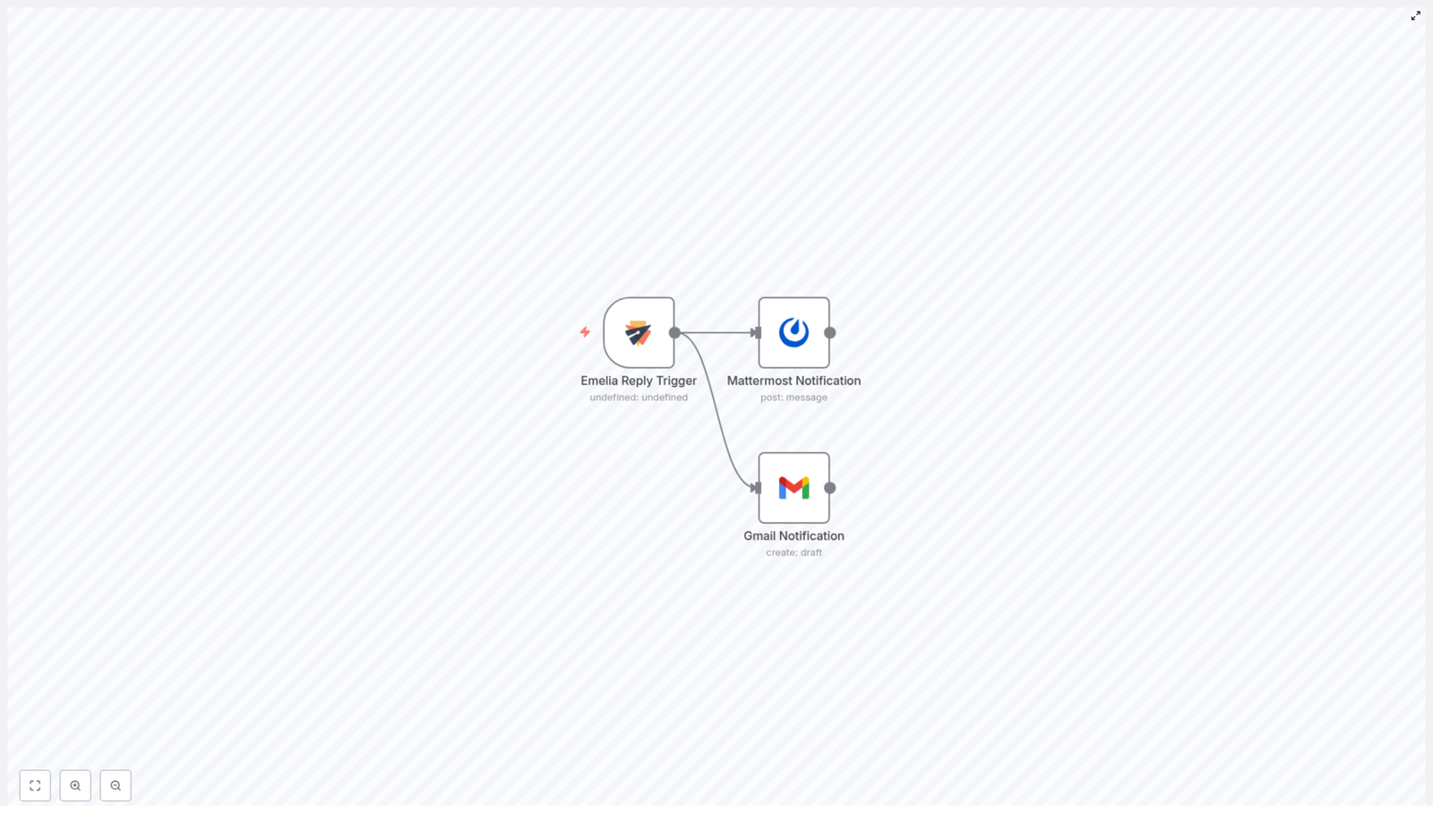
This guide describes a ready-to-use n8n workflow template that automatically sends notifications whenever a contact replies to an Emelia email campaign. The workflow connects Emelia with Mattermost and Gmail so that your team receives real-time alerts in chat and by email without manual monitoring of campaign replies.

The automation is built around an Emelia reply webhook trigger and two notification nodes, and is suitable for teams that already use Emelia for outbound campaigns and want reliable, low-latency reply tracking.

Architecture & Data Flow

At a high level, the workflow follows this event-driven pattern:

  1. Emelia Reply Trigger (Webhook)
    • Listens for replied events from a specific Emelia campaign.
    • Receives reply metadata, including contact details such as first name and company.
  2. Mattermost Notification
    • Posts a formatted message into a predefined Mattermost channel.
    • Uses dynamic fields from the trigger payload to personalize the message.
  3. Gmail Notification
    • Sends an email notification to an administrator or shared inbox.
    • Includes reply information so the email team can follow up quickly.

Once deployed, the workflow runs continuously in n8n. No polling is required, since Emelia pushes reply events directly to the n8n webhook URL.

Prerequisites

  • An active Emelia account with at least one email campaign configured.
  • An n8n instance (self-hosted or cloud) with access to the public internet.
  • A Mattermost workspace and channel where notifications will be posted.
  • A Gmail account (or Google Workspace account) for sending admin notifications.

For details on authentication and available parameters, refer to the official documentation:

Node-by-Node Breakdown

1. Emelia Reply Trigger Node

The Emelia reply trigger is implemented as a webhook endpoint in n8n that is called whenever a contact replies to a specific campaign. This node is responsible for:

  • Listening for replied events associated with a configured campaignId.
  • Extracting key fields from the incoming payload, such as:
    • Contact first name
    • Contact company
    • Any additional reply metadata provided by Emelia
  • Passing the structured data to downstream nodes in the workflow.

Key Configuration Parameters

  • Event Type: Set to a reply-related event, typically replied.
  • Campaign Identifier:
    • campaignId must match the campaign in Emelia that you want to monitor.
    • Only replies from this specific campaign will trigger the workflow.
  • Webhook URL:
    • Generated by n8n when you create the workflow.
    • Configured in Emelia so reply events are sent to this URL.

Behavior & Edge Considerations

  • If the campaignId does not match, no trigger will occur for that campaign’s replies.
  • If Emelia sends a reply event with missing optional fields (for example, company not set), those values may be empty in subsequent nodes. Template your messages to handle missing data gracefully.
  • Network or connectivity issues between Emelia and n8n can prevent the webhook from firing. Check your n8n logs and Emelia webhook configuration if no events are received.

2. Mattermost Notification Node

After the trigger fires, the next node posts a real-time notification into a chosen Mattermost channel. This ensures the team can see and act on replies without leaving their chat environment.

Core Responsibilities

  • Receive the data payload from the Emelia trigger node.
  • Compose a message that includes:
    • The contact’s first name.
    • The contact’s company.
    • Any other relevant reply context available from the trigger.
  • Send the message to a specific Mattermost channel using the configured credentials.

Essential Configuration

  • Mattermost Credentials:
    • Configured in n8n under credentials (for example, personal access token or bot account, depending on how your Mattermost integration is set up).
    • Must have permission to post messages to the target channel.
  • Channel:
    • Set the channel name or ID where notifications should appear.
    • Ensure the channel is accessible to the configured Mattermost user or bot.
  • Message Template:
    • Use n8n expressions to reference fields from the Emelia payload, such as:
      • {{$json["firstName"]}}
      • {{$json["company"]}}
    • Include a short description of the event, for example, that a contact replied to a specific campaign.

Error Handling Notes

  • If Mattermost credentials are invalid or permissions are insufficient, the node will fail and the message will not be posted.
  • Consider configuring workflow error handling or retries in n8n if you expect transient connectivity issues.
  • Message formatting should be robust to missing optional fields. For example, avoid relying on company if it is not always present.

3. Gmail Notification Node

In parallel with the Mattermost alert, the workflow also sends an email notification through Gmail. This is intended for administrators or an email operations team that prefers to track replies directly from their inbox.

Core Responsibilities

  • Build an email that summarizes the reply event.
  • Include dynamic data from the Emelia trigger, such as:
    • Contact name
    • Company
    • Any other reply details you choose to map
  • Send the email to a configured admin address using Gmail credentials.

Essential Configuration

  • Gmail Credentials:
    • Configured in n8n as a Gmail or Google account connection.
    • Must be authorized to send emails from the selected account.
  • Recipient Address:
    • Set to an admin email, shared inbox, or distribution list that should receive reply alerts.
  • Subject and Body Templates:
    • Use n8n expressions to insert data from the Emelia trigger, similar to the Mattermost node.
    • Example elements to include:
      • Campaign identifier
      • Contact first name and company
      • Short indication that the contact has replied

Behavior & Reliability

  • If Gmail rate limits or authentication issues occur, the node may fail and the admin email will not be sent.
  • Ensure that the sending account complies with your organization’s email policies to avoid deliverability issues.
  • For critical notifications, you can monitor n8n execution logs to confirm that emails are being sent as expected.

Configuration Notes

Connecting Emelia to n8n

  • In Emelia, configure the webhook or reply callback URL to point to the webhook URL generated by the Emelia reply trigger node in n8n.
  • Ensure the campaignId in your n8n workflow matches the campaign configured in Emelia.
  • Test the connection by sending a test reply to the campaign and verifying that the workflow executes in n8n.

Securing Your Integrations

  • Store Emelia, Mattermost, and Gmail credentials securely using n8n’s built-in credentials manager.
  • Restrict access to the workflow and credentials to authorized users only.
  • Review permission scopes for each integration so that they are limited to what is required for notifications.

Advanced Customization Ideas

The base template focuses on a straightforward, three-node pipeline. You can extend it in n8n to fit more complex operational needs while preserving the original logic.

  • Additional Filters
    • Add conditional logic to handle replies differently based on contact attributes or campaign segments.
  • Enriched Notifications
    • Include more fields from the Emelia payload in Mattermost and Gmail messages to give your team more context.
  • Multi-channel Routing
    • While this template uses Mattermost and Gmail, you can easily add more nodes to push notifications to other systems supported by n8n.

Benefits of This n8n – Emelia Workflow

  • Efficiency
    • Automates reply tracking and removes the need to manually check Emelia for responses.
  • Real-time Team Alerts
    • Mattermost notifications keep your team informed the moment a contact replies.
  • Centralized Email Communication
    • Gmail notifications ensure that important replies are visible in the inboxes your team already uses.

Get Started

To implement this automation in your environment, import and configure the template in your n8n instance, then connect it to your Emelia campaign, Mattermost workspace, and Gmail account.

For in-depth configuration details and credential setup, consult the official documentation:

Once everything is in place, every reply to your Emelia campaign will automatically trigger the workflow, send a Mattermost message, and dispatch a Gmail notification so your team never misses a response.
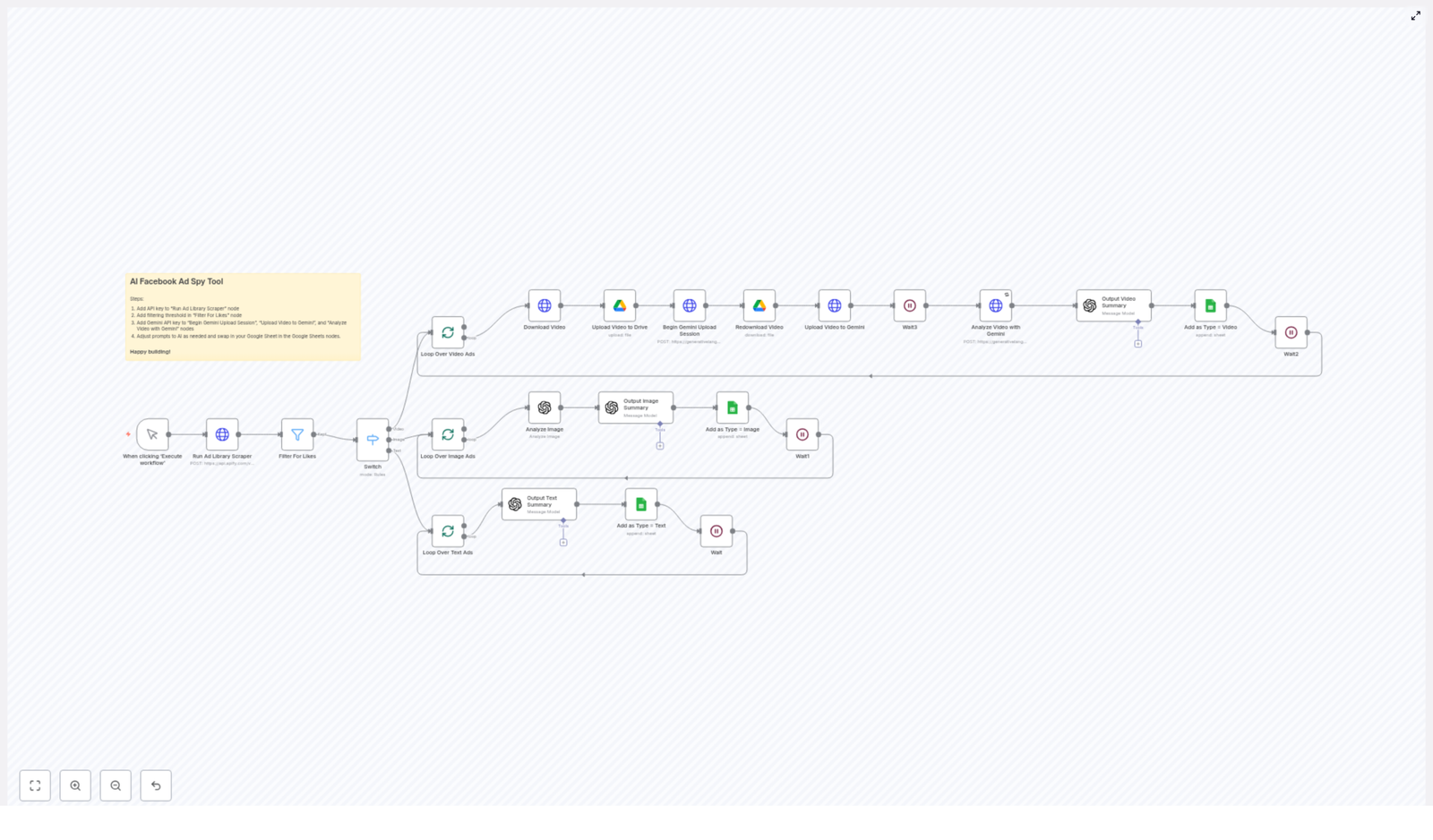
AI Facebook Ad Spy Tool: How to Automate Facebook Ad Analysis

AI Facebook Ad Spy Tool: How to Automate Facebook Ad Analysis in n8n

What You Will Learn

In this tutorial-style guide, you will learn how to use an AI-powered Facebook Ad Spy Tool built on n8n to automatically:

  • Scrape active Facebook ads with the Apify Facebook Ad Library Scraper
  • Filter ads by page popularity to focus on strong competitors
  • Analyze video, image, and text creatives with Google Gemini and OpenAI models
  • Summarize and rewrite ad copy for strategic insights
  • Store all results in Google Sheets for easy tracking and comparison

By the end, you will understand how each part of the workflow works, how the branches for different media types are structured, and how to customize the template for your own ad research.

Concept Overview: How the Automation Works

The workflow is an end-to-end automation pipeline that turns raw Facebook ads into structured insights using n8n. It connects several tools and services:

  • Apify Facebook Ad Library Scraper to collect active ads
  • Google Gemini to deeply analyze video content
  • OpenAI GPT-4.1 and GPT-4o to summarize and rewrite ad copy and image descriptions
  • Google Drive for stable video hosting during analysis
  • Google Sheets as a central database for all processed ads

The workflow runs in several stages:

  1. Trigger & scraping of Facebook ads
  2. Filtering by page popularity (likes)
  3. Routing ads based on media type (video, image, text-only)
  4. Separate processing paths for each media type with AI analysis
  5. Saving structured outputs into Google Sheets
  6. Applying wait nodes to respect API rate limits

Step 1 – Triggering the Workflow and Scraping Ads

1.1 Starting the Workflow

The workflow can be started either:

  • Manually from the n8n editor, or
  • Programmatically through an n8n trigger or external call

Once triggered, the first key node is the “Run Ad Library Scraper” node that connects to Apify.

1.2 Running the Apify Facebook Ad Library Scraper

The “Run Ad Library Scraper” node sends an API request to Apify to fetch active Facebook ads that match your criteria. In the template, it is configured to:

  • Search for ads containing the keyword phrase “ai automation”
  • Limit the number of ads to up to 200
  • Filter by country and date as set in the node parameters

This gives you a batch of current ads related to AI automation that you can then analyze in detail.

Step 2 – Filtering Ads by Page Popularity

Not all ads are equally valuable for competitive research. To focus on more influential advertisers, the workflow includes a filtering step.

2.1 Using the Likes Threshold

After scraping, the ads pass through a node that checks the number of page likes for each advertiser. The template uses a condition such as:

  • Include only ads from pages with more than 1000 likes

This helps you concentrate on brands that already have some traction, which usually means more polished and better-tested ad creatives.

Step 3 – Routing by Media Type in n8n

Once the relevant ads are filtered, the workflow needs to handle different creative formats differently. Video ads require a different analysis pipeline than image or text-only ads.

3.1 The Media Type Switch Node

A Switch node in n8n checks the media type of each ad creative and routes it into one of three branches:

  • Video ads branch
  • Image ads branch
  • Text-only ads branch

From this point, each branch has its own set of nodes tailored to that media type, but all of them eventually send structured results to Google Sheets.

Step 4 – Processing Video Ads with Gemini and GPT-4.1

Video ads carry a lot of information: visuals, motion, scenes, and sometimes voiceover or on-screen text. This branch uses Google Drive, Google Gemini, and OpenAI to extract and refine that information.

4.1 Downloading and Uploading the Video

For each video ad:

  • The workflow downloads the SD video file from the ad snapshot URL provided by the scraper.
  • The file is then uploaded to Google Drive. This creates a stable hosting location that can be used for further processing.

4.2 Preparing the Video for Gemini Analysis

To analyze the video content using Google Gemini, the workflow performs a few technical steps:

  • It starts a resumable upload session with Gemini so that the video can be uploaded reliably.
  • The video is re-downloaded from Google Drive to verify integrity before sending it to Gemini.
  • The verified video data is then uploaded to Gemini for analysis.

4.3 Getting a Detailed Video Description from Gemini

After the upload is complete, the workflow waits for Gemini to finish processing. Once done, Gemini returns an extremely detailed description of the video content, which may include:

  • Scenes and visual elements
  • On-screen text
  • Objects, people, and actions
  • Overall context and themes

4.4 Summarizing and Rewriting Video Ads with GPT-4.1

The next step is to combine:

  • The original scraper data for the ad, and
  • The Gemini video description

These are passed into an OpenAI GPT-4.1 node with a custom prompt. GPT-4.1 is used to:

  • Create a structured, human-readable summary of the ad
  • Generate a rewritten version of the ad copy that is optimized for strategic analysis and inspiration

4.5 Saving Video Ad Results to Google Sheets

The workflow then writes the processed data to a Google Sheet, including:

  • Ad summary
  • Rewritten ad copy
  • Video-related prompts or descriptions
  • Relevant metadata from the scraper
  • A label such as “Type = Video” for easy filtering

A short Wait node is included to pace requests and help you stay within API rate limits.

Step 5 – Processing Image Ads with GPT-4o and GPT-4.1

Image ads focus heavily on visual design and layout. This branch uses image analysis and text generation to understand and reframe these creatives.

5.1 Analyzing the Image with GPT-4o

For each image ad:

  • The workflow takes the image URL from the ad snapshot.
  • An AI model, such as GPT-4o, is used to analyze this image in detail.

The model produces a rich description that can include:

  • Visual elements, colors, and layout
  • Text shown in the image
  • Branding and design style
  • Overall message conveyed by the visuals

5.2 Creating a Summary and New Copy with GPT-4.1

The detailed image description, together with the original scraper data, is then sent to another GPT-4.1 node. This node is responsible for:

  • Producing a clear, structured summary of the ad
  • Generating a more engaging or “spirited” rewritten ad copy for strategic insight

5.3 Storing Image Ad Insights in Google Sheets

As in the video branch, the results are appended to your Google Sheets archive, including:

  • Summary
  • Rewritten copy
  • Image-related outputs
  • Metadata from the original ad
  • A classification such as “Type = Image”

A wait step is also included to maintain a safe pace and avoid hitting API limits.

Step 6 – Processing Text-Only Ads with GPT-4.1

Some ads contain only text, with no images or videos. These are handled in a simpler, more direct branch.

6.1 Sending Text Ads Directly to GPT-4.1

For text-only creatives:

  • The workflow takes the scraped text content from the ad.
  • This content is passed directly to a GPT-4.1 node.

The model is prompted to:

  • Summarize the core message of the ad
  • Rewrite the ad copy in a clear, strategic way

6.2 Logging Text Ad Results

The outputs are then stored in Google Sheets, similar to the other branches, with:

  • Summary
  • Rewritten text
  • Relevant metadata
  • A tag such as “Type = Text”

Wait nodes manage the cadence to stay within API quotas.

Step 7 – Configuration and Setup in n8n

To get this n8n template working in your own environment, you need to configure a few keys and IDs.

7.1 Connecting the Scraper (Apify)

  • Open the “Run Ad Library Scraper” node in n8n.
  • Add your Apify API key so the node can authenticate and perform scraping.
  • Adjust the search keyword, country, and date filters if needed.

7.2 Adjusting the Popularity Filter

  • Locate the “Filter For Likes” node.
  • Set your preferred likes threshold (for example, keep the “more than 1000 likes” condition or set a different value).

7.3 Setting Up Google Gemini for Video

  • In the nodes such as “Begin Gemini Upload Session”, “Upload Video to Gemini”, and “Analyze Video with Gemini”, enter your Gemini API keys.
  • Confirm that the project and region settings match your Google Cloud configuration.

7.4 Configuring OpenAI Prompts

  • Open each OpenAI node that uses GPT-4.1 or GPT-4o.
  • Insert your OpenAI API key if required by your n8n credentials setup.
  • Customize the prompt text to match your preferred tone, level of detail, or strategic focus.

7.5 Connecting Google Sheets

  • In the Google Sheets nodes, replace the default document ID and sheet ID with your own.
  • Confirm that the column mapping matches the fields you want to store, such as summary, rewritten copy, media type, and metadata.

7.6 Respecting API Rate Limits

  • Keep the built-in Wait nodes in place to avoid hitting rate limits for Apify, Gemini, OpenAI, or Google APIs.
  • If you increase the number of ads processed, consider extending the wait durations.

Why Use This AI Facebook Ad Spy Workflow

This automated system provides several practical benefits for marketers, agencies, and growth teams.

  • Time savings – It replaces manual competitor ad research with a repeatable n8n workflow.
  • High-quality insights – AI-generated summaries and rewrites help you quickly understand what competitors are testing.
  • Multi-media coverage – It handles video, image, and text ads using specialized AI models for each format.
  • Centralized intelligence – All processed ads are stored in a single Google Sheet that you can sort, filter, and reference later.

Quick Recap

Here is a short recap of how the AI Facebook Ad Spy Tool works in n8n:

  1. Trigger the workflow and run the Apify Facebook Ad Library Scraper.
  2. Filter ads by page likes to focus on stronger competitors.
  3. Use a Switch node to route ads by media type: video, image, or text-only.
  4. For video ads, download, upload to Google Drive, analyze with Gemini, then summarize and rewrite with GPT-4.1.
  5. For image ads, analyze the image URL with GPT-4o, then summarize and rewrite with GPT-4.1.
  6. For text-only ads, send the text directly to GPT-4.1 for summarization and rewriting.
  7. Store all outputs in Google Sheets with a clear “Type” label and use wait nodes to respect rate limits.

FAQ

Can I change the keyword from “ai automation” to something else?

Yes. In the “Run Ad Library Scraper” node, you can replace the keyword phrase with any term relevant to your niche or industry.

What if I want to track more than 200 ads?

You can increase the limit in the scraper configuration, but you may need to:

  • Extend the wait times between requests
  • Monitor your API quotas for Apify, Gemini, OpenAI, and Google services

Can I use a different storage system instead of Google Sheets?

The template is built around Google Sheets for simplicity, but in n8n you can easily swap or add other destinations, such as databases, Airtable, or CSV files, by adding or replacing nodes.

Is this tool only for agencies?

No. It is useful for anyone running Facebook ads, including solo marketers, in-house teams, and agencies that want a structured way to track competitor creatives and messaging.

Get Started With the Template

If you manage advertising strategy or run an agency, this AI Facebook Ad Spy Tool can significantly speed up your competitive research. Prepare your API keys, plug them into the nodes, customize the prompts and filters, and you will quickly start building a rich library of analyzed ads from your market.

Happy building and optimizing your digital ad intelligence!

AI Facebook Ad Spy Tool Explained: Automate Ad Analysis

AI Facebook Ad Spy Tool Explained: Automate Ad Analysis

The Marketer Who Was Tired Of Guessing

By the time Emma opened her laptop each morning, her competitors were already in her feed.

Emma ran a small but fast-growing performance marketing agency that specialized in AI tools and automation services. Her clients expected her to know which Facebook ads were working in their niche, what angles competitors were using, and which creatives were actually driving conversions.

She knew the answer was hidden in the Facebook Ad Library. The problem was time.

Every week she would:

  • Manually search the Facebook Ad Library for keywords like “ai automation”
  • Screenshot or copy-paste interesting ads into a Google Sheet
  • Try to categorize them by type: video, image, or text
  • Write her own summaries and insights for each ad

It was slow, repetitive, and easy to miss important patterns. Worse, she knew she was only scratching the surface. Hundreds of ads went unseen, and she had no systematic way to turn them into a real competitive intelligence database.

One evening, while browsing automation communities, she stumbled across something that made her stop scrolling.

A template called “AI Facebook Ad Spy Tool” built in n8n.

Discovering an Automated Ad Intelligence Engine

The description sounded almost too good to be true. An AI Facebook Ad Spy Tool that could scrape, analyze, and archive Facebook ads automatically, using:

  • The Facebook Ad Library API for data collection
  • Google Gemini and OpenAI GPT-4 models for analysis and rewriting
  • Google Sheets as a central database for ad intelligence

It promised exactly what Emma needed: a way to turn raw Facebook ads into structured, searchable insights without spending her entire week in the Ad Library.

Curious, she imported the n8n template into her workspace. That is when the story of her ad research workflow changed.

First Run: Watching The Workflow Come Alive

Emma started simple. She adjusted the template to focus on her favorite niche: AI automation tools in the US market. Then she hit the manual execute button in n8n.

That single click triggered the entire workflow.

The Trigger That Started It All

The workflow began with a manual execution trigger. No schedules yet, no fancy triggers, just a clean, controlled run so she could see what was happening at each step.

Immediately after execution, the first node kicked in: Run Ad Library Scraper.

Scraping Facebook Ads With Precision

The scraper used the Facebook Ads Library API to retrieve active ads that matched Emma’s criteria. In the example setup included in the template, it was configured to:

  • Search for ads containing the exact phrase “ai automation”
  • Limit results to the United States
  • Look back over the last 7 days
  • Fetch up to 200 ads
  • Include active statuses and detailed ad information

Within seconds, Emma watched n8n pull in a stream of ads that she would previously have spent hours trying to collect. But the workflow did not stop there.

Raising The Bar: Filtering And Sorting What Matters

Emma knew not all ads are created equal. Some come from brand new pages with no traction, others from established advertisers with real budgets behind them. The template had already thought of that.

Filtering For Credible Advertisers

The next node in the chain was called Filter For Likes. Its job was simple but powerful: only allow ads from pages with more than a certain number of likes to pass through.

By default, the template used a threshold of 1000 likes. That meant Emma would only analyze ads from pages with a real audience and some level of credibility.

She realized she could adjust this number later if she wanted to tighten or relax the filter, but for now, the default made sense. Less noise, more signal.

Sorting Ads By Content Type

Once the weaker pages were filtered out, the remaining ads moved into a Switch node. This is where the workflow began to feel truly intelligent.

The Switch node categorized each ad into one of three main types:

  • Video Ads
  • Image Ads
  • Text Ads

Each category followed its own tailored analysis path, optimized for that specific media type. Emma liked that the workflow did not treat all ads the same. A video needed different handling than a text-only ad, and this template respected that.

The Turning Point: AI Takes Over The Heavy Lifting

As the workflow branched into its three paths, Emma watched in real time as AI models began transforming raw ad data into something far more valuable.

When Video Ads Became Structured Insights

Video ads were always Emma’s biggest headache. Downloading them, hosting them, and then trying to explain what was happening in each one was tedious. The template automated the entire chain.

For Video Ads, the workflow executed a series of steps:

  1. Download Video – The video URL from the Facebook Ad Library was downloaded locally using the Download Video node.
  2. Upload To Google Drive – The video file was uploaded to Google Drive, giving Emma a stable, shareable link for her team and clients.
  3. Prepare Gemini Upload Session – A Gemini API upload session was initiated. The video was then redownloaded and uploaded to the Google Gemini AI platform.
  4. Wait For Processing – The workflow included a short waiting period to give Gemini time to process the video.
  5. AI Video Analysis – Gemini analyzed the video content and produced a detailed description of what was happening, what objects were visible, and the overall context of the ad.
  6. Strategic Summary With GPT-4.1 – The video metadata and Gemini’s description were then passed to OpenAI’s GPT-4.1. GPT generated a comprehensive summary of the ad and rewrote the copy with a focus on strategic intelligence, positioning, and angles.
  7. Append To Google Sheets – All enriched data, including links, descriptions, summaries, and rewritten copy, was appended to a Google Sheet. This became Emma’s growing ad intelligence database.
  8. Rate Limit Handling – Waiting nodes were built into the workflow to avoid hitting API rate limits and to keep everything running smoothly.

For the first time, Emma could see complex video ads broken down into clean, searchable insights without watching each video herself.

Image Ads Turned Into Deep Visual Intelligence

Next, Emma followed the path for Image Ads. These were often the backbone of her clients’ campaigns, and she wanted to know exactly what competitors were doing visually.

The workflow handled image ads like this:

  1. Visual Analysis With GPT-4o – Each image was sent to GPT-4o, which excelled at extremely detailed object and context recognition. It could identify elements in the image, infer the mood, and understand the visual strategy.
  2. Strategic Rewrite With GPT-4.1 – The original ad details and GPT-4o’s visual analysis were combined and passed to GPT-4.1. GPT then summarized the ad and rewrote the copy, focusing on key hooks, offers, and angles.
  3. Store Results In Google Sheets – Just like with video ads, the final output was stored in Emma’s connected Google Sheet, building a structured archive of image ad intelligence.
  4. Wait Nodes For Pacing – Waiting nodes were included to space out API calls and prevent any rate limiting.

Instead of just glancing at screenshots, Emma now had AI-generated breakdowns of what each image was communicating and how it was positioned.

Text Ads, Simplified And Enriched

Finally, the workflow handled Text Ads, which were the simplest from a technical standpoint but still valuable for messaging research.

The path for text-only ads was straightforward yet powerful:

  1. Send To GPT-4.1 – The ad text was passed directly to GPT-4.1 for summarization and rewriting.
  2. Save To Google Sheets – The summarized and rewritten copy, along with original details, was added to the same Google Sheet database.
  3. Include Wait Times – The workflow used wait nodes to avoid hitting rate limits during bursts of processing.

Within one run, Emma had a unified, AI-enriched view of video, image, and text ads, all neatly stored in one place.

Customizing The Workflow To Match Her Agency

After seeing the first successful run, Emma realized the template was not just a fixed tool. It was a flexible framework she could adapt to her own processes and branding.

Adding Her Own API Keys

To move from testing to production, she updated the workflow with her own credentials:

  • Facebook Ads Library Scraper API key in the scraper node
  • Google Gemini API key for video analysis
  • OpenAI API key for GPT-4o and GPT-4.1 processing

Once these were in place, the workflow was fully connected to her own accounts and ready for regular use.

Tuning The Filters For Her Niche

The Filter For Likes node became one of her favorite levers. For broader market research, she kept the threshold at 1000 likes. For premium, high-budget campaigns, she experimented with higher thresholds to focus only on the biggest players.

By simply adjusting a number, she could control how strict the workflow was about which ads made it into her intelligence database.

Custom Prompts For On-Brand Insights

The real magic for Emma came from modifying the AI prompts in the OpenAI nodes. She tailored them so that GPT would:

  • Use her agency’s preferred tone and terminology
  • Highlight hooks, offers, and calls to action
  • Identify target audience and positioning
  • Suggest potential test angles for her own campaigns

This meant the summaries and rewrites were not generic. They felt like they were written by a strategist inside her own agency.

Connecting Her Own Google Sheets

Finally, she swapped out the example Google Sheet with her own document and custom sheet tabs. One tab for video ads, one for images, one for text, and another for high-performing patterns she wanted to track over time.

Every time the workflow ran, her sheets updated automatically, turning a static spreadsheet into a living intelligence system.

Life After Automation: The Benefits In Practice

Within a few weeks, Emma’s workflow looked completely different from the painful manual process she started with. The benefits of the AI Facebook Ad Spy Tool became obvious in her day-to-day work.

  • Automation of manual research – She no longer spent hours searching and copying ads. The workflow did the scraping, filtering, and analysis for her.
  • Unified analysis across media types – Video, image, and text ads were all processed within a single n8n workflow, each with its own optimized path.
  • Deep content understanding – State-of-the-art AI models like Google Gemini, GPT-4o, and GPT-4.1 provided rich descriptions, context, and strategic rewrites.
  • Centralized data in Google Sheets – All outputs were stored in one place, ready for reporting, dashboards, or further analysis.
  • Flexible, prompt-driven insights – By editing prompts, Emma could change the style, depth, and focus of the insights without touching the overall workflow logic.

Instead of guessing what competitors were doing, she had a structured, constantly updated view of the market. Her clients noticed the difference in her strategy decks and creative recommendations.

Putting The Template To Work In Your Own n8n Setup

Emma’s story is not unique. Any marketer, founder, or growth-focused team that relies on Facebook ads can use this same n8n template to build a competitive intelligence engine.

To get started in your own environment:

  1. Import the AI Facebook Ad Spy Tool template into n8n.
  2. Add your API keys for the Facebook Ads Library Scraper, Google Gemini, and OpenAI.
  3. Adjust the search keywords, country, and date range in the scraper node to match your niche.
  4. Set your preferred likes threshold in the Filter For Likes node.
  5. Customize the AI prompts in OpenAI nodes to match your tone and strategic needs.
  6. Connect your own Google Sheets document and define the sheet tabs where data should be stored.
  7. Manually execute the workflow for a first test run, then later schedule it if you want regular updates.

Resolution: From Guesswork To Systematic Ad Intelligence

What started as Emma’s frustration with manual research turned into a repeatable, automated system that powered real strategic decisions.

The AI Facebook Ad Spy Tool is more than a simple scraper. It is a sophisticated n8n workflow that:

  • Collects Facebook ads via the Ad Library API
  • Intelligently analyzes each ad by type using Google Gemini and GPT models
  • Rewrites and summarizes ad copy for fresh strategic insights
  • Logs all enriched data in Google Sheets for easy review and analytics

If you want to move from scattered screenshots to a structured competitive intelligence system, this template gives you a head start.

Deploy it in your n8n environment, plug in your keys, refine the prompts, and let automation handle the heavy lifting while you focus on strategy.

Datengetriebene SEO-Optimierung für effektive Content-Verbesserung

Datengetriebene SEO-Optimierung mit n8n: Schritt-für-Schritt zum automatisierten Content-Upgrade

Lernziele: Was du mit diesem n8n-Workflow erreichst

In diesem Artikel lernst du, wie ein n8n-Workflow zur datengetriebenen SEO-Optimierung aufgebaut ist und wie du ihn gezielt einsetzen kannst, um Inhalte systematisch zu verbessern. Nach der Lektüre weißt du:

  • wie der Workflow Artikel automatisch crawlt und Inhalte extrahiert,
  • wie Google Search Console Daten und BigQuery für SEO-Analysen genutzt werden,
  • wie OpenAI im Workflow für KI-gestützte Textoptimierung eingebunden ist,
  • wie Performance-Reports automatisch in Google Sheets erstellt und gespeichert werden,
  • welche Optimierungspotenziale du im Workflow noch ausschöpfen kannst.

Grundkonzept: Datengetriebene SEO mit n8n automatisieren

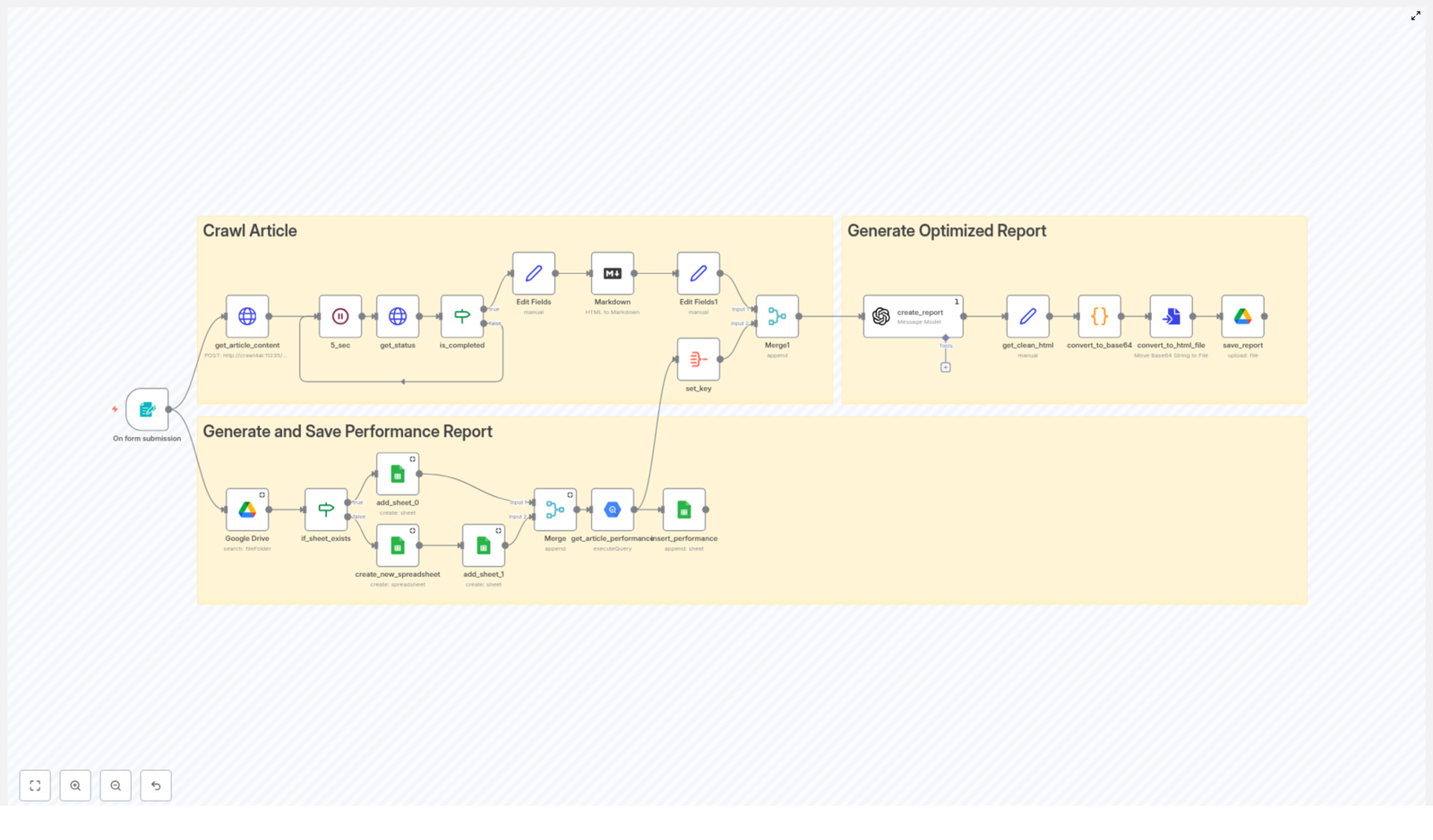
Der vorgestellte n8n-Workflow ist so aufgebaut, dass er den kompletten Prozess der Content-Optimierung abbildet. Er verbindet Crawling, SEO-Datenanalyse und KI-Textoptimierung in einem automatisierten Ablauf. Die drei Kernbereiche sind:

  • Crawl Article – Artikel automatisch abrufen und Inhalte in ein analysierbares Format bringen,
  • Generate Optimized Report – Inhalte mit Hilfe von OpenAI und Google Search Console Daten optimieren,
  • Generate and Save Performance Report – Performance-Daten über BigQuery abrufen und in Google Sheets speichern.

Der Workflow startet mit einer einfachen Formularabfrage, in der du die zu analysierende URL eingibst. Ab diesem Moment laufen alle weiteren Schritte automatisiert ab.

Schritt 1: Einstieg in den Workflow – URL per Formular erfassen

Am Anfang des n8n-Workflows steht ein Formular-Trigger. Dieser dient als Eingangspunkt für deine SEO-Analyse:

  • Du gibst die URL des Artikels ein, den du optimieren möchtest.
  • n8n nimmt diese URL entgegen und leitet sie an den nächsten Bereich des Workflows weiter.

Diese einfache Eingabe bildet die Grundlage für alle folgenden Schritte, da der gesamte Prozess auf dem konkreten Artikel aufbaut.

Schritt 2: Artikel-Crawling und Datenextraktion in n8n

Im Bereich Crawl Article kümmert sich der Workflow darum, den Inhalt der angegebenen Seite automatisiert zu erfassen und in ein geeignetes Format zu bringen.

2.1 Automatisiertes Crawlen der URL

Der Workflow ruft die eingegebene URL auf und:

  • crawlt den Artikel automatisch,
  • extrahiert den relevanten HTML-Content der Seite,
  • bereitet den Inhalt für weitere Verarbeitungsschritte vor.

2.2 HTML zu Markdown konvertieren

Damit der Inhalt besser analysiert und von der KI verarbeitet werden kann, wird der HTML-Text in Markdown umgewandelt. Das hat mehrere Vorteile:

  • Strukturierte Darstellung von Überschriften, Listen und Absätzen,
  • leichtere Weiterverarbeitung in KI-Modellen,
  • klare Trennung von Layout und Inhalt.

2.3 Statusabfragen und Wartelogik

Da Crawling und Konvertierung etwas Zeit benötigen können, baut der Workflow wiederholte Statusabfragen ein:

  • Der Workflow prüft, ob die Datenerfassung abgeschlossen ist.
  • Er wartet bei Bedarf und fragt den Status erneut ab.
  • Erst wenn die Daten vollständig vorliegen, geht es zum nächsten Schritt.

So wird sichergestellt, dass die nachfolgenden Analysen nur mit vollständigen und korrekt verarbeiteten Inhalten arbeiten.

Schritt 3: KI-gestützte SEO-Optimierung mit OpenAI und Search Console

Im zweiten Hauptbereich Generate Optimized Report nutzt der Workflow eine KI-Komponente (OpenAI), um aus den gesammelten Daten konkrete Optimierungsvorschläge zu erzeugen.

3.1 Kombination von Content und Performance-Daten

Die KI erhält zwei zentrale Informationsquellen:

  • den aktuellen Artikel in Markdown-Form,
  • Performance-Daten aus der Google Search Console, zum Beispiel:
    • Klicks,
    • Impressionen,
    • CTR (Click-Through-Rate),
    • Ranking-Positionen.

Durch diese Kombination kann die Optimierung wirklich datengetrieben erfolgen, da die KI nicht nur den Text, sondern auch das tatsächliche Nutzerverhalten berücksichtigt.

3.2 Welche Ergebnisse erzeugt die KI?

Auf Basis dieser Daten generiert die OpenAI-Komponente:

  • Optimierungsvorschläge für bestehende Textpassagen,
  • neue, verbesserte Titel für den Artikel,
  • optimierte Meta-Beschreibungen,
  • angepasste Textabschnitte, die besser auf Suchintention und Keywords eingehen.

So erhältst du konkrete Vorschläge, wie du:

  • die Klickrate (CTR) erhöhen,
  • die Sichtbarkeit verbessern,
  • und die Relevanz deines Contents für bestimmte Suchanfragen steigern kannst.

Schritt 4: Performance-Datenanalyse mit BigQuery

Um die Entwicklung deiner SEO-Performance besser zu verstehen, nutzt der Workflow im dritten Bereich Generate and Save Performance Report eine BigQuery-Abfrage.

4.1 Vergleich von Zeiträumen

Die BigQuery-Abfrage greift auf historische SEO-Daten zu und vergleicht zum Beispiel:

  • aktuelle 30-Tage-Perioden mit vorherigen 30 Tagen,
  • Entwicklung von Klicks, Impressionen und CTR über die Zeit,
  • Veränderungen bei wichtigen Keywords.

Dadurch erkennst du:

  • welche Keywords an Sichtbarkeit gewinnen,
  • wo Rankings stagnieren oder fallen,
  • wo Optimierung besonders dringend ist.

4.2 Keyword-Performance im Überblick

Ein Beispiel für ausgewertete Keywords könnte so aussehen:

Keyword Klicks Impressionen CTR Position Trend
SEO Optimierung 120 1500 8% 10 Gaining
Google Search Console Daten 90 1400 6.4% 12 Stable
Content Optimierung 75 1300 5.8% 15 Gaining
Keyword Tracking 50 1100 4.5% 20 Declining
CTR Analyse 40 900 4.4% 18 Gaining

Solche Tabellen helfen dir, Prioritäten bei der Optimierung zu setzen und gezielt an Keywords zu arbeiten, die viel Potenzial haben.

Schritt 5: Automatisierte Berichtserstellung in Google Sheets

Damit du die Ergebnisse deiner Analysen jederzeit im Blick hast, speichert der Workflow die Daten automatisch in Google Sheets.

5.1 Reports automatisch generieren

Auf Basis der BigQuery-Ergebnisse erstellt n8n einen Performance-Report und überträgt ihn nach Google Sheets. Das ermöglicht dir:

  • alle wichtigen Kennzahlen an einem zentralen Ort zu sammeln,
  • Verläufe und Trends über längere Zeiträume zu verfolgen,
  • Berichte einfach mit deinem Team zu teilen.

5.2 Entscheidungsgrundlage für langfristige SEO-Strategie

Da die Reports regelmäßig aktualisiert werden können, entsteht eine solide Datengrundlage für:

  • laufende SEO-Maßnahmen,
  • Content-Planung,
  • Priorisierung von Optimierungsprojekten.

Erweiterte Themen: Wie du mehr aus dem Workflow herausholst

Über die Basisfunktionen hinaus deckt der Workflow oder seine Erweiterungen weitere wichtige SEO-Aspekte ab.

Keyword-Tracking

Eine kontinuierliche Überwachung der Keyword-Performance hilft dir, schnell auf Veränderungen im Suchverhalten zu reagieren und Inhalte gezielt anzupassen. So erkennst du frühzeitig, wenn ein wichtiges Keyword an Sichtbarkeit verliert oder neue Chancen entstehen.

Suchintention verstehen

Daten sind nur ein Teil der Wahrheit. Erfolgreiche Optimierung berücksichtigt auch die Suchintention hinter den Anfragen. Der Workflow unterstützt dich dabei, Inhalte so anzupassen, dass sie die Erwartungen der Nutzer besser erfüllen und damit die Nutzererfahrung verbessern.

CTR-Optimierung

Durch die Analyse der Click-Through-Rate (CTR) kannst du gezielt Maßnahmen einleiten, etwa:

  • optimierte Titel,
  • ansprechendere Meta-Beschreibungen,
  • bessere Snippets in den Suchergebnissen.

Das Ziel ist, mehr Klicks aus bestehenden Impressionen zu generieren.

Datenintegration als Basis für Strategie

Die Verknüpfung von Google Search Console, BigQuery und Google Sheets schafft eine starke Grundlage für nachhaltige SEO-Strategien. Du kombinierst:

  • Rohdaten aus der Search Console,
  • skalierbare Analysen mit BigQuery,
  • übersichtliche Darstellung und Reporting in Google Sheets.

Automatisierung mit n8n

Durch automatisierte Workflows in n8n sparst du Zeit und erhöhst die Effizienz bei der datengetriebenen Content-Optimierung. Wiederkehrende Aufgaben wie Crawling, Reporting und Datensynchronisation laufen im Hintergrund, während du dich auf die Umsetzung der Optimierungsvorschläge konzentrierst.

Qualität sichern: Empfehlungen und Optimierungspotenziale im Workflow

Damit dein n8n-Workflow stabil und zuverlässig läuft, solltest du einige Punkte beachten und bei Bedarf optimieren.

Automatisierte SEO-Analyse sinnvoll nutzen

Die Kombination aus Crawling, Performance-Daten und KI ist eine sehr effektive Basis, um Artikel datengetrieben zu optimieren. Achte darauf, die generierten Vorschläge kritisch zu prüfen und an deinen individuellen Content-Stil anzupassen.

Fehlerhandling verbessern

Für einen robusten Betrieb empfiehlt es sich, das Fehlerhandling zu stärken:

  • Prüfe, ob beim Crawling Fehlermeldungen oder Zeitüberschreitungen auftreten können.
  • Plane adaptive Wiederholungen ein, wenn Anfragen scheitern.
  • Richte bei Bedarf Alerts ein, zum Beispiel per E-Mail oder Chat, wenn Teile des Workflows fehlschlagen.

Datenvalidierung sicherstellen

Damit die vorgeschlagenen Optimierungen verlässlich sind, müssen die zugrunde liegenden Daten korrekt sein:

  • Stelle sicher, dass die BigQuery-Daten aktuell sind.
  • Überprüfe, ob alle relevanten Properties der Google Search Console angebunden sind.
  • Vermeide veraltete oder unvollständige Datensätze, um falsche Schlüsse zu verhindern.

Skalierung und Mehrsprachigkeit

Wenn der Workflow erfolgreich läuft, kannst du ihn erweitern:

  • Skaliere auf mehrere URLs parallel, zum Beispiel für ganze Content-Cluster.
  • Ergänze Mehrsprachigkeit, um Inhalte in verschiedenen Sprachen automatisiert zu analysieren und zu optimieren.

Beispielhafte optimierte Textpassagen für deinen Content

Im Rahmen des Workflows können Textpassagen gezielt überarbeitet werden. Hier einige Beispiele, wie ursprüngliche Formulierungen optimiert werden können.

Einführung in datengetriebene SEO-Optimierung

Ursprüngliche Passage:
„Unser Workflow nutzt die Google Search Console Daten, um den Erfolg von Inhalten zu messen und darauf basierende Verbesserungen vorzuschlagen.“

Optimiert:
„Mit der datengetriebenen SEO-Optimierung analysieren wir umfangreiche Performance-Daten aus der Google Search Console, um gezielte Empfehlungen für eine bessere Klickrate und Sichtbarkeit zu geben.“

Artikel-Crawling und Datenextraktion

Ursprüngliche Passage:
„Der Artikel wird automatisch gecrawlt und der HTML-Inhalt in Markdown konvertiert.“

Optimiert:
„Durch automatisiertes Crawlen und präzise HTML-zu-Markdown-Konvertierung erfassen wir den vollständigen Artikelinhalt für eine tiefgehende SEO-Analyse und Optimierung.“

Performance-Datenanalyse mit BigQuery

Ursprüngliche Passage:
„Wir vergleichen aktuelle und vorherige 30-Tage-Perioden, um Trends und Veränderungen bei Keywords zu identifizieren.“

Optimiert:
„Mithilfe von BigQuery analysieren wir detailliert die Performance von Keywords über verschiedene Zeiträume, um steigende oder fallende Sichtbarkeit zu erkennen und entsprechende Optimierungen abzuleiten.“

Automatisierte Berichtserstellung

Ursprüngliche Passage:
„Google Sheets wird verwendet, um Berichte zu erstellen und zu speichern.“

Optimiert:
„Die Integration von Google Sheets ermöglicht das automatisierte Erstellen und Speichern von Performance-Berichten, welche jederzeit für die Auswertung und Entscheidungen bereitstehen.“

KI-gestützte Textoptimierung

Ursprüngliche Passage:
„Die OpenAI-Komponente erzeugt auf Basis der Daten verbesserte Artikeltexte und neue Titel.“

Optimiert:
„Durch den Einsatz von KI wie OpenAI werden datenbasierte Textpassagen erstellt und optimierte Titel generiert, um sowohl Nutzer als auch Suchmaschinen besser anzusprechen.“

SEO-Titelideen für deinen Artikel (max. 60 Zeichen)

  • Datengetriebene SEO-Optimierung – So verbesserst du Artikel
  • SEO-Optimierung basierend auf Google Search Console Daten
  • Artikel verbessern mit datenbasierten SEO-Strategien

How to Build a Bitrix24 Chatbot with Webhook Integration

How to Build a Bitrix24 Chatbot with Webhook Integration in n8n

1. Overview

This guide explains how to implement a Bitrix24 chatbot using an n8n workflow template that relies on Bitrix24 webhook events. The workflow receives incoming POST requests from Bitrix24, validates credentials, routes events based on their type, and sends structured responses back to the Bitrix24 REST API.

The content is organized in a documentation-style format for technical users who want a clear reference to the workflow architecture, node behavior, and configuration details.

2. Workflow Architecture

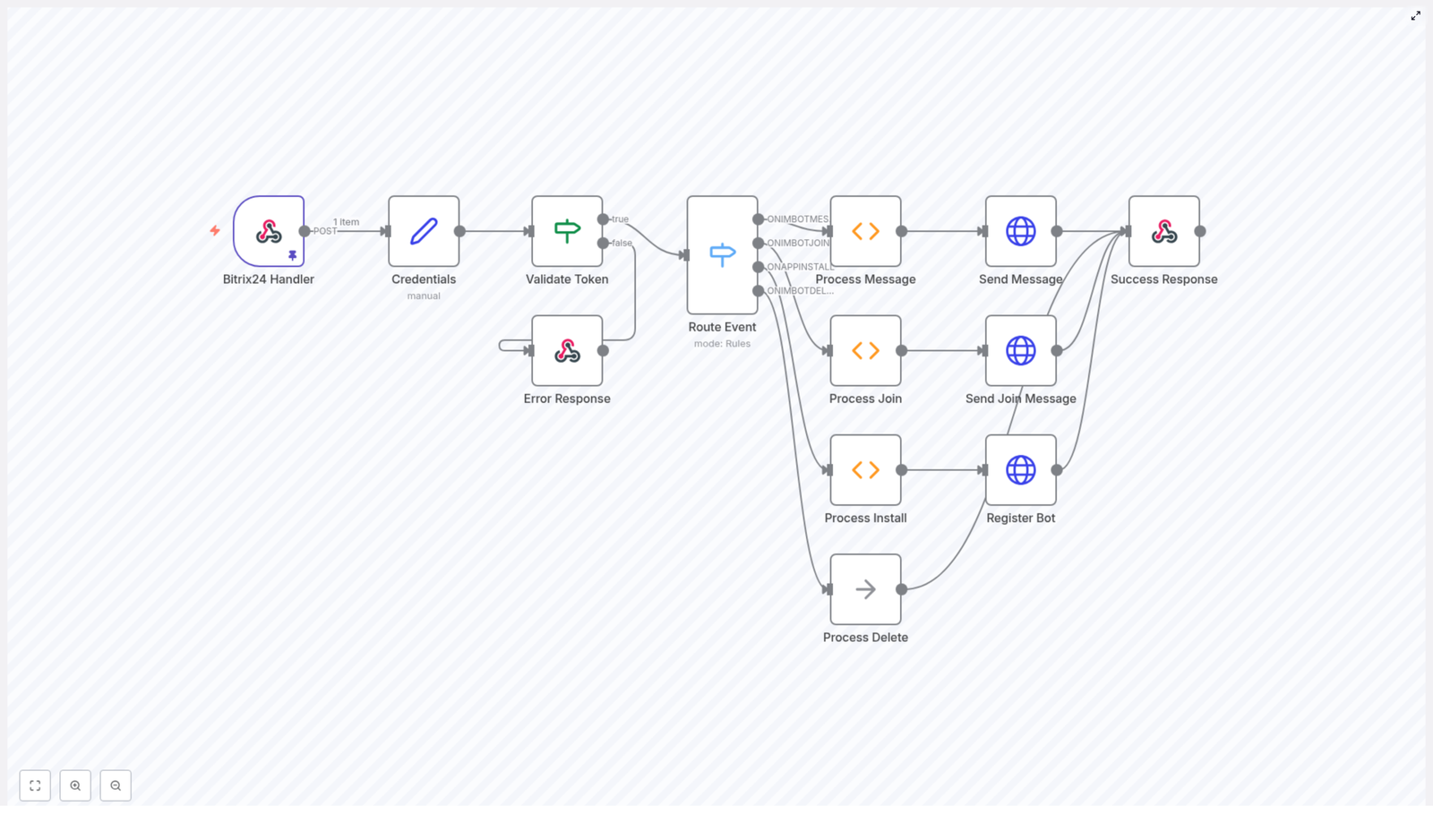
At a high level, the n8n workflow acts as a webhook-based integration between Bitrix24 and your bot logic:

  • Bitrix24 Handler (Webhook trigger) receives incoming HTTP POST requests from Bitrix24.
  • Credentials Node parses the payload and extracts authentication and routing data.
  • Validate Token Node enforces security by verifying the application token.
  • Route Event Node inspects the event type and dispatches it to the correct processing branch.
  • Process Message / Join / Install / Delete Nodes implement event-specific logic.
  • HTTP Request Nodes interact with the Bitrix24 REST API to send messages or register the bot.
  • Respond to Webhook Nodes return success or error responses to Bitrix24.

The data flows linearly from the Bitrix24 webhook into the handler node, through validation and routing, then branches into specialized processing nodes before returning a final HTTP response.

3. Node-by-Node Breakdown

3.1 Bitrix24 Handler (Webhook Trigger)

The Bitrix24 Handler node is the entry point of the workflow. It is configured as a Webhook trigger node in n8n and is responsible for:

  • Accepting HTTP POST requests sent from Bitrix24.
  • Receiving the full webhook payload, including authentication information, event metadata, and message content.
  • Passing the raw JSON body to downstream nodes without modification.

All subsequent nodes rely on this payload to determine the event type and to construct appropriate responses.

3.2 Credentials Node

The Credentials node processes the incoming payload and extracts the fields required for authentication and API calls. Typical data extracted includes:

  • Application or bot token.
  • Client ID or application identifier.
  • Domain or Bitrix24 portal URL used to target the REST API.

This node usually runs as a Function or Set node in n8n that:

  • Reads specific JSON properties from the webhook body.
  • Assigns them to standardized field names used by later nodes.
  • Ensures that required authentication values are present before continuing.

3.3 Validate Token Node

The Validate Token node ensures that the incoming request originates from a trusted Bitrix24 application. It:

  • Compares the application token from the payload with an expected token or validation rule.
  • Determines if the request is authorized to access the workflow.

If the token is invalid, the node triggers an Error Response branch that:

  • Returns an HTTP 401 Unauthorized status code to Bitrix24.
  • Stops further processing for that request.

If the token is valid, processing continues to the routing logic.

3.4 Route Event Node

The Route Event node examines the event type in the webhook payload and decides which branch of the workflow should handle it. Typical event types include:

  • Message add events when a new message is sent to the bot.
  • Bot join events when the bot is added to a chat.
  • Installation events when the bot application is installed.
  • Deletion events when the bot is removed.

This is usually implemented as a Switch or IF node in n8n that:

  • Reads an event identifier from the incoming JSON.
  • Routes execution to one of the processing nodes:
    • Process Message
    • Process Join
    • Process Install
    • Process Delete

3.5 Process Message Node

The Process Message node is responsible for handling new bot messages. It:

  • Extracts the chat dialog ID from the event payload.
  • Reads the message text sent by the user.
  • Constructs a response message that can be static or based on the user input.

In the template, the response behavior is typically:

  • Sending a greeting such as Hi! I am an example-bot. I repeat what you say.
  • Optionally echoing the user’s message back to them.

The processed data is then passed to an HTTP Request node that calls the Bitrix24 REST API to post the reply back into the chat using the extracted dialog ID.

3.6 Process Join Node

The Process Join node handles events where the bot joins a chat. Its main responsibilities are:

  • Identifying the chat or dialog where the bot was added.
  • Preparing a welcome or greeting message for that chat.

The node passes this prepared message to a corresponding HTTP Request node that:

  • Calls the appropriate Bitrix24 REST endpoint.
  • Sends a greeting message to confirm that the bot is active and available.

3.7 Process Install Node

The Process Install node manages bot installation events. It is used to register the bot with Bitrix24 and configure its visible properties. During this step, the workflow:

  • Calls the Bitrix24 REST API to register the bot.
  • Sets configuration properties such as:
    • Bot name and last name.
    • Bot color.
    • Bot email.
    • Other supported registration parameters as required by the Bitrix24 API.

This logic is executed through an HTTP Request node that uses the domain and token extracted earlier to communicate with the Bitrix24 REST interface.

3.8 Process Delete Node

The Process Delete node is triggered when a bot deletion event is received. In the template:

  • It is currently a no-operation (no-op) node.
  • No additional cleanup logic is performed by default.

You can extend this node later to handle tasks such as:

  • Revoking tokens.
  • Clearing related data in external systems.
  • Logging uninstall events for auditing or analytics.

3.9 HTTP Request Nodes

Multiple HTTP Request nodes are used throughout the workflow to interact with Bitrix24:

  • Sending responses to chat messages.
  • Posting greeting messages when the bot joins a chat.
  • Registering the bot during installation.

These nodes typically:

  • Use the domain and token extracted by the Credentials node.
  • Call the relevant Bitrix24 REST endpoints with the required parameters.
  • Include the dialog ID and message body when sending chat messages.

3.10 Respond to Webhook Nodes

The Respond to Webhook nodes finalize communication with Bitrix24 by returning HTTP responses:

  • Success Response node:
    • Sends a JSON response back to Bitrix24.
    • Indicates that the event was processed successfully.
  • Error Response node:
    • Returns appropriate HTTP status codes, for example 401 on token validation failure.
    • Signals that the event was rejected or could not be processed.

4. Execution Flow

The typical execution sequence for the workflow is:

  1. Bitrix24 sends a POST webhook request to the Bitrix24 Handler node URL.
  2. The Credentials node parses the request payload and extracts:
    • Authentication token.
    • Client ID.
    • Domain or portal URL.
  3. The Validate Token node checks the application token:
    • If invalid, the workflow routes to an Error Response node that returns a 401 Unauthorized response.
    • If valid, processing continues.
  4. The Route Event node inspects the event type (for example, message add, bot join, installation, deletion).
  5. The workflow branches to the corresponding processing node:
    • Process Message:
      • Reads the dialog ID and message text.
      • Builds a reply, such as a greeting or echo of the user message.
    • Process Join:
      • Creates a greeting message for the chat where the bot joined.
    • Process Install:
      • Registers the bot via the Bitrix24 REST API and sets its properties.
    • Process Delete:
      • Currently performs no additional logic but can be extended.
  6. Each processing branch uses one or more HTTP Request nodes to:
    • Call Bitrix24 REST endpoints.
    • Send real-time responses or perform bot registration.
  7. A Success Response node returns a JSON response to Bitrix24 confirming that the event was handled successfully.

5. Configuration Notes

5.1 Webhook Setup in Bitrix24

To use this workflow, configure Bitrix24 to send webhook events to the URL exposed by the Bitrix24 Handler webhook node. Ensure:

  • The HTTP method is set to POST.
  • The payload includes the token, domain, client ID, and event details expected by the Credentials node.

5.2 Token Validation

In the Validate Token node:

  • Define the logic to compare the incoming token with the expected application token.
  • Return a 401 error via the Error Response node if the token does not match.

This step is essential for preventing unauthorized requests from triggering the workflow.

5.3 HTTP Request Node Configuration

For each HTTP Request node that calls the Bitrix24 REST API:

  • Use the domain from the Credentials node to build the base URL.
  • Include the token as required by the Bitrix24 REST endpoints.
  • Pass the dialog ID and message text when sending chat messages.
  • Specify bot properties such as name, last name, color, and email during installation.

5.4 Error Handling Considerations

While the template includes a token validation failure path, you may also:

  • Extend error branches to capture HTTP errors from Bitrix24 REST calls.
  • Log unexpected event types routed through the Route Event node.
  • Handle missing or malformed fields in the incoming payload gracefully.

6. Advanced Customization

6.1 Enhancing Message Processing

The Process Message node currently demonstrates a simple pattern, such as:

  • Replying with a statement like Hi! I am an example-bot. I repeat what you say.
  • Echoing the user’s message back to the chat.

You can extend this logic by:

  • Implementing conditional replies based on keywords or patterns.
  • Adding message context awareness across multiple messages.
  • Integrating with external systems for dynamic data retrieval.

6.2 Integrating AI or External Services

To build a more intelligent Bitrix24 chatbot using this n8n workflow, you can:

  • Insert additional nodes between Process Message and the Bitrix24 HTTP Request nodes that:
    • Call AI APIs to generate natural language responses.
    • Query internal tools or databases for contextual information.
  • Use Function nodes to transform or enrich the message text before sending it back.

6.3 Extending Installation and Deletion Logic

The Process Install and Process Delete nodes can be enhanced to:

  • Register additional bot settings or permissions at install time.
  • Perform cleanup actions, such as removing related records or disabling integrations when the bot is deleted.

7. Start Building Your Bitrix24 Chatbot

This n8n workflow template provides a structured starting point for building a Bitrix24 chatbot with webhook integration. By combining the Bitrix24 Handler, validation, event routing, and HTTP Request nodes, you can automate chat interactions, respond in real time, and integrate your bot with other systems.

Use this template as a foundation, then extend the processing nodes with your own business logic, external integrations, or AI-powered responses to deliver fast, personalized automation inside Bitrix24.

How to Load JSON Data into Google Sheets and CSV

How One Marketer Stopped Copy-Pasting JSON and Let n8n Do the Work

The Night Sara Almost Quit Spreadsheets

Sara stared at her screen, eyes blurring over yet another JSON response from an API. Her job as a marketing operations specialist should have been about strategy and insights, yet her evenings kept disappearing into a maze of copy-pasting data into Google Sheets, cleaning columns, and exporting CSV files for her team.

Every campaign meant the same routine. Pull data from an API, download a file, reformat it, import it into Google Sheets, then export a CSV for reporting and backups. One missed field or a wrong column, and her dashboards broke. She knew there had to be a smarter way to load JSON data into Google Sheets and CSV, but every solution she found seemed too complex or too rigid.

Then one afternoon, while searching for “automate JSON to Google Sheets and CSV,” she stumbled on an n8n workflow template that promised exactly what she needed: a simple way to load JSON data from any API directly into Google Sheets or convert it into a CSV file, all without manual effort.

Discovering the n8n Workflow Template

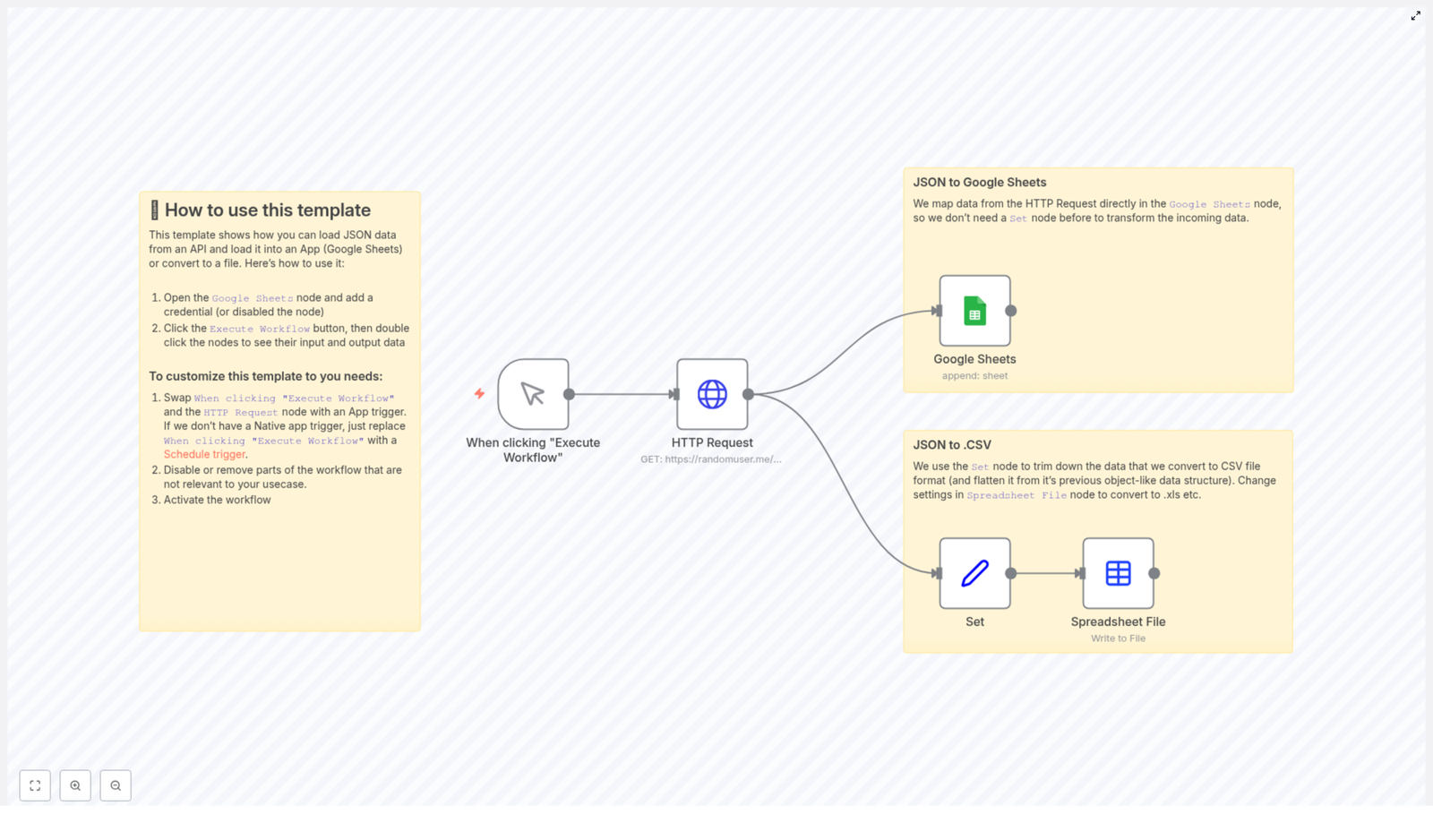
The template description sounded almost too good to be true. It showed a workflow that would:

  • Fetch JSON data from an API using an HTTP Request node
  • Send that JSON straight into Google Sheets, appending new rows automatically
  • Transform the JSON into a flat structure and generate a CSV file using a Spreadsheet File node

Instead of a vague promise, this was a concrete, working automation. It even used a public RandomUser API as an example so she could see the full flow in action before plugging in her own data.

Sara clicked the template link, imported it into n8n, and decided to test it exactly as it was. If it worked with sample data, she could adapt it to her real API later.

First Run: From Click To Clean Data

The Manual Trigger That Changed Her Routine

The workflow started with something simple: a Manual Trigger node. No schedules, no external events, just a button labeled Execute Workflow.

At first, that felt almost too basic, but as she thought about it, it made sense. She could:

  • Use the manual trigger while testing the workflow
  • Later replace it with an app trigger or schedule trigger when she was ready to automate everything

She hit Execute Workflow and watched the next node light up.

Meeting the HTTP Request Node

The core of the template was an HTTP Request node. It was configured to call the RandomUser API at:

https://randomuser.me/api/

The response came back in JSON format, complete with nested objects. There were fields like name, email, and location, all neatly structured but not exactly spreadsheet friendly. For years, this kind of nested JSON had been the reason she spent hours wrangling data.

In n8n, though, she could see the JSON clearly in the node’s output. This was the raw material the rest of the workflow would use.

Two Paths From One JSON: Sheets And CSV

From the HTTP Request node, the workflow split into two distinct paths. This was where Sara realized the template was not just a demo, but a flexible pattern she could reuse across multiple projects.

Path 1 – Sending JSON Straight To Google Sheets

The first branch flowed into a Google Sheets node. Instead of doing complex transformations, it took the JSON output from the HTTP Request node and mapped it directly into a spreadsheet.

The node was configured to:

  • Append new rows to a specific Google Sheet
  • Use the JSON fields as column values

Since some apps and spreadsheets can handle nested JSON, this direct approach worked surprisingly well. For quick reports or internal tools that understand JSON structures, she could skip the whole flattening process and let the data flow straight in.

All she had to do was:

  • Authorize the Google Sheets node with her account
  • Select the target spreadsheet and worksheet
  • Map the JSON fields to the appropriate columns

Within minutes, fresh user data from the RandomUser API appeared in her sheet. No more downloading files or importing manually.

Path 2 – Flattening JSON And Generating A CSV

The second branch was what really caught her attention. It showed how to take the same JSON response and turn it into a clean CSV file using two nodes working together.

Step 1 – The Set Node As A Data Sculptor

The Set node acted like a sculptor for the JSON. Instead of keeping the original nested structure, it:

  • Extracted only the relevant fields, such as full name, country, and email
  • Combined nested properties into simple strings, for example merging first and last name
  • Created a much flatter, spreadsheet-friendly layout

For Sara, this was the missing piece she had been manually reproducing in spreadsheets for years. Now she could define exactly which fields to keep and how to format them, all inside the workflow.

Step 2 – Spreadsheet File Node For CSV Output

Once the data was flattened, it flowed into the Spreadsheet File node. This node converted the structured data into a downloadable file.

In the template, it was configured to generate a CSV file, ideal for:

  • Sharing data with teammates who preferred CSV
  • Uploading into other analytics tools
  • Archiving snapshots of data for later audits

She also noticed that with a quick settings change, the same node could convert the data into other formats like XLS. That meant the workflow could adapt to whatever her team or tools needed.

Shaping The Template Around Her Own API

After running the template a few times with the RandomUser API, Sara felt confident enough to tailor it to her real use case. The structure was already there, she just had to swap in her own details.

How She Customized The Workflow

Step by step, she adapted the template:

  1. Replaced the Manual Trigger She switched the manual trigger to a schedule trigger so the workflow would run automatically every morning before her team checked their dashboards.
  2. Updated the HTTP Request URL She changed the HTTP Request node to point to her marketing analytics API instead of https://randomuser.me/api/, adjusting any authentication settings as needed.
  3. Remapped the Google Sheets Node She updated the Google Sheets node so that the columns matched her actual reporting structure, mapping each JSON field to the correct column name.
  4. Refined the Set Node Fields In the Set node, she selected the exact fields she wanted in her CSV report, flattening nested objects into clear labels like “campaign_name,” “country,” and “click_through_rate.”
  5. Enabled and Authorized Google Sheets She made sure the Google Sheets node was fully authorized with her Google account and had access to the right spreadsheet.
  6. Removed Unnecessary Parts For one project, she only needed the CSV output, so she disabled the Google Sheets branch. For another, she only needed live data in Sheets and turned off the CSV generation.

The template did not lock her into a single pattern. Instead, it gave her a flexible foundation that she could reshape for each data source and reporting requirement.

The Turning Point: From Manual Drudgery To Reliable Automation

A week later, something quietly remarkable happened. The morning rush of “Did you update the sheet?” messages stopped. Her teammates opened their dashboards and found everything already up to date.

The n8n workflow handled:

  • Fetching JSON from her APIs on a schedule
  • Appending data directly into Google Sheets
  • Generating CSV files for archival and sharing

What used to be an hour or more of manual work each day was now a background process she barely had to think about. If she needed to adjust a field, she changed it in the Set node. If a new API endpoint became available, she updated the HTTP Request node and mappings.

Why This n8n Template Became Her Go-To

Looking back, Sara realized the value of the workflow was not just in saving time, but in making her data process more reliable and scalable.

Key Benefits She Experienced

  • Automated Data Integration No more copying and pasting JSON API data into spreadsheets. The workflow handled the entire extraction and loading process automatically.
  • Flexible Output Options She could push data directly into Google Sheets for live reporting or convert it into CSV files for sharing, backups, or imports into other systems.
  • Simplicity And Extensibility The template was easy to understand and customize. She could plug in different APIs, adjust JSON mappings, and switch formats without rebuilding everything from scratch.

From Overwhelmed To In Control

What started as a desperate search for “how to load JSON data into Google Sheets and CSV” turned into a complete shift in how Sara handled API data. Instead of wrestling with exports and imports, she designed workflows that did the heavy lifting for her.

Now, when a new project comes in, she does not dread the data side. She opens n8n, clones her workflow template, updates a few nodes, and lets automation take over.

If you are tired of repetitive data handling, this n8n workflow template can be your turning point too. Use it to automate the extraction, transformation, and loading of JSON data into Google Sheets or CSV files, whether you need real-time syncs or scheduled exports.

Set it up once, refine it as you go, and reclaim the hours you used to spend on manual work.

Happy automating.

Automate Todoist Daily Tasks with n8n

Automate Todoist Daily Tasks from a Template with n8n

Every day you sit down to work, you already know how it starts: opening Todoist, recreating the same routine tasks, setting times, and double checking that nothing slipped through the cracks. It is familiar, but it quietly drains your focus and energy.

What if that part of your day simply took care of itself?

With this n8n workflow template, your daily Todoist tasks can be generated automatically from a single template project. The workflow reads simple scheduling rules from each task description, creates the right tasks for the right days, keeps your Inbox free from duplicates, and sends Slack notifications so you and your team stay aligned. It is a small automation that can open the door to a calmer, more intentional workday.

From repetitive setup to intentional focus

Manual task creation feels harmless, yet it adds up. Each minute you spend recreating “check metrics”, “plan day”, or “follow-up emails” is a minute you are not doing the work that actually moves your goals forward.

Automating Todoist with n8n helps you:

  • Stop re-creating the same daily routines over and over.
  • Use one Todoist template project as your single source of truth.
  • Control due days and times with a simple, readable description format.
  • Keep your Inbox clean by avoiding duplicate daily tasks.
  • Stay informed with realtime Slack alerts whenever tasks are created.

Instead of starting your day by setting up work, you can start by doing the work that matters.

Shifting your mindset: automation as a growth habit

This workflow is more than a handy shortcut. It is a practical first step toward a more automated, scalable way of working. By investing a few minutes in setup, you create a system that quietly supports you every morning.

Think of it as a foundation you can build on. Once you see how easy it is to turn a recurring routine into an automated flow, you will start noticing other opportunities to simplify your processes with n8n. Today it is daily Todoist tasks, tomorrow it might be client onboarding, reporting, or content publishing.

Let us walk through how this specific template works, then you can adapt it to your own style and needs.

How the n8n Todoist template works behind the scenes

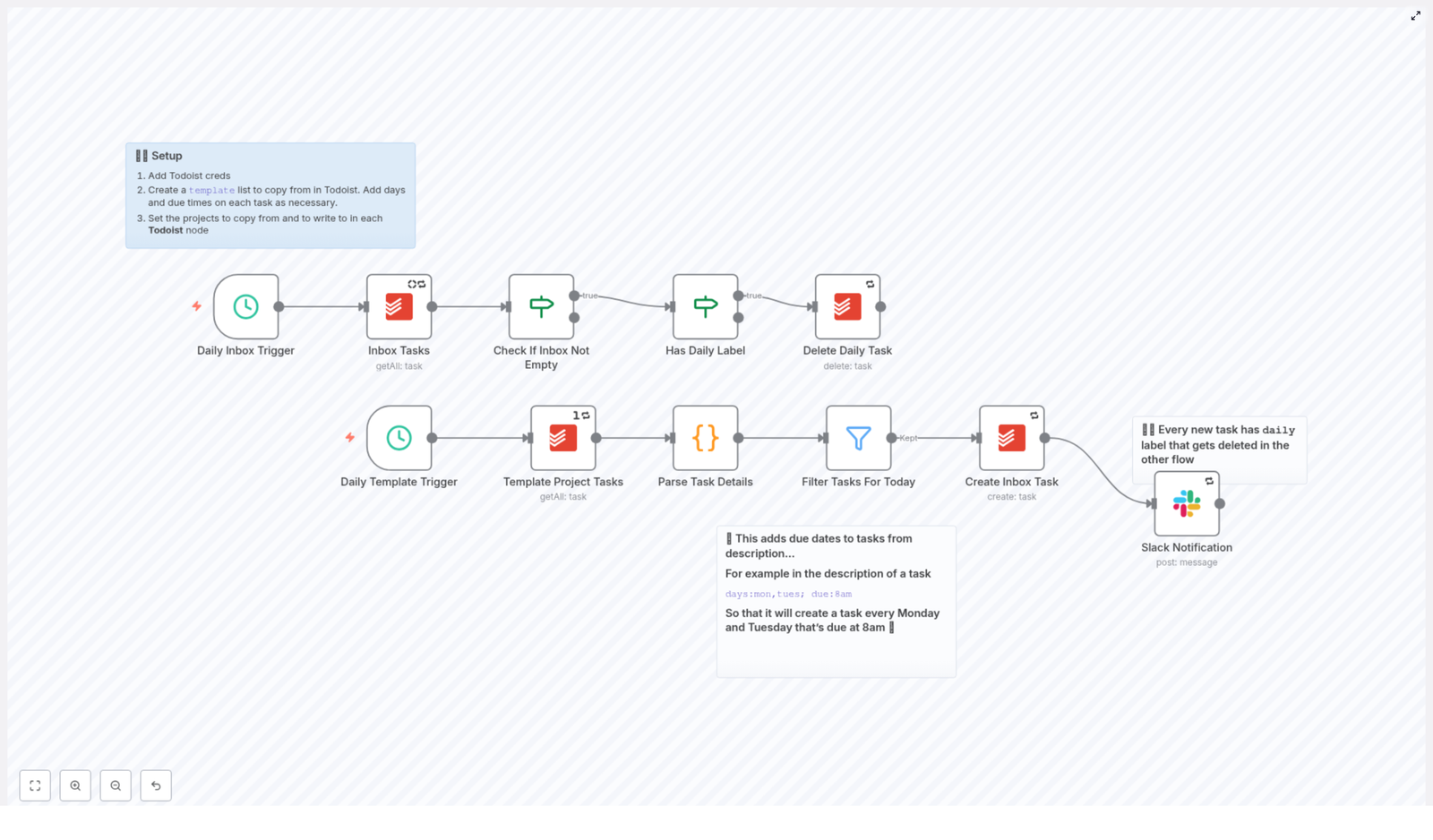
The workflow is built around two coordinated sub-flows that run on a schedule:

  • Inbox cleanup flow – Clears out yesterday’s “daily” tasks so your Inbox never fills with old routines.
  • Template creation flow – Reads tasks from a Todoist template project, interprets scheduling instructions from the description, and creates fresh tasks in your Inbox for the current day, with Slack notifications for visibility.

Both flows run at the same configured time, for example at 05:10 in the morning. First, the cleanup removes outdated daily tasks. Then the template flow adds new ones, tailored to the current weekday and due time. You wake up to a clean, ready-to-go task list.

Core building blocks of the workflow

Schedule Trigger: your daily automation heartbeat

The automation starts with two Schedule Trigger nodes in n8n, both set to the same run time. One trigger launches the Inbox cleanup, the other launches the task creation from your template project.

By running both on a consistent schedule, you ensure that:

  • Old daily tasks are removed first.
  • New tasks are created immediately after, without any overlap.

This rhythm keeps your Todoist Inbox lean and predictable every single day.

Todoist getAll: reading from your template project

The Todoist: getAll node pulls in all tasks from your chosen template project. This project is where you design your ideal daily routines once, instead of rebuilding them every day.

Each template task includes simple metadata in its description to tell the workflow when it should appear, for example:

days:mon,tues; due:8am

This line tells n8n to create that task on Monday and Tuesday, due at 8:00 AM. You can list multiple days with commas and keep the format human friendly so it is easy to maintain.

Code node: parsing the task details into something Todoist understands

The heart of the template is a Code node that parses each task’s description and converts it into structured data. It does three key things:

  1. Extracts the task content and description.
  2. Splits the description by semicolons into key-value pairs like days and due.
  3. Converts a human-friendly time string (for example 8am or 1.30pm) into a UTC timestamp that Todoist accepts as dueDateTime.

Here is the time parsing function used inside the node:

function parseTimeString(timeString) {  const regex = /^(\d{1,2})(\.)?(\d{2})?([ap]m)$/i;  const match = timeString.match(regex);  if (!match) {  throw new Error("Invalid time format");  }  let hours = parseInt(match[1], 10);  let minutes = match[3] ? parseInt(match[3], 10) : 0;  const period = match[4].toLowerCase();  if (hours === 12) {  hours = period === 'am' ? 0 : 12;  } else {  hours = period === 'pm' ? hours + 12 : hours;  }  if (minutes < 0 || minutes >= 60) {  throw new Error("Invalid minutes");  }  const now = DateTime.now().set({ hour: hours, minute: minutes, second: 0, millisecond: 0 });  return now.toUTC();
}

This code uses the Luxon DateTime object that is available in n8n code nodes. It sets the time on today’s date in your server’s local timezone, then converts it to UTC. The result is a clean dueDateTime value that Todoist’s API can use directly.

Filter node: choosing only the tasks for today

Once each task has parsed metadata, a Filter node checks whether the days value includes today’s weekday token, such as mon, tues, wed, and so on.

Only tasks that match the current day move forward in the workflow. Everything else is skipped until its scheduled day comes around. This is how a single template project can power your entire weekly routine without manual intervention.

Todoist create: turning templates into real Inbox tasks

The Todoist: create node is where your templates become real tasks in your Inbox. For each filtered item, it:

  • Sets content as the task title.
  • Copies the original description (including metadata) into the task.
  • Maps dueDateTime to the ISO UTC timestamp from the parsing function.
  • Applies a temporary daily label so the cleanup flow can find it later.

The result is a fresh set of daily tasks, correctly timed, labeled, and ready for action, without you lifting a finger each morning.

Slack notification: sharing visibility with your team

To close the loop, a Slack node sends a simple message to a chosen channel after each task is created. You can include the task name, due time, and any context that helps your team know what has been added.

This is especially powerful if your routines affect others, for example daily standups, reporting, or shared checklists. Everyone can see what is scheduled without needing to ask.

How the workflow keeps duplicates out of your Inbox

One of the most satisfying parts of this setup is how clean it keeps your Todoist Inbox. The workflow uses a straightforward two-phase strategy:

  1. Cleanup phase – The Inbox cleanup flow runs first, finds all tasks that still have the daily label from previous runs, and deletes them.
  2. Creation phase – The template flow then creates new tasks for the current day, each with the daily label applied again.

This pattern prevents duplicates and keeps only the tasks that are relevant for today. If you prefer to keep a history of daily tasks, you can adjust the delete node or change how labels are used, but the core idea remains the same: your Inbox should support your focus, not fight it.

Setting everything up in n8n and Todoist

The workflow is ready to import and customize. Here is how to get it running quickly:

  1. Import the workflow JSON into your n8n instance.
  2. Add Todoist credentials in n8n using your API token, then select the correct project IDs in:
    • The Todoist: getAll node for your template project.
    • The Todoist: create node for your Inbox project.
  3. Prepare your template project in Todoist. For each template task, add metadata in the description, for example:
    days:mon,tues; due:8am

    You can include multiple comma separated days in the days field.

  4. Set your schedule triggers to the time you want the workflow to run each day, such as early morning before you start work.
  5. Connect Slack by adding your credentials and selecting the channel that should receive notifications, if you want alerts.
  6. Run a test by manually triggering the template flow once, then check your Todoist Inbox and Slack channel to confirm everything looks right.

In just a few minutes, you will have a daily routine that runs itself.

Description metadata format: simple rules that unlock smart scheduling

To keep the parser reliable and easy to maintain, use a consistent description pattern:

days:mon,tues; due:8am

Some practical examples:

  • days:mon,wed,fri; due:7.30am – Create tasks on Monday, Wednesday, and Friday at 7:30 AM.
  • days:tues; due:1pm – Create a task every Tuesday at 1:00 PM.
  • days:mon,tues,wed,thurs,fri; due:9am – Create a weekday morning reminder at 9:00 AM.

Once you get comfortable with this pattern, you can quickly adjust your weekly routines just by editing descriptions in your template project.

Ideas to customize and grow this workflow

This template is intentionally simple, but it is also a powerful base to experiment and learn from. As you get familiar with it, you can extend it in many ways, such as:

  • Beyond daily routines – Enhance the parser to support date ranges, weekly or monthly schedules, or even custom recurrence rules.
  • Multiple timezones – Map tasks to specific timezone offsets if you coordinate with people in different regions.
  • Advanced filters – Only create tasks with certain tags, labels, or priorities from the template project.
  • Resilience and error handling – Add error catching nodes and Slack alerts when a task fails to be created.
  • Richer metadata – Extend the description format with keys like project: or priority: and map those fields in the Todoist create node.

Each small improvement is another step toward a workflow that reflects exactly how you and your team like to operate.

Troubleshooting and refining your setup

Tasks are not being created

If tasks do not appear in your Todoist Inbox, check the following:

  • Verify that your Todoist API credential in n8n is valid.
  • Confirm that the template project ID is correctly set in the Todoist: getAll node.
  • Ensure the description format follows the pattern with days: and due:.
  • Look at the Code node logs for parsing errors, such as invalid time formats.

Task times look incorrect

The parser builds a datetime for the current day in the server’s local timezone, then converts it to UTC. If tasks show at the wrong hour:

  • Review the server timezone configuration.
  • Adjust the parsing logic to use a specific timezone, for example:
    DateTime.now().setZone('America/New_York')

Duplicates are still appearing

If you notice duplicates, focus on the timing of the two sub-flows:

  • Confirm the cleanup flow runs before the creation flow.
  • Make sure the daily label is applied to all newly created tasks.
  • Consider adding a short delay between cleanup and creation triggers if needed.

Security and maintenance: keeping your system reliable

As your automation becomes part of your daily rhythm, it is worth treating it like any other important system:

  • Store Todoist and Slack credentials securely in n8n’s credential manager.
  • Limit access to the template project so only the right people can change routine tasks.
  • Monitor n8n execution logs and consider setting up alerts if these tasks are critical for your business.

A little care here ensures your automation remains dependable as your workload and team grow.

Where this template can take you next

With this n8n template, you can:

  • Automate the creation of daily Todoist tasks from a single template project.
  • Use simple description metadata to schedule tasks by day and time.
  • Prevent duplicate clutter in your Inbox with a reliable cleanup and creation pattern.
  • Keep everyone informed through Slack notifications.

More importantly, you give yourself permission to step away from repetitive setup work and move toward a more focused, strategic way of working. Each morning, your tasks will already be waiting for you, so you can start with clarity instead of configuration.

Try it now: Import the workflow JSON into n8n, connect your Todoist and Slack credentials, and run a test. Watch your Inbox populate itself, then imagine what else you could automate.

If you would like help customizing the parser, adding timezone support, or extending this into a broader automation system, feel free to reach out or book a consultation. This template is just the beginning.

Want more automation guides like this? Subscribe for weekly tips and ready-to-import n8n templates that help you reclaim time and focus.

Automate Slack Ideas to Notion with n8n

Automate Slack Ideas to Notion with n8n

Every day, your team shares ideas in Slack that could shape your product, improve your processes, or unlock new opportunities. Yet many of those insights disappear into long threads, forgotten by next week. What if every promising idea, no matter how quickly it was typed, automatically landed in a structured Notion database, ready to be refined and acted on?

This is exactly what this n8n workflow template helps you do. With a simple Slack slash command, a webhook, and a Notion integration, you can turn casual suggestions into organized, trackable items. Think of it as a small but powerful step toward a more focused, automated workflow where your tools quietly handle the admin work and your team stays in the flow.

From lost ideas to a reliable system

Slack is where conversations happen fast. Notion is where ideas grow into plans, specs, and documentation. When these two tools stay disconnected, you rely on memory and manual copy-paste to move ideas from chat to a place where they can be tracked.

Connecting Slack to Notion with n8n changes that dynamic. It creates a simple intake system that works in the background, so your team can keep sharing ideas in Slack while n8n does the organizing for you.

Why connect Slack and Notion with n8n?

By linking Slack and Notion through an automated workflow, you unlock several practical benefits that compound over time:

  • Centralized idea management – no more digging through channels and threads to recover that great suggestion from last week.
  • Faster triage and prioritization – ideas are instantly visible in Notion, ready to be tagged, assigned, and discussed.
  • Clearer context – each idea carries the submitter and message text so follow-ups are easy and attribution is obvious.
  • Less manual work – confirmations and follow-up prompts in Slack are automated, so nothing depends on someone remembering to respond.

Instead of treating idea capture as a chore, you can turn it into a smooth experience that encourages contribution and keeps your backlog organized with almost no extra effort.

Shifting your mindset: automation as a growth tool

This workflow is more than a convenience. It is a mindset shift. When you automate something as simple as capturing ideas, you begin to build a culture where:

  • Everyone knows their suggestions will be seen and tracked.
  • Your tools work together instead of in silos.
  • You reclaim time that used to be spent on repetitive admin work.

n8n makes this possible without needing to be a developer. You can visually connect Slack and Notion, test your setup, and iterate on it over time. This template can be your starting point, a small experiment that shows how much value you can unlock by automating the “little things.”

How the n8n workflow works behind the scenes

The template is intentionally lightweight, but it covers the full journey from Slack message to Notion page and back to Slack confirmations. At a high level, the workflow:

  1. Receives a Slack slash command payload via an Incoming Slack Webhook node.
  2. Stores your target Notion database URL in a Set node so new pages are created in the correct place.
  3. Uses a Switch node as a Command Router so you can support commands like /idea and potentially more in the future.
  4. Creates a Notion database page with the slash command text as the title and the Slack user as the Creator property.
  5. Sends a follow-up message back to the user in Slack via the response_url, inviting them to add more details and linking to the Notion page.
  6. Posts a confirmation message in the original Slack channel so the team sees that the idea has been captured.

In practice, this means someone can type something like:

/idea Add a new onboarding checklist

and within seconds, that idea is safely stored in Notion with clear ownership and a path to action.

What you need before you start

Before you dive into the setup, make sure you have these pieces in place. Getting them ready upfront will make the whole process smoother and faster.

  • An n8n instance (cloud or self-hosted) with access to the workflow editor.
  • A Slack workspace and permission to create a Slack App with slash commands.
  • A Notion account with a database where you can add pages.
  • A Notion integration that has access to that database.
  • Notion API credentials (integration token) added to n8n as credentials for the Notion node.

Your step-by-step journey to automation

Let us walk through the setup as a guided path. You can follow these steps in order, test as you go, and adjust where needed. Once you complete this once, you will find it much easier to build your next automation.

Step 1 – Create a Slack App and slash command

Start by giving your team an easy way to submit ideas directly from Slack.

1. Visit Slack API: Apps and create a new app in your workspace.
2. In the app configuration, go to OAuth & Permissions and add the chat:write scope under bot token scopes so your bot can post messages back to Slack.
3. Open the Slash Commands section and create a new command, such as /idea.
4. In the command’s Request URL field, paste the test webhook URL from the Incoming Slack Webhook node in your n8n workflow.
5. Install the app to your Slack workspace so the command becomes available to your team.

At this point, you have created the front door for ideas. Next, you will connect it to Notion.

Step 2 – Set up the Notion database and integration

Now you will prepare the place where all ideas will live. This is where structure and clarity start to emerge.

1. In Notion, create a database (either a Table or a Database Page) with at least these properties:

  • Name (title)
  • Creator (person or rich_text)

2. Go to Notion Integrations and create a new integration, then grant it access to the database you just created.
3. Copy the integration token and add it to n8n as credentials for the Notion node. This token is what allows n8n to create pages in your database.

With this in place, you have a dedicated, structured space where every Slack idea can land automatically.

Step 3 – Configure the n8n workflow template

Now you will connect everything inside n8n. This is where the automation comes to life.

1. Import or recreate the template in your n8n instance. Then configure these key nodes:

  • Incoming Slack Webhook – verify that the webhook path matches what you used in the Slack slash command’s Request URL. Make sure the node is active when you test.
  • Configure Notion URL – update the placeholder Notion URL with your actual database URL. This allows the Create Notion Page node to correctly resolve the databaseId.
  • Create Notion Page – map the title to {{$json.body.text}} so the slash command text becomes the page title, and map the Creator property to {{$json.body.user_name}} so you know who submitted the idea.
  • Send Slack Followup – configure this HTTP request to post back to the response_url from Slack. Use it to send a friendly prompt and, if desired, a direct link to the Notion page. To include a public URL, adjust the JSON from the Notion node to surface the page link.
  • Post Slack Confirmation – keep this node if you want a visible confirmation in the channel using the bot token, mentioning the user and confirming that the idea was captured.

Once these nodes are configured, you have a complete loop: Slack to n8n to Notion and back to Slack.

How the data flows, step by step

To understand the power of this workflow, it helps to visualize the journey of a single idea:

  1. A team member types /idea Add a new onboarding checklist in Slack.
  2. Slack sends a POST request with the command payload to the n8n Incoming Slack Webhook node.
  3. n8n extracts the text and user metadata from the payload and passes it through the Command Router (Switch node). This design also leaves room for future commands.
  4. The Create Notion Page node uses that data to create a new page in your Notion database, setting the page title to the idea text and the Creator property to the Slack user.
  5. n8n sends a private follow-up message through the response_url, inviting the user to add more details or update the Notion page.
  6. Finally, the workflow posts a confirmation message to the original Slack channel, mentioning the user and signaling to the team that the idea is safely stored.

All of this happens in the background, usually in just a few seconds, without anyone needing to copy, paste, or manually log anything.

Customize and extend the workflow for your team

This template is intentionally simple so you can get value quickly, but it is also a foundation. As your needs grow, you can extend it to match your processes and priorities. Here are some ways to build on it:

  • Split title and body – let users send commands like /idea title | details, then use a Function node to separate the title and details and map them to different Notion properties.
  • Automatic tags or priority – use a Switch or IF node to look for keywords in the idea text and set tags or priority levels in Notion.
  • Handle attachments or images – extract file URLs from the Slack payload and add them as blocks or properties on the Notion page.
  • Trigger other tools – send notifications or create items in Trello, Jira, or email when certain criteria are met.
  • Track analytics – count submissions per user or topic, then populate a Notion dashboard to see which themes or contributors are most active.

Each small improvement saves more time and makes your idea pipeline clearer and more actionable.

Troubleshooting as you iterate

As you experiment and refine the workflow, you might run into configuration issues. That is a natural part of building automations. Use these checks to quickly get back on track:

  • Notion node errors – verify that your integration token has access to the target database and that the databaseId is correct.
  • Slack-related issues – if you add signature verification, confirm that the x-slack-signature and timestamp are being handled correctly, or rely on Slack’s built-in app verification.
  • No response from the slash command – confirm that the Incoming Slack Webhook node is active and that the webhook path exactly matches the Request URL in the Slack slash command configuration.
  • Inspecting payloads – use n8n’s execution logs and the pinned example payload in the workflow to see exactly how Slack is sending fields.

Each troubleshooting step deepens your understanding of n8n, which pays off as you build more automations.

Security and permissions to keep in mind

As you connect tools, it is important to keep security and access in focus. A few simple practices go a long way:

  • Limit your Notion integration to only the databases that need write access.
  • Use scoped Slack permissions and only the minimal bot scopes required, such as chat:write for posting messages.
  • If your workflow is accessible from outside your organization, implement verification of incoming requests to ensure they really come from Slack.

With these safeguards in place, you can confidently automate more of your workflows.

Example: splitting idea title and details with a Function node

If you want to give your team more structure without making the command harder to use, you can allow them to send both a title and details in a single line, then split it in n8n before creating the Notion page.

// In a Function node before Create Notion Page
const raw = $json.body.text || '';
const parts = raw.split('|').map(p => p.trim());
const title = parts[0] || 'Untitled idea';
const details = parts.slice(1).join(' | ');

return [{  json: {  body: $json.body,  title,  details  }
}];

After this node, map title to the Notion Name property and details to a Description or Notes property in your database. This small enhancement can make your Notion pages much more useful without changing how people naturally share ideas.

Building momentum with automation

This n8n template is a simple, maintainable way to capture ideas from Slack and turn them into structured Notion entries. It gives you:

  • A lightweight setup that you can complete in a short session.
  • An easy path to extend and adapt as your team’s needs evolve.
  • A reliable system that preserves context and saves time on every idea submitted.

Whether you are collecting product ideas, bug reports, feedback from retrospectives, or internal improvement suggestions, this workflow helps you move from scattered conversations to an organized, actionable backlog.

Ready to take the next step? Treat this as your starting point for a more automated workspace. Import the template into n8n, set up your Slack app and Notion integration, and run your first test with /idea. Notice how quickly an unstructured message becomes a structured item in Notion.

From here, you can keep iterating: add fields, connect more tools, or build dashboards. Each improvement frees up a bit more time and mental energy for the work that really matters.

Call to action: Import the workflow now, test it with /idea in Slack, and share your experience with your team or automation lead so you can roll it out across your workspace and keep building on it.

Lead Qualification from Form (n8n Template)

Lead Qualification from Form: Let n8n Score Your Leads While You Sip Coffee

Picture this: your form is happily collecting leads all day, your inbox is overflowing, and your sales team is trying to guess which ones are worth a call. Meanwhile, you are stuck copy-pasting emails into tools, checking if they are real, then deciding who gets what. Again. And again. And again.

That is exactly the kind of repetitive task that makes automation look like a superhero. This n8n template, “Lead Qualification from Form”, takes your form submissions, verifies emails with Hunter, scores leads with MadKudu, and pings your team on Telegram and Slack when someone looks seriously promising.

No more manual triage, no more guessing who is “hot” and who is “meh”. Just a clean, low-code workflow that quietly does the boring parts for you.


What this n8n lead qualification template actually does

Under the hood, the workflow connects your form to a smart qualification pipeline. Here is the short version of what happens every time someone hits “Submit”:

  1. Form Trigger – Your form sends data to an n8n webhook. It can be Typeform, Google Forms (via webhook), a custom HTML form, or any tool that posts JSON.
  2. Hunter Email Verification – The workflow checks if the email address is deliverable using Hunter. No more chasing fake inboxes like test123@nowhere.com.
  3. MadKudu Lead Scoring – If the email is valid or deliverable, n8n calls MadKudu to get enrichment and a customer_fit.score for the lead.
  4. Customer Fit Check – The template compares that score against a threshold. By default it is set to 60, but you can tweak it for your own ICP.
  5. High-fit Leads – If the score passes the bar, n8n sends notifications to your Telegram and Slack channels with the key MadKudu signals so sales has instant context.
  6. Low-fit or Invalid Leads – These are quietly ignored (or routed to nurture if you extend the flow) so your team is not spammed with noise.

In other words, the template builds you a mini lead ops assistant that never sleeps and never forgets to notify the team.


Why bother automating lead qualification at all?

If you have ever tried to manually sort leads, you already know the answer. But for the record, here are the key reasons to automate this with n8n:

  • Faster response to hot leads – High-intent prospects do not wait around. Instant scoring and notifications help your team jump in quickly.
  • Cleaner data – Hunter keeps your database from turning into a graveyard of undeliverable emails.
  • Scalable triage – You can handle more inbound volume without hiring a small army to sort spreadsheets.
  • Better sales context – MadKudu’s company fit signals give reps the “why this lead matters” before they even say hello.

So instead of spending hours filtering, tagging, and guessing, you can let n8n do the heavy lifting while you focus on strategy and conversations.


Quick setup guide: from form to fully automated lead scoring

The template is ready to go, you just need to plug in your tools and preferences. Here is a simplified walkthrough of the setup.

Step 1: Add your credentials in n8n

First, connect the services that this workflow uses:

  • Hunter – Your email verifier API key.
  • MadKudu – Your API key or HTTP header configuration.
  • Telegram – Bot token for sending notifications.
  • Slack – Workspace token or app credentials for posting messages.

Store everything in the n8n credential manager. Do not hardcode secrets directly in nodes unless you enjoy security audits.

Step 2: Connect your form with the Form Trigger

The template ships with a demo form trigger. Swap that out for your real form:

  • Use the Webhook node URL that n8n gives you.
  • Configure your form tool (Typeform, Google Forms via webhook, custom HTML form, etc.) to POST JSON to that URL.
  • Make sure the payload includes at least the email field and any other details you want to pass to MadKudu.

Once this is wired up, every new submission will automatically kick off the workflow.

Step 3: Tune email verification and scoring logic

Next, you control which leads are allowed to move forward.

Hunter verification checks:

  • MX records
  • SMTP response
  • Disposable email detection

In the template, only leads where Hunter’s status is valid or deliverable are passed on. Others can be safely ignored or routed elsewhere if you extend the flow.

MadKudu scoring then enriches the lead with company data and a customer_fit.score. The template checks if this score is greater than 60 by default. You can adjust that threshold to better match your ideal customer profile (ICP).

Step 4: Configure Telegram and Slack notifications

This is the fun part where your sales team starts getting “hot lead” alerts instead of cold spreadsheets.

  • In the Telegram node, set the chat ID to your sales group or channel.
  • In the Slack node, choose the channel where you want lead alerts to appear.

The notifications include:

  • The lead’s email address
  • Top MadKudu signals, such as funding, location, industry, or company size

That way, reps instantly see why the lead is worth their time instead of asking “Where did this come from?” in the channel.


Smart ways to pick thresholds and use signals

You do not need to nail your scoring strategy on day one. Start simple and refine over time.

  • Begin with a moderate threshold – A range of 50-60 is a good starting point while you learn what “good fit” looks like for your pipeline.
  • Use top signals for messaging – MadKudu’s signals, like funding round, industry, or geography, are perfect for tailoring outreach.
  • Do not waste borderline leads – Instead of dropping them, route medium-fit leads into a nurture sequence or separate list.

Over time, you can increase the threshold as your volume grows or your ICP becomes more precise.


Where this workflow really shines

This n8n template is especially useful if:

  • You are a SaaS startup trying to reply quickly to high-intent signups.
  • Your marketing team is generating lots of inbound leads and needs a scalable way to qualify them.
  • Your sales team wants richer context before reaching out so calls feel informed, not random.
  • Your operations team is tired of manual lead triage and wants to automate the repetitive bits.

Basically, if you have more leads than time, this template helps you focus on the ones that actually matter.


Customizing and extending the template

The workflow is designed to be a starting point, not a rigid system. You can easily adapt it to your stack and process.

  • Swap the form source – Replace the default Form Trigger with Typeform, Google Forms, or a CMS webhook.
  • Add more enrichment – If you are not using MadKudu or want additional data, plug in tools like Clearbit or FullContact.
  • Push to your CRM – Send high-fit leads directly into HubSpot, Salesforce, Pipedrive, or your CRM of choice.
  • Advanced routing – Use conditional branches to assign very high-priority leads by region, potential ARR, or segment.
  • Log everything – Store lead activity in Google Sheets or a database for analytics, reporting, or audit trails.

With n8n’s visual editor, you can experiment without writing a full backend service every time you want to change your lead flow.


Testing your workflow before going live

Before you unleash this on your real traffic, give it a proper test run.

  1. Use Test Workflow mode in n8n and submit sample form entries with different types of emails to validate Hunter responses and MadKudu scores.
  2. Check your notifications to confirm that Telegram and Slack messages arrive in the correct channels with the expected content.
  3. Verify low-fit behavior so that leads below your threshold either follow the no-op path or your chosen nurture route.

A few test leads now can save you from a lot of “Why did this one not show up?” questions later.


Security and compliance tips

Automation is great, but you still need to keep data safe and compliant.

  • Protect your API keys by storing them in n8n credentials and rotating them regularly.
  • Handle PII carefully and make sure your lead forms and storage respect GDPR, CCPA, and any other relevant regulations.
  • Limit sensitive data exposure by anonymizing or hashing fields if you store them outside tightly controlled systems.

That way you get all the benefits of automation without unexpected legal “surprises”.


Troubleshooting common issues

If something is not working as expected, here are some quick checks:

  • No webhook hits – Confirm your form is posting to the correct public webhook URL and that the n8n workflow is activated.
  • Weird Hunter results – Check your Hunter quota and test with known good and bad emails to see if the behavior is consistent.
  • MadKudu errors – Make sure the API key and endpoint are correct. Inspect the response object in n8n to debug missing properties.
  • No notifications – Double check Telegram bot tokens and chat IDs, and ensure your Slack app has permission to post in the selected channel.

Most issues come down to credentials, permissions, or misconfigured URLs, so start there.


Real-world example: from form fill to “hot lead” ping

Here is how a typical run looks in practice:

A visitor fills in your marketing signup form and hits submit. The workflow:

  1. Receives the submission through the n8n webhook.
  2. Uses Hunter to verify the email is valid.
  3. Calls MadKudu, which returns a customer_fit.score of, say, 81, along with signals like funding amount, industry, and company size.
  4. Sees that 81 is above your threshold, so it fires off messages to your sales Telegram group and Slack channel.

The notification might look something like:

“⭐ New hot lead: [email] – ✔ Company raised $13.5M, ✔ Located in Germany, …”

Your sales team gets a clear, enriched snapshot of why this lead is exciting, and can prioritize outreach accordingly.


Wrapping up: let n8n handle the boring parts

Manual lead qualification is one of those tasks that feels important, but also endlessly repetitive. With this n8n template, you automate the entire flow:

  • Capture leads from your form
  • Verify email deliverability with Hunter
  • Enrich and score with MadKudu
  • Notify your team instantly on Telegram and Slack

That leaves you and your sales team free to do what humans are actually good at: building relationships and closing deals, not sorting rows.

Try it now:

Import the “Lead Qualification from Form” n8n template, add your Hunter, MadKudu, Telegram, and Slack credentials, set your score threshold, and activate the workflow. If you get stuck, loop in your ops team or check the n8n docs for specific node details.

Import the Template

Want to plug this directly into your CRM or design a more advanced routing logic? Reach out and we can help you build a tailored n8n automation that fits your sales process perfectly.

Automated HubSpot Follow-Up Workflow (n8n + Gmail)

Automated HubSpot Follow-Up Workflow with n8n and Gmail

Picture this: you open your CRM, see a wall of contacts you meant to follow up with “last week,” and your soul quietly leaves your body. Rewriting the same “just checking in” email for the 47th time is nobody’s dream job.

That is exactly where this n8n + HubSpot + Gmail workflow comes in to save your sanity. It hunts down the right contacts to follow up with, checks their previous engagement, sends a personalized email, logs everything neatly in HubSpot, and even pings your team in Slack so everyone looks incredibly on top of things.

All of this runs automatically on a schedule, which means fewer awkward “Oops, I forgot to follow up” moments and more time for actual selling, building, or, you know, coffee.

What this n8n HubSpot follow-up workflow actually does

At a high level, this automated follow-up workflow:

  • Runs every day at 9 AM (or whenever you prefer)
  • Searches HubSpot for contacts who have been contacted before
  • Filters out anyone who was contacted in the last 30 days
  • Checks the contact’s engagements to make sure there was exactly one prior outreach
  • Builds a personalized follow-up email
  • Sends the email via Gmail
  • Logs the engagement back into HubSpot
  • Notifies your sales or growth channel in Slack

The result: consistent follow-ups, no double-pinging fresh leads, and a CRM that actually reflects reality.

Why automate follow-ups instead of suffering in silence?

Manual follow-ups sound simple until you have more than 10 leads. Then it becomes a full-time job you did not apply for. Automation helps you:

  • Stay consistent – Follow-ups go out at the same time every day, not “whenever you remember.”
  • Avoid duplicate outreach – No one likes getting three “just bumping this to the top of your inbox” emails in a week.
  • Keep HubSpot clean – Every outreach is logged, so your CRM stays accurate.
  • Customize logic – With n8n, you control the filters, timing, and message templates instead of being stuck with rigid defaults.

n8n sits in the middle, connecting HubSpot, Gmail, and Slack, and gives you a visual, flexible way to tweak the workflow anytime your process changes.

Step-by-step: how the workflow runs

Let’s walk through how this n8n workflow behaves once it is live. Think of it as your little robot assistant doing the boring parts in the background.

1. Schedule Trigger – your robot alarm clock

The workflow starts with the Schedule Trigger node. In the example, it is configured to run every day at 9 AM. You can adjust the schedule to match your timezone and team rhythm.

Once the time hits, the workflow wakes up and begins scanning your HubSpot contacts.

2. Search HubSpot Contacts – finding people worth nudging

Next up, an HubSpot node searches for contacts that have a known last-contacted date. You are specifically using the notes_last_contacted property so you know these people have already heard from you at least once.

Key configuration details:

  • Authentication: HubSpot OAuth2 (follow the n8n docs, and make sure your OAuth scopes are an exact match)
  • Sort By: notes_last_contacted
  • Direction: Ascending (oldest first, so the most neglected souls rise to the top)
  • Properties: Include at least firstname, lastname, email, and the last contact date

This gives you a list of contacts who have been contacted before and can be safely considered for a follow-up.

3. Filter Contacts by Last Contact Date – no spammy behavior

Now it is time to draw a line between “reasonable follow-up” and “borderline spam.” An IF node checks each contact’s notes_last_contacted value and compares it to the current date minus 30 days.

The logic is simple:

  • If the last contact date is more than 30 days ago, the contact moves forward in the workflow.
  • If it is more recent than that, they get filtered out and are not contacted again yet.

This protects both your reputation and your reply rates by not hammering people with too many emails.

4. Fetch Contact Engagements – checking the relationship status

Before you send anything, the workflow checks how much engagement there has been with that contact. Using HubSpot’s associations API, a node fetches the contact’s engagements so you can see prior activity.

This is where you decide what “follow-up worthy” means. In the sample template, the idea is to follow up only if there was exactly one prior outreach email. That way you are not hitting someone who is already in an active conversation or still in the “first contact” stage.

5. Filter Single Engagement – avoiding over-contacting

Another IF node then checks the number and type of engagements that came back from HubSpot. In this example workflow, the condition is:

results.length === 1

If that is true, the workflow continues. If not, the contact is skipped.

This logic:

  • Prevents sending a follow-up to a brand new contact with zero prior outreach
  • Avoids bombarding active leads who already have multiple ongoing engagements

In other words, it focuses your automation where it makes the most sense.

6. Compose Email Payload – writing the “just checking in” so you do not have to

Once a contact passes all the filters, n8n uses a Set or Function node to build the email payload. This is where personalization happens using HubSpot contact properties like firstname and any relevant context you have stored.

Example plaintext template:

Hey {{ $json.properties.firstname }},

Just want to follow up on my previous email since I haven’t heard back. Have you had a chance to consider n8n?

Cheers,
Your Name

You can tweak this message to match your tone, brand, or level of enthusiasm. The main point is that the template is dynamic and uses real contact data instead of sending the same “Dear Customer” email to everyone.

7. Send Outreach Email with Gmail – actually hitting send

With the payload ready, the workflow hands things off to the Gmail node to send the email. You define the subject, body (HTML or plaintext), and sender details here.

Recommended configuration:

  • Use a verified sender name and email address
  • Disable any appended attribution so your email looks clean and professional
  • Add rate limiting if you are sending to a large list, to keep your deliverability and API usage healthy

At this point, your follow-up email is out in the world, and you did not have to copy-paste anything.

8. Record Engagement in HubSpot – keeping your CRM honest

After sending the email, the workflow is not done yet. It uses the HubSpot engagement resource to create a new engagement record tied to that contact.

Typically you will include metadata like:

  • Subject
  • HTML or plaintext body
  • Recipient email
  • Associated contact ID

This updates the contact’s last contact date and ensures they will not show up again in your follow-up workflow until the timeframe you choose, which in this example is one month.

9. Slack Notification – letting the team know the robots are working

Finally, a Slack node posts a short message to your sales or growth channel. Something like:

Follow up email sent to: contact@example.com

This creates a lightweight audit trail, keeps everyone in the loop, and gives your team the pleasant illusion that you personally remembered every single follow-up.

Setup tips, OAuth fun, and common gotchas

OAuth Scopes – tiny settings, big headaches

Both HubSpot and Gmail use OAuth, which means you will need to configure credentials correctly in n8n. Pay close attention to the scopes:

  • Follow the n8n documentation exactly for both HubSpot and Gmail
  • Make sure the scopes you request match what the workflow needs

Missing scopes are a classic source of “why is this not working” errors when searching contacts or creating engagements, so double-check this part early.

Rate limits and deliverability – be kind to APIs and inboxes

When you start scaling this workflow, keep two things in mind:

  • API rate limits: HubSpot and Gmail both limit how many requests you can make in a given period. If you are processing big lists, consider throttling or queue logic in n8n.
  • Email deliverability: Personalize your messages, avoid spammy phrases, and keep an eye on bounce rates to protect your sender reputation.

Automation is powerful, but it should still feel human on the receiving end.

Testing strategy – do not unleash it on your entire database yet

  1. Start with a single staged contact in HubSpot and a personal or test Gmail account.
  2. Check that the engagement is created in HubSpot and that notes_last_contacted updates as expected.
  3. Verify your Slack notification arrives and the formatting looks good.

Once all that works, you can gradually open the floodgates.

Advanced enhancements to level up your automation

Once the basic follow-up flow is running smoothly, you can start adding extra logic and experiments.

  • Filter by engagement type: Skip follow-ups if there have been recent calls or meetings so you do not double up on communication.
  • A/B test subject lines: Branch the workflow so half of the contacts get subject A and half get subject B, then track opens and replies.
  • Unsubscribe logic: Check for a custom property like “Do not contact” before sending, and bail out if it is enabled.
  • Backoff strategy: If someone has repeatedly not replied, flag them for manual review instead of continuing automated follow-ups forever.

These tweaks help you keep the workflow effective, respectful, and aligned with your sales or customer success style.

Security and privacy considerations

Since this workflow touches contact data and email, treat it with care:

  • Store OAuth credentials in the n8n credentials manager and restrict access.
  • Make sure your outreach complies with regulations such as CAN-SPAM and GDPR.
  • Always include a clear way to opt out or unsubscribe in your emails.

Good automation respects both your leads and the law.

Pre-launch checklist before going to production

Before you let this workflow loose on your real contact list, run through this quick checklist:

  • HubSpot and Gmail OAuth credentials are configured and validated
  • Test contact created and verified in HubSpot
  • Rate limiting or throttling in place for larger runs
  • Personalization tokens like {{ $json.properties.firstname }} are working correctly
  • Slack channel is set up and receiving notifications

Once all of these are green, you are ready to automate follow-ups with confidence.

Conclusion & next steps

This n8n workflow gives you a practical, repeatable way to follow up with HubSpot contacts using Gmail, without relying on your memory or a sticky note system. It improves timing, keeps your CRM accurate, and creates a visible audit trail through HubSpot engagements and Slack notifications.

To get started:

  • Clone the workflow into your n8n instance
  • Configure and validate your OAuth scopes for HubSpot and Gmail
  • Test with a sample contact
  • Iterate on your subject lines and message copy until it fits your brand and audience

Call to action

If you would like a copy of this workflow or help tailoring it for your team, reach out to get a downloadable n8n workflow file, or subscribe for more automation recipes, n8n templates, and best practices.


Keywords: n8n, HubSpot follow-up workflow, Gmail outreach, automated follow-up, sales automation, HubSpot automation template, n8n workflow.