


Comprehensive SEO Keyword Research Guide
The Real Problem: Drowning In SEO Data, Starving For Clarity
Most marketers and website owners know they should do keyword research, yet the process often feels messy and overwhelming. You jump between tools, export spreadsheets, copy and paste data, and try to make sense of search volume, CPC, competition, SERP features, and trends. Hours go by, and you still do not have a clear, confident strategy.
This is where many people stop. Not because they lack ambition, but because the workflow is too manual, too fragmented, and too time consuming.
The good news is that it does not have to stay this way. With the right mindset and an automated workflow, keyword research can shift from a draining chore into a powerful engine that consistently feeds your SEO strategy with fresh, actionable insights.
Shifting Your Mindset: From Manual Grind To Automated Growth
Keyword research is not just a checklist item. It is the foundation of every successful SEO campaign, guiding your content, your offers, and your long term growth. When you treat it as a strategic, automated system instead of a one off task, everything changes.
Imagine opening a Google Sheet and instantly seeing:
- Up to date search volumes, CPC, and competition levels
- Relevant keyword suggestions and related terms that reveal new opportunities
- Insights from SERP features like featured snippets, local packs, and People Also Ask
- Trends over time that show where interest is growing or fading
No more scattered tabs or outdated exports. Just a single, living overview of keyword potential that updates through automation. That is the kind of system that frees you to focus on strategy, content, and growth.
Why Keyword Research Still Matters So Much
Even in a fast changing search landscape, keyword research remains the backbone of effective SEO. At its core, it is about understanding how real people search, what they want, and how you can meet that intent better than anyone else.
When you research keywords with the right data, you can:
- Discover what your target audience is actively searching for
- Match your content to search intent, not just isolated phrases
- Identify realistic opportunities based on competition and SERP layout
- Plan content that supports both short term wins and long term authority
To do this well, you need to look at several key metrics together, not in isolation.
Key Keyword Metrics That Power Smarter Decisions
Effective keyword research is about reading the story behind the numbers. The main data points you will work with include:
- Search Volume: The average number of searches per month for a keyword. This shows demand and helps you gauge interest, but should always be weighed against intent and competition.
- CPC (Cost Per Click): A signal from paid advertisers. Higher CPC often points to strong commercial value, which can guide both SEO and PPC priorities.
- Competition Level: Often labeled as low, medium, or high. This helps you understand how difficult it may be to rank and where quick wins might exist.
When these metrics are automatically collected and processed inside a workflow, they stop being random numbers and start becoming clear direction for your SEO strategy.
Bringing Automation Into Your Keyword Research
Modern SEO teams no longer rely only on manual checks. They build automated workflows that gather, enrich, and organize keyword data so they can spend their time on analysis and execution.
With automation, you can:
- Pull live keyword metrics from APIs at regular intervals
- Store and update data in Google Sheets for easy collaboration
- Use code nodes to calculate averages, normalize values, and extract useful fields
- Merge data from multiple sources into a single, reliable overview
This is where an n8n workflow template becomes your ally. Instead of starting from scratch, you can use a ready made structure and adapt it to your needs.
Meet Your New Ally: An n8n Workflow Template For SEO Keyword Research
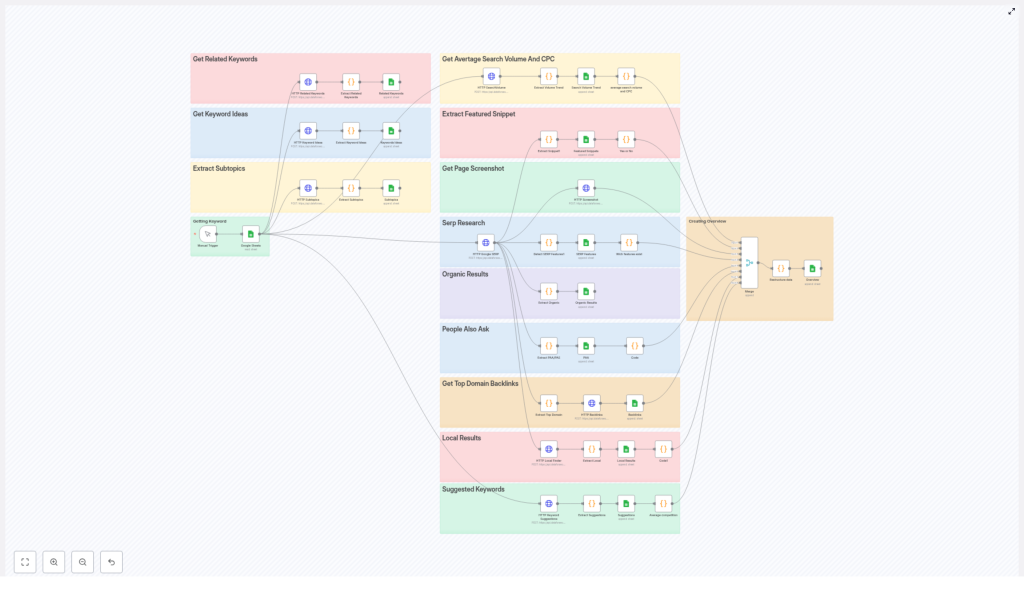
Think of the template as a launchpad. It does not replace your strategic thinking, it amplifies it. By plugging into APIs, Google Sheets, and code nodes, this n8n workflow handles the repetitive work of gathering and processing keyword data so you can focus on what really matters.
At a high level, the template is designed to:
- Automate keyword data collection into Google Sheets
- Fetch key metrics like search volume, CPC, and competition
- Retrieve SERP features, related keywords, and suggestions
- Process and consolidate all of this into a comprehensive overview
Instead of manually stitching everything together, you get a structured, repeatable process that you can run on demand or on a schedule.
Core Building Blocks Of The Automated Workflow
1. Google Sheets Automation For Real Time Collaboration
Google Sheets acts as your shared dashboard. The workflow writes keyword data directly into your sheet so your team can:
- Review fresh metrics without logging into multiple tools
- Filter and sort by volume, CPC, competition, or SERP features
- Comment, prioritize, and plan content in one place
Because the process is automated, you reduce the risk of human error and avoid repetitive copy paste work.
2. API Integrations For Live Keyword Insights
APIs are where the workflow pulls in the real power. Through integrations, the template can fetch:
- Live search volume for each keyword
- Keyword suggestions and related terms that expand your list
- Information on SERP features such as featured snippets and local packs
- Additional data like backlink profiles of top ranking domains for deeper competitive insight
This gives you a dynamic, data rich view of each keyword, instead of static snapshots.
3. Code Nodes To Process And Enrich Data
Code nodes inside the n8n workflow handle the logic that turns raw data into insights. For example, you can:
- Compute average CPC across multiple results
- Standardize competition levels into clear categories
- Extract and structure snippet data from SERPs
- Merge multiple datasets into a single, clean record per keyword
These small automated calculations save you hours while making your keyword research more consistent and reliable.
Reading The SERP: Insights From Features That Shape Strategy
Not all search results pages are created equal. Two keywords with similar volume can have very different opportunities depending on what appears on the SERP.
The workflow helps you account for features like:
- Featured snippets: These quick answer boxes sit at the top of the results and offer prime visibility. Knowing which keywords trigger snippets helps you craft content that can win them.
- Local packs: For local SEO, these map based results are critical. If your keywords trigger local packs, you will know you need to optimize your local presence as part of your strategy.
- People Also Ask (PAA): These questions reveal what users are curious about around your topic. They are a goldmine for FAQ sections, supporting articles, and content expansion.
By automatically capturing this information, the workflow helps you see beyond volume and understand the real shape of the opportunity.
Expanding Your Reach With Suggestions And Related Keywords
Great SEO strategies rarely rely on a handful of head terms. They grow by covering an entire topic in depth, supported by related and long tail keywords that capture specific needs and questions.
The template supports this by pulling in:
- Keyword suggestions: Programmatically generated ideas that branch out from your main terms and reveal content gaps you might have missed.
- Related keywords: Variations and semantically connected terms that help you build topical authority and capture secondary traffic.
With automation, you can expand your list quickly while still keeping everything organized and purposeful.
Tracking Trends And Competitors Over Time
Search behavior is not static. Interests rise and fall, new topics emerge, and competition shifts. Your workflow should reflect that reality.
By monitoring:
- Monthly and yearly search volume trends to spot seasonality and emerging topics
- Backlink profiles of top ranking domains to gauge the difficulty of competing
you get a more realistic view of what it will take to rank and when it is worth investing in a particular keyword cluster.
Automating this tracking means you can revisit your keyword landscape regularly without restarting from zero each time.
Creating A Single, Comprehensive Keyword Overview
The real power of this n8n template shows when you bring everything together. Instead of juggling separate reports, the workflow merges data from:
- Organic search results
- Featured snippets and other SERP features
- Backlink data for top domains
- Local finder and local pack results
- Keyword suggestions and related terms
The result is a clear, consolidated overview of each keyword’s potential and challenges. You can instantly see which terms are high value, which are realistic, and which require a stronger link building or content approach.
Actionable Tips To Get The Most From The Workflow
- Schedule the automation to run regularly so your keyword insights stay fresh and your strategy can adjust dynamically.
- Look beyond high volume. Combine search volume with intent, competition, and SERP features to prioritize smarter.
- Use backlink and local results data to understand the full competitive landscape, not just what appears on the surface.
From Data To Growth: Using This Template As Your Next Step Forward
SEO keyword research is not a one time project. It is an ongoing journey of discovery, testing, and refinement. When you combine structured data sourcing with automation and thoughtful interpretation, you give yourself a real advantage.
This n8n workflow template is not the final destination. It is a powerful starting point that you can:
- Customize with your own APIs, filters, and logic
- Extend to cover more markets, languages, or product lines
- Connect to other automations for content planning, reporting, or outreach
Each improvement you make compounds over time, freeing more of your energy for strategic work and creative problem solving.
Take The Next Step: Automate Your Keyword Research Today
If you are ready to move from scattered manual tasks to a focused, automated keyword research system, this is your moment. By integrating advanced keyword research automation workflows, you can transform your SEO from reactive to intentional and your campaigns from guesswork to data driven impact.
Start with this template, experiment with it, refine it, and let it become the backbone of a more efficient, more insightful SEO process.
