


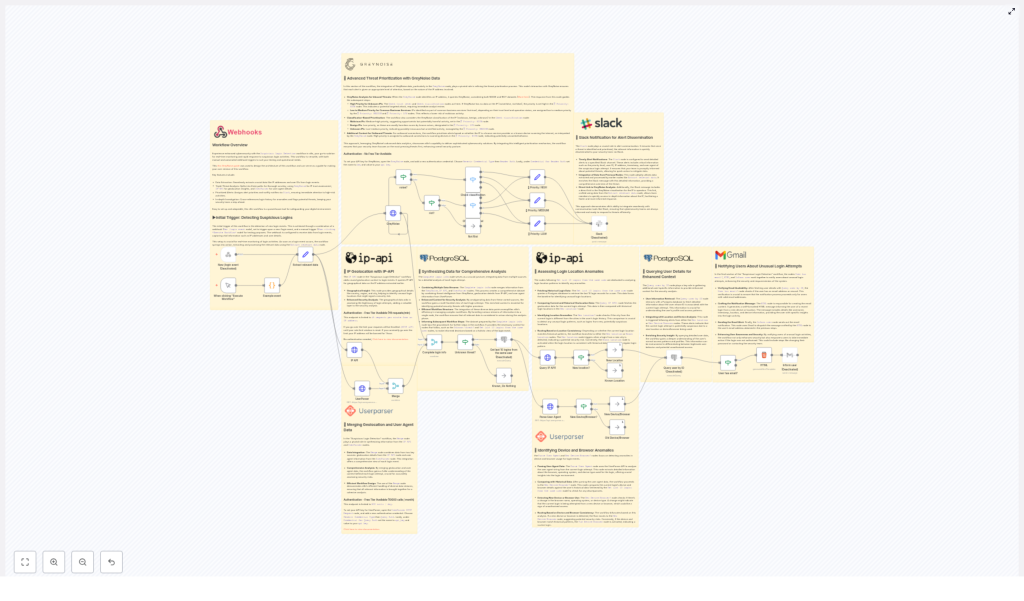
Advanced Suspicious Login Detection with GreyNoise in n8n
Introduction
Protecting user accounts from credential abuse and unauthorized access is a critical requirement in modern infrastructures. The Suspicious Login Detection workflow template for n8n combines real-time event ingestion, threat intelligence from GreyNoise, and contextual enrichment from multiple data sources to help security and platform teams quickly identify and prioritize risky login activity.
This article explains how the workflow operates, the role of each node, and how the different integrations work together to deliver a robust, automated suspicious login detection capability.
Use Case and Workflow Logic
The workflow is designed to ingest login events, enrich them with intelligence and context, then classify and notify on suspicious behavior. It focuses on four main dimensions of risk:
- IP reputation and internet noise activity (via GreyNoise)
- Geolocation anomalies (via IP-API)
- Device and browser changes (via UserParser)
- Historical login patterns (via PostgreSQL)
By correlating these data points, the n8n workflow assigns a priority level to each login attempt and triggers the appropriate alerts to both security teams and end users.
Triggers and Data Ingestion
Webhook and Manual Trigger
The workflow can be initiated in two ways, which is useful both for production usage and for controlled testing:
- Webhook Trigger: The primary entry point that listens for incoming login events from your application or authentication service. Each event typically contains IP address, user agent, timestamp, and user identifier.
- Manual Trigger: A secondary trigger that allows security engineers or developers to manually start the workflow for testing, validation, or simulation of specific scenarios.
Data Extraction
Once the workflow is triggered, a dedicated node extracts and normalizes the key attributes from the login event payload:
- IP address of the client making the request
- User agent string used during the login
- Timestamp of the login attempt
- User ID associated with the session
This structured data then feeds into the analysis and enrichment stages that follow.
Threat Intelligence and Contextual Enrichment
IP Reputation with GreyNoise
The GreyNoise node is central to the workflow’s risk assessment. It evaluates the IP address of each login attempt against GreyNoise’s datasets, including NOISE and RIOT, to determine how that IP behaves on the wider internet.
Through this integration, the workflow can classify the IP as:
- Known noisy or malicious: Frequently involved in scanning, probing, or attack activity.
- Benign: Considered non-threatening based on GreyNoise intelligence.
- Unknown or ambiguous: Not clearly benign and may require closer inspection.
Based on this classification, the workflow assigns an initial priority level to the login event, which is later refined with additional context.
Geolocation Analysis with IP-API
To identify unusual login locations, the workflow uses IP-API to enrich the IP address with geolocation data. This typically includes:
- City
- Country
The workflow then compares the current location against the user’s last 10 login locations. If the new login originates from a location that is significantly different from the user’s recent history, it can be treated as a potential anomaly and contribute to a higher risk score.
User Agent and Device Profiling with UserParser
Device and browser changes are another strong signal for suspicious activity. The workflow integrates with UserParser to parse the raw user agent string into structured attributes, such as:
- Browser type and version
- Operating system
- Device type
The parsed user agent from the current login is then compared against device and browser information from previous logins. A completely new device or browser profile for the same user can indicate credential theft or account sharing and is used as an additional factor in the risk assessment.
Historical Login Context from PostgreSQL
To provide behavioral context, the workflow queries a PostgreSQL database for the user’s last 10 login records. This historical data supports:
- Comparison of current IP and geolocation with recent login locations
- Comparison of current device and browser with previously observed user agents
- Detection of unusual patterns, such as sudden changes in geography or device profile
This step is essential for anomaly detection, allowing the workflow to move beyond static rules and incorporate user-specific behavior.
Risk Scoring and Threat Prioritization
After enrichment, the workflow correlates all signals to determine the final alert priority. GreyNoise classifications play a key role in this decision, while geolocation and device anomalies provide additional weight.
The template uses a three-tier priority model:
- High Priority: Login attempts from IPs that are unknown or malicious in GreyNoise, especially when combined with unusual location or device data. These events are likely to indicate targeted attacks or active exploitation attempts.
- Medium Priority: Activity from IPs that are not clearly malicious but may be associated with RIOT or are otherwise unknown, possibly with some contextual anomalies. These events warrant review but may not require immediate incident response.
- Low Priority: Benign IPs with no strong anomaly indicators. These logins are typically part of normal user behavior and can be logged with minimal operational overhead.
Notification and Response Automation
Slack Alerts for Security Teams
For operational visibility, the workflow sends structured alerts to one or more Slack channels. Each alert contains:
- Assigned priority (high, medium, or low)
- IP address and GreyNoise classification
- Geolocation details (city and country)
- Device and browser information from UserParser
- Relevant historical context from the last 10 logins
This enables security and SRE teams to rapidly triage events, correlate them with other signals, and decide on appropriate response actions such as session invalidation or additional verification.
Email Notifications to End Users
When the workflow detects a new device or unusual location, it can also send an email notification directly to the affected user. This serves two purposes:
- Increases user awareness of possible account misuse
- Encourages users to take immediate action, such as changing passwords or enabling multi-factor authentication
By involving users in the detection loop, organizations can shorten the time to discovery for compromised accounts.
Benefits and Best Practices
This n8n workflow template delivers several advantages for teams looking to strengthen their authentication security posture:
- Holistic risk assessment: Combines IP reputation, geolocation, device fingerprinting, and historical behavior into a single, automated decision process.
- Real-time monitoring: Webhook-based ingestion enables immediate analysis and response at the moment of login.
- Actionable alerts: Rich, contextual notifications via Slack and email support fast, informed decision making.
- Straightforward integration: Uses standard APIs and PostgreSQL queries that can be integrated with most existing authentication and logging systems.
For best results, ensure:
- Consistent and reliable logging of login events into the source system that triggers the webhook
- Accurate and up-to-date user login history in PostgreSQL
- Secure storage and management of API credentials for GreyNoise, IP-API, and UserParser
- Clearly defined operational runbooks for handling high and medium priority alerts
Implementation Considerations
Before deploying the template into production, automation and security teams should:
- Configure and validate all external integrations using valid API credentials for GreyNoise, IP-API, and UserParser.
- Connect the workflow to the appropriate PostgreSQL instance containing user login history.
- Adjust Slack channels and email templates to align with internal incident response processes.
- Test various scenarios using the manual trigger to confirm that enrichment, prioritization, and notifications behave as expected.
Conclusion
The Suspicious Login Detection workflow for n8n provides a powerful, extensible foundation for advanced login monitoring. By aggregating intelligence from GreyNoise, IP-API, and UserParser, and correlating it with historical login data stored in PostgreSQL, it enables proactive detection of high-risk login activity and supports rapid, informed responses.
Organizations can use this template as-is or adapt it to fit their specific authentication stack, alerting preferences, and incident response workflows.
Next Steps
To take advantage of this template in your own environment:
- Deploy the workflow in your n8n instance.
- Configure webhook endpoints to receive login events from your application or identity provider.
- Provide valid credentials for GreyNoise, IP-API, and UserParser, and connect your PostgreSQL database.
- Iterate on alert thresholds and notification rules based on your risk appetite and operational capacity.
Once configured, you will be able to detect, prioritize, and respond to suspicious login attempts as they occur.
