Create a Simple Webhook Response with n8n

Create a Simple Webhook Response with n8n

Overview

This guide explains how to implement a minimal webhook-based HTTP response in n8n using a ready-made workflow template. The workflow listens for an incoming GET request, then returns a basic HTML page styled with Bootstrap. It is designed as a simple, technical example of how to:

  • Expose an HTTP endpoint using the Webhook node
  • Delegate the HTTP response to a Respond to Webhook node
  • Serve an HTML5 page with correct headers and content type

This template is ideal if you want to understand how n8n handles incoming web requests, how response modes work, or how to use n8n as a lightweight web endpoint or form handler.

Workflow Architecture

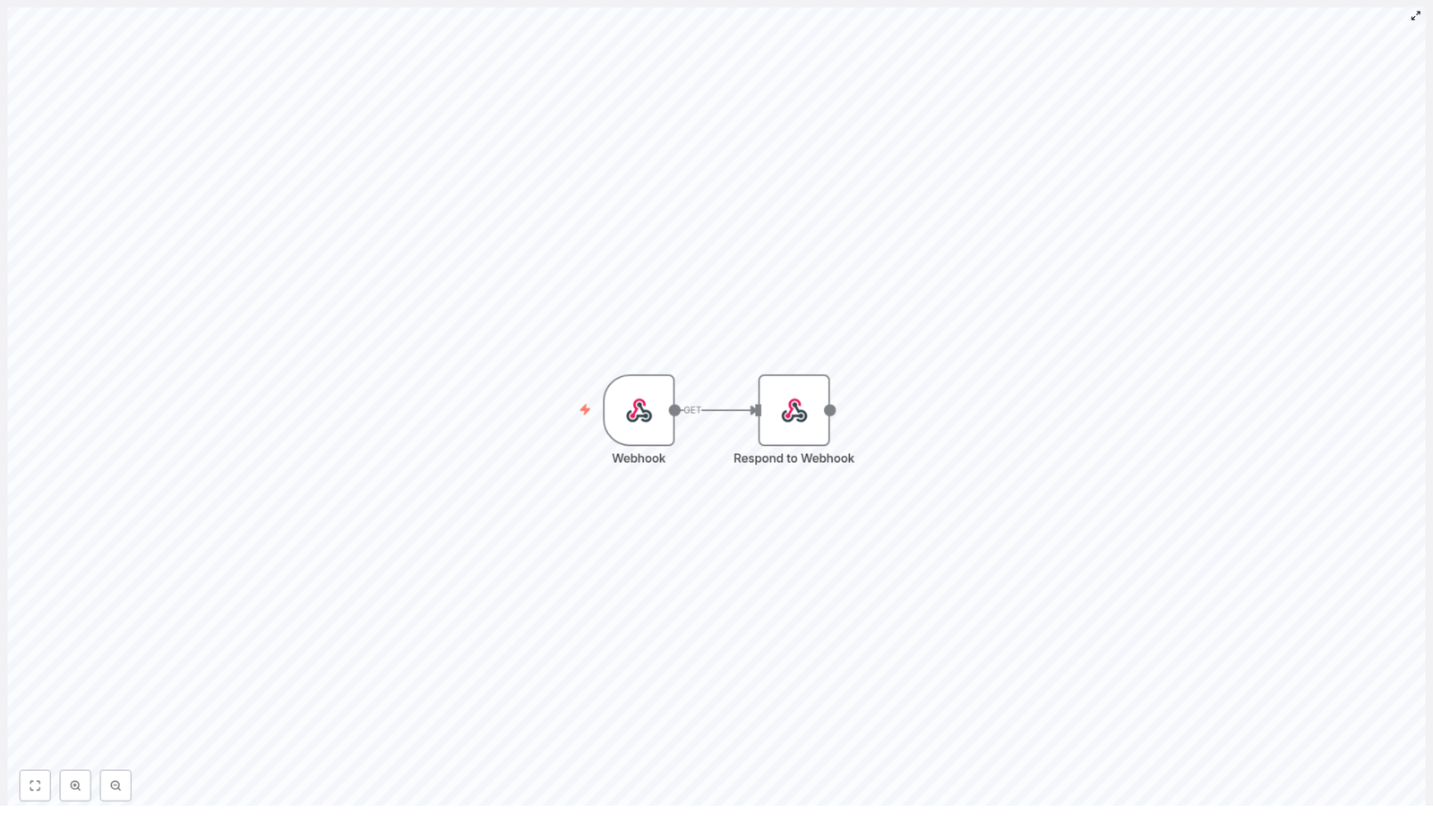
The workflow is intentionally minimal and consists of exactly two nodes connected in sequence:

  1. Webhook node – receives the incoming HTTP request at a defined path and triggers the workflow.
  2. Respond to Webhook node – generates and returns the HTTP response, including headers and an HTML body.

The data flow is straightforward:

  1. A client sends a GET request to the configured webhook URL.
  2. n8n routes the request to the Webhook node based on the path.
  3. The Webhook node passes control and request data to the next node.
  4. The Respond to Webhook node constructs the HTTP response and sends an HTML page back to the client.

Because the Webhook node is configured with responseMode = responseNode, it does not respond directly. Instead, it waits for the Respond to Webhook node to explicitly define and send the response. This pattern is recommended whenever you need precise control over headers, status codes, or response bodies.

Node-by-Node Breakdown

1. Webhook Node

The Webhook node is the entry point of the workflow. It exposes an HTTP endpoint that external services or browsers can call.

Core configuration

  • Path: my-form
  • HTTP Method: GET (the template is demonstrated with GET requests)
  • Response Mode: responseNode

With this configuration, the webhook URL typically follows this pattern:

http://YOUR_N8N_URL/webhook/my-form

The exact URL depends on how your n8n instance is deployed and configured (base URL, SSL, reverse proxy, etc.), but the path segment /webhook/my-form is determined by the node’s Path setting.

Behavior

  • The node listens for incoming GET requests at the specified path.
  • When a request arrives, n8n triggers the workflow and passes the request data to the next node.
  • Because responseMode is set to responseNode, the webhook does not send an automatic response. Instead, it waits for a downstream Respond to Webhook node to finalize the HTTP response.

If no Respond to Webhook node is executed, the client will not receive the intended HTML response. In most setups this results in a timeout or default error, so it is important that the response node is always reached for handled requests.

2. Respond to Webhook Node

The Respond to Webhook node is responsible for returning the actual HTTP response to the caller. In this template, it returns a simple HTML page that includes Bootstrap 5 from a CDN and displays a Hello, world! heading.

Response headers

  • Content-Type: text/html; charset=UTF-8

Setting the Content-Type header to text/html; charset=UTF-8 ensures the browser interprets the payload as HTML and uses UTF-8 encoding. Without this header, some clients might treat the content as plain text or apply incorrect character encoding.

Response body

The response body is a minimal but complete HTML5 document, typically including:

  • <!doctype html> declaration
  • <html>, <head>, and <body> sections
  • A link to Bootstrap 5 via a CDN in the <head> section
  • A simple layout in the <body> that renders a Hello, world! heading

The exact HTML may vary slightly depending on the template version, but the key idea is:

  • Bootstrap is loaded from a public CDN, so no local assets are required.
  • The page is valid HTML5 and should render correctly in modern browsers.
  • The visible content is a basic greeting, which can be easily replaced or extended.

Because the Respond to Webhook node is invoked after the Webhook node, it has access to the incoming request data if you want to use it for dynamic rendering in more advanced scenarios.

Configuration & Execution Notes

Prerequisites

  • A running n8n instance (local or hosted).
  • Access to the n8n editor to import or open the template.
  • Network access from your client or browser to the n8n webhook URL.

Activating the workflow

  1. Start your n8n instance.
  2. Open the workflow template in the n8n editor.
  3. Ensure the workflow is active. Inactive workflows will not respond to incoming webhooks.

Testing the webhook endpoint

To verify that the webhook and response are working:

  1. Identify your n8n base URL. For local setups, this is commonly:
    http://localhost:5678

    or a similar URL configured in your environment.

  2. Combine the base URL with the webhook path:
    http://YOUR_N8N_URL/webhook/my-form
  3. Send an HTTP GET request to this URL using:
    • A web browser
    • curl or another CLI tool
    • An API client such as Postman or Insomnia
  4. If everything is configured correctly, the response will be an HTML page that displays a Hello, world! message.

In a browser, the page should render as a styled HTML document. In tools like curl, you will see the raw HTML output along with the Content-Type: text/html; charset=UTF-8 header.

Common edge cases

  • Workflow not active: The webhook URL will not respond as expected. Make sure the workflow is switched to active.
  • Incorrect URL or path: If the path is not exactly my-form or if the base URL is wrong, n8n will not route the request to this workflow.
  • Missing Respond to Webhook execution: If the flow is modified and the Respond to Webhook node is skipped, the client may experience a timeout or receive a generic error.

Extending the Template

This workflow is intentionally simple so you can use it as a foundation for more advanced automation scenarios. Below are several common extensions that keep the same core pattern but add useful behavior.

Dynamic HTML generation

Instead of returning static HTML, you can:

  • Use incoming query parameters or headers to customize the response.
  • Inject data from previous nodes into the HTML template, for example using expressions.
  • Build conditional sections in the HTML based on request content.

The basic structure remains the same: the Webhook node receives data, intermediate nodes process it, and the Respond to Webhook node composes the final HTML.

Handling POST requests and form submissions

To support form submissions:

  • Change or duplicate the Webhook node to accept POST requests.
  • Configure the form on your web page to submit to the webhook URL.
  • Access form fields in the workflow and use them in the response or in downstream integrations.

The template itself shows a GET-based example, but the same response pattern applies to POST and other HTTP methods, as long as the Webhook node is configured accordingly.

Adding security layers

For production use, you will typically want to restrict who can call your webhook endpoint. Common options include:

  • Using API keys in headers or query parameters and validating them inside the workflow.
  • Placing n8n behind an authenticated reverse proxy.
  • Using OAuth or other authentication mechanisms, depending on your environment.

This template does not enforce authentication by default. Any security checks should be added as intermediate steps before the Respond to Webhook node, and unauthorized requests should receive an appropriate HTTP status and message.

Integrating with external systems

Once the basic webhook pattern is in place, you can extend the workflow to:

  • Call APIs or databases based on the incoming request.
  • Trigger other automations or send notifications.
  • Transform data before returning a response or storing it.

The Webhook + Respond to Webhook structure remains the same, but additional nodes are inserted between them to perform business logic or external integrations.

Use Cases for This Pattern

  • Interactive web forms: Use the webhook as the backend for simple forms that return immediate feedback or confirmation pages.
  • Lightweight APIs: Expose small, custom endpoints that return HTML or JSON without deploying a dedicated web server.
  • Static or semi-static content delivery: Serve basic pages or status messages directly from n8n workflows.

Summary & Next Steps

By combining n8n’s Webhook node with the Respond to Webhook node, you can quickly build HTTP endpoints that return fully controlled HTML responses. This simple template shows how to:

  • Register a webhook at /webhook/my-form
  • Handle GET requests
  • Return a Bootstrap-styled Hello, world! HTML page with correct headers

Use this as a base to implement more complex web interactions, handle form submissions, or integrate with other systems directly from n8n. Experiment with different response types, dynamic content, and additional nodes to tailor the workflow to your specific automation requirements.

Try the template

Import the template into your n8n instance, activate the workflow, and start customizing the HTML response or request handling logic to fit your use case.
How to Send a Private Message on Zulip with n8n

How to Send a Private Message on Zulip with n8n

Overview

This guide describes a minimal but production-ready n8n workflow template that sends a private Zulip message using a manual trigger. It is intended for users who are already familiar with n8n concepts such as nodes, credentials, and executions, and who use Zulip as a team chat platform.

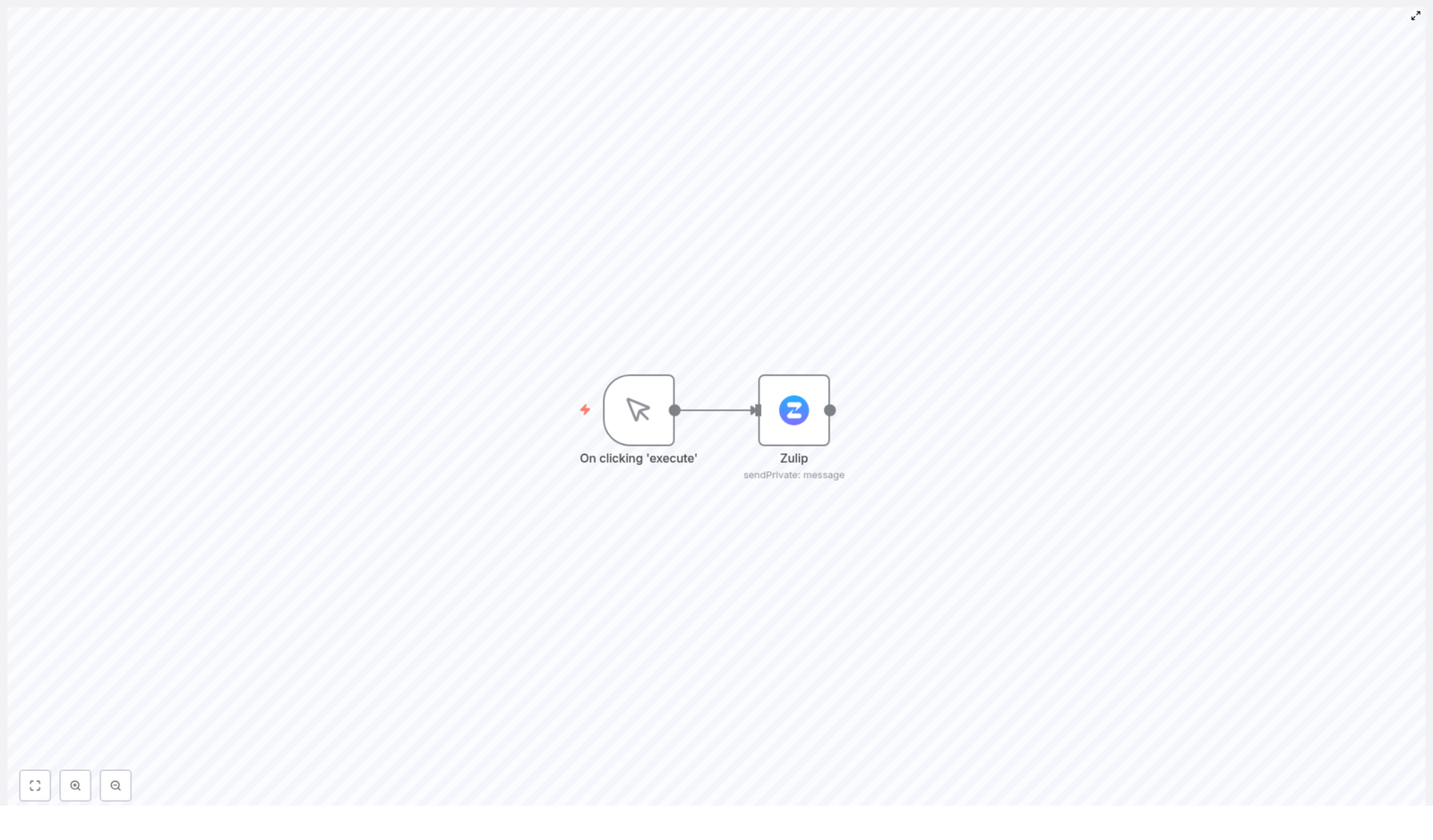
The workflow is composed of two nodes:

  • A Manual Trigger node that starts the workflow on demand.
  • A Zulip node that calls the Zulip API to send one or more private messages to specified recipients.

This template is useful for testing Zulip integration, sending ad hoc private notifications, or wiring it into more complex workflows as a reusable sub-flow.

Background: n8n and Zulip

n8n

n8n is an open-source workflow automation platform that connects multiple services and APIs through a node-based interface. Each node performs a specific task, such as triggering a workflow, transforming data, or calling an external API. Workflows can be executed manually, on a schedule, or in response to external events.

Zulip

Zulip is an open-source team chat application that structures conversations by topics. It supports:

  • Private messages (direct messages) between one or more users.
  • Group chats via multiple recipients in a single private message.
  • Public streams and topics for team-wide discussions.

The workflow described here focuses specifically on the private messaging capability using the Zulip API.

Workflow Architecture

At a high level, the workflow has a straightforward architecture:

  1. Manual Trigger node
    • Execution is initiated when the user clicks Execute Workflow in the n8n editor.
    • No external input is required, which makes it ideal for testing or controlled, on-demand messaging.
  2. Zulip node
    • Consumes the trigger event and uses configured Zulip API credentials to authenticate.
    • Sends a private message to one or more recipients specified by email address.
    • Allows customization of the message body within the node configuration.

Data flow is linear and predictable. The Manual Trigger simply passes a single item into the Zulip node, and the Zulip node uses static configuration values (for example, hardcoded recipient emails and message content) unless you extend it to use dynamic data from previous nodes.

Node-by-Node Breakdown

1. Manual Trigger Node

Purpose

The Manual Trigger node is used to initiate the workflow only when explicitly requested from the n8n UI. It is suitable for:

  • Testing the Zulip integration and credentials.
  • Sending one-off private messages on demand.
  • Using the workflow as a controlled utility instead of an always-on automation.

Behavior

  • The node emits a single item each time you click Execute Workflow.
  • It does not require any parameters or configuration for this template.
  • It does not modify data, it only acts as a starting signal for downstream nodes.

2. Zulip Node

Role in the Workflow

The Zulip node is configured to send a private message via the Zulip API. It uses the credentials you configure in n8n to authenticate and then sends a message to the specified recipients.

Key Configuration Parameters

When you configure the Zulip node for this template, pay attention to the following fields:

  • Operation / Message Type
    Ensure that the node is set to send a private message. In the node configuration, this typically corresponds to choosing the appropriate operation or message type that targets one or more users directly rather than a stream.
  • To
    In the to field, specify the recipients by their Zulip email addresses. This field usually accepts:
    • A single email address for a one-to-one private message.
    • Multiple email addresses for a group private message.

    Make sure the email addresses match existing Zulip users on your Zulip server. If an email does not correspond to a valid user, the Zulip API request will fail.

  • Credentials
    Select the zulipApi credentials you have configured in n8n. These credentials handle:
    • Authentication against your Zulip instance.
    • Authorization to send messages as the associated Zulip user.
  • Message Content
    Define the text of the private message in the node configuration. For this simple template, the content is static, but you can later parameterize it using expressions or data from previous nodes.

Execution Flow and Output

  • On execution, the node sends a single Zulip API request using the configured zulipApi credentials.
  • If the request is successful, the node returns the Zulip API response, which you can inspect in the n8n execution view.
  • If the request fails, n8n will surface the error message from the Zulip API in the node execution details.

Configuring Zulip API Credentials in n8n

Before the Zulip node can send messages, you must configure the zulipApi credentials in n8n.

Steps to Add Zulip Credentials

  1. Open the Credentials section in your n8n instance.
  2. Create a new credential of type Zulip API (or select the relevant Zulip credential type provided by your n8n version).
  3. Provide the required details, typically including:
    • Base URL of your Zulip instance, for example https://your-zulip-domain.example.com.
    • API key obtained from your Zulip user settings.
    • Any additional fields requested by the Zulip credential type in n8n, such as the associated email or username, if applicable.
  4. Save the credential and optionally test it in the n8n UI if a test function is available.
  5. Back in the workflow, open the Zulip node and select the newly created zulipApi credential from the credentials dropdown.

Once credentials are configured and selected, n8n will use them to authenticate every time the Zulip node executes.

Typical Use Cases

Although the template is minimal, it can be applied in several real-world automation scenarios:

  • Targeted reminders Manually trigger the workflow to send reminders to specific team members, for example about deadlines, meeting follow-ups, or approvals.
  • On-demand alerts Use the manual trigger during testing or incident response to send private alerts to a small group of stakeholders.
  • Integration with other workflows While this template uses a Manual Trigger, the Zulip node configuration can be reused in more complex workflows that react to events from other tools, then send private notifications to individuals in Zulip.

Configuration Notes and Edge Considerations

Recipient Handling

  • All recipients in the to field must be valid users on the configured Zulip server.
  • If one or more email addresses are invalid, the Zulip API may reject the entire request, depending on the server configuration.
  • For testing, start with a single known-valid email address to confirm connectivity and permissions.

Authentication and Permissions

  • The message is sent as the Zulip user associated with the API key configured in the zulipApi credentials.
  • Ensure this user has permission to send private messages to the intended recipients according to your Zulip organization settings.

Error Handling

The template itself is intentionally simple and does not include explicit error-handling branches. However, n8n will still:

  • Mark the workflow execution as failed if the Zulip API returns an error status.
  • Display the error details in the Zulip node execution panel, which can include HTTP status codes and messages from Zulip.

You can later extend the workflow with additional nodes to:

  • Catch errors and send alternative notifications.
  • Log failures to another system, such as a database or logging tool.

Advanced Customization Ideas

Once the basic template is working, you can evolve it into a more flexible automation by:

  • Using dynamic message content Replace static text in the Zulip node with n8n expressions that reference data from previous nodes or user input.
  • Replacing the Manual Trigger Swap the Manual Trigger node with:
    • A webhook trigger to send Zulip messages in response to external HTTP calls.
    • A schedule trigger to send recurring reminders.
    • Other app-specific triggers to react to events in your existing tooling.
  • Branching by recipient Add logic nodes to route messages to different recipient lists based on conditions, such as severity level or event type.

All of these enhancements build on the same core pattern described in this template: a trigger node feeding into a properly configured Zulip node with valid credentials and recipients.

Summary

This n8n workflow template demonstrates a clear and minimal pattern for sending private messages on Zulip:

  • A Manual Trigger node executes the workflow on demand.
  • A Zulip node, using configured zulipApi credentials, sends a private message to specified email addresses.

By integrating Zulip with n8n in this way, you can automate targeted, private communication for reminders, alerts, and notifications, while keeping full control over when and how messages are sent.

Call to Action: Import this template into your n8n instance, configure your Zulip API credentials, and start sending private messages programmatically to streamline your team communication.

Automate WordPress Posting & Featured Image Setup

Automate WordPress Posting & Featured Image Setup with n8n and Airtable

1. Overview

This reference guide documents an n8n workflow template that automates publishing blog posts from Airtable to WordPress, including automatic featured image selection. The workflow retrieves Markdown content from Airtable, converts it to HTML, publishes it via the WordPress REST API, uploads an image from Pexels as media, assigns it as the featured image, and then updates the originating Airtable record.

The documentation below is written for users already familiar with n8n concepts such as nodes, triggers, credentials, and data mapping.

2. Prerequisites & External Services

2.1 Required Services and Credentials

  • WordPress site with REST API access
    You need:
    • A WordPress user account with permission to create posts and upload media.
    • An Application Password generated for that user to authenticate API calls from n8n.
  • Airtable base
    An Airtable base with at least the following fields:
    • Keyword – used to search for a relevant image.
    • Title – used as the WordPress post title.
    • Blog content – the full blog body in Markdown format.
    • A status field (for example Status) that includes values like To Post and Posted for workflow control.
  • Pexels API access
    An API key for the Pexels image service so the workflow can retrieve a relevant image for each post based on its keyword.

2.2 Content Format Requirements

  • Markdown content
    The Blog content field in Airtable should contain Markdown-formatted text. This content is later converted to HTML for WordPress compatibility. The Markdown can be authored manually or generated by AI tools.

3. Workflow Architecture

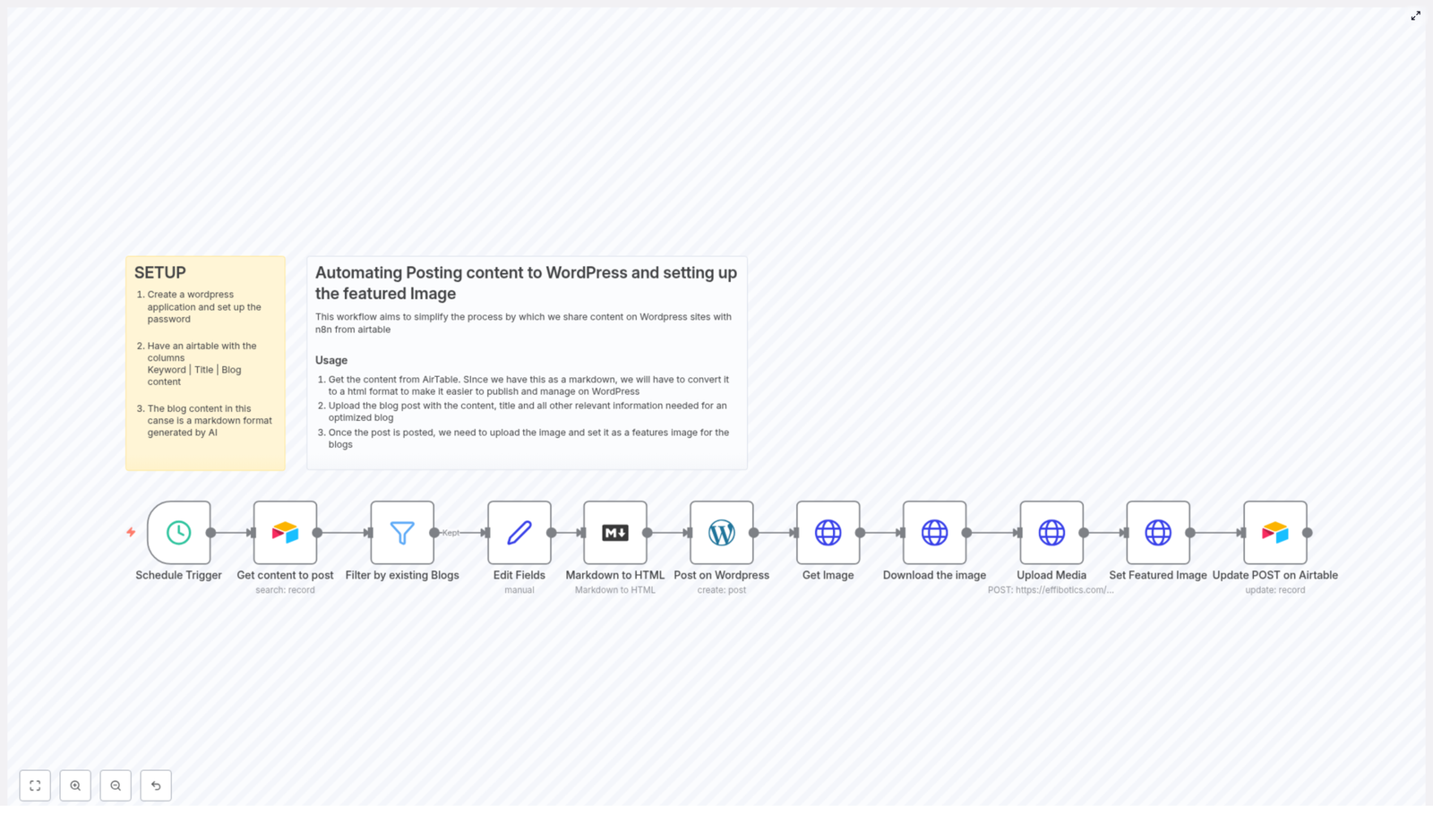
The workflow is designed as a scheduled, batch-oriented automation that pulls pending records from Airtable, processes them one by one, and then updates their status after publishing. At a high level, the workflow performs the following operations:

  1. Trigger – Start execution on a time-based schedule.
  2. Fetch records from Airtable – Retrieve all items marked as ready to publish (for example status To Post).
  3. Filter existing posts – Skip any records that already correspond to a published blog to avoid duplicates.
  4. Normalize and map fields – Extract and map Title, Keyword, and Blog content into a consistent internal structure.
  5. Convert Markdown to HTML – Transform the post body into HTML for WordPress.
  6. Create WordPress post – Publish the post using the WordPress REST API with the converted HTML content.
  7. Retrieve image from Pexels – Use the keyword to request a relevant image via Pexels API.
  8. Download selected image – Download the chosen image so it can be uploaded to WordPress.
  9. Upload image to WordPress media library – Create a media item in WordPress.
  10. Set featured image on the post – Assign the uploaded media as the featured image for the newly created post.
  11. Update Airtable record – Mark the record as Posted and optionally store any related metadata to prevent reprocessing.

4. Node-by-Node Breakdown

4.1 Schedule Trigger

Node type: Schedule Trigger
Purpose: Periodically start the workflow to check for new content in Airtable.

Typical configuration:

  • Mode: Recurring interval or cron expression, depending on your publishing cadence.
  • Example: Run every hour or every day at a specific time.

The Schedule Trigger does not require external credentials. It simply initiates the workflow and passes control to the first data node.

4.2 Retrieve Content from Airtable

Node type: Airtable
Purpose: Fetch all records that are ready to be posted.

Key parameters:

  • Credentials: Airtable API key or personal access token configured in n8n.
  • Base ID & Table name: The base and table that store blog data.
  • Filter / Formula: A filter that returns only records with a status like To Post. For example, a formula can check a Status field equals "To Post".
  • Fields: At minimum, select:
    • Keyword
    • Title
    • Blog content
    • The status field used for tracking (for example Status).

The node outputs one item per Airtable record, which subsequent nodes process individually or as a collection, depending on your node configuration.

4.3 Filter by Existing Blogs

Node type: Typically an IF node, Filter node, or similar conditional logic.
Purpose: Ensure that records already published are not processed again.

Typical logic:

  • Check whether the record already has:
    • A status of Posted in Airtable, or
    • Another field that indicates it has been processed (for example a stored WordPress post ID, depending on how your template is configured).
  • Only pass items that are not yet published to the next steps.

This prevents duplicate WordPress posts and keeps Airtable and WordPress in sync. The exact condition depends on how the template tracks processed items, but the intent is always to avoid reposting the same content.

4.4 Edit Fields (Data Mapping)

Node type: Set / Function / Item Lists (depending on template implementation).
Purpose: Normalize and map Airtable fields into a structure that is easier to consume by later nodes.

Key operations:

  • Extract Title from the Airtable record and map it to a field like postTitle.
  • Extract Keyword and map it to a field like postKeyword for use with the Pexels API.
  • Extract Blog content and map it to a field like postMarkdown.

This step ensures that subsequent nodes reference consistent property names, which simplifies configuration and reduces the risk of misconfigured expressions.

4.5 Markdown to HTML Conversion

Node type: Markdown conversion utility or a Function node that uses a Markdown library, depending on the template.
Purpose: Convert the Markdown-formatted body into HTML suitable for WordPress.

Input: The postMarkdown field from the previous node.

Output: A corresponding postHtml field that contains the fully converted HTML string.

This conversion preserves headings, lists, links, and other Markdown elements in a format that WordPress can render correctly in the post content area.

4.6 Post on WordPress

Node type: WordPress (REST API)
Purpose: Create a new blog post in WordPress using the title and HTML content.

Key parameters:

  • Credentials: WordPress credentials configured with an Application Password for the chosen user.
  • Operation: Create Post.
  • Title: Mapped from postTitle.
  • Content: Mapped from postHtml.
  • Status: Typically set to publish, although you can configure draft or other states if needed.

Output: The node returns the newly created post object, including its post ID. This ID is important for the subsequent step that attaches a featured image.

4.7 Get Relevant Image from Pexels

Node type: HTTP Request or dedicated Pexels node (if available in your n8n version).
Purpose: Retrieve a relevant image based on the post keyword.

Key parameters:

  • Method: GET
  • Endpoint: Pexels search endpoint.
  • Query parameter: query mapped from postKeyword.
  • Headers: Include the Pexels API key in the required authorization header.

Output: A list of images or a single image object, depending on the configuration. The workflow typically selects one image URL from the response to use for download.

Edge case handling: If the Pexels API returns no results for a given keyword, the workflow should either:

  • Fail gracefully and skip image assignment for that post, or
  • Use a fallback keyword or default image, if you configure such logic.

The template is focused on the normal case where at least one relevant image is returned.

4.8 Download the Image

Node type: HTTP Request (binary data enabled).
Purpose: Download the selected image file from the Pexels URL.

Key parameters:

  • Method: GET
  • URL: The chosen image URL from the previous node.
  • Response format: Binary data, so the image can be passed to the WordPress media upload node.

Output: Binary image data attached to the item, typically stored under a property such as data or a named binary property.

4.9 Upload Media to WordPress

Node type: WordPress (Media / Upload Media operation).
Purpose: Upload the downloaded image to the WordPress Media Library.

Key parameters:

  • Credentials: Same WordPress credentials used for post creation.
  • Operation: Upload Media.
  • Binary property: Reference to the binary image data from the download node.
  • File name and MIME type: Either inferred from the response headers or set explicitly in the node configuration.

Output: The created media object, including a media ID. This ID is required to set the featured image on the post.

4.10 Set Featured Image

Node type: WordPress (Update Post operation).
Purpose: Associate the uploaded media item as the featured image for the newly created post.

Key parameters:

  • Post ID: The ID returned by the earlier “Post on WordPress” node.
  • Featured Media: The media ID returned by the “Upload Media to WordPress” node.

After this step, the WordPress post will display the selected image as its featured image in themes and archives that support featured images.

4.11 Update Airtable Record

Node type: Airtable (Update operation).
Purpose: Mark the Airtable record as processed so it is not reposted.

Key parameters:

  • Record ID: The original Airtable record ID from the initial retrieval node.
  • Fields to update:
    • Set the status field to Posted.
    • Optionally store the WordPress post ID or URL for reference and auditing.

This step closes the loop between Airtable and WordPress and provides clear tracking of what has been published.

5. Configuration Notes & Integration Details

5.1 WordPress Application Password

  • Generate an Application Password in your WordPress user profile.
  • Configure it as credentials in n8n under the WordPress node credentials.
  • Ensure the user has sufficient capabilities to create posts and upload media.

5.2 Airtable Structure

  • Use consistent field names (Keyword, Title, Blog content, and a status field) to match the template expectations.
  • Make sure the status field initial value is set to To Post for records you want the workflow to process.

5.3 Markdown to HTML Compatibility

  • Verify that the Markdown syntax used in your content aligns with the converter used in the workflow.
  • Test posts that include headings, lists, links, and images to ensure the HTML renders correctly in your WordPress theme.

5.4 Error Handling Considerations

The template focuses on the core happy path, but during implementation you should consider:

  • Airtable connectivity issues: Handle cases where Airtable is unavailable or returns no records.
  • WordPress API errors: For example authentication failures, permission issues, or invalid content payloads.
  • Pexels rate limits or empty results: Define what should happen if no image is returned for a given keyword.
  • Partial failures: For example, post creation succeeds but media upload fails. In such cases, you may want to:
    • Still mark the record as posted but without a featured image, or
    • Flag the record for manual review instead of setting it to Posted.

6. Advanced Customization Options

Once the base template is running correctly, you can extend it to better fit your content pipeline:

  • Custom post statuses: Create posts as draft for editorial review before publishing.
  • Additional WordPress fields: Map categories, tags, or custom fields from Airtable to WordPress.
  • Image selection rules: Add logic to select images based on additional Airtable fields, not only the keyword.
  • Multi-language workflows: Use separate Airtable views or fields to manage localized content and publish to different WordPress sites or categories.

7. Benefits of This n8n Workflow Template

  • Time savings: Automates manual tasks such as copy and paste, media upload, and featured image assignment.
  • Consistent formatting: Standardizes content by converting Markdown to HTML before publishing.
  • Automatic visual enhancement: Enriches posts with relevant images fetched from Pexels using the post keyword.
  • Clear content tracking: Keeps Airtable in sync with WordPress by updating each record to Posted after successful publication.

8. Next Steps

How to Build a Chinese Translator with Line and OpenRouter.ai

How to Build a Chinese Translator with Line and OpenRouter.ai (So You Never Copy-Paste Into Google Translate Again)

Imagine This…

You are chatting with someone in Chinese, screenshots are flying in, text blocks are piling up, and you are stuck in a never-ending loop of:

  • Copy message
  • Open translator
  • Paste
  • Squint at tones and characters
  • Repeat until your soul leaves your body

Now imagine instead that you just send a message or image in Line, wait for a short loading animation, and then – like magic – you get Chinese characters, pinyin, and English translation back in the same chat.

That is exactly what this n8n workflow template does, using the Line Messaging API plus OpenRouter.ai large language models. No more manual copy-paste gymnastics, just smooth, automated translation right where you are already chatting.

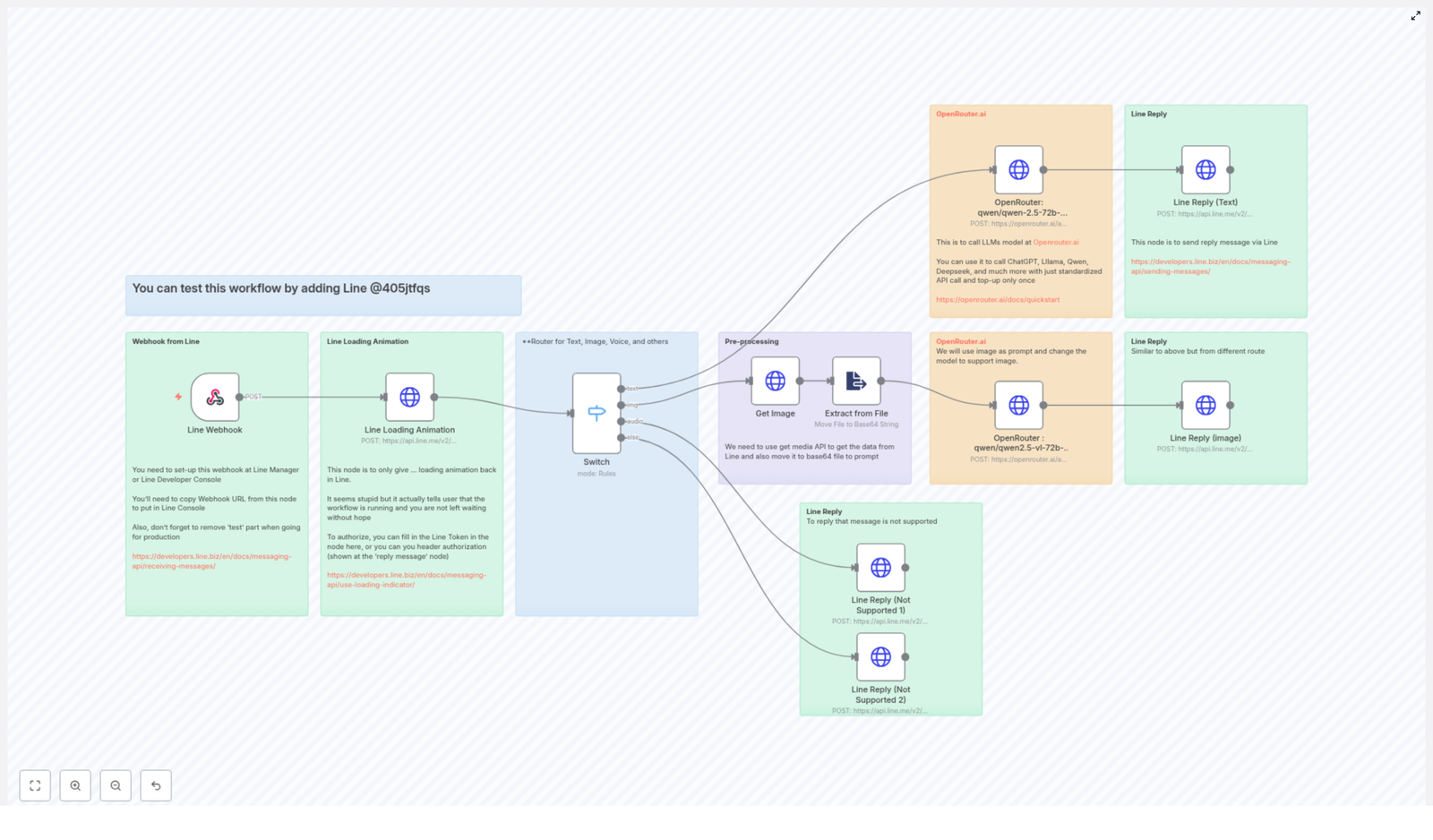
What This n8n Workflow Actually Does

This workflow turns your Line account into a mini Chinese translator bot that can:

  • Receive text messages in Line and send them to an OpenRouter.ai LLM
  • Return Chinese characters, pinyin, and English meaning
  • Handle images, grab them via Line’s Get Image API, and send them to an image-capable LLM for translation
  • Reply directly in Line with the translation results
  • Politely tell users when they send something unsupported, like audio, instead of silently panicking

Under the hood, the flow is powered by:

  • A Line Webhook that listens for incoming messages
  • A loading animation node to reassure users that things are happening in the background
  • A Switch node that decides if the message is text, image, audio, or something else
  • Text and image OpenRouter.ai LLM calls for translation
  • Reply nodes that send everything back neatly to the user

How the Workflow Flows (From Message to Translation)

1. Line Webhook – Your Entry Gate

Everything starts with the Line Webhook node. This is where Line forwards incoming messages to your n8n workflow.

To make it work, you need to:

  • Set your workflow URL as the Webhook URL in the Line Manager or Developer Console
  • Ensure the webhook is enabled so Line can actually send events to your workflow

Once that is done, every time a user sends a message, your workflow wakes up and gets to work.

2. Line Loading Animation – The “Please Hold” Moment

Users hate staring at silence, and so do we. That is why the workflow sends a loading animation in Line right after receiving the message.

This node simply tells the user, in a friendly visual way, that their request is being processed. No one needs to wonder if the bot fell asleep.

3. Switch Node – Message Type Router

Next up is the Switch node, which acts like the bouncer at the door deciding where each message should go.

It checks the message type and routes it accordingly:

  • Text – goes to the text translation chain using an OpenRouter text model
  • Image – goes to the image processing nodes for OCR-style translation
  • Audio & others – get sent to a friendly “unsupported message type” reply

This way, each type of content is handled by the right part of the workflow, and you do not need to manually sort anything.

Handling Text vs Images

4. Text Messages – Straight to OpenRouter

When the user sends text, the flow is pleasantly simple:

  1. The text is passed to an OpenRouter.ai text translation model
  2. The model returns:
    • Chinese characters
    • Pinyin
    • English translation
  3. The result is formatted and sent back through a Line reply node

The result: the user gets a neat translation bundle with characters, pronunciation, and meaning all in one place.

5. Image Messages – Pre-processing Before Translation

Images take a slightly longer route, but it is still fully automated.

For image messages, the workflow does the following:

  1. Uses Line’s Get Image API to fetch the image binary data
  2. Extracts the image file content and converts it into a base64 string
  3. Includes that base64-encoded image in the prompt for an image-capable OpenRouter.ai LLM
  4. Receives translated text back from the model

In other words, the workflow handles the annoying technical bits of binary data and encoding so you do not have to.

Talking to OpenRouter.ai

6. Calling the Right OpenRouter Models

The workflow uses two different OpenRouter.ai model setups, depending on the content type:

  • Text translation model
    – Input: raw user text from Line
    – Output: Chinese characters, pinyin, and English translations
  • Image translation model
    – Input: base64-encoded image content
    – Output: extracted text plus translations, using image understanding and OCR-like capabilities

Both models plug neatly into n8n nodes, so your main job is configuring the prompts, credentials, and any formatting you want in the final response.

Replying in Line (And Handling the “Nope” Cases)

7. Reply Nodes – Sending Results Back to the User

Once the translation is ready, the workflow uses Line Reply nodes to send everything back through Line’s Messaging API.

These nodes:

  • Take the processed translation from the LLM
  • Format it into a Line reply message
  • Send it directly to the user in the same conversation thread

The user experience is simple: send message or image, wait for the loading animation, receive translation.

8. Unsupported Message Types – Polite Decline

Not every message type is supported in this template. When the Switch node detects something like audio or other unsupported content, the workflow does not just fail silently.

Instead, it sends a clear and polite message, for example:

“Please try again. Message type is not supported.”

This keeps the user informed and gently nudges them back to using text or images, which the workflow can actually handle.

Setup Tips & Important Details

Before you unleash your new Chinese translator bot on the world, keep these practical points in mind:

  • Line Channel Access Token
    Make sure you set your Line Channel Access Token correctly so the API calls can authenticate and the bot can send replies.
  • Webhook URL Cleanup
    If you used any test or temporary URLs during development, remove or update them when you move to production. Old test settings can cause very confusing bugs.
  • Official Documentation
    For deeper configuration, rate limits, and extra capabilities, check:
    • The official Line Messaging API docs
    • The official OpenRouter.ai documentation for supported models and features

Try the Workflow Live in Line

If you want to see this in action before you start tweaking the template, you can test the workflow directly in Line.

Add this Line ID:

@405jtfqs

Then:

  • Send a text message you want translated
  • Or send an image that contains text
  • Watch as the bot replies with:
    • Chinese characters
    • Pinyin
    • English meaning

It is a quick way to confirm the full flow, from webhook to LLM to reply, is working as expected.

Next Step: Use the n8n Template and Build Your Own Bot

If you are tired of repetitive translation tasks and ready to let automation handle the boring parts, this n8n workflow template is a great starting point.

You can customize it further by:

  • Adjusting the prompt for the OpenRouter models
  • Formatting the reply messages to match your brand or teaching style
  • Extending the Switch node logic to handle more cases in the future

Ready to explore the template in n8n?

Start building your own integrated translation bot today, and let n8n, Line, and OpenRouter.ai handle the language heavy lifting while you focus on the conversation.

Generate Google Meet Links Directly From Slack

Generate Google Meet Links Directly From Slack

Picture This: “Can Someone Drop a Meet Link?”… Again

You are in a busy Slack channel, the discussion is heating up, and someone says the classic line: “Let’s just jump on a quick call.” Then the chaos begins.

Who creates the Google Meet? Who has the right calendar? Why is everyone waiting for that one person who always “just needs a second” to find the Meet button?

If you are tired of playing “who has the meeting link,” this n8n workflow template is your new favorite coworker. With a simple Slack slash command, you can instantly generate a Google Meet link, drop it in the channel, and move on with your life.

What This n8n Workflow Template Actually Does

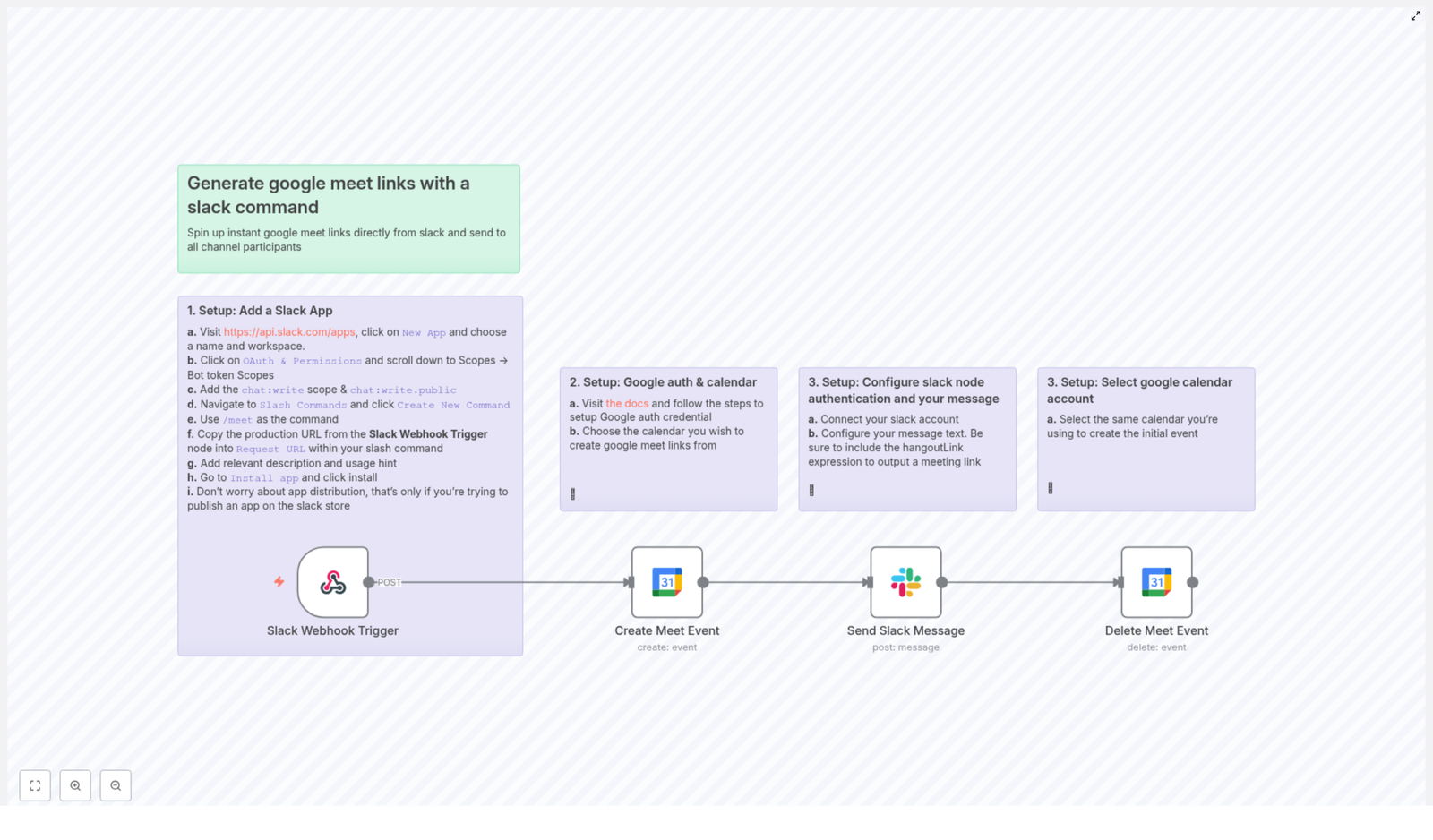
This template connects Slack and Google Calendar so you can create Google Meet links directly from Slack using a slash command. No tab switching, no manual event creation, no copy-paste juggling.

Here is the magic in plain terms:

  • You type /meet in Slack.
  • n8n listens for that command, creates a short Google Calendar event with a Meet link, and grabs the hangoutLink.
  • It posts that Google Meet link right back into the same Slack channel.
  • Then, to keep your calendar from looking like a graveyard of 15-minute “Quick chat” events, the workflow deletes the event again.

Result: instant Google Meet links in Slack, with zero manual work.

Why Automate Google Meet Links in Slack?

Manually creating and sharing meeting links is one of those tiny tasks that does not feel like a big deal… until you do it 20 times a day. Then it becomes a full-time job you never applied for.

Automating Google Meet link generation with n8n and Slack helps you:

  • Save time – No more jumping between Slack and Google Calendar.
  • Avoid mistakes – No wrong links, no forgotten invites, no “which Meet is this?” confusion.
  • Keep everyone aligned – The link is shared right in the channel where the conversation started.
  • Keep your calendar clean – The event is deleted after the link is shared, so your calendar is not cluttered with temporary calls.

In short, you get smoother meetings, less friction, and fewer “wait, where is the link?” messages.

How the n8n Workflow Works Behind the Scenes

Here is what happens each time someone uses the slash command in Slack:

  • The Slack Webhook Trigger node listens for the /meet command in your Slack workspace.
  • When the command comes in, the workflow uses the Google Calendar node to create a Google Meet event that:
    • Starts immediately
    • Lasts 15 minutes
    • Includes a Google Meet hangoutLink
  • The workflow then sends a Slack message back to the originating channel with the newly created Meet link.
  • Finally, the Google Calendar event is deleted so your calendar stays tidy while the Meet link lives on in Slack.

All of this happens automatically in the background. You just see a Meet link appear like it was always meant to be there.

Quick Setup Overview

To get this workflow running, you will set up three main things:

  1. A Slack app with a slash command.
  2. Google authentication and calendar access in n8n.
  3. Slack messaging configuration that posts the Meet link back to your channel.

Below is the detailed guide, step by step, so you can get everything connected without guesswork.

Step 1 – Create and Configure Your Slack App

This is where you teach Slack how to talk to your n8n workflow.

  1. Go to the Slack API Apps page and create a new app.
    • Pick a name that makes sense (for example, “Meet Bot” or “Instant Meet”).
    • Select the workspace where you want to use the /meet command.
  2. In your app settings, navigate to OAuth & Permissions.
  3. Under Bot Token Scopes, add these scopes:
    • chat:write
    • chat:write.public

    This gives your bot permission to post messages in channels.

  4. Next, set up a Slash Command:
    • Create a new command named /meet.
    • Copy the webhook URL from your Slack Webhook Trigger node in n8n.
    • Paste that URL as the Request URL for the slash command.
    • Add a short description and usage hint so your teammates know what it does, for example:
      • Description: “Create an instant Google Meet link.”
      • Usage hint: “Type /meet to generate a meeting link.”
  5. Finally, click Install App to add your new Slack app to your workspace.

Once this is done, Slack knows how to send the /meet command to your n8n workflow.

Step 2 – Connect Google with n8n and Choose Your Calendar

Now you need to let n8n talk to Google Calendar so it can create the Meet links for you.

Follow the official n8n Google OAuth documentation to configure your Google credentials. This ensures secure access to your Google account and calendar.

After your credentials are set up, choose the Google Calendar where you want these Google Meet links to be created. This is the calendar that will briefly host the 15-minute events used to generate the Meet URLs.

Step 3 – Configure the Slack Message in n8n

With Slack and Google both connected, you can now define what gets posted back into the channel.

In your Slack node inside the workflow:

  • Connect your Slack account so the node can send messages as your bot.
  • Set the message text to include the Google Meet link by using the hangoutLink expression.

The hangoutLink expression dynamically inserts the meeting URL created by the Google Calendar node, so each time you run the workflow, a fresh link is sent to Slack.

Step 4 – Make Sure the Right Google Calendar Account Is Used

To avoid any surprise “wrong account” issues, double check that the Google Calendar node is using the same calendar account you used for the initial Google Meet event configuration.

This keeps everything consistent and ensures that the event is created and deleted correctly in the right calendar.

Benefits You Get From This n8n Template

Once you have everything wired up, you get a surprisingly big payoff for a small setup:

  • Instant meeting links in Slack – Just type /meet and the link appears.
  • Google Calendar automation – Events are created automatically to generate Meet links.
  • Cleaner calendars – Temporary events are deleted after the link is posted, so your calendar is not flooded with “test” or “quick chat” entries.
  • Better team productivity – Less time chasing links, more time actually talking.

It is the small automation that quietly saves you from a lot of repetitive clicks.

Next Steps: Try the Template and Stop Manually Creating Meet Links

If your team lives in Slack and uses Google Meet, this workflow is a simple quality-of-life upgrade. No more asking “who has the link” or digging through calendar invites.

Set up the Slack app, connect your Google Calendar, configure the Slack message, and you are ready to generate instant meeting links with a single slash command.

Ready to plug this into your n8n instance and let it do the boring part for you?

Automated Book Recommendations with n8n & Open Library

Automated Book Recommendations with n8n & Open Library

Why automate your book recommendations?

Imagine this: every Friday at 11:00 AM, a fresh book recommendation quietly lands in your inbox. No scrolling through endless lists, no decision fatigue, just a new title waiting for you. Sounds nice, right?

That is exactly what this n8n workflow template does. It connects to Open Library, grabs a random book from a subject you choose (by default, juvenile_literature), and emails you the details. You set it up once, then let the automation do the rest.

What this n8n workflow actually does

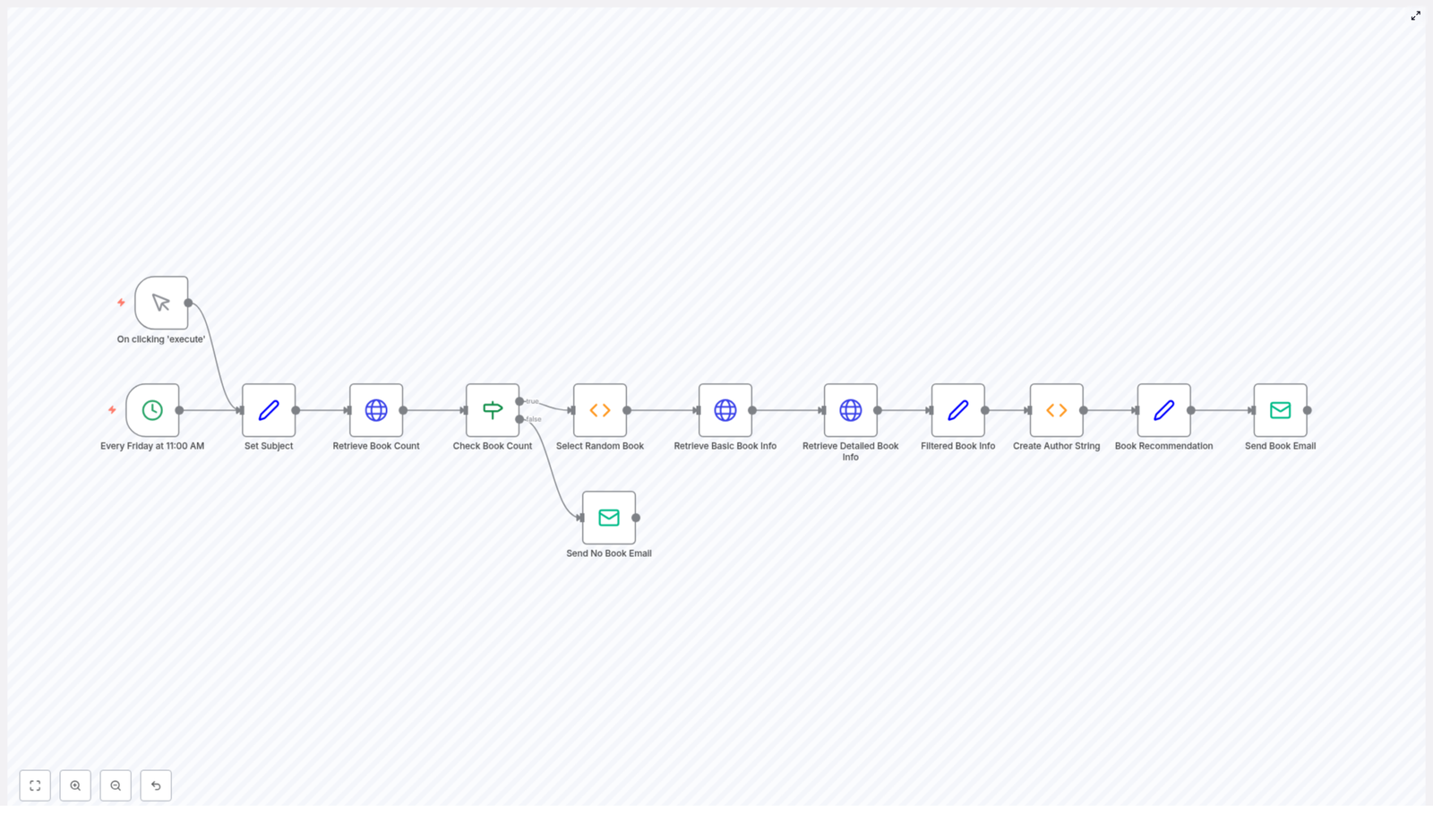
At a high level, the workflow:

  • Runs on a schedule (every Friday at 11:00 AM) or whenever you trigger it manually
  • Looks up how many books exist in a specific Open Library subject
  • Checks if that subject has any books available
  • Picks one random book from the list
  • Collects both basic and detailed info about that book
  • Formats the authors as clickable links to their Open Library profiles
  • Sends you a nicely formatted HTML email with the full recommendation

So instead of hunting for something new to read, you just open your inbox and let the workflow surprise you.

When is this template useful?

This workflow is great if you:

  • Love reading but hate deciding what to read next
  • Want a fun, low-effort way to discover new titles
  • Are building a reading habit and like getting a weekly “nudge”
  • Curate books for kids or young readers and want random juvenile literature picks
  • Enjoy experimenting with n8n and want a practical, easy-to-customize example

And yes, you can absolutely switch the subject to something else. The workflow is built so you can tweak the topic in seconds.

How the workflow flows: step-by-step overview

Let’s walk through the journey from “nothing running” to “book in your inbox”.

  1. The workflow is triggered (either manually or by a weekly schedule).
  2. The subject is set to juvenile_literature by default.
  3. An HTTP request asks Open Library how many works exist for that subject.
  4. An IF check confirms that at least one book is available.
  5. If there are no books, you get an email saying nothing is available for that subject.
  6. If there are books, a random index is generated within the available range.
  7. Another HTTP request fetches basic info for the randomly selected book.
  8. A follow-up request retrieves detailed data like the description.
  9. The workflow merges and cleans up the data, including building the Open Library URL.
  10. A small function formats author names into HTML links.
  11. An HTML email is generated and sent to your configured email address.

Diving into the n8n nodes

1. Trigger nodes: manual and scheduled

The workflow starts with two trigger options:

  • Manual Trigger – Lets you run the workflow instantly from n8n whenever you want a recommendation on demand.
  • Cron Trigger – Schedules the workflow to run automatically every Friday at 11:00 AM. You can change the day and time to whatever fits your routine.

Use both if you like: automatic weekly picks plus the ability to grab an extra book whenever you feel like it.

2. Set Subject: choose what you want to read about

This node sets the subject that Open Library will use. In the template, it is statically set to juvenile_literature. That is perfect for children’s or young readers’ books.

If you want a different genre or topic, you simply replace that value with another Open Library subject key. The rest of the workflow keeps working the same way.

3. Retrieve Book Count from Open Library

Next, an HTTP Request node asks Open Library how many works exist for the chosen subject. It calls:

http://openlibrary.org/subjects/juvenile_literature.json?limit=0

The important part here is the metadata in the response, especially the work_count field. That tells n8n how many books it can randomly choose from.

4. Check Book Count: make sure there is something to recommend

An IF node checks whether work_count is greater than zero. There are two possible paths from here:

  • If work_count is 0 – No books are available for that subject. The workflow sends you a quick email letting you know there are no titles to recommend.
  • If work_count is greater than 0 – The workflow continues and picks a random book.

5. Select Random Book: pick a surprise

A Function node now comes into play. It generates a random index between 0 and the total number of works minus 1. That index is then used as an offset in the next HTTP request so that the workflow retrieves just one specific, random book from the subject list.

6. Retrieve Basic Book Info

Using the random offset, another HTTP Request node calls Open Library again to get the basic data for that one selected work. From this response, you get fields like:

  • Book title
  • Author keys
  • Book key

This information is the foundation for the next, more detailed lookup.

7. Retrieve Detailed Book Info

Now that you have the book’s key, the workflow sends another HTTP request to Open Library to fetch more detailed information. This typically includes:

  • Book description
  • Additional metadata about the work

At this point, you have both the basic and detailed data needed to build a rich recommendation email.

8. Filtered Book Info: combine and clean up the data

This node merges the key details from the previous responses and prepares them for the email. It pulls together information like:

  • Title
  • Description
  • Author data
  • A direct URL to the book’s page on Open Library

The result is a clean, structured set of fields that are easy to drop into an HTML email template.

9. Create Author String: clickable author links

Here, a Function node takes the author data and turns each author into a clickable HTML anchor tag. Each name links to the author’s profile page on Open Library.

The output is a nicely formatted string of authors that looks good in the email and invites you to explore more of their work.

10. Send Book Email: your recommendation arrives

Finally, an Email node sends everything to your inbox. It uses HTML formatting to include:

  • The book title
  • Linked author names
  • The book description
  • A clickable link to view the book on Open Library

You can customize the subject line, body text, and recipient email address to match your style or share recommendations with others.

Why this n8n workflow makes life easier

  • Save time – No more endless browsing. A curated random pick just appears in your inbox.
  • Discover more variety – Because the book is chosen at random, you are more likely to stumble across titles you would never have searched for.
  • Easy customization – Change a single subject parameter to switch genres or topics. The automation logic stays the same.
  • Flexible scheduling – Run it weekly, daily, or only when you feel like it. Just adjust the Cron trigger or use the manual trigger.

What you need to get started

To run this template, you only need a few basics in place:

  • An active n8n instance
  • SMTP credentials configured in n8n so emails can be sent
  • Your email address set in the Send Email node

Once that is done, you can import the template, update the subject if you want a different genre, tweak the schedule, and you are ready to go.

Wrapping up

This workflow is a simple but powerful example of what you can do when you combine n8n’s automation with Open Library’s huge catalog. With just a few nodes, you turn a small weekly task into something that runs quietly in the background and keeps your reading list fresh.

Once you are comfortable with it, you can:

  • Swap in different subjects to explore new genres
  • Send recommendations to friends or family
  • Use the same pattern to automate discovery for other types of content

Try it out and make it your own

Give this workflow a spin and see how it fits into your reading routine. Start with the default juvenile_literature subject, then experiment with others. Adjust the schedule, refine the email design, or plug it into a broader content discovery system.

If you enjoy this kind of automation, keep an eye on our blog for more n8n workflow ideas and templates. And once you have customized it, share what you built so others can get inspired too.

How to Verify Phone Numbers Using n8n Workflow

How to Verify Phone Numbers Using an n8n Workflow Template

Why Phone Number Validation Matters

Accurate phone numbers are essential for user verification, transactional messaging, and reliable customer communication. Invalid or poorly formatted numbers can lead to failed SMS deliveries, security issues, and unnecessary operational cost. For teams that manage large volumes of contact data, manual checks are not sustainable.

n8n, an extensible open-source workflow automation platform, enables you to automate phone validation at scale. By combining native nodes with external APIs, you can centralize data quality checks in a repeatable, auditable workflow.

Use Case Overview

This workflow template demonstrates how to validate a phone number in n8n using the getPhoneParsed tool from uproc. The logic is intentionally simple so it can be embedded into larger automations such as user onboarding, CRM enrichment, or lead qualification pipelines.

The workflow executes the following core steps:

  • Trigger the validation process on demand or from another event
  • Provide a phone number as input
  • Send the number to uproc’s getPhoneParsed tool for parsing and validation
  • Evaluate the result and branch the flow based on whether the number is valid

Workflow Architecture

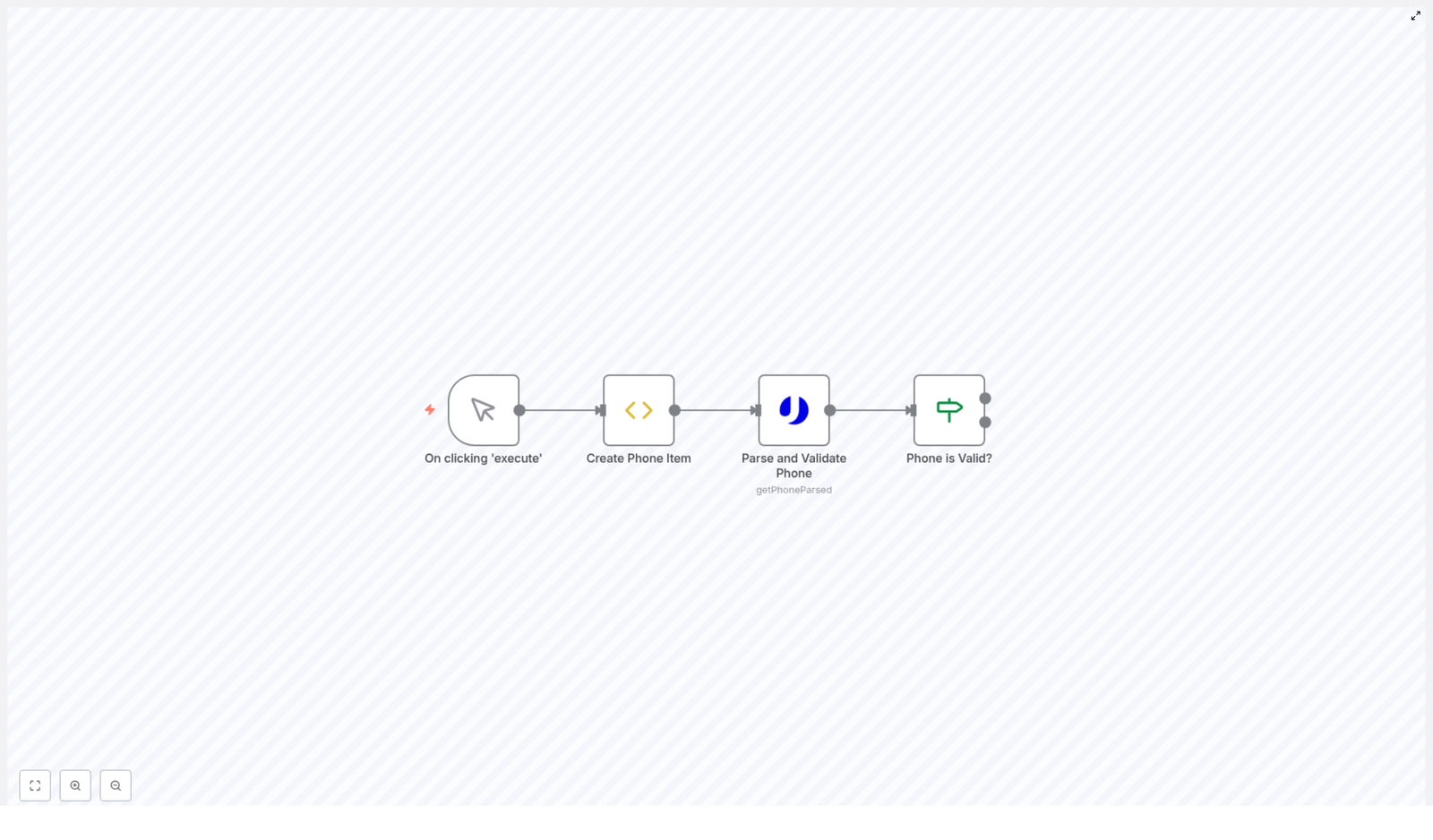
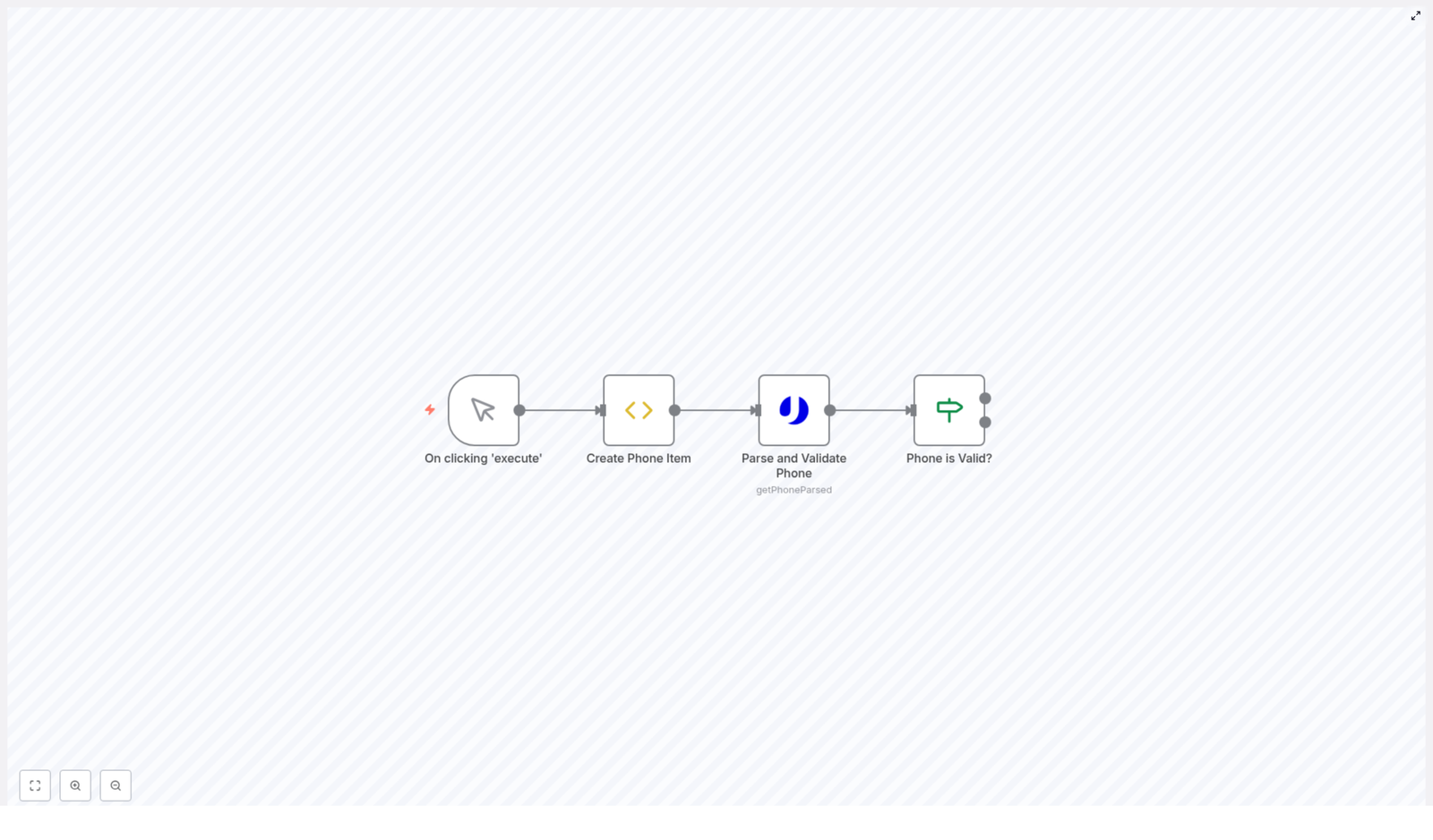
The template is composed of four primary nodes connected in sequence:

  1. Manual Trigger – Starts the workflow execution
  2. Create Phone Item – Prepares the phone number to validate
  3. Parse and Validate Phone – Calls uproc’s getPhoneParsed endpoint
  4. Phone is Valid? – Uses conditional logic to branch based on the validation result

Although minimal, this structure follows automation best practices: a clear trigger, a deterministic input, a dedicated validation step, and explicit branching logic.

Node-by-Node Breakdown

1. Triggering the Workflow

Node type: Manual Trigger

The workflow starts with a Manual Trigger node. This is ideal for testing, debugging, and demonstration purposes because it lets you execute the workflow directly from the n8n editor.

In production scenarios, automation professionals typically replace this node with more suitable triggers, for example:

  • Webhook Trigger to validate numbers from external applications or web forms
  • Cron Trigger to run scheduled bulk validations
  • App-specific Triggers (such as CRM or database events) for real-time data quality checks

The rest of the workflow remains compatible with these alternative triggers, which makes the template easy to adapt and reuse.

2. Preparing the Phone Number Input

Node type: functionItem (Create Phone Item)

This node creates the data structure that will be passed to the validation service. It sets a phone property on the current item. In the template, the phone number is hardcoded for demonstration:

item.phone = "+34605281220";
return item;

For real-world usage, you would typically replace this hardcoded value with dynamic input, for example:

  • Values coming from a previous node such as a Webhook, database query, or form submission
  • Numbers read from a CSV or spreadsheet in batch processing workflows

Maintaining a consistent field name, such as item.phone, helps standardize downstream logic and simplifies workflow maintenance.

3. Parsing and Validating the Phone Number

Node type: uproc (Parse and Validate Phone)

The core validation step is handled by the uproc node, which integrates with the getPhoneParsed tool. This node sends the phone number to uproc, which then:

  • Parses the phone number
  • Checks its structure and format
  • Determines whether the number is valid
  • Returns a response that includes a valid flag and other metadata

To use this node, you must configure valid uproc API credentials in n8n. These credentials ensure secure communication with the uproc service and are managed centrally in n8n’s credential store.

From an automation best practice perspective, keep credentials separate from workflow logic and avoid hardcoding secrets directly in nodes. This approach improves security and simplifies environment-specific configuration.

4. Conditional Logic: Is the Phone Valid?

Node type: if (Phone is Valid?)

The final node evaluates the response from uproc. It checks whether the field message.valid is equal to true. Based on this condition, the workflow branches into two paths:

  • True branch for valid phone numbers
  • False branch for invalid phone numbers

This conditional structure allows you to implement differentiated handling, such as:

  • Accepting valid numbers and storing them in a CRM or marketing platform
  • Flagging or rejecting invalid entries and notifying users or administrators
  • Triggering remediation workflows, such as asking users to update their contact information

Explicit branching like this keeps the workflow transparent and easier to troubleshoot.

Implementing the Template in Your n8n Instance

To start using this phone validation workflow template, follow these steps:

  1. Import the workflow JSON into your n8n instance using the Import from file or clipboard option.
  2. Configure uproc credentials in the n8n Credentials section and link them to the uproc node that uses the getPhoneParsed tool.
  3. Adjust the input phone number in the Create Phone Item node:
    • For testing, you may keep or change the hardcoded number.
    • For production, map this field from the data source that provides user phone numbers.
  4. Execute the workflow manually using the Manual Trigger to verify that your credentials, input, and logic are working as expected.
  5. Extend the valid and invalid branches with your own business logic, such as database updates, notifications, or error handling.

Best Practices for Phone Validation Workflows in n8n

  • Centralize validation in a reusable sub-workflow or template so multiple processes can share the same logic.
  • Log validation outcomes for observability and auditing. Consider writing results to a log store, monitoring system, or data warehouse.
  • Handle edge cases gracefully, including network errors, API timeouts, or unexpected response formats from uproc.
  • Normalize phone formats after validation, for example by storing numbers in a consistent international format for downstream systems.
  • Secure API credentials using n8n’s credential management rather than embedding secrets in node parameters.

Advantages of Using n8n for Automated Phone Validation

  • Full automation – Replace manual checks with a repeatable workflow that validates every number as it enters your systems.
  • Rich integration capabilities – Combine the uproc getPhoneParsed tool with other APIs and services to build complete data quality pipelines.
  • Scalable design – Extend the template to support bulk validation jobs or integrate it into high-throughput event-driven architectures.
  • Flexible customization – Tailor conditional logic, error handling, and downstream actions to align with your specific business rules and compliance requirements.

Conclusion

This n8n workflow template provides a concise and effective pattern for programmatic phone number verification using the uproc getPhoneParsed tool. By understanding the role of each node and how they interact, you can confidently embed phone validation into your existing automation landscape, improve contact data quality, and reduce operational friction.

Next Steps

If you are ready to enhance the reliability of your contact data, integrate this template into your n8n setup and adapt it to your own triggers and systems.

Import the workflow, connect your uproc account, and start validating phone numbers automatically.

How to Verify Phone Numbers in n8n Workflows

How to Verify Phone Numbers in n8n Workflows

Phone number verification is a critical part of many production workflows. Whether you are validating user signups, cleaning CRM records, or preparing contact lists for marketing campaigns, you need a robust way to parse and verify phone numbers before they reach downstream systems.

This guide explains, in a technical and reference-style format, how an n8n workflow template validates phone numbers using a combination of core nodes and an external API integration. The focus is on how data flows between nodes, how expressions are used, and how to extend the workflow safely for real-world automation.

Workflow Overview

This n8n phone verification workflow performs a simple but complete validation cycle:

  • Manual execution of the workflow via a Manual Trigger node.
  • Creation of a data item that contains a phone number to verify.
  • Parsing and validation of the phone number using the uproc integration and the getPhoneParsed tool.
  • Conditional branching based on the validation result using an If node.

The template is intentionally minimal so it can be reused as a building block inside larger n8n automations, or adapted for batch processing, user-facing forms, and external systems.

Workflow Architecture and Data Flow

The workflow consists of four primary nodes executed in sequence:

  1. Manual Trigger – controls when the workflow starts.
  2. Create Phone Item (Function or Function Item node) – initializes the payload with a phone number.
  3. Parse and Validate Phone (uproc node) – calls the getPhoneParsed tool to analyze and validate the number.
  4. Phone Is Valid? (If node) – evaluates the response and routes items based on validity.

At a high level, the JSON item flows through the workflow as follows:

{  // After "Create Phone Item"  "phone": "+34605281220"
}

This phone property is then passed as an input parameter to the getPhoneParsed tool. The response from the uproc integration contains a message object that includes a valid field, along with other metadata such as country code and formatted versions of the number. The If node reads message.valid and compares it to the string "true" to determine the next path.

Node-by-Node Breakdown

1. Manual Trigger Node

Node type: Manual Trigger

The workflow is initiated manually from the n8n editor by clicking Execute Workflow. This trigger is ideal for:

  • Interactive testing during development.
  • Ad-hoc verification runs.
  • Demonstrating or debugging the template without external dependencies.

Because the trigger is manual, this template is safe to modify and experiment with. In production, you can replace this node with other triggers such as Webhook, Cron, or integration-specific triggers to automate verification.

2. Create Phone Item Node

Node type: typically a Function or Function Item node

This node is responsible for creating the data structure that will be passed into the validation step. It sets a single property, phone, on the item:

item.phone = "+34605281220";
return item;

Key characteristics:

  • Hardcoded test value: The phone number +34605281220 is used as an example. It is stored on the item as item.phone.
  • Simple data model: Only one field is required for the workflow to function, which keeps the template easy to extend.

In a real workflow, you can replace this hardcoded value with:

  • Form submissions received via a Webhook node.
  • Records fetched from a database (e.g., PostgreSQL, MySQL, or Airtable nodes).
  • Data pulled from external services via HTTP Request or native n8n integrations.

When adapting the template, ensure that the property name phone is preserved or adjust downstream expressions accordingly.

3. Parse and Validate Phone Node

Node type: uproc node using the getPhoneParsed tool

This node integrates with the uproc service to parse and validate the phone number according to international and country-specific rules. The phone number is passed dynamically using an n8n expression that references the output of the previous node.

Input Parameter Configuration

The phone number parameter is populated with this expression:

= {{$node["Create Phone Item"].json["phone"]}}

Details of this expression:

  • $node["Create Phone Item"] selects the previous node by its name.
  • .json["phone"] reads the phone field from the node’s JSON output.
  • The leading = tells n8n to interpret the field as an expression rather than a static string.

This ensures that whatever value is set as item.phone in the Create Phone Item node is used as the input to the uproc API.

Validation Output

The getPhoneParsed tool analyzes the phone number and returns a structured response that typically includes:

  • Validity status (e.g., a valid field indicating whether the number is recognized as valid).
  • Country code associated with the number.
  • Formatted versions of the phone number, often in standardized international format.
  • Carrier information, when available, such as the provider or network.

In the workflow, the validation result is accessed under the message object of the response JSON. The exact structure is important for the subsequent If node, which reads message.valid.

4. Phone Is Valid? Node

Node type: If node

This node performs a conditional check to determine whether the phone number is valid based on the uproc response.

Condition Configuration

The condition uses an expression that reads the valid field from the previous node’s JSON and converts it to a string:

= {{$node["Parse and Validate Phone"].json["message"]["valid"] + ""}}

Key aspects of this expression:

  • $node["Parse and Validate Phone"] references the uproc node by name.
  • .json["message"]["valid"] accesses the valid field inside the message object.
  • + "" coerces the value into a string, which simplifies comparison in the If node configuration.

The If node then compares this string value to "true". If the value equals "true", the item is routed to the true branch. Otherwise, it follows the false branch.

Branch Semantics

  • True branch: Executed when the phone number is valid. This is where you typically place downstream processing such as database writes, notifications, or further enrichment.
  • False branch: Executed when the number is not valid. You can use this path to log invalid numbers, send alerts, or trigger corrective actions.

This conditional routing is the core decision point of the workflow and can be extended with additional nodes depending on your use case.

Configuration Notes and Practical Considerations

Credentials and Integration Setup

To use the uproc integration in the Parse and Validate Phone node, you must configure valid uproc credentials in n8n. Ensure that:

  • The correct credential type is selected in the node configuration.
  • API keys or tokens are stored securely in n8n credentials, not hardcoded into expressions.
  • The getPhoneParsed tool is selected as the operation within the uproc node.

If credentials are missing or invalid, the node will fail and the workflow execution will stop at that point. Use n8n’s error view to inspect such failures.

Data Types and Expression Behavior

The workflow relies on string comparison for the validity check. The + "" coercion in the If node expression is important because:

  • It normalizes values like true or false (boolean) into "true" or "false" (string).
  • It avoids mismatches when the API returns booleans that need to be compared to string literals in the If node configuration.

If you modify the workflow and change the data structure or field types, review the expressions and conditions to ensure they still match the expected format.

Handling Errors and Edge Cases

While the template focuses on the happy path, consider the following edge cases when adapting it:

  • Missing or empty phone field: If item.phone is empty or undefined, the uproc node may return an error or an invalid result. You can add a preliminary If node to check for a non-empty phone value before calling uproc.
  • API failures: Network issues or rate limits from uproc can cause node errors. In production, consider using n8n’s Error Workflow feature or wrap the uproc call with retry logic and error handling patterns.
  • Unexpected response shape: If the uproc API response changes or if certain fields are missing, the expression .json["message"]["valid"] may be undefined. You can guard against this by adding checks or default values in a Function node before the If node.

Extending and Customizing the Workflow

The template is intentionally minimal so it can act as a base for more complex automations. Below are common extension patterns you can implement on top of this phone verification workflow.

Persisting Verified Phone Numbers

On the true branch of the Phone Is Valid? node, you can add database or storage nodes to persist verified numbers, for example:

  • Insert or update records in a relational database using MySQL, Postgres, or SQLite nodes.
  • Sync verified contacts to CRM tools or marketing platforms supported by n8n.
  • Write structured logs to a storage service or file system for auditing.

Handling Invalid Numbers

On the false branch, you can implement remediation or notification logic, such as:

  • Sending an email or chat message to a support team to review the invalid number.
  • Returning validation feedback to the user if the workflow is triggered via a Webhook.
  • Flagging or removing invalid records from your contact lists.

Bulk Phone Number Processing

To process multiple phone numbers in one execution:

  • Replace the Manual Trigger and Create Phone Item nodes with a node that outputs multiple items, such as a database query or CSV file reader.
  • Ensure the node that generates items sets a phone field for each item.
  • Keep the same Parse and Validate Phone and Phone Is Valid? nodes. n8n will iterate over each item automatically.

This pattern lets you validate entire lists of phone numbers using the same logic.

Enriching with Carrier or Region Details

The uproc response can include additional metadata such as carrier and region. After the Parse and Validate Phone node, you can:

  • Use a Set or Function node to extract and normalize carrier or region fields.
  • Store these attributes in your database or pass them to downstream systems for segmentation.

Summary

This n8n workflow template demonstrates a complete, modular pattern for phone number verification:

  • A Manual Trigger node for controlled execution.
  • A Create Phone Item node to define the phone field.
  • A Parse and Validate Phone node using the uproc getPhoneParsed tool.
  • A Phone Is Valid? If node that branches logic based on message.valid.

By combining n8n’s expression system, external API integrations, and conditional routing, you can reliably validate phone numbers and integrate the results into your broader automation landscape.

Next Steps

To start using this pattern in your own automations, import the template into your n8n instance, adjust the phone input source, and extend the true and false branches to match your business requirements.

Create a URL Shortener with n8n & Airtable

Create a URL Shortener with n8n & Airtable

1. Technical Overview

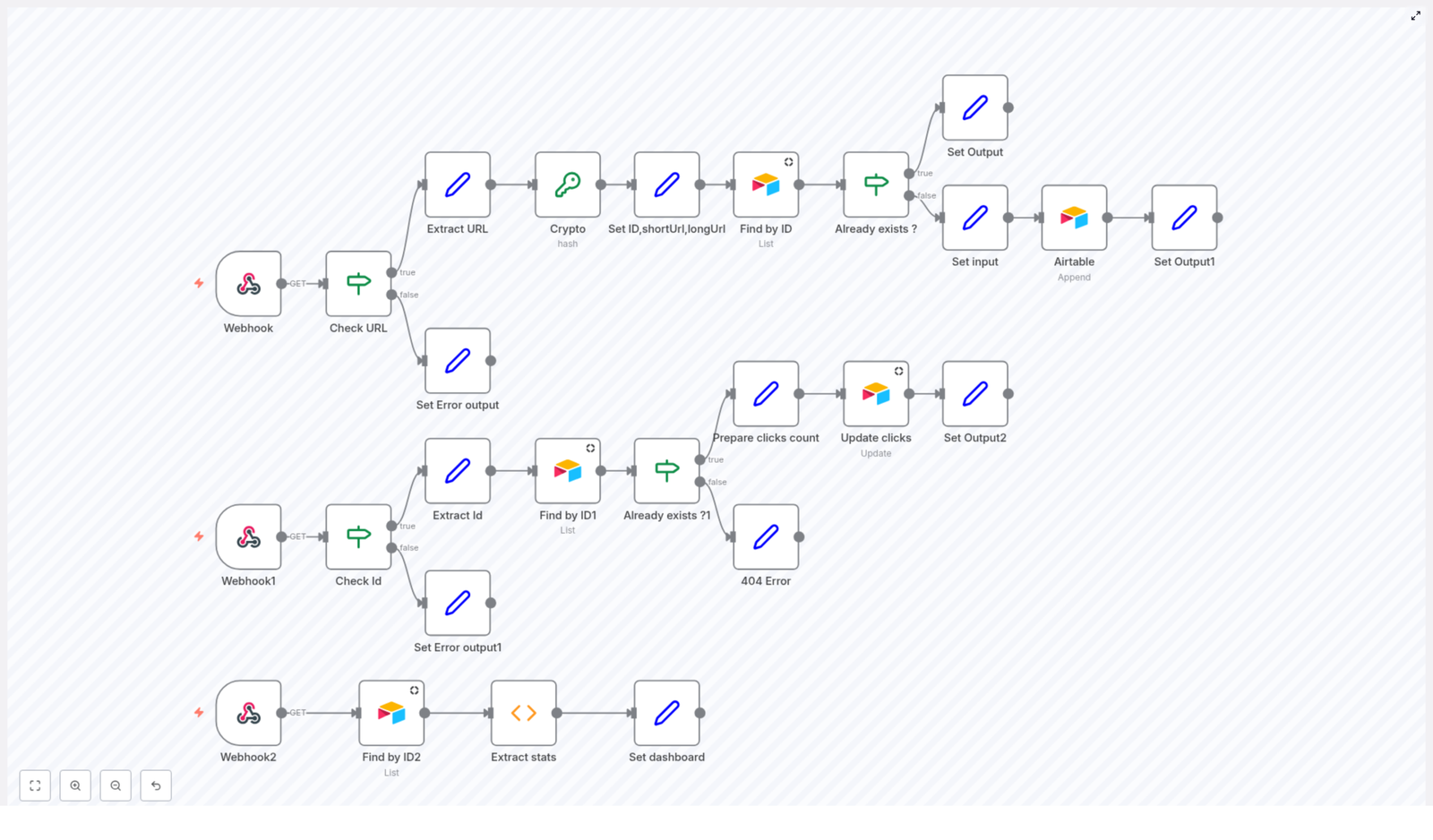
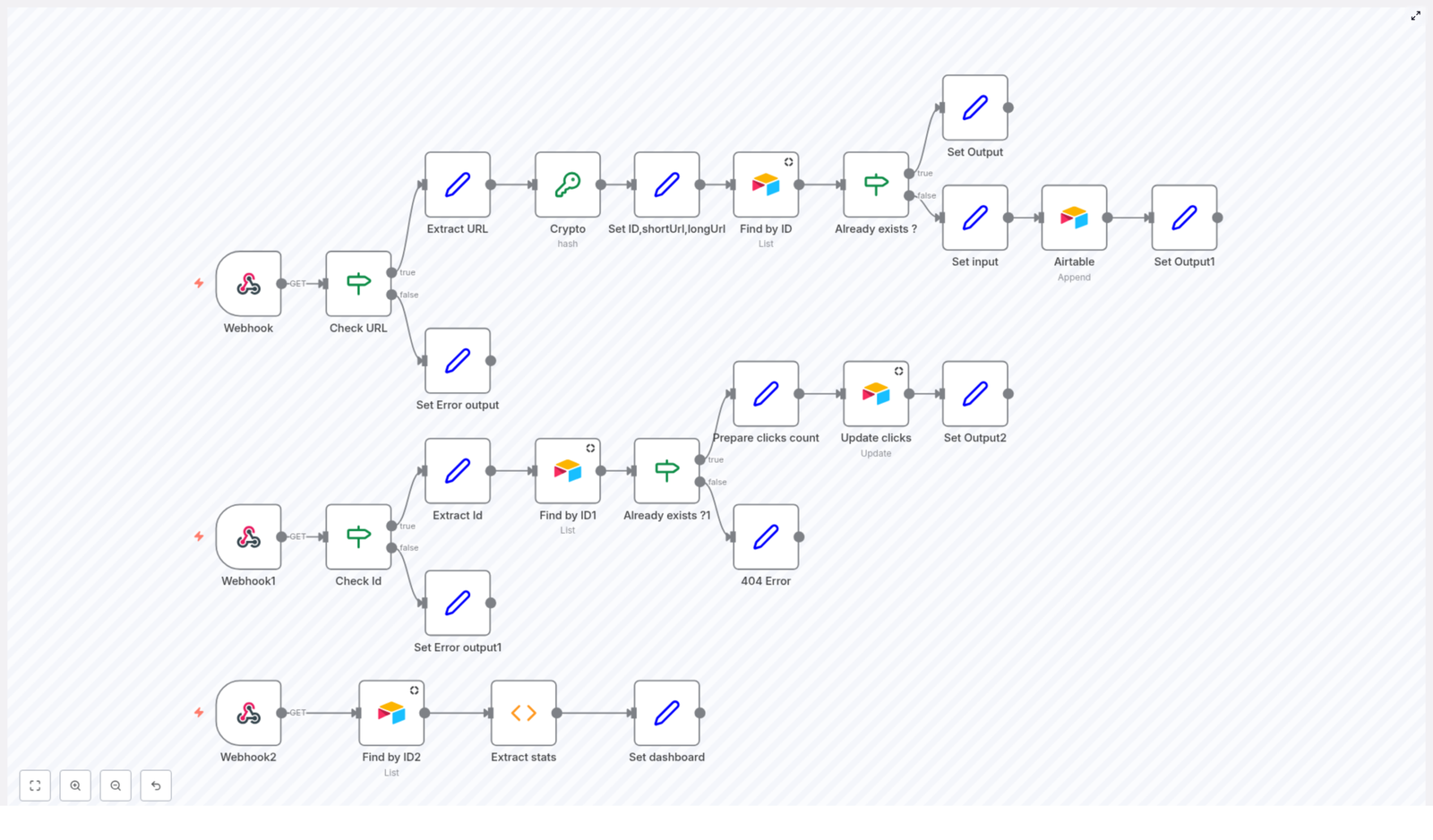
This guide documents an n8n workflow template that implements a simple URL shortener backed by Airtable. The workflow exposes three HTTP endpoints via Webhook nodes:

  • /sh – Creates or returns a shortened URL for a given long URL.
  • /go – Resolves a short URL ID to its original URL and tracks clicks.
  • /dashboard – Renders a basic HTML dashboard with aggregate statistics.

The solution uses:

  • n8n as the automation engine and HTTP interface.
  • Airtable as the persistent data store for URLs and click counts.
  • SHA256 hashing to generate deterministic short IDs.
  • JavaScript Function nodes for data aggregation and HTML rendering.

The goal is to provide a reproducible, extensible template suitable for users already familiar with n8n concepts such as nodes, triggers, credentials, and execution data.

2. Architecture & Data Flow

2.1 High-Level Request Flow

  • Shortening endpoint (/sh)
    • Accepts a GET request with a url query parameter.
    • Validates input, hashes the URL, and creates a short ID.
    • Checks Airtable for an existing record by that ID.
    • Returns an existing or newly created short URL.
  • Redirect endpoint (/go)
    • Accepts a GET request with an id query parameter.
    • Looks up the corresponding record in Airtable.
    • Increments the click counter for that record.
    • Performs an HTTP redirect to the original long URL.
  • Dashboard endpoint (/dashboard)
    • Fetches all URL records from Airtable.
    • Aggregates total links, total clicks, and total unique host domains.
    • Returns an HTML page with a simple, responsive dashboard layout.

2.2 Airtable Data Model

The workflow assumes a single Airtable base and table that stores URL metadata. While field names may vary by implementation, the logic relies on the following conceptual fields:

  • ID – Short identifier (first 6 characters of SHA256 hash).
  • Original URL – The full, long URL provided by the user.
  • Short URL – The complete short link (typically base URL + /go?id=<ID>).
  • Clicks – Integer counter of how many times the short URL was used.

The dashboard logic additionally derives the host (domain) from the stored original URL to compute unique hosts.

3. Node-by-Node Breakdown

3.1 Webhook: URL Shortening Endpoint (/sh)

Purpose

Accepts a long URL and returns a short URL ID, either by reusing an existing record or by creating a new one in Airtable.

Trigger & Method

  • Node type: Webhook
  • Path: /sh
  • HTTP method: GET

Input Parameters

  • url (query parameter)
    • Required for normal operation.
    • Represents the full URL to be shortened.

Validation Logic

The workflow first checks if the url parameter is present in the incoming query string:

  • If url is missing, the workflow returns an error response with the message url parameter missing. No Airtable operations are performed.
  • If url is present, the value is extracted and passed to the hashing step.

Typical validation is minimal in this template. In a production environment you may also want to verify that the URL is syntactically valid and uses an allowed scheme (such as http or https).

Hashing & ID Generation

To generate a deterministic short ID, the workflow uses SHA256 hashing:

  1. Take the input URL string.
  2. Compute the SHA256 hash of the string.
  3. Extract the first 6 characters of the resulting hex-encoded hash.

The 6-character substring is used as the short identifier. This approach reduces the chance of collisions while keeping the ID short. The template does not implement explicit collision resolution logic beyond reusing an existing record if the same ID exists for the same URL.

Airtable Lookup: Detect Existing Record

Next, an Airtable node searches the URL table for a record whose ID matches the generated short ID.

  • Node type: Airtable (Search / List Records)
  • Filter: ID field equals the generated 6-character hash fragment.

Behavior:

  • If a record is found:
    • The stored short URL is returned to the client.
    • No new record is created.
  • If no record is found:
    • The workflow proceeds to create a new Airtable record.

Airtable Create: Insert New Short URL

If the short ID is not already present in Airtable, a second Airtable node appends a new record:

  • Fields populated:
    • ID – The generated 6-character ID.
    • Original URL – The URL from the url query parameter.
    • Short URL – Constructed short link, typically combining your public base URL with the /go endpoint and the ID parameter.
    • Clicks – Usually initialized to 0.

The workflow then returns the newly created short URL as the response to the /sh request.

3.2 Webhook: Redirect Endpoint (/go)

Purpose

Resolves a short ID to its original URL, increments the click counter, and redirects the client to the target URL.

Trigger & Method

  • Node type: Webhook
  • Path: /go
  • HTTP method: GET

Input Parameters

  • id (query parameter)
    • Required for successful redirection.
    • Represents the short ID generated by the /sh endpoint.

Validation Logic

  • If the id parameter is missing:
    • The workflow returns a response with the message id parameter missing.
    • No Airtable lookup or redirect is attempted.
  • If id is present:
    • The value is extracted and passed to an Airtable lookup node.

Airtable Lookup: Resolve ID

An Airtable node searches for a record whose ID field matches the provided id value:

  • If a record is found:
    • The workflow extracts the original URL from the record.
    • The click count is incremented and written back to Airtable.
    • The Webhook node (or a dedicated HTTP Response node) sends an HTTP redirect to the original URL.
  • If no record is found:
    • The workflow responds with Short URL not found.
    • No redirect is executed.

Click Counting & Update

When a record is successfully matched:

  1. The current Clicks value is read from the Airtable record.
  2. The value is incremented by 1.
  3. An Airtable Update node writes the new click count back to the same record.

The increment operation is straightforward and assumes that concurrent updates are rare. For very high-traffic deployments, you would need to consider potential race conditions, but the template targets typical small to medium workloads where basic increments are sufficient.

Redirection Behavior

After updating the click count, the workflow issues an HTTP redirect to the original URL. In n8n, this is typically configured by setting the response headers and status code (for example, 301 or 302) in the Webhook or an HTTP Response node. The template uses the record’s stored original URL as the redirect target.

3.3 Webhook: Dashboard Endpoint (/dashboard)

Purpose

Provides a simple analytics dashboard summarizing usage of all short links stored in Airtable.

Trigger & Method

  • Node type: Webhook
  • Path: /dashboard
  • HTTP method: GET

Data Retrieval

An Airtable node retrieves all URL records from the configured table. The workflow then passes this dataset to a JavaScript Function node for aggregation.

  • Node type: Airtable (List Records)
  • Scope: All records (pagination or maximum record limits depend on your Airtable node configuration).

Aggregation Logic (Function Node)

The Function node processes the full set of records to compute three key metrics:

  • Total Links
    • Computed as the count of all fetched records.
  • Total Clicks
    • Computed as the sum of the Clicks field across all records.
  • Total Hosts
    • Computed as the number of unique host domains derived from each record’s original URL.
    • The Function node parses URLs, extracts the host part, and collects unique values.

Potential edge cases include malformed URLs or missing fields. The template assumes valid data and does not implement extensive error handling inside the aggregation logic, but you can extend the Function node to skip invalid entries or log issues.

Dashboard Rendering

After computing the metrics, the workflow generates an HTML response that includes:

  • A clean, responsive layout using basic HTML and CSS.
  • Clearly labeled boxes or cards displaying:
    • Total Links
    • Total Clicks
    • Total Hosts

The HTML is returned directly from the Webhook or HTTP Response node, so accessing /dashboard in a browser displays the analytics view without additional front-end components.

4. Configuration & Setup Notes

4.1 n8n Webhook Configuration

  • Ensure that all three Webhook nodes (/sh, /go, /dashboard) are set to the correct HTTP method (GET) and that the paths are unique.
  • When deploying n8n behind a reverse proxy, make sure the external URLs for these webhooks are correctly exposed and reachable.
  • Use the production webhook URLs when generating your short URLs so that they work outside of the n8n editor environment.

4.2 Airtable Credentials

  • Create or use an existing Airtable API key / personal access token and configure it in n8n as Airtable credentials.
  • Set the correct Base ID and Table name in each Airtable node used for:
    • Searching by ID in /sh.
    • Creating new records in /sh.
    • Searching and updating records in /go.
    • Listing all records in /dashboard.

4.3 Field Mapping in Airtable

Match your Airtable table fields to the workflow logic:

  • ID – Short code generated from SHA256 hash (text field).
  • Original URL – Full URL string (URL or text field).
  • Short URL – Generated short link (URL or text field).
  • Clicks – Integer field, initialized to 0.

If your field names differ, adjust the field mappings in each Airtable node accordingly.

4.4 Error Handling Considerations

The template includes basic validation:

  • /sh returns url parameter missing if the url query parameter is absent.
  • /go returns id parameter missing. if the id query parameter is absent.
  • /go returns Short URL not found if there is no matching record in Airtable.

For more robust deployments you may want to:

  • Add explicit HTTP status codes (for example, 400 for missing parameters, 404 for unknown IDs).
  • Validate URL format in /sh and optionally restrict to specific domains.
  • Implement logging nodes or error workflows for Airtable API failures or network issues.

5. Advanced Customization Ideas

The provided n8n template is intentionally minimal and easy to understand, but it can be extended in multiple ways without changing the core logic described above.

5.1 Custom Aliases & Vanity URLs

  • Accept an optional alias parameter in the /sh endpoint.
  • Use the alias as the ID if it passes validation and is not already used in Airtable.
  • Fallback to the SHA256-based ID generation when no alias is provided.

5.2 Expiration & Lifecycle Management

  • Add an Expiration Date field in Airtable.
  • Adjust the /go logic to check whether the link has expired before redirecting.
  • Return an appropriate message or redirect to a custom landing page when a link is expired.

5.3 Extended Analytics & External Tools

  • Log additional metadata such as user agent, referrer, or IP in separate Airtable tables.
  • Forward events to external analytics tools or data warehouses for deeper analysis.
  • Enhance the /dashboard Function node to compute more metrics like top hosts or most-clicked links.

6. Benefits of Using n8n & Airtable for URL Shortening

How to Build a URL Shortener with n8n and Airtable

How to Build a URL Shortener with n8n and Airtable

Introduction

URL shortening is a common requirement in modern applications, particularly for marketing, analytics, and user experience optimization. In this guide, we walk through how to implement a production-ready URL shortener using n8n as the orchestration layer and Airtable as the backing datastore.

The n8n workflow template described here provides a complete solution. It generates shortened URLs, persists and retrieves records from Airtable, tracks click counts, and exposes a simple analytics dashboard. The design follows automation best practices such as clear separation of concerns, idempotent operations where possible, and the use of deterministic IDs for predictable behavior.

Architecture Overview

The workflow is divided into three independent HTTP-facing components, each implemented as a dedicated Webhook in n8n:

  1. Shortening API endpoint – Receives a long URL, creates a short identifier, validates uniqueness, and stores the mapping in Airtable.
  2. Redirect endpoint – Accepts a short ID, resolves it to the original URL, increments a click counter, and returns an HTML-based redirect response.
  3. Dashboard endpoint – Aggregates data from Airtable and renders an HTML dashboard with key metrics such as total links, total clicks, and unique hosts.

This separation allows you to scale, secure, and evolve each capability independently, while keeping the underlying data model consistent in Airtable.

Core Components and Integrations

Key n8n Nodes

  • Webhook nodes to expose HTTP endpoints for shortening, redirect, and dashboard views.
  • Crypto node configured with SHA256 hashing to derive deterministic short IDs from long URLs.
  • Set nodes to construct structured payloads, including IDs, short URLs, and HTML responses.
  • If / Conditional nodes to implement validation logic, existence checks, and error handling.
  • Airtable nodes for querying, inserting, and updating URL records.

Airtable as the Data Layer

Airtable is used as the central database for the URL shortener. Each record typically contains:

  • Short ID
  • Original long URL
  • Shortened URL
  • Host (domain extracted from the long URL)
  • Click count

Using Airtable provides a flexible schema, straightforward CRUD operations, and powerful filtering that integrates cleanly with n8n’s native Airtable node.

Implementing the URL Shortening Endpoint

The first part of the workflow exposes an API-style endpoint that accepts a long URL and returns a shortened URL. The logic is deterministic: the same input URL always generates the same short ID, and the workflow checks Airtable to avoid duplicate records.

Request Handling and Validation

  • Webhook Node
    Configured to listen for HTTP GET requests. It expects a query parameter named url that contains the long URL to shorten.
  • Check URL Node
    A conditional node that validates the presence of the url parameter. If the parameter is missing, the workflow immediately returns an error response, preventing unnecessary processing and database calls.
  • Extract URL Node
    Extracts the value of the url query parameter and normalizes it for further processing. This ensures that downstream nodes operate on a clean, predictable field.

Generating and Managing Short IDs

  • Crypto Node (SHA256)
    The Crypto node computes a SHA256 hash of the long URL. Using a hash function ensures that identical URLs consistently produce the same hash, which keeps the shortener idempotent for repeated requests with the same URL.
  • Set ID, shortUrl, longUrl Node
    From the generated hash, the workflow takes the first 6 characters to form the short ID. It then constructs the full short URL by combining the base domain of your shortener service with this ID. The node also standardizes the long URL field for insertion into Airtable.

Persistence and De-duplication in Airtable

  • Find by ID Node
    Queries Airtable to determine whether a record with the generated short ID already exists. This step is critical to avoid collisions and to reuse the existing short URL for the same long URL when applicable.
  • Conditional Node – Already exists?
    If the short ID is found, the workflow returns the existing record’s short URL, avoiding duplicate entries. If it does not exist, the workflow proceeds to create a new Airtable record.
  • Airtable Append Operation
    Inserts a new record into the Airtable table with:
    • The generated short ID
    • The original long URL
    • The full short URL
    • The host extracted from the long URL
    • An initial click count, typically set to zero

    This structure supports both efficient lookups and downstream analytics.

  • Set Output Node
    Builds the HTTP response that returns the short URL to the caller. This can be a simple JSON payload or any format appropriate for your integration.

Implementing Redirects and Click Tracking

The second part of the workflow is responsible for resolving a short URL to its original long URL and tracking usage. It is exposed as a separate Webhook endpoint that users hit when they access a short link.

Short ID Resolution

  • Webhook1 Node
    Listens for GET requests that include a query parameter id, which represents the short URL identifier.
  • Check Id Node
    Validates that the id parameter is present. If it is missing, the workflow responds with an appropriate error, such as a 400 Bad Request.
  • Extract Id Node
    Extracts the short ID from the request for use in the lookup step.
  • Find by ID1 Node
    Queries Airtable for a record that matches the provided short ID. This is the core resolution step that maps the short URL back to the original long URL.

Error Handling and Click Increment

  • Already exists?1 Node
    A conditional node that checks whether the Airtable query returned a record. If no record is found, the workflow returns a 404-style response, indicating that the short URL is invalid or no longer available. If the record exists, the workflow continues to click tracking.
  • Prepare clicks count Node
    Reads the current click count from the record, increments it by one, and prepares the updated value for persistence. This node ensures that the click counter is always advanced atomically within the workflow execution.
  • Update clicks Node
    Updates the Airtable record with the new click count. This step closes the loop on tracking and enables accurate reporting in the dashboard.

Redirect Response

  • Set Output2 Node
    Constructs an HTML response that automatically redirects the user to the original long URL. This is typically implemented with a simple HTML page that contains a meta refresh tag or JavaScript-based redirect. Using an HTML intermediary allows you to customize the user experience, for example by adding branding or a brief message.

Building the Analytics Dashboard

The third part of the workflow provides an at-a-glance dashboard that aggregates statistics from Airtable. It is designed as another Webhook endpoint that returns a styled HTML page.

Data Retrieval and Aggregation

  • Webhook2 Node
    Exposes an endpoint that, when accessed, triggers the generation of the analytics dashboard. This can be secured or left open depending on your use case and authentication strategy.
  • Find by ID2 Node
    Fetches all URL records from Airtable. The complete dataset is required to compute aggregate metrics such as total links and total clicks.
  • Extract stats Node
    Processes the retrieved data to derive:
    • Total shortened links – The number of records in the table.
    • Total clicks – The sum of the click count field across all records.
    • Total unique hosts – The count of distinct host values, giving a sense of domain diversity.

    This node can also be extended with additional calculations as your reporting needs evolve.

Dashboard Rendering

  • Set dashboard Node
    Generates an HTML page that presents the calculated metrics in a readable, styled format. This can include basic styling or be integrated into a more sophisticated front-end. The result is returned directly as the HTTP response from the Webhook, providing a lightweight analytics interface without additional infrastructure.

Why Combine n8n and Airtable for URL Shortening?

n8n provides a flexible, visual automation platform that is particularly well suited to building API-centric workflows. It supports real-time Webhook triggers, conditional routing, data transformation, and native integrations with a broad range of services. For automation professionals, this means rapid prototyping and production deployment without extensive custom code.

Airtable functions as an accessible yet powerful backend database. Its spreadsheet-like interface simplifies schema management and manual inspection of data, while the API and n8n integration enable robust automation. Features such as filtering and sorting are leveraged by the workflow to perform efficient lookups and updates for URL records.

Together, n8n and Airtable provide a low-friction stack that is ideal for building and maintaining a URL shortener, particularly in environments where agility and visibility are priorities.

Extending and Hardening the Workflow

The described implementation forms a solid baseline that can be evolved into a more advanced link management system. Potential enhancements include:

  • Custom aliases – Allow users to specify their own short IDs instead of always relying on hashed values.
  • Advanced analytics – Integrate additional data sources or services to capture geolocation, device type, or referrer information for each click.
  • Expiration and lifecycle management – Add fields and logic for expiration dates, soft deletion, or archival of inactive links.
  • Authentication and access control – Protect the shortening and dashboard endpoints with authentication, and restrict access to creation, modification, or viewing of statistics.

Because the workflow is built on n8n, these extensions can typically be implemented by adding or adjusting nodes rather than rewriting large portions of code.

Next Steps

Implement this URL shortener workflow in your own n8n instance and connect it to your Airtable base to see it in action. Once the core functionality is working, iterate on it to align with your organization’s branding, security requirements, and analytics needs.

For additional automation patterns, best practices, and workflow templates, continue exploring our tutorials and resources.