Unique QR Code Coupon System for Lead Generation

Unique QR Code Coupon System for Lead Generation

From Manual Follow-ups to Automated Growth

If you have ever juggled spreadsheets, CRM entries, and email campaigns just to send a simple coupon to a new lead, you know how draining that can be. Manual work slows you down, introduces errors, and keeps you from focusing on what actually grows your business: building relationships, improving offers, and closing deals.

This is where automation becomes more than a technical trick. It becomes a mindset shift. Instead of reacting to every new lead, you can design a system that welcomes them, rewards them, and captures their data consistently, all while you focus on higher-value work.

The n8n workflow template described here is a concrete, ready-to-use step in that direction. It gives you a complete system for assigning and validating unique QR code coupons, tied directly to your lead generation funnel. Think of it as a starting point for a more automated, scalable, and predictable marketing engine.

Imagine a Smarter Lead Capture Process

Picture this: a visitor fills out a landing page form, instantly receives a unique QR code coupon by email, and when they redeem it, your CRM and Google Sheets update automatically. No duplicate coupons, no forgotten follow-ups, no manual cross-checking.

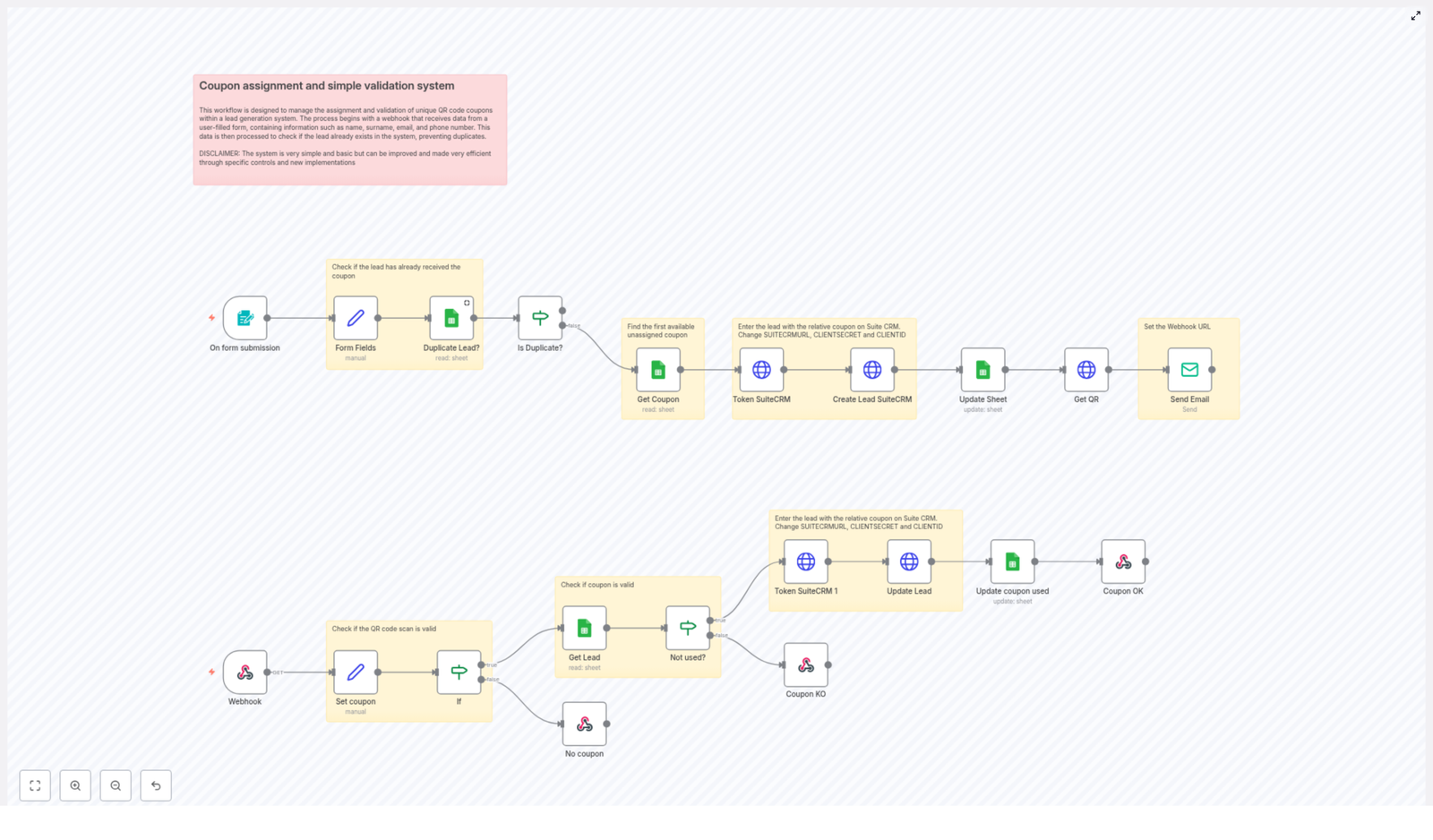
This n8n workflow template turns that vision into a practical, repeatable process. It connects:

  • Your landing page form to capture lead data
  • Google Sheets to store and manage unique coupon codes
  • SuiteCRM to create and update lead records
  • QuickChart.io to generate QR codes for your coupons
  • Webhook triggers to validate coupons when they are scanned

The result is a fully automated QR code coupon system that supports your lead generation strategy instead of slowing it down.

The Journey: From Form Submission to Coupon Redemption

Let us walk through the flow as your lead experiences it, and see how n8n quietly handles the work in the background.

1. A Lead Submits the Form

The journey begins when someone fills out your landing page form with their name, surname, email, and phone number. This form submission is the trigger that starts your n8n workflow.

Inside the workflow, the data is first collected and prepared. n8n then checks your Google Sheets document to see if this lead already exists. This duplicate check is crucial. It prevents sending multiple coupons to the same person and keeps your campaigns fair and organized.

2. Screening for Duplicates and Assigning a Unique Coupon

If the lead is identified as new, the automation continues. n8n looks into a dedicated Google Sheet where your pre-generated unique coupon codes are stored. From this list, it retrieves the first available coupon that has not yet been assigned.

This simple step is powerful. It means you can generate a batch of coupons once, store them in Google Sheets, and let the workflow handle the rest. No more copy-paste, no more accidental reuse of codes.

3. Creating the Lead in SuiteCRM

With a fresh coupon code ready, the workflow connects to SuiteCRM. It first obtains an OAuth token using your SuiteCRM credentials, which allows n8n to communicate securely with your CRM.

Using this token, n8n creates a new lead record in SuiteCRM via API. The record includes:

  • The lead’s name, surname, email, and phone number
  • The unique coupon assigned to that lead

Right after that, the same details are written back to Google Sheets, linking the coupon to the lead. Now both your CRM and your sheet are in sync, with no manual data entry.

4. Sending the Coupon via Email With a QR Code

Next comes the rewarding moment for your lead. The workflow uses QuickChart.io to generate a QR code that encodes the coupon link. This link can lead to a redemption page, a checkout with a discount, or any URL you configure.

n8n then sends an email to the lead, including:

  • A personalized message that acknowledges their sign-up
  • The unique coupon details
  • The QR code image generated from QuickChart.io

From the lead’s perspective, they receive an instant, exclusive reward. From your perspective, the entire process from form submission to coupon delivery is fully automated.

5. Validating the Coupon When the QR Code Is Scanned

The final stage of the journey happens when the lead scans the QR code to redeem their offer. That scan triggers a webhook in n8n, which starts the coupon validation part of the workflow.

Here is what happens behind the scenes:

  • n8n reads the coupon data sent by the QR scan.
  • It checks your Google Sheet to confirm that the coupon exists.
  • It verifies that the coupon has not been used yet.

If the coupon is valid and unused:

  • The corresponding lead is fetched and verified.
  • The coupon usage is marked as “yes” both in Google Sheets and in SuiteCRM.
  • A confirmation response is sent back, so your redemption flow can continue smoothly.

If the coupon is invalid or already used, the workflow responds accordingly, allowing you to handle declined or expired coupons in a consistent way.

Why This n8n Template Is a Stepping Stone

Beyond the technical flow, this template represents a mindset: automate the repetitive, so you can invest energy in strategy and creativity. By implementing this QR code coupon system, you:

  • Save time on manual lead entry and coupon handling
  • Reduce errors and duplicate coupons
  • Improve lead experience with instant, personalized rewards
  • Keep data aligned across Google Sheets and SuiteCRM
  • Build a foundation you can extend with more automation later

Once this is in place, you can start asking bigger questions: What if every campaign had its own coupon list? What if high-value leads received special offers? What if redeemed coupons triggered follow-up sequences, surveys, or upsell emails?

Automation in n8n grows with you. This template is not the finish line, it is your launchpad.

Customizing the Workflow for Your Business

To make this template truly yours, you only need a few configuration changes. These adjustments connect the workflow to your own CRM, sheets, and email setup.

1. Connect to Your SuiteCRM Instance

In the nodes that interact with SuiteCRM, update the following values:

  • SUITECRMURL – set this to your SuiteCRM base URL
  • CLIENTID – your SuiteCRM OAuth client ID
  • CLIENTSECRET – your SuiteCRM OAuth client secret

These details allow n8n to request an OAuth token and create or update lead records securely in your CRM.

2. Point to the Correct Google Sheets Document

In the Google Sheets nodes, configure:

  • Your Google Sheets document ID
  • The relevant sheet name where coupons and lead data are stored

Make sure this sheet includes your list of pre-generated unique coupons, along with any columns needed for lead details and coupon usage status.

3. Set Up Your Email Details

Within the email node, update:

  • The sender email address
  • Any SMTP configuration required by your email provider

You can also customize the email subject and body to match your brand voice, making the coupon delivery feel aligned with your existing communication style.

4. Prepare Your Coupon List

Before running the workflow, make sure you have:

  • A list of unique coupon codes pre-generated and stored in your Google Sheet
  • Columns that indicate whether a coupon is assigned and whether it has been used

This preparation ensures the workflow can assign coupons efficiently and track their status accurately.

From First Automation to Continuous Improvement

Once you see this template running in your n8n instance, you will likely start spotting new opportunities. Maybe you want to:

  • Trigger a follow-up email after a coupon is redeemed
  • Tag leads in SuiteCRM based on coupon usage
  • Send internal notifications to your sales team when a high-value coupon is scanned
  • Add more validation steps or error handling to make the system even more robust

The beauty of n8n is that you can evolve your workflow step by step. Start simple, get it working, then iterate. Each improvement frees a little more of your time and creates a smoother experience for your leads.

Conclusion: Start Automating Your Lead Generation Today

This unique QR code coupon system offers a clear, practical path from manual lead handling to a more automated, integrated, and scalable process. With n8n orchestrating the flow between Google Sheets, SuiteCRM, QuickChart.io, and your email provider, you can focus on strategy while your workflow quietly does the heavy lifting.

Use this template as your first or next step toward a more automated business. Adapt it, extend it, and let it inspire other workflows that support your growth.

Get started today, and transform your lead generation campaigns with personalized, automated QR code coupons.

Disclaimer: This system is a basic implementation and can be further enhanced with additional validation, logging, and error handling as your needs grow.
How to Write JSON Configs to Binary Files with n8n

How to Write JSON Configs to Binary Files with n8n

Overview

This guide documents a minimal, production-ready n8n workflow that converts JSON configuration data to binary and writes it to a file on the server file system. It is intended for users who already understand n8n basics and want a precise reference for implementing JSON-to-file automation.

The workflow focuses on a simple but common pattern:

  • Manually trigger execution.
  • Transform JSON data into binary using the Move Binary Data node.
  • Persist the binary payload using the Write Binary File node.

This pattern is particularly useful for configuration management, dynamic file generation, and automated backups of JSON data within n8n workflows.

Workflow Architecture

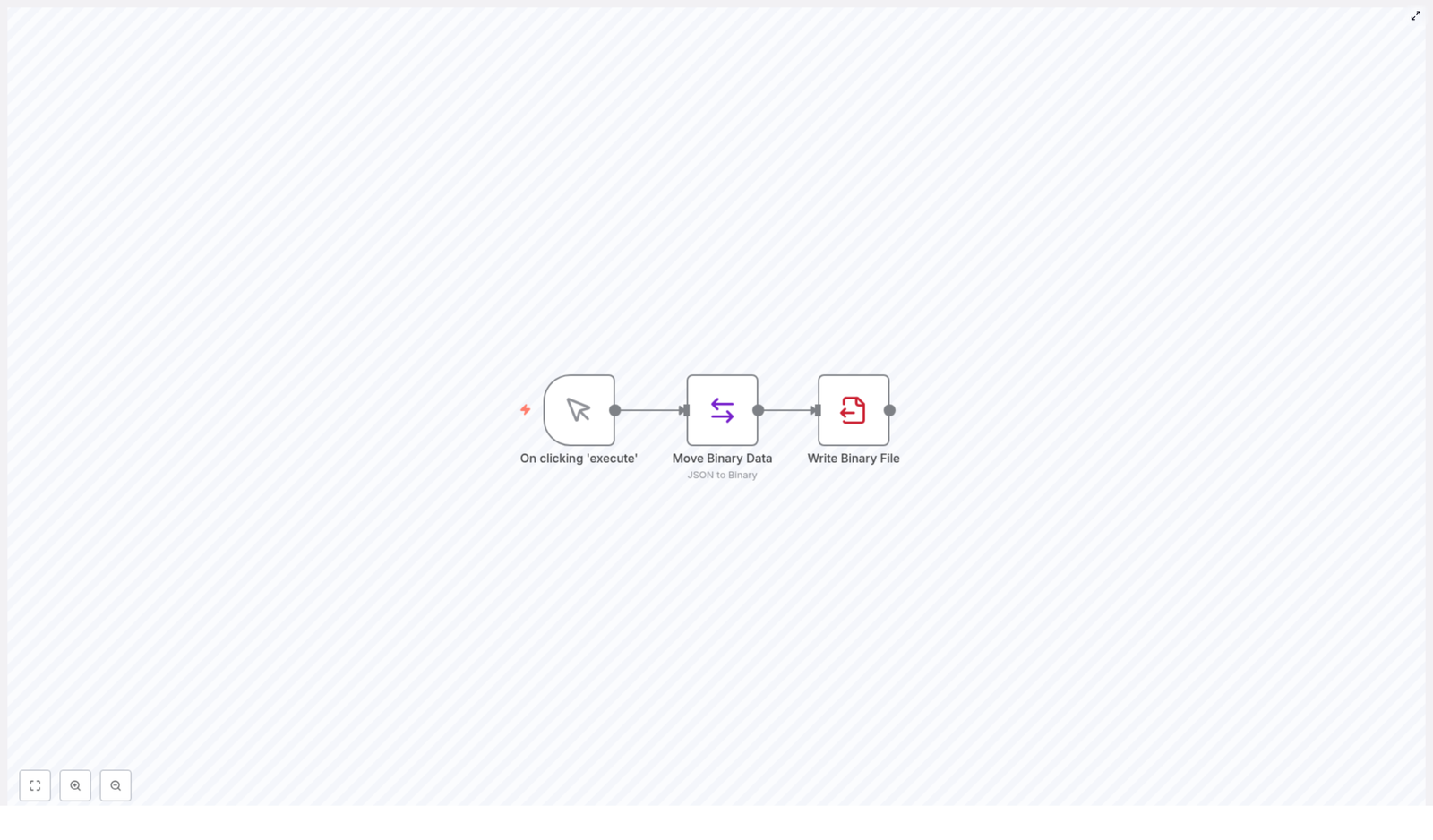
The example workflow is linear and consists of three nodes in sequence:

  1. Manual Trigger node
  2. Move Binary Data node
  3. Write Binary File node

There are no external credentials or API integrations involved. All operations are performed within the n8n instance and its underlying file system.

At a high level, the data flow is:

  1. The Manual Trigger node produces an initial JSON item or passes through preconfigured JSON data.
  2. The Move Binary Data node reads that JSON, serializes it using utf8 encoding, and stores it in a binary property.
  3. The Write Binary File node writes the binary property to a fixed path, for example /home/node/.n8n/standup-bot-config.json.

Node-by-Node Breakdown

1. Manual Trigger Node

The Manual Trigger node is used as the workflow entry point. It does not require configuration beyond being added to the canvas.

  • Type: Trigger node
  • Execution: Activated only when you click Execute Workflow in the n8n editor UI.
  • Purpose: Provide a controlled, on-demand start to the workflow for testing or ad-hoc file generation.

When you execute the workflow manually:

  • The node emits one or more items into the workflow.
  • Those items are passed directly to the next node, which is responsible for preparing the JSON that will be written to disk.

In the simplest case, you can attach additional nodes before the Move Binary Data node to construct or modify the JSON payload that will be converted to a file.

2. Move Binary Data Node

The Move Binary Data node is the core of the JSON-to-file conversion. It transforms JSON data in the item into a binary representation that the Write Binary File node can handle.

Primary Responsibilities

  • Read JSON data from the incoming item.
  • Serialize it as a string using the specified encoding (in this case, utf8).
  • Store the resulting data in a binary property, typically under a property name such as data or file.
  • Optionally define a target file name in the binary metadata.

Key Configuration Parameters

Typical configuration for this node in the described workflow:

  • Operation: Convert to Binary
  • Source: JSON data from the incoming item
  • Encoding: utf8
  • Binary Property: A property name that will hold the binary data (for example, data)
  • File Name: The logical file name to associate with the binary data (for example, standup-bot-config.json)

The encoding is important. Using utf8 ensures that the serialized JSON text is correctly represented and can be opened and read by standard tools and editors once written to disk.

Data Flow Details

Input to this node is plain JSON. The node:

  1. Takes the JSON payload from the incoming item.
  2. Stringifies it (if it is not already a string).
  3. Applies utf8 encoding.
  4. Stores the result as binary in the specified binary property.

The output item now contains:

  • The original JSON data (unless explicitly removed), and
  • A binary property that can be consumed by file-writing or file-upload nodes.

Edge Cases and Validation

To avoid issues when converting JSON to binary:

  • Ensure the JSON is valid and serializable. Invalid JSON or circular references can cause conversion errors or unexpected results.
  • Confirm that the encoding matches the expected use case. For standard configuration files, utf8 is typically the correct choice.
  • If the JSON originates from external systems, consider validating or normalizing it in a previous node before passing it into Move Binary Data.

3. Write Binary File Node

The Write Binary File node is responsible for persisting the binary payload to a local file on the n8n host system.

Primary Responsibilities

  • Read the binary property created by the Move Binary Data node.
  • Write the binary content to the specified file path.
  • Optionally overwrite existing files if the path already exists.

Key Configuration Parameters

In the example workflow, the node is configured to write to:

/home/node/.n8n/standup-bot-config.json

Typical settings include:

  • Binary Property: The name of the binary property produced by Move Binary Data.
  • File Path: Absolute path to the destination file, for example /home/node/.n8n/standup-bot-config.json.
  • Overwrite: Whether to overwrite the file if it already exists (depending on your environment and requirements).

File System Considerations

When configuring the file path, keep in mind:

  • The path must be valid on the server where n8n is running.
  • The n8n process user must have write permissions for the target directory and file.
  • If running n8n inside a container, the path must be accessible inside the container and mapped correctly to the host if you need external access.

Error Handling and Common Issues

  • Permission errors: If the n8n user cannot write to the path, the node will fail. Check directory permissions and ownership.
  • Invalid path: A non-existent directory or mis-typed path will result in a write failure. Ensure the directory structure exists in advance.
  • Binary property mismatch: If the binary property name does not match the one produced by Move Binary Data, the node will not find data to write. Confirm property names are consistent.

Configuration Notes

File Path and Permissions

The example path /home/node/.n8n/standup-bot-config.json is typical for n8n installations running under a user named node. Adjust this path to match your environment:

  • On different Linux distributions, the home directory or user name may differ.
  • On other operating systems, choose an equivalent writable location.

Before running the workflow in production:

  • Verify that the directory exists.
  • Ensure the n8n process can create or modify files in that directory.

JSON Data Validation

To prevent corrupted configuration files:

  • Validate JSON structure before the Move Binary Data node.
  • Use previous nodes or expressions to sanitize values and ensure required fields are present.
  • Optionally log or store the JSON payload before conversion for debugging or audit purposes.

Naming Conventions

Use clear and descriptive file names and paths to simplify maintenance:

  • Include environment identifiers, for example standup-bot-config.prod.json or standup-bot-config.staging.json.
  • Organize configuration files under a dedicated directory, for example /home/node/.n8n/configs/.

Use Cases and Practical Applications

This JSON-to-binary-to-file pattern is broadly applicable in n8n automation:

  • Dynamic configuration updates: Automatically regenerate and save configuration files after a workflow updates settings or receives new parameters.
  • JSON backups: Persist JSON data snapshots to disk for backup, versioning, or later inspection.
  • Pipeline handoff: Convert data streams into static files that can be consumed by external services, scripts, or cron jobs outside of n8n.

Because the workflow is minimal and self-contained, it is a good starting point for integrating file-based configuration management into more complex automations.

Tips for Optimization

  • Check file permissions early: Validate directory permissions before deploying the workflow to avoid runtime write errors.
  • Use consistent naming: Adopt clear file naming and directory structures to keep multiple configuration files manageable.
  • Validate JSON before conversion: Add a validation or transformation step before Move Binary Data to ensure you never write malformed JSON to disk.

Advanced Customization

Once the basic workflow is working, you can extend it while preserving the same core pattern:

  • Insert additional nodes before Move Binary Data to build JSON from APIs, databases, or user input.
  • Branch the workflow to write multiple configuration files by repeating the Move Binary Data and Write Binary File pattern with different paths.
  • Combine this workflow with scheduling or event-based triggers (instead of manual) once you are satisfied with the behavior.

Conclusion

This n8n workflow demonstrates a clean, reliable approach to converting JSON configurations into binary data and writing them to local files. By chaining a Manual Trigger, Move Binary Data, and Write Binary File node, you gain a reusable pattern for automating configuration updates, backups, and JSON file generation with minimal complexity.

Use this template as a starting point, then adapt the file path, JSON source, and surrounding nodes to fit your own automation scenarios.

Next step: Explore n8n further to build more advanced data and file automation workflows. Start with this JSON-to-file example and extend it to match your environment and configuration management needs.

How AI Agents Use Tools to Enhance Chat Responses

How AI Agents Use Tools To Transform Chat Responses

The Shift From Manual Work To Smart Automation

Every growing business eventually hits the same wall: there are too many conversations, too many questions, and not enough time. You answer the same queries, look up the same information, and jump between tools to keep up. It works for a while, but it is not scalable and it keeps you away from the work that truly moves the needle.

This is where automation and AI agents become more than a technical curiosity. They become a way to reclaim your time, scale your support, and create space for deeper, more strategic work. Instead of manually searching for answers, you can design an automated system that listens, understands, and responds with context-aware, accurate information.

In this article, you will walk through how an AI agent powered by n8n and tools like Wikipedia, SerpAPI, memory buffers, and OpenAI’s GPT models can upgrade your chat experience. Think of this workflow template as a starting point in your automation journey – a practical, ready-to-use foundation you can adapt, extend, and make your own.

From Static Replies To Tool-Powered AI Agents

Traditional chatbots rely on fixed rules or predefined answers. They can be useful, but they hit their limits quickly. Modern AI agents are different. They combine:

  • Powerful language models for natural conversation
  • Memory to remember what was said before
  • External tools to look up real-time, verified information

Instead of acting like a script, your agent behaves more like a smart assistant that can think, recall, and research on demand. With n8n, you can orchestrate all of this visually, turning complex AI behavior into a clear, maintainable workflow.

Mindset: Treat Your AI Agent As A Growing System

Before diving into the template itself, it helps to adopt the right mindset. This is not about building a perfect chatbot on day one. It is about creating a flexible system you can iterate on.

Start small, then improve:

  • Launch with a simple, working AI agent that can answer questions
  • Observe how users interact with it and what they ask most
  • Add new tools, refine prompts, and adjust memory as you learn

Every improvement you make compounds over time. As your AI agent becomes smarter, you free up more of your energy for creative and strategic work. The n8n template you are about to explore is built exactly with this spirit of growth and experimentation in mind.

Inside The AI Agent Architecture

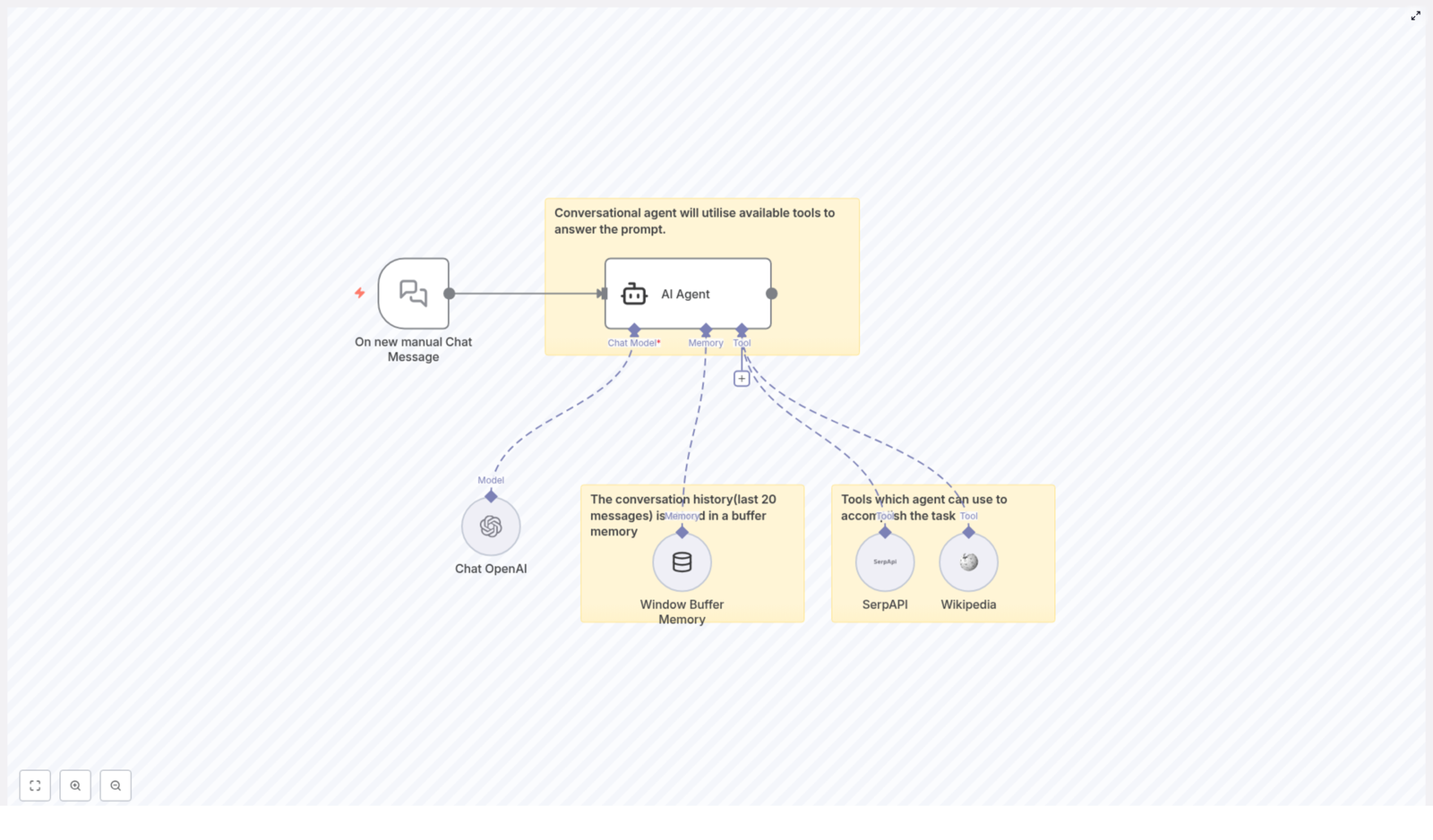
At the heart of this n8n workflow template is a simple but powerful architecture. It brings together four core components that work in harmony:

  • User Input Trigger – Listens for new chat messages and kicks off the workflow.
  • Language Model (Chat OpenAI) – Understands the user’s request and generates human-like responses.
  • Memory Module – Keeps track of recent conversation history so replies stay consistent and contextual.
  • External Tools – Connects to services like Wikipedia and SerpAPI to fetch fresh, accurate information.

Instead of treating AI as a black box, this architecture lets you see and control how each part contributes. You can tweak settings, add or remove tools, and adapt the workflow as your needs evolve.

Step 1: Triggering The AI Agent With A New Chat Message

Every great conversation starts with a message. In this workflow, that moment is captured by a dedicated trigger node.

The process begins when a user sends a manual chat message. In n8n, this is represented by the “On new manual Chat Message” node. This node detects incoming messages and passes them directly into the AI agent block.

From a business perspective, this is where your automation starts saving time. Instead of someone manually reading, interpreting, and responding, the workflow takes over instantly, 24/7, without losing quality.

Step 2: Letting The Language Model Do The Heavy Lifting

Once the message is received, the AI agent calls a language model such as the GPT-4 variant via Chat OpenAI. This is the brain of your agent.

The model:

  • Understands natural language queries
  • Interprets intent, not just keywords
  • Generates coherent, context-aware responses

Within the node configuration, you can fine-tune parameters like temperature to balance creativity and precision. A lower temperature keeps answers focused and reliable. A slightly higher one allows more flexible, exploratory responses. This is your chance to shape the personality and tone of your AI assistant to match your brand or use case.

Step 3: Using Memory Buffers To Build Real Conversations

Real conversations flow. Users refer back to earlier questions, change their minds, or build on previous replies. Without memory, an AI agent would treat every message as if it were the first, which quickly becomes frustrating.

To solve this, the workflow uses a window buffer memory that stores the last 20 chat exchanges. This memory module:

  • Preserves recent context so the AI can follow the thread
  • Supports follow-up questions and clarifications
  • Makes the interaction feel more human and continuous

In practice, this means your agent can answer questions like “What about the previous option?” or “Can you expand on that?” without losing track. It is a small configuration that delivers a big upgrade in user experience.

Step 4: Connecting External Tools For Real-Time Accuracy

Language models are powerful, but they are not omniscient. Their knowledge is based on what they were trained on, which means they can be out of date or uncertain about specific details.

This is where external tools come into play. In this n8n workflow template, the AI agent can call out to:

  • Wikipedia – To retrieve factual information, definitions, and background knowledge.
  • SerpAPI – To perform real-time web searches and access up-to-date information from the internet.

The agent does not have to guess. It can query these APIs on demand, then weave the results into its responses. The outcome is a chatbot that feels both knowledgeable and current, ideal for users who rely on you for accurate, timely information.

Why A Multi-Tool Conversational Agent Changes The Game

By combining a language model, memory, and external tools inside n8n, you are not just building a chatbot. You are building a scalable, intelligent assistant that grows with your business.

Some of the key benefits include:

  • Improved Accuracy – Access to real-time and verified data sources like SerpAPI and Wikipedia reduces misinformation and guesswork.
  • Context Awareness – Memory buffers help maintain natural conversation flow, so users feel heard and understood.
  • Enhanced Flexibility – You can plug in different tools and APIs to handle a wide range of tasks, from research to support.
  • Better User Experience – Responses feel more relevant, more helpful, and more human, which builds trust and satisfaction.

Most importantly, this kind of automation frees you and your team from repetitive support tasks. You can invest your energy in strategy, creativity, and growth, knowing that your AI agent is handling a large portion of everyday questions and lookups.

Using The n8n Template As Your Starting Point

Instead of assembling all of this from scratch, you can start from a ready-made n8n workflow template that already connects:

  • The “On new manual Chat Message” trigger
  • The Chat OpenAI language model
  • A window buffer memory storing the last 20 exchanges
  • External tools like Wikipedia and SerpAPI

From there, you can:

  • Adjust prompts and temperature to match your voice
  • Change how many messages the memory keeps
  • Add new tools or APIs your business relies on
  • Integrate the agent into your existing chat interface or internal systems

This template is not the final destination. It is a launchpad that helps you move faster, experiment safely, and learn what works for your audience.

Next Steps: Build, Experiment, And Grow Your Automation

Modern conversational AI agents are no longer just language models. They are connected systems that use memory, external tools, and smart workflows to deliver enriched, context-aware responses. By combining Chat OpenAI, memory buffers, and APIs like SerpAPI and Wikipedia inside n8n, you can create an AI assistant that feels intelligent, reliable, and genuinely helpful.

If you have been waiting for the right moment to start automating more of your work, this is it. Use this template as your first step. Launch it, watch how it behaves, then refine and expand it as you go. Every improvement you make will compound, saving you time and giving your users a better experience.

Try The Template And Start Your Automation Journey

Ready to build your own AI-powered chatbot that leverages multiple tools for enhanced responsiveness and accuracy? Explore integrations with OpenAI, Wikipedia APIs, and search APIs like SerpAPI inside n8n, and turn your conversations into a powerful, automated system.

Use the workflow template below as your foundation, then customize it to fit your unique needs, brand, and goals.

How to Build an Air Quality Alerting System with n8n

How to Build an Air Quality Alerting System with n8n

What You Will Learn

In this tutorial-style guide, you will learn how to build an automated Air Quality Alerting System using n8n, an open-source workflow automation platform.

By the end, you will understand how to:

  • Schedule a workflow to run automatically every few minutes
  • Fetch live air quality data from the OpenAQ API
  • Format and calculate an AQI value from pollutant data
  • Send processed measurements to an AWS SQS queue
  • Check an AQI threshold and decide when to alert
  • Post detailed alerts into a Slack channel when air quality worsens

This guide focuses on Los Angeles as an example city, but you can easily adapt it to any location supported by OpenAQ.

Why Automate Air Quality Monitoring with n8n?

Monitoring air quality is important for public health, especially in cities that experience frequent pollution events. Manual checks are easy to forget and do not scale well. With n8n you can:

  • Run checks in near real time without manual effort
  • Centralize data collection in a queue for later analysis
  • Alert teams instantly when conditions become unhealthy
  • Extend the workflow as your needs grow

The workflow you will build fetches live data, processes it, stores it, and sends alerts when pollution crosses a defined threshold.

Conceptual Overview of the n8n Workflow

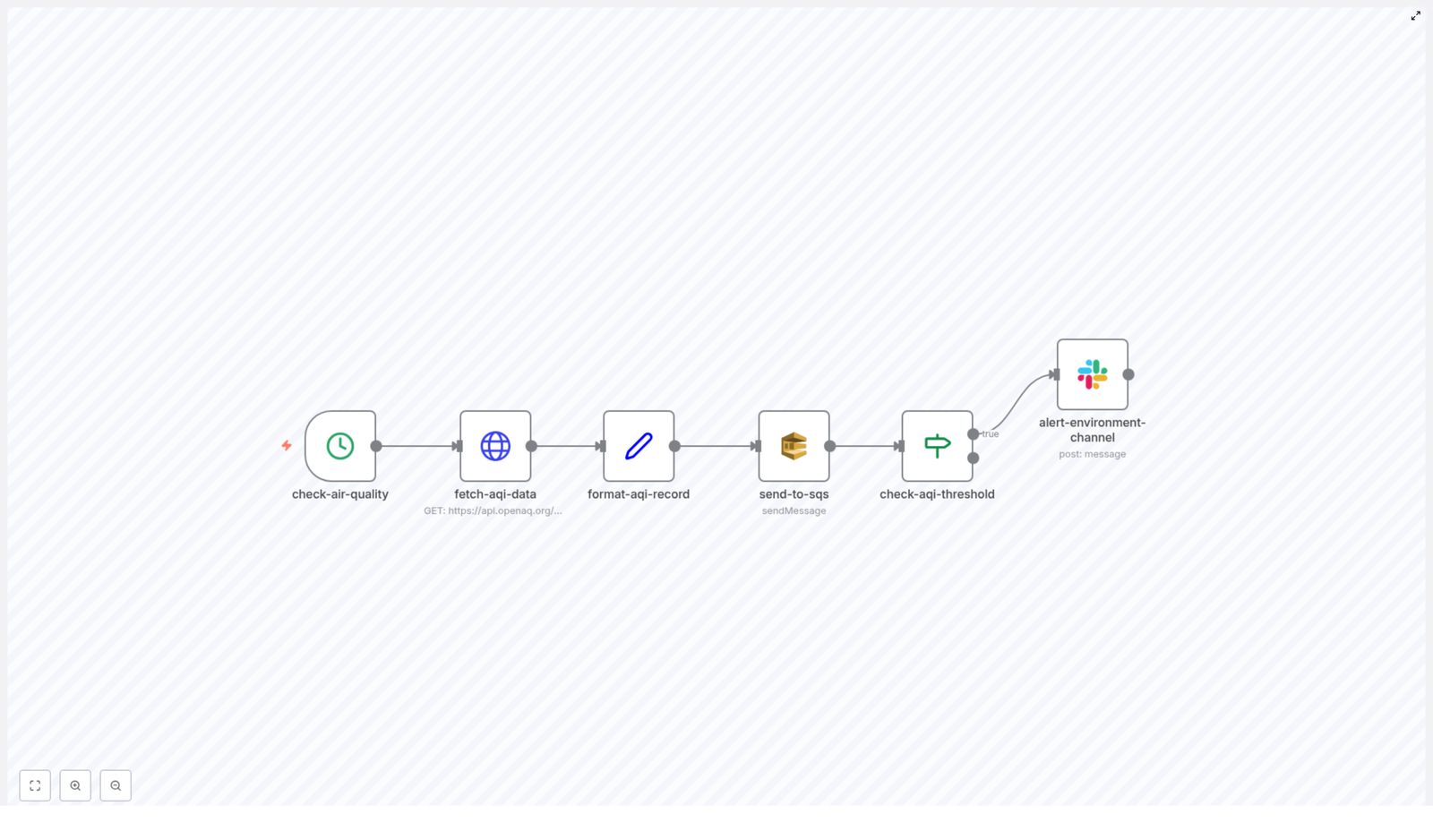
Before we dive into configuration steps, it helps to understand how the workflow is structured in n8n. At a high level, the automation follows this pattern:

  1. Scheduled Trigger – A Cron node runs the workflow every 5 minutes.
  2. Fetch AQI Data – An HTTP request retrieves the latest OpenAQ data for Los Angeles.
  3. Format AQI Record – A Set node extracts key fields and calculates an AQI value.
  4. Send to AWS SQS – The formatted record is serialized to JSON and pushed into an SQS queue.
  5. Check AQI Threshold – An IF node checks whether AQI is above 100.
  6. Alert Environment Channel – A Slack node posts an alert if the threshold is exceeded.

Each step is handled by a specific n8n node, which makes the workflow easy to read, debug, and extend.

Prerequisites

To follow along and implement this air quality alerting system, you will need:

  • n8n installed and running (self-hosted or cloud)
  • AWS credentials with permission to send messages to an SQS queue
  • An AWS SQS queue, for example named aqi-ingest-queue
  • A Slack app with permissions to post messages into your chosen channel
  • Access to the OpenAQ API (public and free at the time of writing)

Once you have these in place, you can create the workflow in n8n step by step.

Step-by-Step: Building the Air Quality Alerting Workflow in n8n

Step 1 – Configure the Scheduled Trigger (Cron Node)

The first node is responsible for starting the workflow at regular intervals.

  1. Add a Cron node to your workflow.
  2. Set the schedule to run every 5 minutes. For example:
    • Mode: Every X minutes
    • Value: 5

This node ensures near real-time monitoring without requiring you to manually click “Execute” in n8n.

Step 2 – Fetch Air Quality Data from OpenAQ

Next, you will retrieve the most recent air quality measurements from OpenAQ.

  1. Add an HTTP Request node (or a dedicated OpenAQ node if available in your n8n version).
  2. Configure it to call the OpenAQ API endpoint that returns measurements for Los Angeles.
  3. Set query parameters so that:
    • The results are limited to the latest single record.
    • You filter for the pollutant parameters PM2.5, PM10, and O3.

The response will typically include location information, timestamps, and pollutant concentrations. This raw data is what you will process in the next node.

Step 3 – Format and Enrich the AQI Record

Now you will extract the fields you care about and compute a simple AQI value.

  1. Add a Set node after the HTTP Request node.
  2. Use it to:
    • Pick out the location details from the API response.
    • Extract the pollutant concentrations for PM2.5, PM10, and O3.
    • Capture latitude and longitude for geo-referencing.
  3. In the same node (using expressions or additional fields), calculate an AQI value:
    • Apply a multiplier of 4.17 to the PM2.5 concentration to derive a basic AQI.
    • If the PM2.5 value is unavailable, default the AQI to 50.

This step turns the raw OpenAQ payload into a structured record that is easier to store, analyze, and display in alerts.

Step 4 – Send Processed Data to AWS SQS

With a clean record in hand, you can now send it to an AWS SQS queue for further processing or logging.

  1. Add an AWS SQS node.
  2. Configure your AWS credentials in n8n if you have not already.
  3. Set the target queue name to aqi-ingest-queue (or your chosen queue name).
  4. Serialize the formatted data into JSON and use it as the message body.

Storing the data in SQS decouples data ingestion from alerting. Other systems can read from the queue to batch process, archive, or analyze historical air quality trends without affecting this workflow.

Step 5 – Check the AQI Threshold with an IF Node

Next, you will decide whether the current air quality should trigger an alert.

  1. Add an IF node after the SQS node (or directly after the Set node, depending on your preferred sequence).
  2. Configure a condition that checks if:
    • AQI > 100

An AQI over 100 is commonly used as a cutoff where air quality moves from moderate into unhealthy for sensitive groups. If the condition is met, the workflow follows the “true” path to send an alert. If not, the workflow ends quietly without any notification.

Step 6 – Send an Alert to a Slack Channel

When the threshold is exceeded, you want your team or community to know quickly.

  1. On the “true” branch of the IF node, add a Slack node.
  2. Connect your Slack credentials or use an existing Slack integration in n8n.
  3. Choose the target channel, for example an environment or alerts channel.
  4. Compose a detailed message that includes:
    • The location and timestamp
    • The calculated AQI value
    • Individual pollutant concentrations for PM2.5, PM10, and O3
    • A short health advisory based on the AQI level, such as advising sensitive groups to limit outdoor activity

This Slack node becomes the visible part of your system, turning raw sensor data into actionable information for your audience.

Benefits of This Automated n8n Air Quality System

Once the workflow is live, you gain several advantages:

  • Timely alerts – The Cron node checks every 5 minutes so you get near real-time warnings as conditions change.
  • Reliable data storage – Using AWS SQS provides a scalable buffer for all processed records, which is ideal for later analysis or integration with other services.
  • Easy scalability – You can duplicate or extend nodes to support multiple cities or additional pollutants without redesigning the system.
  • Flexible alerting – Slack message formatting is fully customizable, so you can tailor alerts for technical teams, public channels, or other platforms.

Next Steps and Extensions

After your basic air quality alerting system is running, you can build on it with more advanced features:

  • Historical data logging – Add a database node to store each record for long-term trend analysis.
  • Multi-channel notifications – Extend the alert branch to include email or SMS for critical AQI levels.
  • More advanced AQI calculations – Incorporate multiple pollutants and more detailed formulas to improve accuracy.
  • Dashboards and visualizations – Connect the data in SQS or your database to a BI tool to create live monitoring dashboards.

Each of these enhancements can be added as extra nodes or branches in the same n8n workflow.

Quick Recap

To summarize, your n8n air quality alerting workflow:

  1. Uses a Cron node to trigger every 5 minutes.
  2. Calls the OpenAQ API to fetch the latest Los Angeles measurements for PM2.5, PM10, and O3.
  3. Formats the response with a Set node, calculates an AQI using a 4.17 multiplier on PM2.5, and captures location and coordinates.
  4. Sends the structured data as JSON to an AWS SQS queue named aqi-ingest-queue.
  5. Uses an IF node to check if AQI is greater than 100.
  6. Posts a detailed alert to a Slack channel if the threshold is exceeded.

FAQ

Can I monitor a different city instead of Los Angeles?

Yes. Update the parameters in the node that calls the OpenAQ API to use your target city or coordinates. The rest of the workflow can remain the same.

Do I have to use AWS SQS?

No. SQS is used here to provide scalable message buffering and decouple ingestion from processing. You can replace it with a database, another queue system, or skip it if you only need alerts.

Is the AQI calculation accurate?

The example uses a simple multiplier of 4.17 on PM2.5 and defaults to 50 when PM2.5 is missing. This is a simplified approach. For production use, you may want to implement a more detailed AQI formula that considers multiple pollutants.

Can I send alerts to other platforms besides Slack?

Yes. n8n supports many integrations. You can add nodes for email, SMS, incident management tools, or other messaging apps alongside or instead of Slack.

Start Building Your Air Quality Alert System

With n8n, you can automate air quality monitoring, protect public health, and stay informed with minimal ongoing effort. Once you have your prerequisites ready, configure each node, test the workflow, then activate it so it runs on schedule.

Explore the n8n documentation and the AWS and Slack integrations to customize this workflow for your specific needs and audience. Small adjustments to thresholds, locations, or alert messages can tailor the system for local communities, workplaces, or city-wide monitoring projects.

If you find this kind of automation helpful, share the idea with your tech community and help raise awareness about clean air initiatives.

Integre sua Clínica com Poli: Automação de Agendamento Inteligente

Integre sua Clínica com Poli: Automação de Agendamento Inteligente (e Fim das Tarefas Repetitivas)

Imagine esta cena…

Telefone tocando sem parar, WhatsApp explodindo de mensagens, paciente pedindo remarcação em cima da hora, outro perguntando o preço do procedimento, mais um querendo saber se “tem horário amanhã cedinho”. Enquanto isso, alguém na recepção tenta atualizar a agenda, responder com educação, não perder nenhum dado importante e ainda manter o sorriso no rosto.

Se isso parece a rotina da sua clínica, boa notícia: você não precisa mais viver nesse modo “super-herói sobrecarregado”. É aqui que entra o Poli, um agente virtual integrado ao n8n, que assume boa parte desse caos com automação inteligente e um toque bem humano.

O que é o Poli e por que ele é tão útil?

Poli é um agente virtual criado para ser o recepcionista digital da OdontoCompany, atendendo seus pacientes diretamente pelo WhatsApp. Ele não se cansa, não esquece informações e não se irrita quando alguém manda áudio de 3 minutos para remarcar um horário.

Usando um fluxo inteligente no n8n, o Poli cuida de:

  • Receber e entender mensagens dos pacientes
  • Identificar necessidades, como agendamento ou remarcação
  • Consultar e gerenciar a agenda da clínica no Google Calendar
  • Confirmar horários disponíveis e registrar consultas
  • Enviar mensagens e lembretes personalizados

Em resumo, ele funciona como uma recepção digital sempre disponível, com atendimento acolhedor, organizado e automatizado.

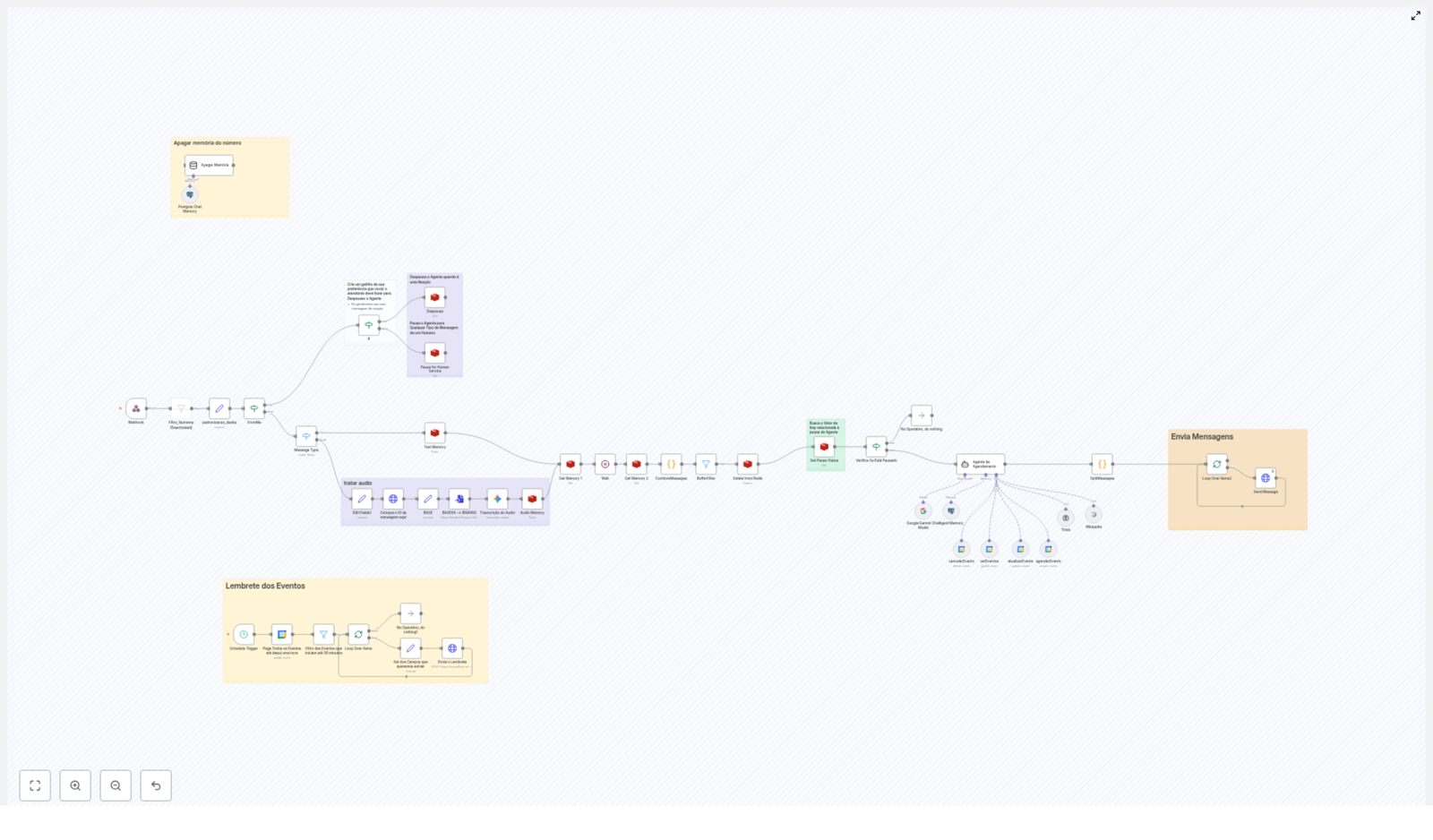
Como o fluxo de automação no n8n funciona por trás dos bastidores

Mesmo com uma pegada leve e amigável, o fluxo do Poli é bem sofisticado. Aqui está o que acontece nos bastidores, etapa por etapa.

1. Webhook: a porta de entrada das mensagens

Tudo começa quando o paciente manda uma mensagem pelo WhatsApp. Essa mensagem chega ao n8n por meio de um webhook, que é o ponto de entrada do fluxo.

Nessa etapa, o fluxo:

  • Recebe os dados da mensagem
  • Padroniza o número de telefone do paciente
  • Organiza o conteúdo da mensagem e outras informações essenciais

Isso garante que, independentemente de como o paciente escreve ou salva o número, o sistema consegue entender e tratar tudo de forma consistente.

2. Memória com Redis: o cérebro da conversa

Para que o Poli não pareça um robô sem memória, o fluxo usa o Redis para armazenar e recuperar dados da conversa em tempo real.

Com essa memória estruturada, o sistema consegue:

  • Manter o histórico do paciente
  • Controlar o estado atual da conversa
  • Continuar o atendimento de forma coerente, mesmo em interações longas ou pausadas

3. Trilha de mensagens: texto, áudio e tudo no meio do caminho

Nem todo mundo gosta de digitar. Alguns pacientes preferem mandar um áudio de “só um minutinho” que dura uma eternidade. O Poli está preparado para isso.

O fluxo é capaz de:

  • Diferenciar mensagens de texto e áudio
  • Transcrever automaticamente áudios em texto para facilitar o processamento

Assim, independentemente do formato, o conteúdo é entendido e tratado pelo agente de forma eficiente.

4. Controle de pausa: quando entra o atendimento humano

Nem tudo precisa ser 100% automatizado. Em alguns casos, é melhor que um humano assuma a conversa, por exemplo em situações mais sensíveis ou específicas.

Por isso, o fluxo conta com um controle inteligente de pausa:

  • Permite pausar o Poli quando necessário
  • Evita que conversas paralelas se misturem
  • Garante que o atendimento humano e o automático convivam sem bagunça

5. Agente de agendamento: o coração da automação

Esta é a parte que faz os olhos da equipe brilharem. O agente de agendamento usa Language Models (modelos de linguagem) para interpretar o que o paciente quer e agir em cima disso.

Ele é responsável por:

  • Entender comandos de forma natural, como “quero marcar uma limpeza” ou “posso remarcar meu horário de amanhã?”
  • Coletar dados importantes como nome, preferência de horário e tipo de procedimento
  • Consultar o Google Calendar em busca de horários disponíveis
  • Aplicar regras rígidas para evitar erros de agendamento
  • Executar agendamentos e remarcações automaticamente

Em outras palavras, o Poli entende o que o paciente quer, verifica a agenda e já resolve, sem precisar interromper ninguém da equipe.

6. Envio de mensagens: comunicação clara e acolhedora

Depois de processar tudo, o Poli responde o paciente pelo próprio WhatsApp, com mensagens:

  • Personalizadas de acordo com o contexto
  • Escritas em um tom caloroso, empático e natural
  • Claras sobre horários, confirmações e próximos passos

Assim, o atendimento continua humano e próximo, mesmo sendo automatizado.

7. Lembretes automáticos: adeus, esquecimento de consulta

Para reduzir faltas, o fluxo conta com um subfluxo de lembretes automáticos.

Ele:

  • Verifica no Google Calendar os eventos que vão acontecer nos próximos minutos
  • Envia mensagens pró-ativas lembrando o paciente do compromisso

É como ter alguém na recepção ligando para cada paciente, só que sem ocupar o tempo de ninguém.

Principais benefícios da automação com Poli e n8n

Além de acabar com boa parte das tarefas repetitivas, o fluxo com Poli traz resultados bem práticos para a clínica.

Atendimento realmente humanizado, mesmo sendo digital

  • Uso de um tom caloroso e empático nas mensagens
  • Comunicação natural, sem parecer um robô engessado
  • Possibilidade de personalizar interações de acordo com o perfil do paciente

Gestão de agenda inteligente e confiável

  • Antes de confirmar qualquer horário, o sistema checa conflitos para evitar sobreposições
  • Os compromissos são criados com descrições claras, facilitando o entendimento da equipe
  • O fluxo segue regras rígidas para manter a agenda organizada

Flexibilidade em múltiplos canais e formatos

  • Captação de mensagens em diferentes formatos, como texto e áudio
  • Adaptação da resposta conforme o canal de comunicação
  • Transcrição de áudios para garantir que nada importante se perca

Histórico e padronização dos atendimentos

  • Registro detalhado de histórico de conversas e agendamentos
  • Facilidade para consultar informações em futuras remarcações
  • Padronização dos dados do paciente, o que evita confusão com nomes, telefones e horários

Operação automatizada, escalável e menos cansativa

  • Atende vários pacientes ao mesmo tempo sem perder o controle
  • Permite pausar e retomar o agente quando a equipe humana precisar intervir
  • Libera a recepção para focar em atendimentos mais complexos e presenciais

Como começar a usar o template do Poli no n8n

Se você já está imaginando a paz na recepção, o próximo passo é colocar esse fluxo para rodar. O melhor de tudo é que você não precisa montar tudo do zero, já existe um template pronto no n8n que representa esse fluxo visualmente.

Passo a passo simplificado

  1. Acesse o template do Poli no n8n usando o link disponível abaixo.
  2. Importe o fluxo para o seu ambiente n8n.
  3. Configure:
    • O webhook que recebe as mensagens do WhatsApp
    • A conexão com o Redis para a memória da conversa
    • A integração com o Google Calendar para os agendamentos
    • As chaves e credenciais necessárias para os serviços envolvidos
  4. Ajuste as mensagens, o tom de voz e as regras de agendamento conforme a realidade da sua clínica.
  5. Teste o fluxo com alguns números de WhatsApp antes de liberar para os pacientes.

Depois disso, é só deixar o Poli trabalhar e acompanhar os resultados.

Conclusão: menos tarefa repetitiva, mais foco no paciente

Integrar o Poli com o n8n transforma o jeito como a OdontoCompany lida com agendamentos, remarcações e comunicação com pacientes. Você ganha um fluxo de trabalho automatizado, visualmente claro dentro do n8n, que combina:

  • Inteligência para interpretar pedidos e gerenciar horários
  • Empatia na forma de se comunicar com o paciente
  • Regras robustas para manter a agenda organizada e confiável

O resultado é uma clínica mais produtiva, pacientes melhor atendidos e uma recepção que finalmente pode respirar.

Quer implementar essa solução na sua clínica ou negócio?

Se você quer reduzir tarefas manuais, organizar melhor os agendamentos e oferecer uma experiência moderna para os pacientes, vale ver o fluxo do Poli em ação.

Entre em contato conosco para uma demonstração personalizada e descubra como levar o atendimento da sua clínica para o próximo nível com n8n e automação inteligente.

Automate AI Voice Calls with Airtable & telli Integration

Automate AI Voice Calls with Airtable & telli Integration: A Story of One Marketer’s Breakthrough

The Day Emma Realized Her Calls Were Holding Her Back

By Tuesday afternoon, Emma’s coffee was cold and her call list was still only half done.

As the marketing manager at a fast-growing service company, her days were packed with lead follow-ups, appointment reminders, and customer feedback calls. Airtable kept her contacts organized, but the real problem was the time spent dialing numbers, leaving voicemails, and updating notes after each conversation.

Leads slipped through the cracks when she could not call fast enough. Clients missed appointments because reminder calls went out late. Feedback surveys were often forgotten when the team got busy. Emma knew automation could help, but she did not want to lose the human touch or rewrite her entire tech stack.

That changed the day she discovered an n8n workflow template that connected Airtable with telli, an AI voice-agent platform. It promised to automate AI voice calls directly from her CRM, using smart, conversational agents instead of manual dialing.

Discovering a Smarter Way to Call

Emma’s search started with a simple question: “How can I automate voice calls from Airtable?”

She came across an n8n template designed exactly for that. It integrated Airtable contacts with telli’s AI voice agents, allowing her to schedule and manage calls without lifting a phone. The idea was simple but powerful: every time a new contact appeared in Airtable, a workflow would automatically send that contact to telli, then schedule an AI-powered call.

Before she could try it, Emma made a checklist of what she needed.

What Emma Set Up Before Building Her Workflow

  • A telli account with API access so she could use the AI voice-agent platform and its HTTP API endpoints.
  • An Airtable base that already contained her leads and customers, with fields like name, phone number, email, and other useful details.
  • n8n automation platform where she would import and customize the workflow template that connected Airtable and telli.

With those pieces ready, she opened n8n and started turning her manual phone routine into an automated, AI-driven voice system.

Building the Workflow: From Contact in Airtable to AI Voice Call

Emma’s goal was clear: whenever a new lead or contact appeared in Airtable, an AI voice agent from telli should call them, either to qualify them, remind them of an appointment, or collect feedback.

Instead of a dry checklist, the workflow became part of her story of reclaiming time and improving her customer communication.

1. The Trigger That Changed Everything

Emma started with the first key piece in n8n: an Airtable Trigger node.

She configured this node to watch her Airtable base for new or updated records. Any time a new contact was added, or an existing one changed in a way that signaled “ready for a call,” the Airtable Trigger node would fire. That event became the starting point of the whole automation.

Instead of manually checking Airtable every morning, the workflow now listened in real time.

2. Sending Contacts to telli With an HTTP Request

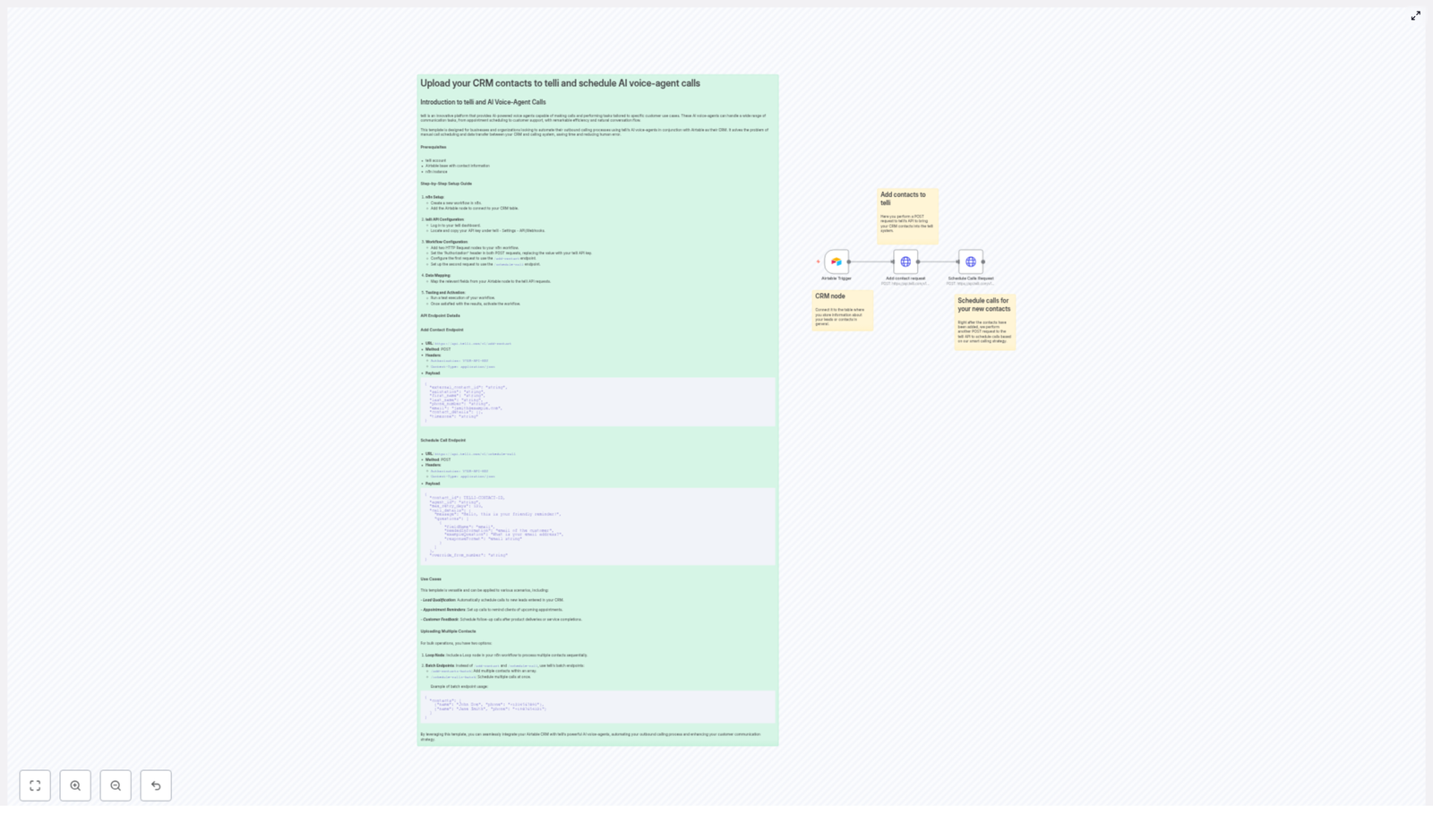
Once the trigger fired, Emma needed to get that contact into telli. For this, she added an HTTP Request node in n8n, configured to call telli’s /add-contact API endpoint.

She set the method to POST, added the correct headers, and mapped fields from Airtable into the JSON body.

telli Add Contact Endpoint Details

  • URL: https://api.telli.com/v1/add-contact
  • Method: POST
  • Headers:
    • Authorization: YOUR-API-KEY
    • Content-Type: application/json
  • Payload Example:
{  "external_contact_id": "string",  "salutation": "string",  "first_name": "string",  "last_name": "string",  "phone_number": "string",  "email": "jsmith@example.com",  "contact_details": {},  "timezone": "string"
}

In her workflow, Emma mapped Airtable fields like first_name, last_name, phone_number, and email into this payload. She used her telli API key in the Authorization header to authenticate the request.

Each time the node ran, a new contact appeared in telli, ready to be called by an AI voice agent.

3. The Moment the AI Agent Started Calling

Creating contacts in telli was only half the story. Emma also needed to schedule actual calls. So she added a second HTTP Request node in n8n, this time pointing to telli’s /schedule-call endpoint.

telli Schedule Call Endpoint Details

  • URL: https://api.telli.com/v1/schedule-call
  • Method: POST
  • Headers:
    • Authorization: YOUR-API-KEY
    • Content-Type: application/json
  • Payload Example:
{  "contact_id": TELLI-CONTACT-ID,  "agent_id": "string",  "max_retry_days": 123,  "call_details": {  "message": "Hello, this is your friendly reminder!",  "questions": [  {  "fieldName": "email",  "neededInformation": "email of the customer",  "exampleQuestion": "What is your email address?",  "responseFormat": "email string"  }  ]  },  "override_from_number": "string"
}

In n8n, Emma took the contact_id returned by the previous /add-contact call and used it in the schedule-call payload. She chose an agent_id that matched the AI agent she had configured in telli, and customized the message and questions to fit each use case.

Now, when a new contact landed in Airtable, the workflow automatically:

  • Created that contact in telli through the /add-contact endpoint.
  • Scheduled an AI voice call through the /schedule-call endpoint.

For Emma, this was the turning point. The calls started happening in the background while she focused on strategy instead of spreadsheets and dial pads.

Where the AI Voice Workflow Really Shined

Once the n8n workflow was live, Emma began to see how flexible the Airtable and telli integration could be. She used the same structure for several key scenarios, just by adjusting the Airtable views, call messages, and agent configurations.

Lead Qualification on Autopilot

New leads used to sit in her CRM for hours or even days before someone had time to call. With the n8n template, Emma set up a dedicated Airtable view for “New Leads” and connected that to her workflow trigger.

As soon as a lead landed in that view, telli’s AI voice agent would call to:

  • Welcome the lead.
  • Ask a few qualification questions.
  • Capture key details like email, company size, or service interest.

The responses were logged, and Emma could prioritize high-intent leads without spending time on basic screening calls.

Appointment Reminders Without Manual Dialing

Missed appointments were a constant headache. Emma created another Airtable view for upcoming appointments. Her workflow used that view to trigger reminder calls through telli.

The AI agent would say something like, “Hello, this is your friendly reminder about your appointment tomorrow,” and could even ask the customer to confirm or reschedule if needed, depending on the agent setup in telli.

Customer Feedback Calls That Actually Got Done

Post-service feedback used to be the first task to get dropped when the team got busy. With the integration in place, Emma created a simple rule: any completed service in Airtable would trigger a follow-up call through telli.

The AI agent would:

  • Thank the customer for their business.
  • Ask a few feedback questions.
  • Capture responses in a structured way that could be reviewed later.

For Emma, this meant higher response rates and better insights, without adding work to her team’s day.

Scaling Up: Handling Many Contacts at Once

As the company grew, Emma’s workflows had to keep up. Processing one contact at a time was fine at first, but soon she needed to handle larger batches efficiently.

She explored two approaches inside n8n and telli to scale her automation.

Option 1 – Looping Through Contacts in n8n

For moderate volumes, Emma used an n8n Loop node to iterate through multiple contacts sequentially.

  1. The Airtable node fetched a list of contacts that matched her criteria.
  2. The Loop node processed each contact one by one.
  3. For each item, the workflow:
    • Called the /add-contact endpoint.
    • Then called the /schedule-call endpoint using the returned contact_id.

This approach gave her fine control over each contact and made it easy to add conditions or custom logic per lead.

Option 2 – Using telli Batch Endpoints

When Emma needed to handle larger lists, she turned to telli’s batch APIs to speed things up.

Instead of sending contacts one by one, she could:

  1. Use /add-contacts-batch to add multiple contacts to telli in a single request.
  2. Use /schedule-calls-batch to schedule many calls at once.

In n8n, she built arrays of contacts and call configurations, then posted them to the batch endpoints. This reduced API overhead and made it easier to run large campaigns, such as seasonal promotions or mass feedback initiatives.

The Resolution: From Overwhelmed to Orchestrated

A few weeks after setting up the Airtable and telli integration with n8n, Emma’s workday looked completely different.

Her outbound calling was no longer a pile of to-dos. Instead, it was a coordinated system of AI voice calls that:

  • Automatically reached out to new leads.
  • Reminded clients about their appointments on time.
  • Collected feedback after each service.

Errors from manual data entry dropped, and she gained back hours each week. Most importantly, her team could focus on higher-value conversations, while the AI handled routine but essential touchpoints.

The workflow did not just automate calls, it upgraded the entire customer contact strategy.

Where You Can Go From Here

If you are managing contacts in Airtable and want to automate AI voice calls with minimal friction, this n8n workflow template offers a direct path forward. By linking Airtable with telli through n8n, you can:

  • Automate outbound calling with AI voice agents.
  • Reduce manual work and human error.
  • Customize call scripts, questions, and retry logic to match your customer journey.

You can extend the setup by exploring more of telli’s API features, refining your AI agent scripts, or adding conditions in n8n to route different contacts to different agents or call flows.

Ready to build your own story like Emma’s? Set up your n8n workflow today and streamline your communications with powerful AI voice calls powered by telli.

Simple Google Indexing API Workflow Explained

Simple Google Indexing API Workflow, Explained Like We’re Chatting Over Coffee

If you’ve ever hit “publish” on a new page and then sat there wondering when Google will finally notice it, you’re not alone. Waiting for Google to crawl and index your content can feel slow and unpredictable.

That’s where the Google Indexing API comes in. And with an n8n workflow built around it, you can turn that whole process into a simple, hands-off automation that quietly does the work for you in the background.

In this guide, we’ll walk through what this n8n template does, when you should use it, and exactly how it works under the hood. We’ll keep things friendly and practical, so you can follow along even if you’re not a hardcore developer.

What This Google Indexing API Workflow Actually Does

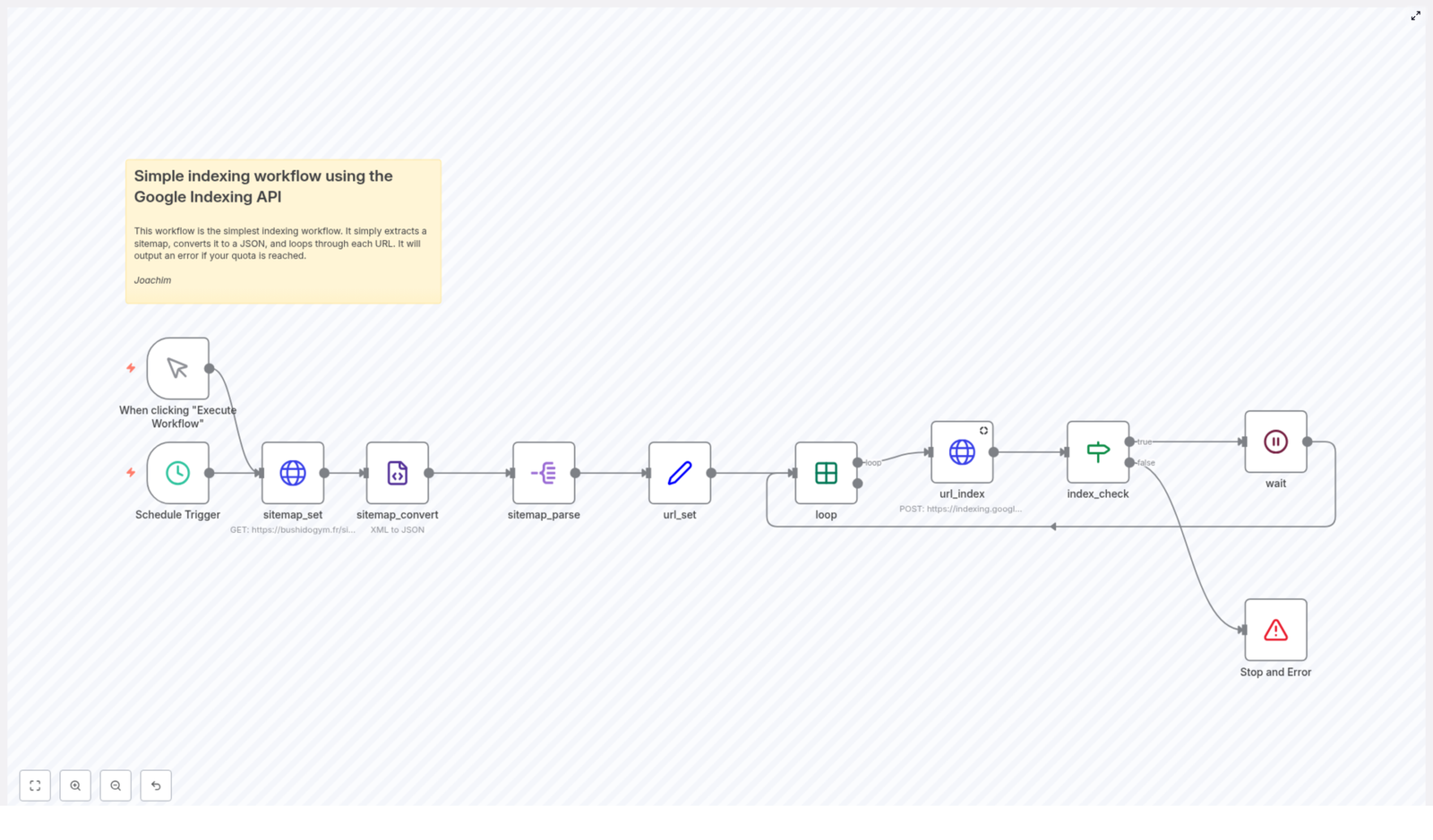
At a high level, this n8n workflow grabs all the URLs from your XML sitemap, then feeds them to the Google Indexing API in a controlled, automated way. It takes care of:

  • Fetching your sitemap file, for example https://bushidogym.fr/sitemap.xml
  • Converting that XML into a format that is easy to work with
  • Extracting all the URLs from the sitemap
  • Sending each URL to Google as an indexing request
  • Respecting your API quota so you do not get blocked
  • Pausing between requests to keep everything running smoothly

The end result: new or updated pages get submitted to Google automatically, without you having to paste URLs into tools or wait around hoping for a crawl.

When Should You Use This Workflow?

This workflow is especially useful if you:

  • Publish new content regularly and want Google to see it quickly
  • Update existing pages and need Google to re-crawl them
  • Manage a site where manual URL submissions are becoming a time sink
  • Care about SEO and want more control over how fast your pages get discovered

In short, if you have a sitemap and you are using n8n, this template is a very easy win for your automation stack.

How the Workflow Flows, Step by Step

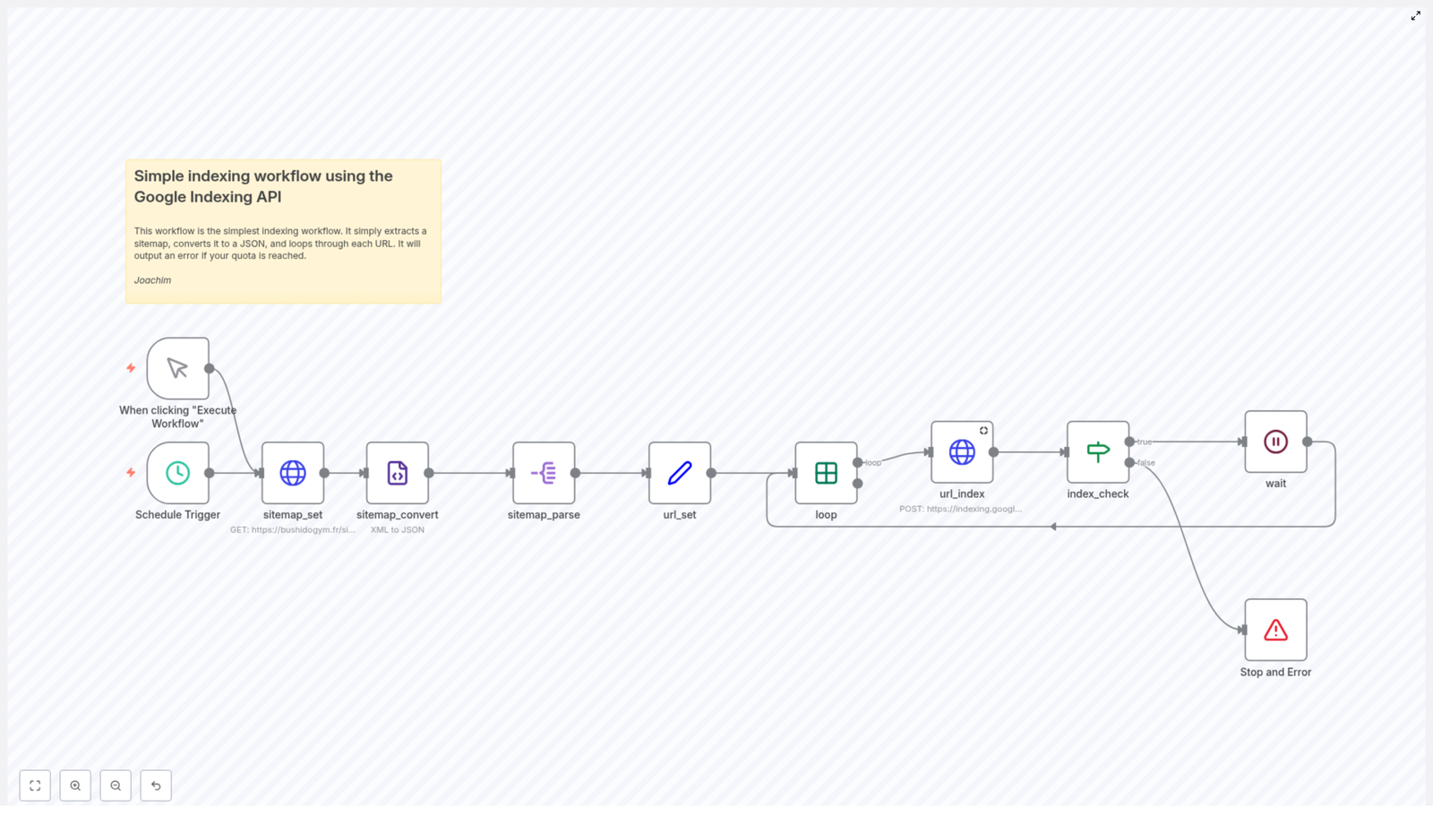
Let’s break down how everything fits together inside n8n. Think of it as a small assembly line where each node has a specific job.

1. Starting the Workflow: Manual or Automatic

You get two ways to kick things off:

  • Manual trigger: The “When clicking ‘Execute Workflow’” node lets you run everything on demand. Perfect for testing or occasional use.
  • Scheduled trigger: The “Schedule Trigger” node can be set to run daily or at whatever interval you prefer. This is what turns your indexing into true “set it and forget it” automation.

2. Fetching Your Sitemap

Next up, the workflow needs to know where your sitemap lives.

The sitemap_set node is responsible for that. Here you simply provide your sitemap URL, such as:

https://bushidogym.fr/sitemap.xml

The node then passes that URL to the part of the workflow that actually fetches the file.

3. Converting XML to JSON for Easier Handling

Sitemaps are usually in XML format, which is not the most convenient to work with inside automations. That is why the workflow uses the sitemap_convert node.

This node converts the XML sitemap into JSON. Once it is in JSON, n8n can easily loop through the data, pick out specific fields, and pass them along to other nodes.

4. Parsing and Preparing the URLs

Now that the sitemap is in JSON, it is time to pull out the actual URLs.

  • sitemap_parse node: This node digs into the JSON and extracts the list of URLs from the sitemap entries.
  • url_set node: Each URL is then set individually so the workflow can treat them one by one. This makes it easy to handle batch processing and apply logic per URL.

5. Looping Through URLs in Batches

Instead of firing all URLs at Google at once, the workflow uses a loop to process them in a controlled way.

The loop node goes through each URL, one at a time. This is important for:

  • Staying within your Google Indexing API quota
  • Preventing sudden spikes in requests
  • Making it easier to debug if something goes wrong

6. Sending URLs to the Google Indexing API

Here is where the magic happens.

The url_index node sends a POST request to the Google Indexing API for each URL. It includes:

  • The URL that needs to be indexed or updated
  • The type URL_UPDATED, which tells Google that the page is new or has changed and should be re-crawled

This node uses your configured Google API credentials, so authentication is handled securely and automatically once you set it up.

7. Checking Quota and Handling Limits

Google’s Indexing API has usage limits, so it is smart to keep an eye on those.

The index_check node looks at the response from Google and checks two things:

  • Did the request succeed?
  • Has the API quota been reached?

If everything looks good, the workflow can move on. If not, it knows when to stop.

8. Waiting or Stopping the Workflow

To avoid hammering the API, the workflow includes a small pause between each request.

  • wait node: If the quota has not been exceeded, this node waits for a short time, usually about 2 seconds, before moving on to the next URL.
  • “Stop and Error” node: If the quota limit is hit, this node ends the workflow and returns an error message instead of continuing blindly.

This combination keeps your automation polite and API friendly.

How To Set Up And Use This Workflow In n8n

Getting this running is easier than it might sound. Here is a simple checklist to follow.

Step 1: Point To Your Own Sitemap

In the sitemap_set node, replace the example URL with your actual sitemap URL. For example:

https://yourdomain.com/sitemap.xml

Step 2: Configure Google API Credentials

In the url_index node, make sure your Google API credentials are set up correctly. This is what lets n8n authenticate with the Google Indexing API and send valid requests.

Step 3: Schedule the Workflow

Use the “Schedule Trigger” node to decide when this automation should run. Many people like to:

  • Run it daily during off-peak hours
  • Schedule it after regular content publishing times

Once that is in place, you do not need to manually trigger indexing every time you publish or update content.

Step 4: Fine Tune For Your Quota

Keep an eye on your API usage at first. If you notice that you are getting close to your quota, you can:

  • Increase the delay in the wait node
  • Adjust how many URLs you process per run

This gives you a good balance between fast indexing and safe API usage.

Why This Automation Makes Your Life Easier

So what do you actually gain from all this? Quite a bit:

  • Time savings: No more manually submitting URLs whenever you publish or update pages.
  • Better SEO hygiene: Google gets notified about new or updated content faster, which helps with timely crawling and indexing.
  • Quota friendly: The workflow respects API limits and avoids unnecessary failures.
  • More control and visibility: You can see exactly which URLs are being sent and how the API responds.

Instead of hoping Google finds your pages quickly, you are actively giving it a nudge in a structured, automated way.

Ready To Try The Google Indexing API Workflow?

If you are looking to level up your SEO automation with n8n, this template is a great place to start. It is simple, practical, and once it is configured, it quietly keeps your sitemap and Google in sync.

Set it up, let it run on a schedule, and enjoy knowing your URLs are being submitted without you lifting a finger each time.

If you want to explore even more automation ideas or need help tailoring this workflow for your specific SEO strategy, do not hesitate to reach out.

How to Automate Website Indexing with Google Indexing API

How to Automate Website Indexing with Google Indexing API in n8n

1. Technical Overview

This n8n workflow automates the submission of website URLs to the Google Indexing API. It reads a sitemap, extracts each URL, and sends an update notification request to Google. The workflow is designed for reliable, repeatable execution, with support for both manual and scheduled triggers, basic rate limiting, and daily quota checks.

The reference implementation uses the sitemap at https://bushidogym.fr/sitemap.xml, but the structure can be adapted to any standard XML sitemap. The Google Indexing API is accessed via authenticated HTTP POST requests and is used to notify Google that a URL has been created or updated.

2. Workflow Architecture

At a high level, the workflow executes the following sequence:

  1. Start the workflow via a manual or scheduled trigger.
  2. Fetch the sitemap XML from a specified URL using an HTTP Request node.
  3. Convert the XML response to JSON for easier parsing in n8n.
  4. Parse and split the list of URLs into individual items.
  5. Prepare each URL for submission to the Google Indexing API.
  6. Loop through URLs one by one (batch size 1) to respect rate limits.
  7. Send a POST request to the Google Indexing API for each URL.
  8. Inspect the response and validate that the URL was accepted for indexing.
  9. Handle quota errors and enforce a delay between requests.

The workflow is composed of standard n8n nodes: triggers, HTTP Request nodes, data transformation nodes, and simple control logic that checks API responses and stops execution when the daily quota is reached.

3. Node-by-Node Breakdown

3.1 Trigger Nodes

3.1.1 Manual Trigger

The Manual Trigger node allows you to run the workflow on demand from the n8n editor or from any manual execution context. It is typically used during:

  • Initial setup and testing of the Google Indexing workflow.
  • Ad-hoc reindexing after major site updates.

No additional configuration is required on this node. It simply starts the flow and passes control to the next node without data.

3.1.2 Schedule Trigger

The Schedule Trigger node automates recurring execution. In the referenced workflow, it is configured to:

  • Run daily at 1:00 AM server time.

This ensures that new or updated URLs in the sitemap are regularly submitted to Google without manual intervention. You can adjust the schedule according to your preferred indexing cadence or server load considerations.

3.2 Sitemap Retrieval and Conversion

3.2.1 HTTP Request: Fetch Sitemap

The workflow uses an HTTP Request node to retrieve the sitemap:

  • Method: GET
  • URL: https://bushidogym.fr/sitemap.xml
  • Response Format: XML (as returned by the server)

This node downloads the XML sitemap file that contains all publicly available URLs intended for indexing. The same pattern applies if you replace the URL with your own sitemap location.

3.2.2 XML to JSON Conversion

Once the XML is retrieved, it is converted into JSON format within the workflow. In n8n, this is typically done using:

  • Either the built-in XML to JSON option on the HTTP Request node (if enabled), or
  • A dedicated transformation node (for example, a Function or a specific XML parsing node) that takes the XML string and outputs JSON.

The goal is to obtain a JSON structure that exposes the sitemap entries (usually under tags like <urlset> and <url>) as a list or array. This structure is easier to iterate over in subsequent nodes.

3.3 URL Extraction and Preparation

3.3.1 Parsing URL Entries

The converted JSON sitemap contains a collection of URL entries. These are typically represented as an array of objects, each containing a location field (for example, loc) that holds the actual page URL.

The workflow parses this JSON and splits the collection into individual items:

  • Each item corresponds to a single URL from the sitemap.
  • This split enables item-by-item processing within n8n, which is crucial for clean looping and error handling.

3.3.2 Set Node: Extract URL String

A Set node is used to normalize and expose the URL in a dedicated field that will be used by the Google Indexing API request. This node:

  • Reads the URL value from the parsed sitemap data (for example, from json.url.loc or similar paths, depending on the sitemap structure).
  • Writes it to a clearly named field such as url.

This step ensures that the downstream HTTP Request node can reference a consistent property regardless of the exact JSON structure of the original sitemap.

3.4 URL Looping and Rate Control

3.4.1 Batch Processing (1 URL per Batch)

The workflow processes URLs one at a time. This is typically implemented using a node that:

  • Iterates over all items passed from the previous step.
  • Enforces a batch size of 1, so each Google Indexing API call handles a single URL.

Single-item batches provide:

  • Fine-grained control over rate limiting.
  • Easier error detection and handling for individual URLs.

3.4.2 Delay Between Requests

To stay within Google’s general usage guidelines and avoid unnecessary throttling, the workflow introduces a delay between consecutive indexing requests:

  • Delay duration: 2 seconds between each URL submission.

This delay is applied after a successful API call and before moving to the next URL in the loop. It is a basic but effective way to reduce the risk of hitting short-term rate limits.

3.5 Google Indexing API Integration

3.5.1 HTTP Request: Publish URL Notification

For each URL, the workflow uses another HTTP Request node to call the Google Indexing API:

  • Method: POST
  • Endpoint: https://indexing.googleapis.com/v3/urlNotifications:publish
  • Authentication: Google service account credentials configured in n8n (via a Google-related credential type or generic OAuth2 / service account setup, depending on your n8n version).

The request body specifies:

  • url: The URL extracted from the sitemap and prepared in the Set node.
  • type: URL_UPDATED to indicate that the URL has been updated or created and should be (re)indexed.

This is the core interaction with the Google Indexing API. If authentication and permissions are correctly configured in your Google Cloud project, Google will accept the notification and schedule the URL for indexing or reindexing.

3.5.2 Response Validation

After each POST request, the workflow evaluates the response from Google. The key aspects checked are:

  • Notification type: The response should indicate URL_UPDATED, confirming that the update request was accepted.
  • Error fields: If the response contains an error object, the workflow uses this information to decide whether to stop or continue.

When the response type is URL_UPDATED, the workflow considers the operation successful and proceeds to the next URL after the 2-second delay.

3.6 Quota and Error Handling

3.6.1 Daily Quota Check

The Google Indexing API enforces a daily quota, which is typically:

  • Default limit: 200 requests per day per project (subject to Google’s current policy).

If the API returns an error that indicates the daily quota has been reached, the workflow:

  • Stops further processing of URLs.
  • Outputs an error message to indicate that the daily limit has been exceeded.

This prevents unnecessary retries and avoids additional errors or potential penalties.

3.6.2 Handling Rate Limit Errors

In addition to daily quotas, the workflow is designed with basic rate control through the per-request delay. If you encounter rate limit responses or similar HTTP errors:

  • The existing delay helps reduce the likelihood of repeated rate limit errors.
  • You can increase the delay duration if rate limit errors persist.

The original template focuses on halting when the daily quota is exceeded and does not implement complex retry logic, so any advanced error handling would need to be added as a customization.

4. Configuration Notes

4.1 Prerequisites

To deploy this workflow, you need:

  • An n8n instance (self-hosted or cloud) with access to the internet.
  • A Google Cloud project with the Indexing API enabled.
  • A configured Google service account with appropriate permissions.
  • Service account credentials connected to n8n via a suitable credential type.

4.2 Google Service Account & Credentials

The workflow authenticates to the Google Indexing API using a service account. In practice, you will:

  • Create or use an existing service account in your Google Cloud project.
  • Enable the Indexing API for that project.
  • Generate and securely store the service account credentials (for example, JSON key file).
  • Configure these credentials in n8n under Credentials, then select them in the HTTP Request node that calls the Indexing API.

Ensure that the service account is authorized to use the Indexing API for the domain you are indexing, according to Google’s documentation.

4.3 Sitemap URL Configuration

The example workflow uses:

  • https://bushidogym.fr/sitemap.xml

In your own setup, replace this with the URL of your sitemap. The sitemap should:

  • Be publicly accessible via HTTP or HTTPS.
  • Use a standard sitemap XML structure so that the URL entries can be parsed correctly.

4.4 Trigger Scheduling

The Schedule Trigger is set to 1 AM daily in the template. You can modify this to:

  • Run multiple times per day if you update content frequently.
  • Run less frequently if your content changes rarely.

Adjust the cron expression or schedule settings directly in the Schedule Trigger node to match your indexing strategy.

5. Advanced Customization Options

5.1 Filtering URLs

You may not want to submit every URL in the sitemap to the Indexing API. To customize:

  • Add a filter or Function node after the JSON parsing step.
  • Implement conditions to include or exclude certain URLs (for example, based on path, query parameters, or change frequency if present in the sitemap).

This lets you prioritize high-value or frequently updated content.

5.2 Adjusting Rate Limits

If you notice rate limit errors or if your quota usage is too high:

  • Increase the inter-request delay beyond 2 seconds.
  • Reduce the frequency of the Schedule Trigger.

These changes help keep the workflow stable under higher load or stricter quotas.

5.3 Error Logging and Notifications

The base workflow stops when the daily quota is exceeded and returns an error. For improved observability, you can extend it to:

  • Log failed URLs into a database or a spreadsheet.
  • Send notifications (for example, email or chat message) when quota errors or unexpected responses occur.

These additions make it easier to monitor indexing health over time.

6. Benefits of the n8n Google Indexing Workflow

  • Full automation: Once configured, the workflow runs on a schedule or on demand, eliminating manual URL submissions.
  • Faster indexing: Direct integration with the Google Indexing API helps new and updated URLs appear in search results more quickly.
  • Quota-aware execution: Built-in checks prevent exceeding the daily request limit, reducing errors and avoiding wasted API calls.
  • Flexible triggering: Supports both manual and scheduled runs, so you can combine regular indexing with ad-hoc reindexing when needed.

7. Getting Started

To implement this workflow in your own environment:

  1. Set up an n8n instance and ensure it can reach the internet.
  2. Create a Google Cloud project, enable the Indexing API, and configure a service account.
  3. Add your service account credentials in n8n and connect them to the Google Indexing HTTP Request node.
  4. Update the sitemap URL in the HTTP Request node that fetches the sitemap.
  5. Test the workflow with the Manual Trigger to verify indexing responses.
  6. Enable and tune the Schedule Trigger to match your desired indexing frequency.

8. Conclusion

This n8n workflow provides a structured, reliable way to automate website indexing with the Google Indexing API. By reading your sitemap, processing each URL individually, and respecting daily quotas and basic rate limits, it helps keep your site fresh in Google search results with minimal ongoing effort.

If you rely on organic traffic and regularly update your content, integrating this automated indexing pipeline into your deployment or publishing process can significantly streamline your SEO operations.

Ready to automate your website indexing? Configure the Google Indexing API, connect your service account in n8n, and use this workflow to keep your URLs consistently submitted to Google.

Automate Lead Scoring and Notifications with n8n Workflow

Automate Lead Scoring and Notifications with n8n Workflow

From Overwhelmed Inbox to Focused Pipeline

If you have ever felt buried under a pile of unqualified leads, you are not alone. Many teams spend hours every week sifting through forms, checking emails by hand, and guessing which prospects are worth a follow up. It is tiring, it is repetitive, and it pulls your focus away from the work that actually grows your business.

Automation gives you a different path. Instead of reacting to every new lead manually, you can design a system that does the heavy lifting for you. With the right workflow, your tools can verify emails, score leads, and notify your team about the best opportunities, all while you focus on strategy and meaningful conversations.

This is where n8n comes in. In this article, you will walk through a practical n8n workflow template that connects a form, Hunter.io, MadKudu, and Telegram. By the end, you will see how this single workflow can become a stepping stone to a more automated, calm, and high impact sales process.

Shifting Your Mindset: Let Automation Do the First Pass

Before we dive into the technical steps, it helps to reframe how you think about leads. Your job is not to touch every single contact. Your job is to focus on the right ones. Automation is not here to replace your judgment, it is here to protect it, by filtering out noise and highlighting the leads that deserve your attention.

With n8n, you can:

  • Turn a simple form into a smart entry point for your pipeline
  • Automatically validate email addresses so you stop chasing dead ends
  • Score leads based on quality and fit, not gut feeling alone
  • Receive instant Telegram alerts when a hot lead appears

Think of this workflow as your always on assistant that never forgets a step and never gets tired of repetitive checks.

The Big Picture: What This n8n Workflow Does

This n8n lead scoring template is designed to automate lead capture and qualification from the moment someone submits a form to the moment your team gets notified about a high value prospect. At a high level, it:

  • Collects lead information through a form trigger
  • Verifies the email address with Hunter.io
  • Scores the lead with MadKudu based on quality and fit
  • Sends a Telegram notification when the lead is promising enough

Everything happens in the background, so by the time a new lead reaches your sales team, it has already been cleaned, checked, and scored.

Step 1: Turn Your Form Into a Smart Entry Point

Every great automation starts with a clear, simple trigger. In this workflow, that trigger is a form where new leads submit their details.

You can:

  • Use n8n’s built in form trigger
  • Or plug in your existing tools, such as Typeform, Google Forms, or SurveyMonkey

The key is to collect the business email address. This email is the foundation for everything that follows, from validation to lead scoring. Once the form is submitted, the workflow automatically picks up the data and moves to the next step, without any manual copy and paste.

Step 2: Automatically Verify Emails With Hunter.io

Next, the workflow protects your time by checking whether the email is actually usable. It sends the collected email address to Hunter’s email verification API.

Hunter analyzes several factors, such as:

  • SMTP validation
  • Disposable email detection
  • Other signals that indicate if the email is deliverable and legitimate

Inside the n8n workflow, a condition node evaluates Hunter’s response and checks if the email status is valid. If the email fails this check, the lead is ignored and quietly filtered out. You and your team never have to waste time on unreachable or fake addresses.

Step 3: Score Qualified Leads With MadKudu

Once an email passes verification, the workflow sends it to MadKudu for lead scoring. This is where your automation starts to feel truly intelligent.

MadKudu’s scoring API enriches the lead data and returns a customer fit score. This score reflects how well the lead matches your ideal customer profile based on fit and behavior signals. Instead of treating all leads the same, you now have a clear, data driven way to prioritize your outreach.

In the n8n workflow, this score becomes a key decision point. It tells your system which leads are worth immediate attention and which ones can be archived or nurtured later.

Step 4: Trigger Telegram Notifications for Hot Leads

Here is where the workflow starts to directly impact your day. When MadKudu returns a customer fit score, the automation compares it against a threshold, for example 60.

  • If the score is higher than the threshold, the workflow sends a Telegram notification to your sales team.
  • If the score is lower, the lead is marked as not interesting enough and archived silently.

The Telegram message includes the lead’s email and relevant signals, so your team can immediately understand why this prospect stands out. No more refreshing dashboards or digging through spreadsheets. Your best opportunities simply arrive in your Telegram chat, ready for action.

Why This n8n Automation Is a Growth Lever

This workflow is more than a convenience. It can reshape how your team spends its time and energy.

  • Increased efficiency – Manual lead filtering disappears. Your workflow handles verification and scoring, so your team can focus on conversations and closing deals.
  • Improved lead quality – You automatically prioritize validated, high fit prospects. Your pipeline becomes cleaner, sharper, and easier to manage.
  • Real time alerts – Telegram notifications ensure hot leads never sit unnoticed in a database. You respond faster, which often means better conversion rates.
  • Flexible integration – You can easily swap the form trigger or change the notification method to fit your existing stack, while keeping the same core logic.

Most importantly, this workflow gives you a repeatable system. Every new lead goes through the same reliable process, which creates consistency and confidence in your sales operations.

Getting Started: Your First Version Is Just the Beginning

Setting up this template in n8n is straightforward, and you can improve it over time as you learn what works best for your business. To get started:

  1. Add your MadKudu, Hunter.io, and Telegram credentials inside n8n.
  2. Configure your Telegram chat ID to receive notifications in the right channel or group.
  3. Connect your form trigger and make sure it sends the lead’s business email to the workflow.
  4. Test the entire flow by submitting a sample email and confirming that the Telegram alert arrives when the score is above your chosen threshold.
  5. Once everything looks good, activate the workflow and let it start qualifying leads in the background.

From there, you can experiment. Adjust the score threshold, add more fields, enrich leads with additional tools, or route different scores to different follow up paths. n8n gives you the freedom to evolve your automation as your strategy grows.

Take the Next Step Toward a More Automated Workflow

Every time you remove a manual step, you reclaim a bit of focus. This n8n workflow template is a simple but powerful way to do that. It validates emails, scores leads, and alerts your team about the most promising prospects through Telegram, so you can spend less time sorting and more time selling.

You do not need to automate everything at once. Start here, see the impact, then keep building. Over time, these small improvements add up to a smoother, more scalable sales process.

Ready to transform how you handle leads? Use this n8n workflow as your starting point, customize it to your needs, and let automation support your growth every day.

Automate Lead Scoring and Notifications with n8n Workflow

Automate Lead Scoring and Notifications with n8n Workflow

What You Will Learn

In this tutorial-style guide, you will learn how to use an n8n workflow template to:

  • Capture leads using an n8n form trigger or any external form tool
  • Validate email addresses automatically with Hunter
  • Score and enrich leads using the MadKudu API
  • Filter leads based on a customer fit score threshold
  • Send instant Telegram notifications for high-potential leads
  • Configure credentials and activate the workflow in n8n

By the end, you will understand each part of the workflow and how they work together to automate lead qualification and real-time sales alerts.

Concept Overview: How the Workflow Fits Into Your Sales Funnel

This n8n workflow is designed to streamline lead validation, scoring, and notification. It connects several tools and checks into one automated pipeline:

  • Input: A form where a potential lead submits a business email
  • Validation: Hunter verifies if the email is real and deliverable
  • Scoring: MadKudu evaluates how good the lead is based on multiple attributes
  • Filtering: Only leads above a certain score are considered high potential
  • Notification: Telegram sends instant alerts to your sales or growth team

This approach helps you focus your attention on the leads most likely to convert while automatically dropping invalid or low-quality contacts.

Key Components Used in n8n

Form Trigger

The workflow begins with an n8n Form Trigger. This node creates a simple web form that collects at least one field: the lead’s business email. The form trigger URL can be embedded into your website or landing page.

You can also replace this form trigger with other tools such as:

  • Typeform
  • Google Forms
  • SurveyMonkey

In those cases, you would use the appropriate n8n node or webhook from your form provider instead of the native form trigger, but the rest of the workflow logic remains the same.

Hunter Email Verifier

After a lead submits an email, the workflow uses the Hunter Email Verifier node to check that email address. Hunter returns information about whether the email is:

  • Valid
  • Invalid
  • Risky or undeliverable

This step helps prevent sending follow-ups to fake or mistyped emails, which reduces bounce rates and keeps your list clean.

If Nodes for Decision Making

The workflow uses If nodes to make decisions based on the data returned by other nodes. There are two key decision points:

  1. Checking if the email is valid, based on Hunter’s verification result
  2. Checking if the MadKudu customer fit score is above a chosen threshold

These If nodes route leads down different paths, for example toward notification or toward a no-operation node where the workflow ends.

MadKudu API for Lead Scoring

Leads that pass the email validation step are sent to the MadKudu API node. MadKudu analyzes the lead using multiple attributes such as:

  • Company revenue
  • Industry
  • Location
  • Other behavioral or firmographic data (depending on your MadKudu setup)

MadKudu then returns a customer fit score. This score indicates how likely the lead is to convert, which helps you prioritize your outreach.

Telegram Node for Real-Time Alerts

High-scoring leads are sent to a Telegram node. This node sends an automated message to a specific Telegram chat ID, for example:

  • A private chat with a sales manager
  • A group chat for the sales team

This real-time notification ensures that hot leads are noticed quickly and followed up with in a timely manner.

No-Operation Nodes for Stopping the Flow

When a lead does not meet certain criteria, the workflow routes them to a no-operation (NoOp) node. These nodes are used to clearly mark where the workflow ends for:

  • Invalid emails
  • Leads that are “not interesting enough” based on their score

NoOp nodes do not perform any action, they simply act as clear endpoints for those branches.

Step-by-Step: How the n8n Workflow Runs

Step 1: A Lead Submits the Form

1. A visitor lands on your website or landing page and fills in a form that asks for their business email.

2. The form is powered by the n8n Form Trigger node (or a different form tool integrated into n8n). When the user submits the form, n8n receives the email data and starts the workflow.

Step 2: Validate the Email with Hunter

3. The email is passed to the Hunter Email Verifier node.

4. Hunter checks whether the email is legitimate and deliverable. It returns a status that indicates if the email is valid or not.

Example outcome:

  • Valid: The email appears real and can receive mail
  • Invalid: The email is fake, mistyped, or undeliverable

Step 3: Use an If Node to Filter Invalid Emails

5. The workflow now uses an If node to evaluate the result from Hunter.

  • If the verification status is valid, the lead continues to the scoring step.
  • If the email is not valid, the workflow routes the lead to a NoOp node, and the process ends for that input.

This makes sure that only legitimate contacts are processed further.

Step 4: Score the Lead with MadKudu

6. For valid emails, the workflow calls the MadKudu API node.

7. MadKudu enriches the lead and calculates a customer fit score using attributes like company revenue, industry, and location, among others.

8. This score is returned to n8n and attached to the lead’s data inside the workflow.

Step 5: Evaluate the Customer Fit Score

9. Another If node checks the customer fit score value from MadKudu.

10. The template uses a threshold of 60 as an example. The logic is:

  • If the score is above 60, the lead is considered “interesting” or high potential.
  • If the score is 60 or below, the lead is treated as not interesting enough for immediate follow-up.

Step 6: Send a Telegram Notification for High-Scoring Leads

11. Leads that pass the score threshold are sent to the Telegram node.

12. The Telegram node sends a message to a pre-configured chat ID. This could include details like:

  • The lead’s email
  • Their MadKudu fit score
  • Any other useful context you choose to include in the message template

13. Your sales or growth team receives this notification in real time and can act on the lead quickly.

Step 7: End the Flow for Non-Qualified Leads

14. Leads that do not meet the scoring threshold are routed to a NoOp node labeled “Not interesting enough”.

15. No further actions are taken for these leads, which keeps your team’s focus on the most promising prospects.

How to Set Up the Workflow in n8n

To start using this template in your own n8n instance, follow these setup steps.

1. Add Required Credentials

In your n8n account, add credentials for each external service used in the workflow:

  • MadKudu – for lead scoring and enrichment
  • Hunter – for email verification
  • Telegram – for sending notifications

Make sure your API keys or tokens are correct and active. These credentials will be linked to the corresponding nodes inside the template.

2. Configure the Telegram Chat ID

Next, set the Telegram chat ID in the Telegram node:

  • Decide whether you want messages in a private chat or a group
  • Retrieve the chat ID and paste it into the Telegram node configuration

This ensures that every high-scoring lead will trigger a notification in the right place.

3. Test the Workflow

Before going live, use the Test Workflow feature in n8n:

  1. Open the workflow in the n8n editor
  2. Click on the Test or Execute Workflow button
  3. Submit a sample email through the form trigger
  4. Check that:
    • Hunter validates the email
    • MadKudu returns a score
    • Telegram sends a notification for high-scoring leads

If any part fails, review the node configuration and credentials, then test again.

4. Activate and Connect to Your Live Form

Once testing is successful:

  • Activate the workflow in n8n
  • Copy the Form Trigger URL from n8n
  • Replace the form action or link in your public-facing form (or embed the n8n form directly)

From this point onward, new leads that submit their email will automatically be validated, scored, and, if qualified, will trigger Telegram alerts.

Benefits of Using This n8n Lead Scoring Template

  • Higher Lead Quality: Invalid or undeliverable emails are filtered out early, so your team focuses on real prospects.
  • Prioritized Outreach: MadKudu scoring highlights leads with the best customer fit, letting you allocate time and resources where they matter most.
  • Real-Time Alerting: Telegram notifications keep your team informed instantly when a high-potential lead appears.
  • Flexible Integrations: You can easily swap the input form provider or change the notification channel while keeping the same n8n logic.

Quick FAQ

Can I use a different form tool instead of the n8n Form Trigger?

Yes. You can replace the n8n Form Trigger with tools like Typeform, Google Forms, or SurveyMonkey. Use the appropriate integration or webhook in n8n, and connect it to the same validation and scoring steps.

Can I change the MadKudu score threshold?

Absolutely. The example uses a customer fit score of 60 as the threshold, but you can adjust this value in the corresponding If node to match your own lead qualification criteria.

What happens to low-scoring leads?

Leads that do not reach the chosen score are sent to a NoOp node labeled “Not interesting enough”. The workflow stops for those leads, which helps you avoid cluttering your notification channels with low-priority contacts.

Is this workflow suitable for B2B leads?

Yes. This setup is particularly useful for B2B lead generation where business email validity and firmographic scoring are critical for effective sales outreach.

Get Started With This n8n Workflow Template

If you want to automate your lead qualification process and make sure no high-potential lead slips through the cracks, this n8n workflow template is a powerful starting point. It combines email verification, lead scoring, and instant notifications into a single, easy-to-manage automation.

Set it up in your n8n instance, connect your tools, and start scoring leads automatically to boost your sales efficiency and conversion rates. If you need support with integration or customization, you can contact the n8n support team for expert help.