Automate GitHub → Jenkins with n8n & Supabase

Automate GitHub → Jenkins with n8n & Supabase

Ever pushed a commit and then spent the next ten minutes clicking around like a DevOps intern on loop? Trigger Jenkins, update a sheet, check logs, ping Slack, repeat. It is like Groundhog Day, but with more YAML.

This guide walks you through an n8n workflow template that does all that busywork for you. It listens to GitHub commits, generates embeddings, stores and queries vectors in Supabase, runs a RAG agent with OpenAI for context-aware processing, logs results to Google Sheets, and even yells in Slack when something breaks. You get a production-ready CI/CD automation pipeline that is smart, traceable, and way less annoying than doing it all by hand.

What this n8n workflow actually does (and why you will love it)

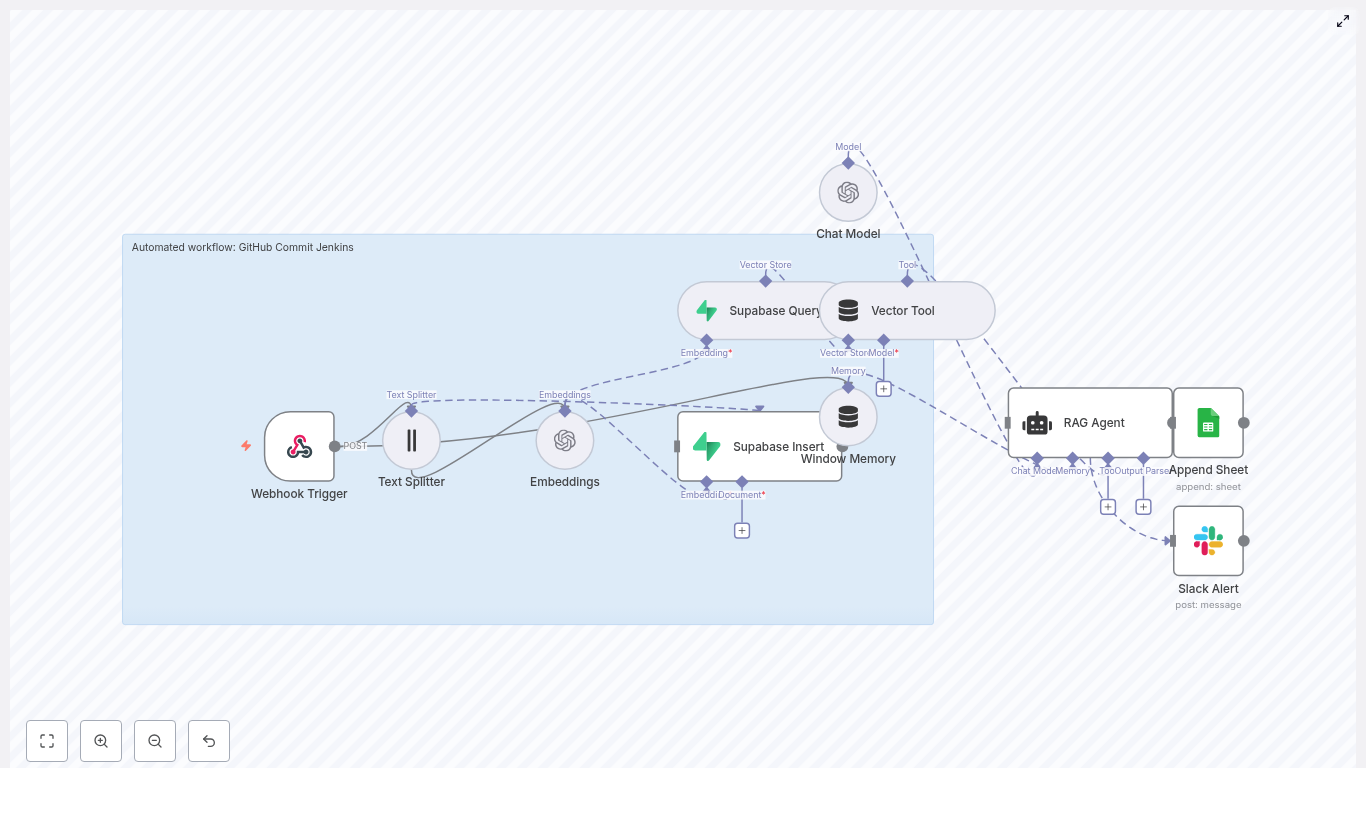
At a high level, this template turns a simple GitHub push into a fully automated, context-aware flow:

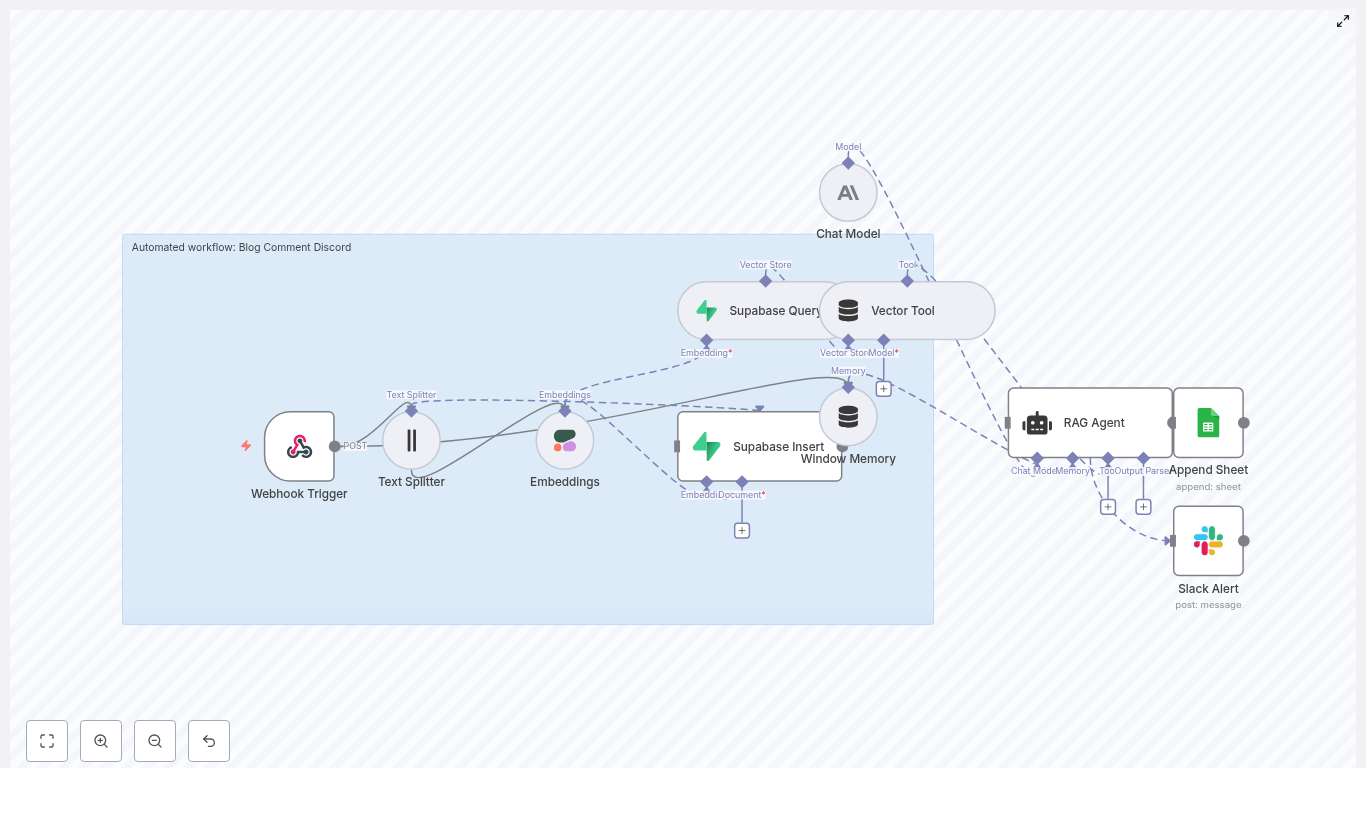
  • Webhook Trigger catches GitHub commit events.
  • Text Splitter slices long commit messages or payloads into chunks.
  • OpenAI Embeddings converts those chunks into vectors using text-embedding-3-small.
  • Supabase Insert stores chunks and embeddings in a Supabase vector index.
  • Supabase Query + Vector Tool performs similarity search to pull relevant context.
  • Window Memory & Chat Model give the RAG agent short-term memory and an LLM brain.
  • RAG Agent combines tools, memory, and the model to produce contextual output.
  • Append Sheet writes everything to Google Sheets for auditing and reporting.
  • Slack Alert shouts into a channel when errors or important statuses appear.

The result is a GitHub-to-Jenkins automation that is not just a dumb trigger, but an intelligent layer that can:

  • Generate release notes from commits.
  • Run semantic checks for security or policy issues.
  • Feed Jenkins or other CI jobs with rich, contextual data.
  • Keep non-technical stakeholders informed with friendly summaries.

Why use n8n, Jenkins, and Supabase together?

Modern DevOps is less about “can we automate this” and more about “why are we still doing this manually.” By wiring GitHub → n8n → Jenkins + Supabase + OpenAI, you get:

  • Visual orchestration with n8n, so you can see and tweak the workflow without spelunking through scripts.
  • Semantic search and RAG reasoning by storing embeddings in Supabase and using OpenAI to interpret them.
  • Faster feedback loops, since every push can be enriched, checked, logged, and acted on automatically.
  • Better observability with Google Sheets logs and Slack alerts when something goes sideways.

In short, you get a smarter, more resilient CI/CD automation pipeline that saves time and sanity.

Quick setup: from template to running workflow

Here is the short version of how to get this n8n template running without rage-quitting:

  1. Import the template
    Clone the provided n8n template JSON and import it into your n8n instance.
  2. Create required credentials
    Set up and configure:
    • OpenAI API key
    • Supabase account and API keys
    • Google Sheets OAuth credentials
    • Slack API token

    Store all of these in n8n credentials, not hard-coded in nodes.

  3. Expose your n8n webhook
    Deploy a public n8n endpoint or use a tunneling tool like ngrok for testing. Make sure GitHub can reach your webhook URL.
  4. Configure the GitHub webhook
    In your GitHub repo go to Settings → Webhooks and:
    • Point the webhook to your n8n URL + path, for example https://your-n8n-url/webhook/github-commit-jenkins.
    • Set the method to POST.
    • Filter events to push or any other events you want to handle.
  5. Tune text chunking
    Adjust the Text Splitter chunk size to match your typical commit messages or diffs.
  6. Validate Supabase vector storage
    Confirm that inserts and queries work as expected and that similarity search returns relevant chunks.
  7. Customize the RAG prompts
    Tailor the RAG agent’s system and task prompts to your use case, like:
    • Release note generation
    • Triggering Jenkins jobs
    • Compliance or security checks

Deep dive: how each n8n node is configured

Webhook Trigger: catching GitHub commits

This is where everything starts. Configure it to:

  • Use method POST.
  • Use a clear path such as /github-commit-jenkins.

In GitHub, create a webhook under Settings → Webhooks, point it to your n8n webhook URL plus that path, and filter to push events or any additional events you want. Once that is done, every push politely knocks on your workflow’s door.

Text Splitter: breaking up long commit payloads

Some commits are short and sweet, others are “refactor entire app” essays. The Text Splitter keeps things manageable by using a character-based splitter. In the template, it uses:

{  "chunkSize": 400,  "chunkOverlap": 40
}

This keeps chunks small enough for embeddings while overlapping slightly so context is not lost. It improves the quality of semantic similarity queries later on.

Embeddings (OpenAI): turning text into vectors

The Embeddings node uses OpenAI’s text-embedding-3-small model. Attach your OpenAI credential to this node and it will:

  • Take each text chunk from the splitter.
  • Generate a vector embedding for it.
  • Send those vectors to Supabase for indexing.

Keep an eye on token usage and quotas, especially if your repo is very active. You can tweak chunk sizes or batch operations to stay within rate limits.

Supabase Insert and Query: your vector brain

In Supabase, create a vector index, for example named github_commit_jenkins. The workflow uses two key nodes:

  • Supabase Insert Stores:
    • Chunked documents.
    • Their embeddings.
    • Metadata like repo, commit hash, author, and timestamp.

    This metadata is gold later when you want to filter or audit.

  • Supabase Query Performs a similarity search to fetch the top relevant chunks for the RAG agent. You can tune parameters such as:
    • top_k (how many neighbors to fetch).
    • Distance metric, depending on your vector setup.

Vector Tool and Window Memory: giving the agent context

The Vector Tool is how the RAG agent talks to your Supabase vector store. When the agent needs context, it uses this tool to pull relevant chunks.

Window Memory keeps a short rolling history of recent interactions. That way, if several related commits come in a row or you trigger follow-up processing, the agent can “remember” what just happened instead of starting from scratch every time.

RAG Agent and Chat Model: the brains of the operation

The RAG Agent is the orchestration layer that:

  • Uses the Chat Model node (OpenAI Chat endpoints) as its language model.
  • Calls the Vector Tool to retrieve context from Supabase.
  • Uses Window Memory for short-term history.

It is configured with:

  • A system message that sets its role, for example: You are an assistant for GitHub Commit Jenkins.
  • A task prompt that explains how to process the incoming data, such as generating summaries, checking for security terms, or deciding whether to trigger Jenkins jobs.

Because it is RAG-based, the agent does not just hallucinate. It uses actual commit data pulled from your vector store to produce contextual, grounded output.

Append Sheet (Google Sheets): logging everything

To keep a nice audit trail that even non-engineers can read, the workflow uses the Append Sheet node. It writes the RAG Agent output into a Google Sheet with columns like:

  • Status
  • Commit
  • Author
  • Timestamp

The template appends results to a Log sheet, turning it into a simple reporting and review dashboard. Great for managers, auditors, or your future self trying to remember what happened last week.

Slack Alert: instant feedback when things go wrong

When the RAG agent detects errors or important statuses, it triggers the Slack Alert node. You can configure it to post in a channel like #alerts, including fields such as:

  • Error message
  • Commit hash
  • Repository name
  • Link to the corresponding row in Google Sheets

Instead of discovering failures hours later in a random log file, you get a clear “hey, fix me” message right in Slack.

Real-world ways to use this GitHub → Jenkins automation

Once this workflow is running, you can plug it into a bunch of practical scenarios:

  • Automatic release notes Summarize commit messages and push them to a release dashboard or hand them to Jenkins as part of your deployment pipeline.
  • Semantic security checks Scan commit messages for security-related keywords or patterns and automatically trigger Jenkins jobs or security scans when something suspicious appears.
  • Context-enriched CI pipelines Use vector search to pull in relevant historical commits so Jenkins jobs have more context about what changed and why.
  • Human-friendly reporting Send clear summaries to Google Sheets so non-technical stakeholders can follow along without needing to read diffs.

Security and best practices (so you can sleep at night)

Automation is fun until you accidentally expose secrets or log sensitive data. To keep things safe:

  • Use GitHub webhook secrets and validate payload signatures in n8n.
  • Store all API keys in n8n credentials, never hard-coded. Limit scope and rotate them regularly.
  • Lock down your n8n instance with IP allowlists or VPNs, especially in production.
  • Rate-limit embedding requests and cache repeated embeddings where possible to control costs.
  • Sanitize payloads before storing them in vector databases or logs so you do not accidentally index sensitive information.

Troubleshooting: when the robots misbehave

No webhook events are showing up

If your workflow is suspiciously quiet:

  • Double-check the webhook URL in GitHub.
  • Inspect GitHub webhook delivery logs for errors.
  • Confirm that your n8n endpoint is reachable. If you use ngrok, make sure the tunnel is running and that GitHub has the latest URL.

Embeddings are failing or super slow

When embedding performance tanks:

  • Verify your OpenAI API key and account quota.
  • Reduce chunk size or batch embeddings to avoid hitting rate limits.
  • Check n8n logs for request latency or error messages.

Supabase query returns random or irrelevant results

If the RAG agent seems confused:

  • Confirm you are using the intended embedding model.
  • Make sure your vector table is properly populated with representative data.
  • Tune similarity search settings like top_k and the distance metric.

Observability and monitoring: watch the pipeline, not just the logs

To keep this GitHub-to-Jenkins automation healthy, track a few key metrics:

  • Webhook delivery success and failure rates.
  • Embedding API errors and latency.
  • Supabase insert and query performance.
  • RAG agent execution times.
  • Slack alert frequency and error spikes.

You can use tools like Grafana or Prometheus for dashboards, or rely on n8n’s execution history plus your Google Sheets logs as a simple audit trail.

Wrapping up: from repetitive chores to smart automation

This n8n workflow template connects GitHub commits to an intelligent, RAG-powered process that works hand-in-hand with Jenkins, Supabase, and OpenAI. You get:

  • Automated handling of commit events.
  • Semantic understanding via embeddings and vector search.
  • Context-aware processing with a RAG agent.
  • Structured logging in Google Sheets.
  • Real-time Slack alerts when things go off script.

To get started, simply import the template, plug in your credentials, and test with a few sample commits. Then iterate on:

  • Prompt design for the RAG agent.
  • Chunking strategy in the Text Splitter.
  • Vector metadata design and Supabase query parameters.

As you refine it, the workflow becomes a tailored automation layer that fits your team’s CI/CD style perfectly.

Call to action: Import this n8n template, subscribe for more DevOps automation guides, or reach out if you want help adapting it to your environment. Ready to automate smarter and retire a few repetitive tasks from your daily routine?
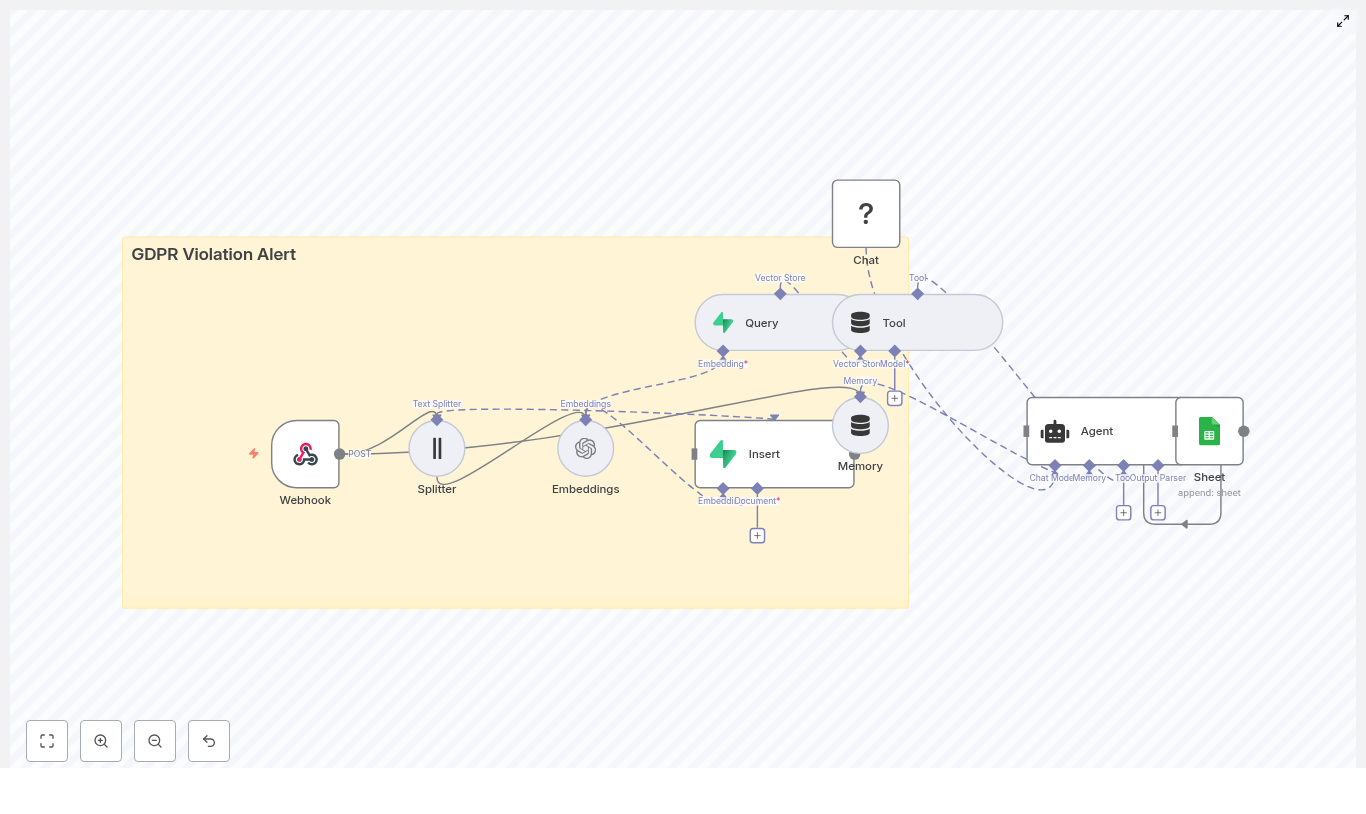
GDPR Violation Alert: n8n + Vector DB Workflow

GDPR Violation Alert: n8n + Vector DB Workflow

This documentation-style guide describes a reusable, production-ready n8n workflow template that detects, enriches, and logs potential GDPR violations using vector embeddings, a Supabase vector store, and an LLM-based agent. It explains the architecture, node configuration, data flow, and operational considerations so you can confidently deploy and customize the automation in a real environment.

1. Workflow Overview

The workflow implements an automated GDPR violation alert pipeline that:

  • Accepts incoming incident reports or logs through an HTTP webhook
  • Splits long text into chunks suitable for embedding and retrieval
  • Generates embeddings with OpenAI and stores them in a Supabase vector database
  • Queries the vector store for similar historical incidents
  • Uses a HuggingFace-powered chat model and agent to classify and score potential GDPR violations
  • Logs structured results into Google Sheets for auditing and downstream processing

This template is designed for teams that already understand GDPR basics, NLP-based semantic search, and n8n concepts such as nodes, credentials, and workflow triggers.

2. Use Case & Compliance Context

2.1 Why automate GDPR violation detection

Organizations that process personal data must detect, assess, and document potential GDPR violations quickly. Manual review of logs, support tickets, and incident reports does not scale and can introduce delays or inconsistencies.

This workflow addresses that gap by:

  • Automatically flagging content that may include personal data or GDPR-relevant issues
  • Providing a consistent severity classification and recommended next steps
  • Maintaining an audit-ready log of processed incidents
  • Leveraging semantic search to detect nuanced violations, not just keyword matches

Natural language processing and vector search allow the system to recognize similar patterns across different phrasings, making it more robust than simple rule-based or regex-based detection.

3. High-Level Architecture

At a high level, the n8n workflow consists of the following components, ordered by execution flow:

  1. Webhook – Entry point that accepts POST requests with incident content.
  2. Text Splitter – Splits long input text into overlapping chunks.
  3. Embeddings (OpenAI) – Transforms text chunks into vectors.
  4. Insert (Supabase Vector Store) – Persists embeddings and metadata.
  5. Query + Tool – Performs similarity search and exposes it as an agent tool.
  6. Memory – Maintains recent context for multi-step reasoning.
  7. Chat (HuggingFace) – LLM that performs reasoning and classification.
  8. Agent – Orchestrates tools and model outputs into a structured decision.
  9. Google Sheets – Appends a log row for each processed incident.

The combination of webhook ingestion, vector storage, and an LLM-based agent makes this workflow suitable as a central component in a broader security or privacy incident management pipeline.

4. Node-by-Node Breakdown

4.1 Webhook Node – Entry Point

Purpose: Accepts incoming GDPR-related reports, alerts, or logs via HTTP POST.

  • HTTP Method: POST
  • Path: /webhook/gdpr_violation_alert

Typical payload sources:

  • Support tickets describing data exposure or access issues
  • Security Information and Event Management (SIEM) alerts that may contain user identifiers
  • Automated privacy scanners or third-party monitoring tools

Configuration notes:

  • Enable authentication or IP allowlists to restrict who can call the endpoint.
  • Validate JSON structure early to avoid downstream errors in text processing nodes.
  • Normalize incoming fields (for example, map description, message, or log fields into a single text field used by the Splitter).

4.2 Text Splitter Node – Chunking Input Text

Purpose: Breaks long incident descriptions or logs into smaller segments that fit embedding and context constraints.

  • Chunk size: 400 characters (or tokens, depending on implementation)
  • Chunk overlap: 40 characters

Behavior:

  • Ensures that each chunk retains enough local context for meaningful embeddings.
  • Overlap avoids losing critical context at chunk boundaries, improving search quality.
  • Protects against exceeding embedding model token limits on very long inputs.

Edge considerations:

  • Short texts may result in a single chunk, which is expected and supported.
  • Very large logs will produce many chunks, which may impact embedding cost and query time.

4.3 Embeddings Node (OpenAI) – Vectorization

Purpose: Converts each chunk into a high-dimensional vector representation for semantic search.

  • Provider: OpenAI Embeddings
  • Model: A semantic search capable embedding model (workflow uses the default embedding model configured in n8n)

Data stored per chunk:

  • Text chunk content
  • Vector embedding
  • Metadata such as:
    • Source or incident ID
    • Timestamp of the report
    • Chunk index or position
    • Optional severity hints or category tags

Configuration considerations:

  • Use a model optimized for semantic similarity tasks, not for completion.
  • Propagate metadata fields from the webhook payload so that search results remain explainable.
  • Handle API errors or rate limits by configuring retries or backoff at the n8n workflow level.

4.4 Insert Node – Supabase Vector Store

Purpose: Writes embeddings and associated metadata into a Supabase-backed vector index.

  • Index name: gdpr_violation_alert
  • Operation mode: insert (adds new documents and vectors)

Functionality:

  • Persists each chunk embedding into the configured index.
  • Enables efficient nearest-neighbor queries across historical incidents.
  • Supports use cases such as:
    • Identifying repeated PII exposure patterns
    • Finding similar previously investigated incidents
    • Detecting known risky phrases or behaviors

Configuration notes:

  • Ensure Supabase credentials are correctly set up in n8n.
  • Map metadata fields consistently so that future queries can filter or explain results.
  • Plan for index growth and retention policies as the volume of stored incidents increases.

4.5 Query Node + Tool Node – Vector Search as an Agent Tool

Purpose: Retrieve similar incidents from the vector store and expose that capability to the agent.

Query Node:

  • Executes a similarity search against gdpr_violation_alert using the current input embedding or text.
  • Returns the most similar stored chunks, along with their metadata.

Tool Node:

  • Wraps the Query node as a tool that the agent can call on demand.
  • Enables the agent to perform hybrid reasoning, for example:
    • “Find previous incidents mentioning ’email dump’ similar to this report.”
  • Provides the agent with concrete historical context to improve its classification and recommendations.

Edge considerations:

  • If the index is empty or few matches exist, the query may return no or low-quality results. The agent should be prompted to handle this gracefully.
  • Similarity thresholds can be tuned within the node configuration or in downstream logic to reduce noisy matches.

4.6 Memory Node & Chat Node (HuggingFace) – Context and Reasoning

Memory Node:

  • Type: Buffer-window memory
  • Purpose: Stores recent conversation or processing context for the agent.
  • Maintains a sliding window of messages so the agent can reference prior steps and tool outputs without exceeding model context limits.

Chat Node (HuggingFace):

  • Provider: HuggingFace
  • Role: Core language model that interprets the incident, vector search results, and prompt instructions.
  • Performs:
    • Summarization of incident content
    • Classification of GDPR relevance
    • Reasoning about severity and recommended actions

Combined behavior:

  • The memory node ensures the agent can reason across multiple tool calls and intermediate steps.
  • The chat model uses both the original text and vector search context to produce informed decisions.

4.7 Agent Node – Decision Logic and Orchestration

Purpose: Orchestrates the chat model and tools, then outputs a structured decision object.

Core responsibilities:

  • Call the Chat node and Tool node as needed.
  • Apply prompt instructions that define what constitutes a GDPR violation.
  • Generate structured fields for downstream logging.

Recommended prompt behavior:

  • Determine whether the text:
    • Contains personal data (names, email addresses, phone numbers, identifiers)
    • Indicates a possible GDPR breach or is more likely a benign report
  • Assign a severity level such as:
    • Low
    • Medium
    • High
  • Recommend next actions, for example:
    • Escalate to Data Protection Officer (DPO)
    • Redact or anonymize specific data
    • Notify affected users or internal stakeholders
  • Produce structured output fields:
    • Timestamp
    • Severity
    • Short summary
    • Evidence snippets or references to chunks

Prompt example:

"Classify whether the given text contains personal data (names, email, phone, identifiers), indicate the likely GDPR article impacted, and assign a severity level with reasoning."

Error-handling considerations:

  • Ensure the agent prompt instructs the model to output a consistent JSON-like structure to avoid parsing issues.
  • Handle model timeouts or failures in n8n by configuring retries or fallback behavior if needed.

4.8 Google Sheets Node – Logging & Audit Trail

Purpose: Persist the agent’s decision and metadata in a human-readable, queryable format.

  • Operation: Append
  • Target: Sheet named Log

Typical logged fields:

  • Incident timestamp
  • Severity level
  • Short description or summary
  • Key evidence snippets or references
  • Optional link to original system or ticket ID

Usage:

  • Serves as an audit trail for compliance and internal reviews.
  • Can be integrated with reporting dashboards or ticketing systems.
  • Allows manual overrides or annotations by privacy and security teams.

5. Implementation & Configuration Best Practices

5.1 Webhook Security

Do not expose the webhook endpoint publicly without controls. Recommended measures:

  • Require an API key header or bearer token in incoming requests.
  • Implement HMAC signature validation so only trusted systems can send data.
  • Use IP allowlists or VPN access restrictions where possible.
  • Rate limit the endpoint to mitigate abuse and accidental floods.

5.2 Metadata & Observability

Rich metadata improves search quality and incident analysis. When inserting embeddings, include fields such as:

  • Origin system (for example, support desk, SIEM, scanner)
  • Submitter or reporter ID (hashed or pseudonymized if sensitive)
  • Original timestamp and timezone
  • Chunk index and total chunks count
  • Any initial severity hints or category labels from the source system

These fields help with:

  • Explaining why a particular incident was flagged
  • Tracing issues across systems during root-cause analysis
  • Filtering historical incidents by source or timeframe

5.3 Prompt Design for the Agent

Clear, explicit prompts are critical for consistent classification. When defining the agent prompt:

  • Specify what qualifies as personal data, with examples.
  • Instruct the model to refer to GDPR concepts (for example, personal data, data breach, processing, consent) without making legal conclusions.
  • Define severity levels and criteria for each level.
  • Request a deterministic, structured output format that can be parsed by n8n.

Use the earlier example prompt as a baseline, then iterate based on false positives and negatives observed during testing.

5.4 Data Minimization & Privacy Controls

GDPR requires limiting stored personal data to what is strictly necessary. Within this workflow:

  • Consider hashing or redacting highly sensitive identifiers (for example, full email addresses, phone numbers) before sending them to embedding or logging nodes.
  • If raw content is required for investigations:
    • Restrict access to the vector store and Google Sheets to authorized roles only.
    • Define retention periods and automatic deletion processes.
  • Avoid storing more context than necessary in memory or logs.

5.5 Monitoring & Alerting Integration

For high-severity events, integrate the workflow with alerting tools:

  • Send notifications to Slack channels for immediate team visibility.
  • Trigger PagerDuty or similar incident response tools for critical cases.
  • Use n8n branches or additional nodes to:
    • Throttle repeated alerts from the same source
    • Implement anomaly detection and rate-based rules to reduce noise

6. Testing & Validation Strategy

Before deploying this workflow to production, perform structured testing:

  • Synthetic incidents: Create artificial examples that clearly contain personal data and obvious violations.
  • Historical incidents: Replay anonymized or sanitized real cases to validate behavior.
  • Borderline cases: Include:
    • Pseudonymized or tokenized data
    • Aggregated statistics without individual identifiers
    • Internal technical logs that may or may not contain user data

Automating Game Bug Triage with n8n and Vector Embeddings

Automating Game Bug Triage with n8n and Vector Embeddings

Keeping up with bug reports in a live game can feel like playing whack-a-mole, right? One report comes in, then ten more, and suddenly you’re juggling duplicates, missing critical issues, and copying things into spreadsheets at 11 pm.

This is where an automated bug triage workflow in n8n really shines. In this guide, we’ll walk through a ready-to-use n8n template that uses:

  • Webhooks to ingest bug reports
  • Text splitting for long descriptions
  • Cohere embeddings to turn text into vectors
  • A Redis vector store for semantic search
  • An LLM-backed agent to analyze and prioritize bugs
  • Google Sheets for simple, shareable logging

The result: a scalable bug triage pipeline that automatically ingests reports, indexes them semantically, retrieves relevant context, and logs everything in a structured way. Less manual triage, more time to actually fix the game.

Why bother automating game bug triage?

If you’ve ever handled bug reports manually, you already know the pain points:

  • It’s slow – reports pile up faster than you can read them.
  • Duplicates slip through – same bug, different wording, new ticket.
  • Important issues get buried – P0 bugs arrive, but they look like just another report.
  • Context gets lost – logs, player info, and environment details end up scattered.

This n8n workflow template tackles those problems by:

  • Capturing bug reports instantly through a Webhook
  • Splitting long descriptions into searchable chunks
  • Storing semantic embeddings in Redis for robust similarity search
  • Using an Agent + LLM to summarize, prioritize, and label bugs
  • Logging everything into Google Sheets so your team has a simple, central source of truth

In short, it helps you find duplicates faster, spot critical issues sooner, and keep a clean log without babysitting every report.

What this n8n workflow template actually does

Let’s look at the high-level architecture first, then we’ll go step by step.

Key components in the workflow

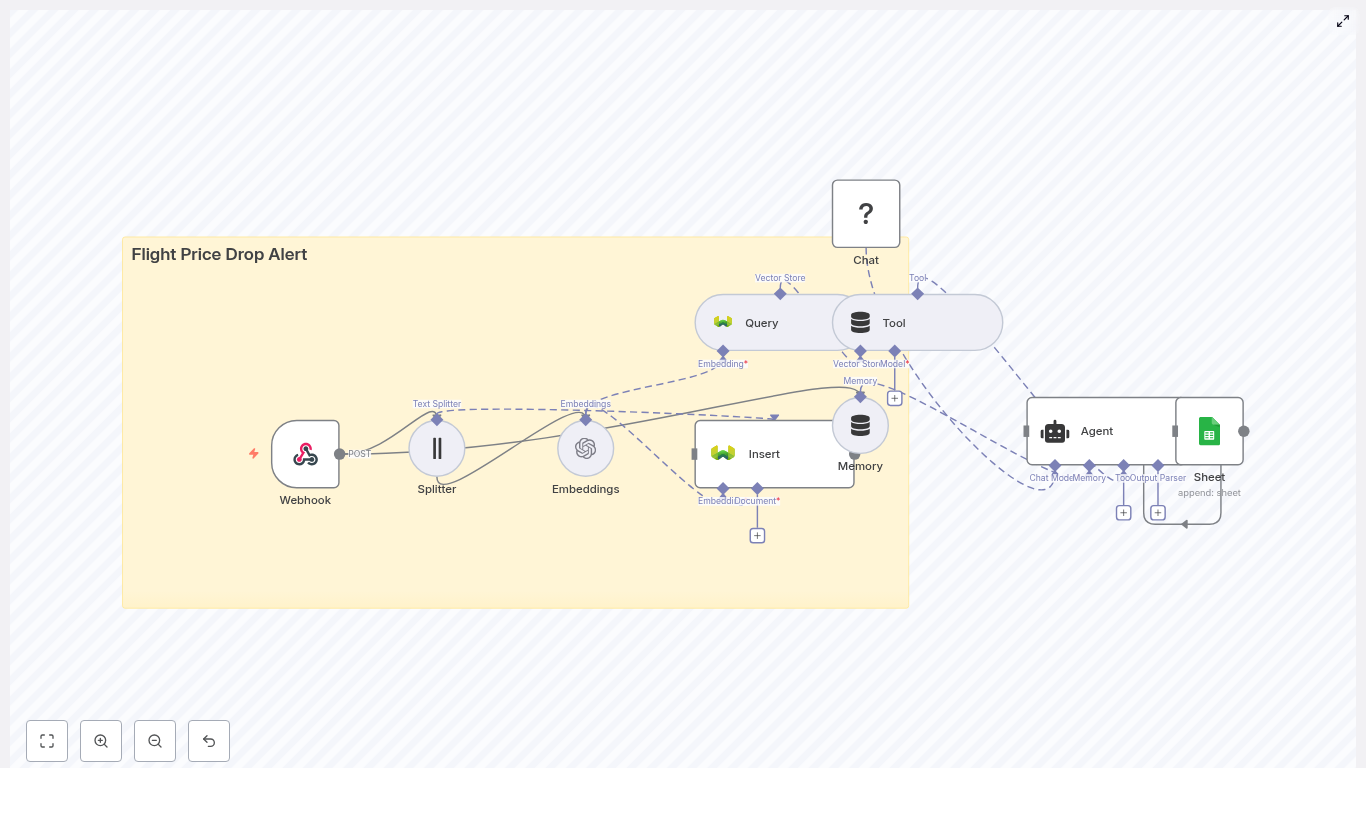
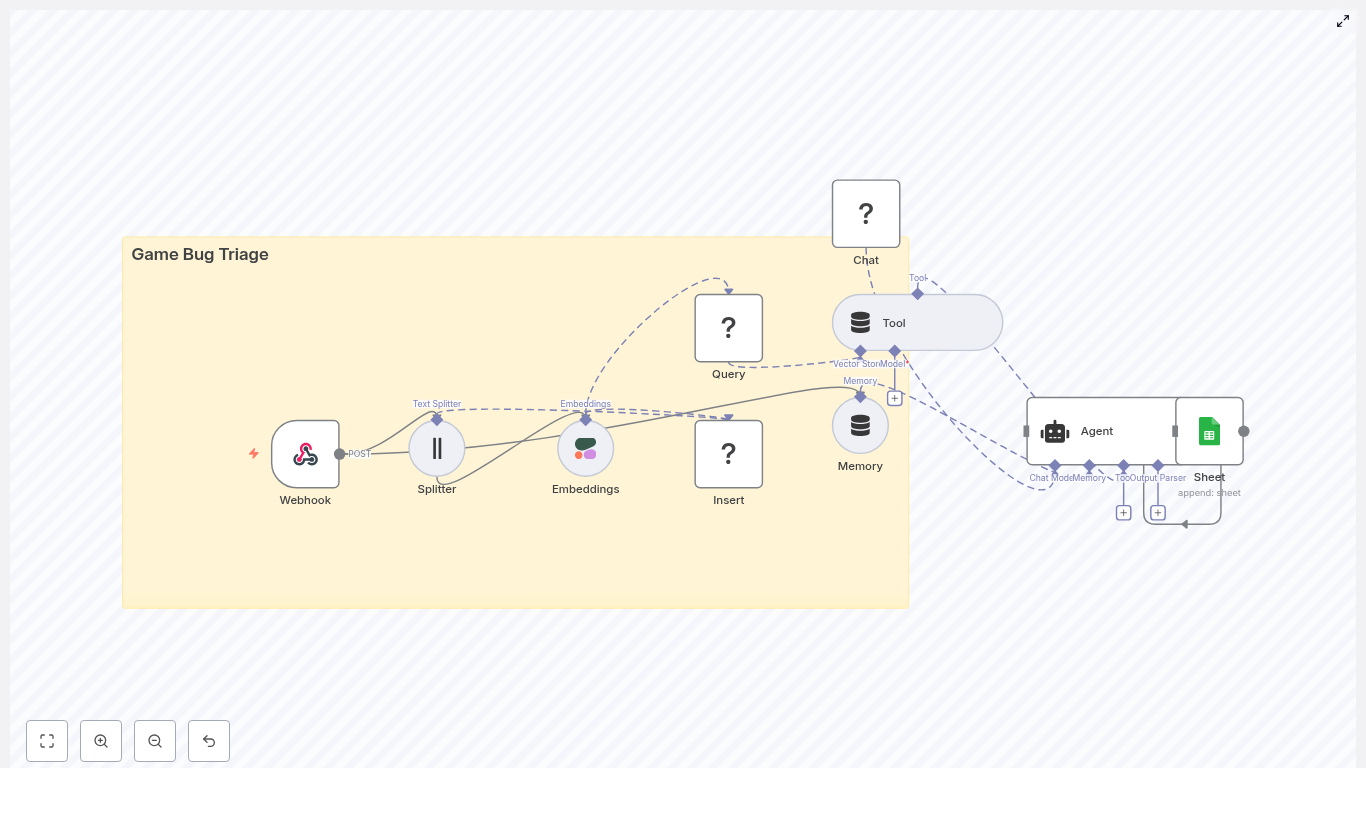
The reference n8n workflow uses the following nodes:

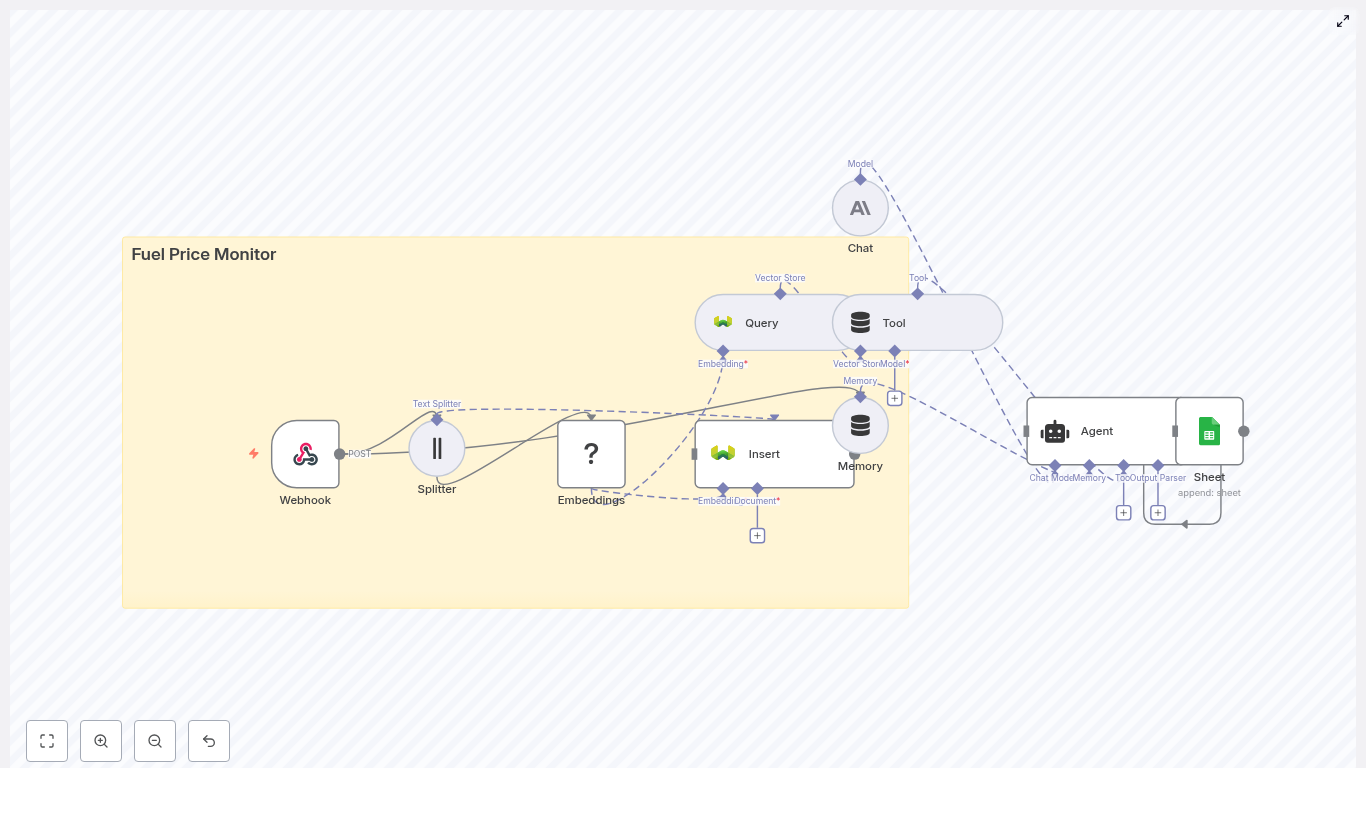
  • Webhook – receives bug reports via HTTP POST
  • Splitter – breaks long text into smaller chunks (chunkSize 400, overlap 40)
  • Embeddings (Cohere) – converts text chunks into vector embeddings
  • Insert (Redis vector store) – indexes embeddings in Redis with indexName=game_bug_triage
  • Query (Redis) – searches the vector index for similar past reports
  • Tool (VectorStore wrapper) – exposes those search results as a tool for the agent
  • Memory (buffer window) – keeps recent interactions for context
  • Chat (language model, Hugging Face) – provides the LLM processing power
  • Agent – coordinates tools, memory, and the LLM, then formats a structured triage output
  • Sheet (Google Sheets) – appends a row to your triage log sheet

Now let’s unpack how all of this works together when a new bug report comes in.

Step-by-step: How the bug triage workflow runs

1. Bug reports flow in through a Webhook

First, your game or community tools send bug reports directly into n8n using a Webhook node.

This could be wired up from:

  • An in-game feedback form
  • A Discord bot collecting bug reports
  • A customer support or web form

These systems POST a JSON payload to the webhook URL. A typical payload might include:

  • title
  • description
  • playerId
  • platform (PC, console, mobile)
  • buildNumber
  • Links to screenshots or attachments (files themselves are usually stored elsewhere)

The Webhook node ensures reports are captured in real time, so you don’t have to import or sync anything manually.

2. Clean up and split long descriptions

Bug reports can be messy. Some are short, others are walls of logs and text. To make them usable for embeddings and semantic search, the workflow uses a Splitter node.

In the template, the Splitter is configured with:

  • chunkSize: 400 characters
  • chunkOverlap: 40 characters

Why those numbers?

  • 400 characters is a nice balance between context and precision. It’s big enough to keep related information together, but not so large that embeddings become noisy or expensive.
  • 40 characters overlap ensures that context flows from one chunk to the next. That way, semantic search still “understands” the bug even when it spans multiple chunks.

The result: long descriptions and logs are broken into chunks that are easier to index and search, without losing the bigger picture.

3. Turn text into embeddings with Cohere

Once the text is split, each chunk is passed to the Cohere Embeddings node.

Embeddings are dense numeric vectors that capture the meaning of text. Instead of matching exact keywords, you can search by semantic similarity. For example, these can help you find:

  • Two reports describing the same crash but in totally different words
  • Different players hitting the same UI bug on different platforms

Cohere’s embeddings model converts each chunk into a vector that can be stored and searched efficiently.

4. Index all bug chunks in a Redis vector store

Those embeddings need a home, and that’s where Redis comes in.

The workflow uses an Insert node that writes embeddings into a Redis vector index named game_bug_triage. Along with each vector, you can store metadata, such as:

  • playerId
  • buildNumber
  • platform
  • timestamp
  • Attachment or screenshot URLs

Redis is fast and production-ready, which makes it a solid choice for high-throughput bug triage in a live game environment.

5. Query Redis for related bug reports

When a new bug comes in and you want to triage it, the workflow uses a Query node to search the same Redis index.

This node performs a similarity search over the game_bug_triage index and returns the most relevant chunks. That retrieved context helps you (or rather, the agent) answer questions like:

  • Is this bug a duplicate of something we’ve already seen?
  • Has this issue been reported in previous builds?
  • Does this look like a known crash, UI glitch, or network problem?

The results are wrapped in a Tool node (a VectorStore wrapper) so the agent can call this “search tool” as part of its reasoning process.

6. Agent, Memory, and LLM work together to triage

This is where the magic happens. The Agent node coordinates the logic using:

  • The raw bug payload from the Webhook
  • Relevant context from Redis via the Tool
  • Recent interaction history from the Memory node (buffer window)
  • The Chat node, which connects to a Hugging Face language model

The agent then produces a structured triage result. Typically, that includes fields like:

  • Priority (P0 – P3)
  • Likely cause (Networking, Rendering, UI, etc.)
  • Duplicate of (if it matches a known issue)
  • Suggested next steps for the team

In the provided workflow, the Agent uses a prompt with promptType="define" and the text set to = {{$json}}. You’ll want to fine-tune this prompt with clear instructions and examples so the model consistently returns the fields you care about.

7. Log everything into Google Sheets

Finally, the structured triage result is appended to a Google Sheet using the Sheet node.

In the template, the sheet name is set to “Log”. Each new bug triage becomes a new row with all the important details.

Why Google Sheets?

  • Everyone on the team can view it without extra tooling.
  • You can plug it into dashboards or BI tools later.
  • It works as an audit trail for how bugs were classified over time.

From there, you can build further automations, like syncing into JIRA, GitHub, or your internal tools.

How to get the most out of this template

Prompt engineering for reliable outputs

The Agent is only as good as the instructions you give it. To make your triage results consistent:

  • Define required fields clearly, such as priority, category, duplicateOf, nextSteps.
  • Specify allowed values for priority and severity (for example P0 to P3, or Critical / High / Medium / Low).
  • Provide example mappings, like “frequent disconnects during matchmaking” → Networking, or “UI elements not clickable” → UI.
  • Include a few sample bug reports and the expected structured output in the prompt.

The better your examples, the more predictable your triage results will be.

Fine-tuning chunking and embeddings

Chunking is not one-size-fits-all. You can experiment with:

  • chunkSize – larger chunks capture more context but cost more to embed and may be less precise.
  • chunkOverlap – more overlap keeps context smoother but increases total embedding volume.

Start with the default 400 / 40 settings, then:

  • Check whether similar bugs are being matched correctly.
  • Adjust chunk size if your reports are usually much shorter or much longer.

Designing useful metadata

Metadata is your friend when you want to filter or slice your search results. Good candidates for metadata in the Redis index include:

  • buildNumber
  • platform (PC, PS, Xbox, Mobile, etc.)
  • region
  • Attachment or replay URLs

With this, you can filter by platform or build, for example “show similar bugs, but only on the current production build.”

Scaling and performance tips

As your game grows, so will your bug reports. To keep the system snappy:

  • Use a production-ready Redis deployment or managed service like Redis Cloud.
  • Batch embedding requests where possible to reduce API overhead.
  • Monitor the size of your Redis index and periodically:
    • Prune very old entries, or
    • Archive them to cheaper storage if you still want history.

Security and privacy considerations

Game logs and bug reports can contain sensitive data, so it’s important to handle them carefully:

  • Sanitize or remove any personally identifiable information (PII) before indexing.
  • If logs contain user tokens, IPs, or emails, redact or hash them.
  • Secure your Webhook endpoint with:
    • HMAC signatures
    • API keys or other authentication
  • Restrict access to your Redis instance and Google Sheets credentials.

Testing and monitoring your triage pipeline

Before you roll this out to your entire player base, it’s worth doing a bit of tuning.

  • Start with a test dataset of real historical bug reports.
  • Use those to refine:
    • Your chunking settings
    • Your prompts and output schema
  • Track key metrics, such as:
    • Triage latency – how long it takes from report to logged result.
    • Accuracy – how often duplicates are correctly identified.
    • False positives – when unrelated bugs are marked as duplicates.
  • Regularly sample model-generated outputs for human review and iterate on prompts.

A bit of upfront testing pays off quickly once the system is running on live data.

Popular extensions to this workflow

Once you have the core triage automation running, it’s easy to extend it in n8n. Some common next steps include:

  • Auto-create tickets in JIRA or GitHub when a bug hits a certain priority (for example P0 or P1).
  • Send alerts to Slack or Discord channels for high-priority issues, including context and a link to the Google Sheet.
  • Attach related assets like screenshots or session replays, using URLs stored as metadata in the vector index.
  • Build dashboards to visualize trends over time, like bug volume by build or platform.

Because this is all in n8n, you can keep iterating without rebuilding everything from scratch.

Putting it all together

This n8n Game Bug Triage template gives you a practical, AI-assisted pipeline that:

  • Ingests bug reports automatically
  • Indexes them using semantic embeddings in Redis
  • Uses an LLM-driven agent to prioritize and categorize issues
  • Logs everything into a simple, shareable Google Sheet

It reduces manual triage work, surfaces critical issues faster, and gives your team a solid foundation to build more automation on top of.

Ready to try it?

Here’s a simple way to get started:

  1. Import the n8n workflow template.
  2. Plug in your Cohere and Redis credentials.
  3. Point your game’s bug reporting system at the Webhook URL.
  4. Test with a set of sample bug reports and tweak

Automate Blog Comments to Discord with n8n

Automate Blog Comments to Discord with n8n

Picture this: you publish a new blog post, go grab a coffee, and by the time you are back there are fifteen new comments. Some are brilliant, some are spicy, and some are just “first!”. Now imagine manually reading, summarizing, logging, and sharing the best ones with your Discord community every single day. Forever.

If that sounds like a recurring side quest you did not sign up for, this is where n8n comes in to save your sanity. In this guide, we will walk through an n8n workflow template that automatically turns blog comments into searchable context, runs them through a RAG (retrieval-augmented generation) agent, stores everything neatly in Supabase, logs outputs to Google Sheets, and optionally sends the interesting stuff to Discord (or Slack) so your team and community never miss a thing.

All the brain work stays, the repetitive clicking goes away.

What this n8n workflow actually does

This template is built to solve three very real problems that show up once your blog grows beyond “my mom and two friends” traffic:

  • Capture everything automatically – Every comment is ingested, split, embedded, and stored in a Supabase vector store so you can search and reuse it later.
  • Use RAG to respond intelligently – A RAG agent uses embeddings and historical context to create summaries, suggested replies, or moderation hints that are actually relevant.
  • Send the important bits where people live – Highlights and action items can be sent to Discord or Slack, while all outputs are logged to Google Sheets for tracking and audit.

In other words, you get a tireless assistant that reads every comment, remembers them, and helps you respond in a smart way, without you living inside your CMS all day.

Under the hood: key n8n building blocks

Here is the cast of characters in this automation, all wired together inside n8n:

  • Webhook Trigger – Receives incoming blog comment payloads via HTTP POST.
  • Text Splitter – Chops long comments into smaller, embedding-friendly chunks.
  • Embeddings (Cohere) – Uses the embed-english-v3.0 model to turn text chunks into vectors.
  • Supabase Insert / Query – Stores vectors and metadata, and later retrieves similar comments for context.
  • Vector Tool – Packages retrieved vectors so the RAG agent can easily access contextual information.
  • Window Memory – Keeps recent conversation context available for the agent.
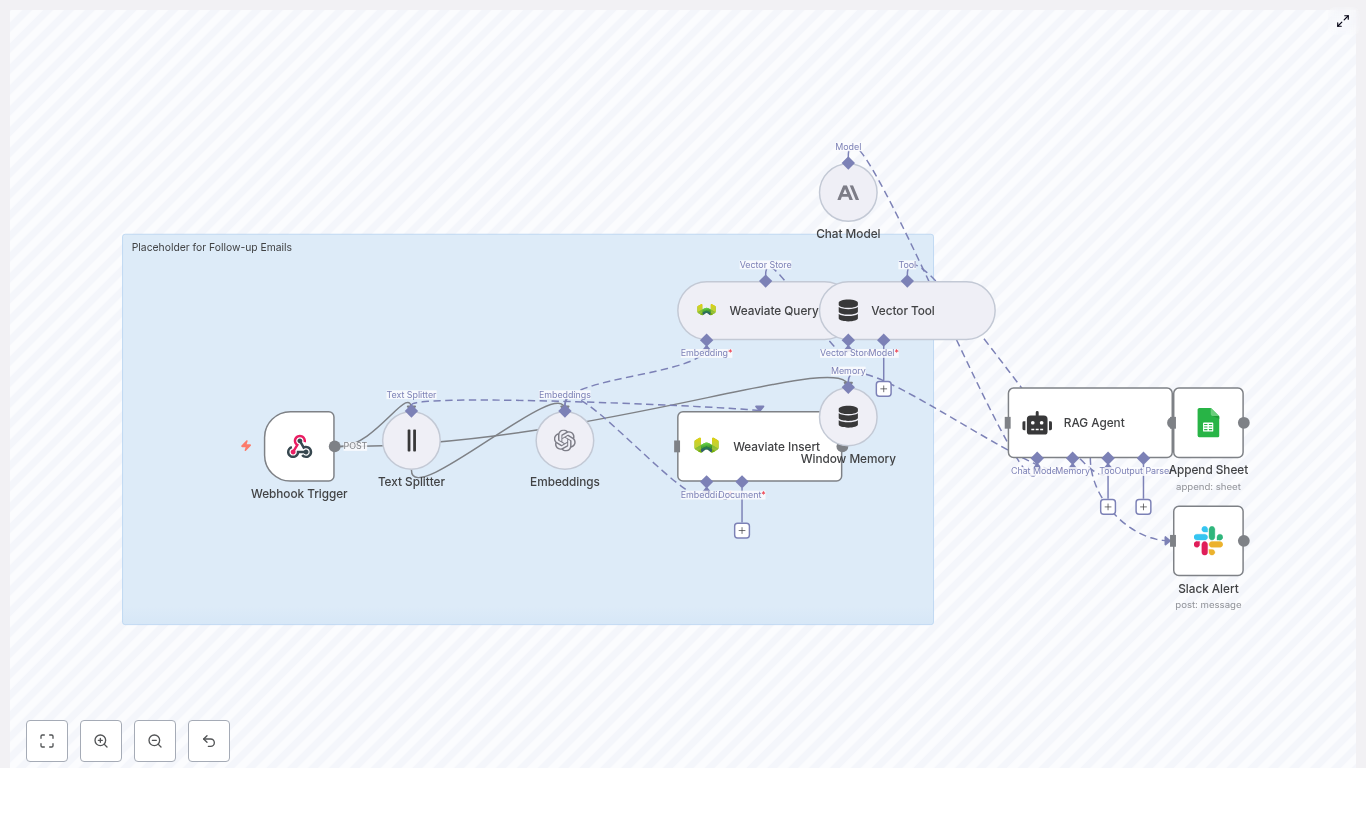
  • Chat Model (Anthropic) – Generates summaries, replies, or moderation recommendations.
  • RAG Agent – Orchestrates the retrieval + generation steps and sends final output to Google Sheets.
  • Slack Alert – Sends a message if any node errors out so failures do not silently pile up.

Optionally, you can add a Discord node or HTTP Request node to post approved highlights straight into a Discord channel via webhook.

How the workflow runs, step by step

Let us walk through what actually happens when a new comment shows up, from “someone typed words” to “Discord and Google Sheets are updated.”

1. Receive the comment via webhook

The workflow starts with a Webhook Trigger node. This exposes an HTTP POST endpoint in n8n. Your blog or CMS should be configured to send comment data to this endpoint whenever a new comment is created.

Example payload:

{  "post_id": "123",  "comment_id": "c456",  "author": "Jane Doe",  "content": "Thanks for the article! I think the performance section could use benchmarks.",  "timestamp": "2025-08-31T12:34:56Z"
}

So instead of you refreshing the comments page on loop, your blog just pings n8n directly.

2. Split and embed the text

Next, the comment text goes to a Text Splitter node. This is where long comments get sliced into smaller chunks so the embedding model can handle them efficiently.

In the template, the recommended settings are:

  • Chunk size – 400 characters
  • Overlap – 40 characters

This keeps enough overlap to preserve context between chunks without exploding your storage or embedding costs.

Each chunk is then passed to Cohere’s embed-english-v3.0 model. The node generates a vector for each chunk, which is essentially a numerical representation of the meaning of that text. These vectors are what make similarity search and RAG magic possible later on.

3. Store embeddings in Supabase

Once you have vectors, the workflow uses a Supabase Insert node to store them in a Supabase table or index, for example blog_comment_discord.

Along with each vector, the following metadata is stored:

  • post_id
  • comment_id
  • author or anonymized ID
  • timestamp

This metadata makes it possible to filter, search, and trace comments later, which is extremely helpful when you need to answer questions like “what were people saying on this post last month?” or “which comment did this summary come from?”

4. Retrieve context for RAG

When the workflow needs to generate a response, summary, or moderation suggestion, it uses a Supabase Query node to look up similar vectors. This retrieves the most relevant historical comments based on semantic similarity.

The results are then wrapped by a Vector Tool node. This gives the RAG agent a clean interface to fetch contextual snippets and ground its responses in real past comments, instead of hallucinating or guessing.

5. RAG agent and Chat Model (Anthropic)

Now the fun part. The RAG Agent pulls together:

  • The current comment
  • The retrieved context from Supabase via the Vector Tool
  • A system prompt that tells it what kind of output to produce

It then calls a Chat Model node using Anthropic. The model generates the final output, which could be:

  • A short summary of the comment
  • A suggested reply for you or your team
  • A moderation recommendation or policy-based decision

You can customize the agent prompt to match your tone and use case. For example, here is a solid starting point:

System: You are an assistant that summarizes blog comments. Use retrieved context only to ground your answers. Produce a 1-2 sentence summary and a recommended short reply for the author.

Change the instructions to be more friendly, strict, or concise depending on your community style.

6. Log to Google Sheets and notify your team

Once the RAG agent has done its job, the workflow sends the final output to a Google Sheets Append node. This writes a new row in a “Log” sheet so you have a complete history of processed comments and generated responses.

Meanwhile, if anything fails along the way (API hiccups, schema issues, etc.), the onError path triggers a Slack Alert node that posts into a channel such as #alerts. That way you find out quickly when automation is unhappy instead of discovering missing data a week later.

On top of that, you can plug in a Discord node or HTTP Request node to post selected summaries, highlights, or suggested replies straight into a Discord channel via webhook. This is great for surfacing the best comments to your community or to a private moderation channel for review.

Posting to Discord: quick example

To send a summary to Discord after human review or automatic approval, add either:

  • A Discord node configured with your webhook URL, or
  • An HTTP Request node pointing at the Discord webhook URL

A minimal JSON payload for a Discord webhook looks like this:

{  "content": "New highlighted comment on Post 123: \"Great article - consider adding benchmarks.\" - Suggested reply: Thanks! We'll add benchmarks in an update." 
}

You can dynamically fill in the post ID, comment text, and suggested reply from previous nodes so Discord always gets fresh, contextual messages.

Configuration tips and best practices

Once you have the template running, a bit of tuning goes a long way to make it feel tailored to your blog and community.

Chunking strategy

The default chunk size of 400 characters with a 40-character overlap works well for many setups, but you can tweak it based on typical comment length:

  • Short comments – You can reduce chunk size or even skip aggressive splitting.
  • Long, essay-style comments – Keep overlap to preserve context across chunks, but be mindful that more overlap means more storage and more embeddings.

Choosing an embedding model

The template uses Cohere’s embed-english-v3.0 model, which is a strong general-purpose option for English text. If your comments are in a specific domain or language, you might consider another model that better fits your content.

Keep an eye on:

  • Cost – More comments and more chunks mean more embeddings.
  • Latency – If you want near real-time responses, model speed matters.

Metadata and indexing strategy

Good metadata makes your life easier later. When storing vectors in Supabase, make sure you include:

  • post_id to group comments by article
  • comment_id to uniquely identify each comment
  • author or an anonymized identifier
  • timestamp for chronological analysis

It is also smart to namespace your vector index per environment or project, for example:

  • blog_comment_discord_dev
  • blog_comment_discord_prod

This avoids collisions when you are testing changes and keeps production data nice and clean.

RAG prompt engineering

The system prompt you give the RAG agent has a huge impact on the quality and tone of its output. Use clear instructions and be explicit about length, style, and constraints.

For example:

System: You are an assistant that summarizes blog comments. Use retrieved context only to ground your answers. Produce a 1-2 sentence summary and a recommended short reply for the author.

From here, you can iterate. Want more playful replies, stricter moderation, or bullet-point summaries? Update the prompt and test with a few sample comments until it feels right.

Security essentials

Automation is great, leaking API keys is not. A few simple habits keep this workflow safe:

  • Store all API keys (Cohere, Supabase, Anthropic, Google Sheets, Discord, Slack) as n8n credentials or environment variables, not hardcoded in JSON or shared repos.
  • If your webhook is publicly accessible, validate payloads. Use signatures or a shared secret to prevent spam or malicious requests from triggering your workflow.

Monitoring and durability

To keep things reliable over time:

  • Use the onError path and Slack Alert node so your team is notified whenever something breaks.
  • Implement retries for transient issues like network timeouts or temporary API failures.
  • Track processed comment_id values in your datastore so that if a webhook is retried, you do not accidentally process the same comment multiple times.

That way, your automation behaves more like a dependable teammate and less like a moody script.

Ideas to extend the workflow

Once the basics are in place, you can start layering on extra capabilities without rewriting everything from scratch.

  • Moderation queue in Discord – Auto-post suggested replies into a private Discord channel where moderators can approve or tweak them before they go public.
  • Sentiment analysis – Tag comments as positive, neutral, or negative and route them to different channels or sheets for follow-up.
  • Daily digests – Aggregate summaries of comments and send a daily recap to your team or community.
  • Role-based workflows – Use different n8n credentials or logic paths so some users can trigger automated posting, while others can only view suggestions.

Think of the current template as a foundation. You can stack features on top as your needs evolve.

Testing checklist before going live

Before you trust this workflow with your real community, run through this quick checklist:

  • Send a test POST to the webhook with a realistic comment payload.
  • Check that the Text Splitter chunks the comment in a way that still preserves meaning.
  • Verify that embeddings are generated and stored in Supabase with the correct metadata.
  • Run a full flow and confirm the RAG output looks reasonable, and that it is logged to Google Sheets correctly.
  • Trigger a deliberate error (for example, by breaking a credential in a test environment) and confirm the Slack notification fires.

Once all of that checks out, you are ready to let automation handle the boring parts while you focus on writing more great content.

Conclusion: let automation babysit your comments

This n8n-based RAG workflow gives you a scalable way to handle blog comments without living in your moderation panel. With Supabase storing vectorized context, Cohere generating embeddings, Anthropic handling generation, and Google Sheets logging everything, you end up with a robust system that:

  • Makes comments searchable and reusable
  • Produces context-aware summaries and replies
  • Surfaces highlights to Discord or Slack automatically

Instead of manually copy-pasting comments into spreadsheets and chat apps, you get a smooth pipeline that runs in the background.

Next steps: import the template into n8n, plug in your credentials (Cohere, Supabase, Anthropic, Google Sheets, Slack/Discord), and run a few test comments. Tweak chunk sizes, prompts, and notification rules until the workflow feels like a helpful assistant instead of a noisy robot.

Call to action: Try the n8n template today, throw a handful of real comments at it, and start piping the best ones into your Discord channel. If you want a tailored setup or need help adapting it to your stack, reach out for a customization walkthrough.

Automate GA Report Emails with n8n & RAG Agent

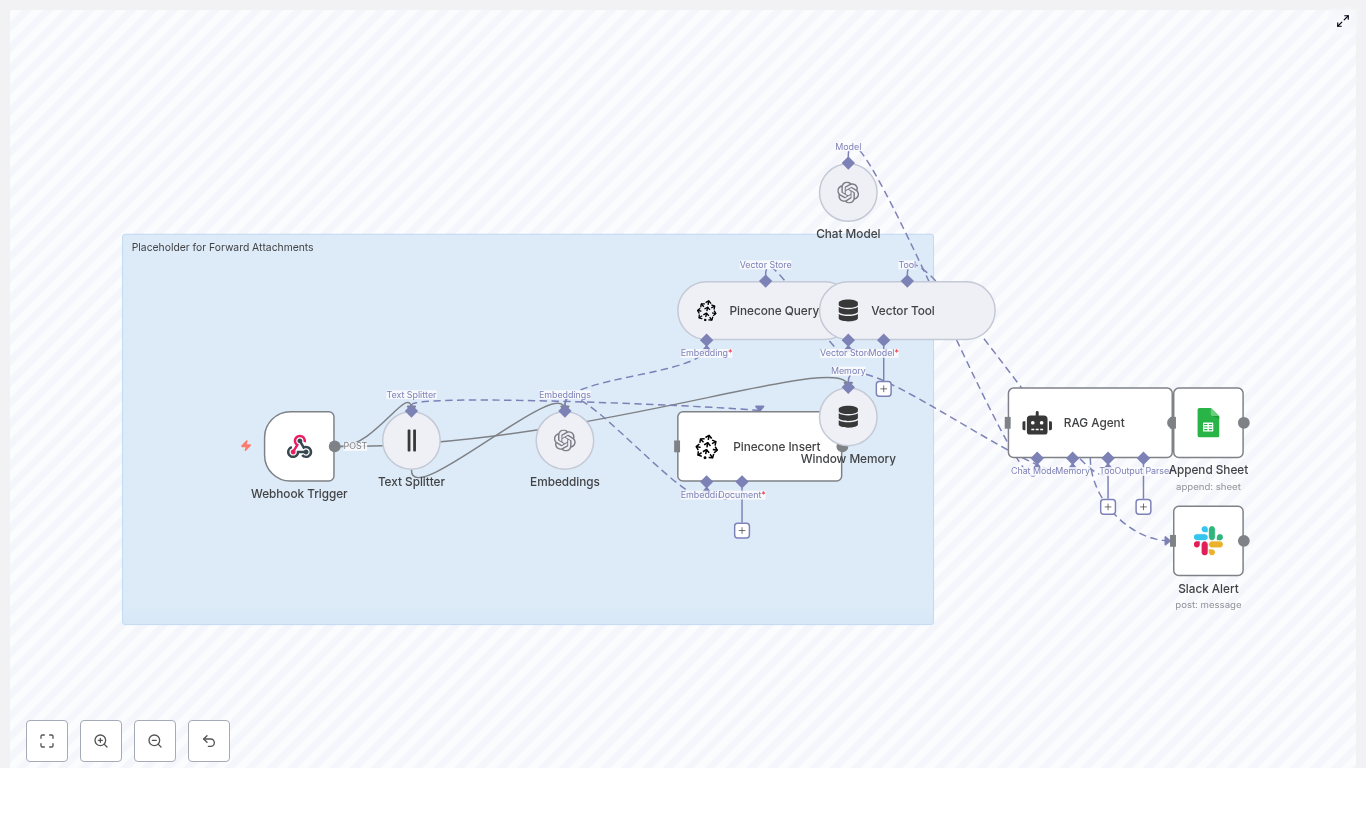
Automate GA Report Emails with n8n & a RAG Agent

Imagine never having to skim through another massive Google Analytics report just to figure out what actually matters. With this n8n workflow template, you can do exactly that.

This reusable automation takes your GA report data, turns it into embeddings, stores it in Pinecone for smart search, and then uses an OpenAI-powered RAG (Retrieval-Augmented Generation) agent to write clear, human-friendly summaries. It can even log outputs to Google Sheets and alert you in Slack if something breaks.

In this guide, we’ll walk through what the workflow does, how the pieces fit together, when to use it, and how to set it up step by step in n8n.

What this n8n GA report email template actually does

At a high level, this workflow takes incoming GA reports, breaks them into chunks, converts them into embeddings, stores those embeddings in Pinecone, and then uses a RAG agent to generate an email-style summary with insights, anomalies, and recommended actions.

Here is what’s included in the template:

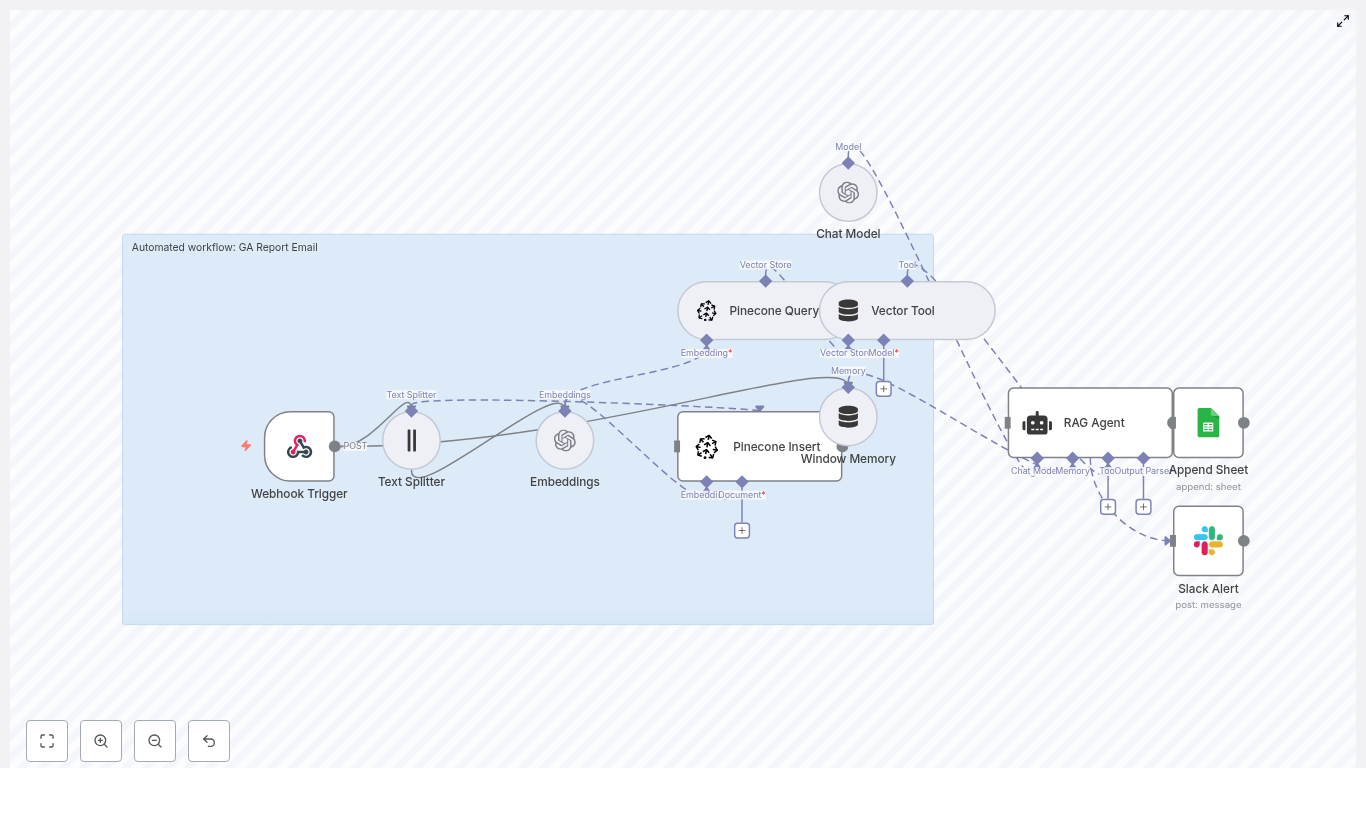
  • Webhook Trigger (path: ga-report-email) to receive GA report payloads from an external system.
  • Text Splitter (character-based) that splits long reports into chunks with:
    • chunkSize = 400
    • chunkOverlap = 40
  • Embeddings node using OpenAI:
    • Model: text-embedding-3-small
  • Pinecone Insert that stores embeddings in a Pinecone index named ga_report_email.
  • Pinecone Query + Vector Tool to retrieve the most relevant context for each new request.
  • Window Memory to keep short-term context for the RAG agent.
  • Chat Model & RAG Agent (OpenAI) that uses the retrieved context and current report to generate a summary or email body.
  • Append Sheet (Google Sheets) to log the output in a sheet called Log:
    • Status column maps to {{$json["RAG Agent"].text}}
  • Slack Alert that sends an error notification to a channel such as #alerts if something fails.

In other words, the template handles the boring parts: ingestion, storage, retrieval, and summarization, so you can focus on the insights.

Why use n8n, embeddings, and a RAG agent for GA reports?

Standard report automation can feel pretty rigid. You often end up with:

  • Fixed email templates that do not adapt to what actually happened in the data.
  • Fragile parsing scripts that break when the format changes.
  • No real context from historical reports.

By combining n8n, embeddings, and a RAG agent, you get something much smarter:

  • Reports are semantically indexed, not just stored as plain text.
  • The workflow can search historical context in Pinecone when generating new summaries.
  • The RAG agent can produce tailored, concise email summaries that highlight what changed, where anomalies are, and what to do next.

This is especially handy if you send recurring GA reports that need interpretation instead of just raw numbers. Think weekly performance summaries, monthly stakeholder updates, or anomaly alerts.

How the data flows through the workflow

Let’s quickly walk through what happens from the moment a GA report hits the webhook to the moment you get a summary.

  1. An external system (for example, a script or another tool) sends a GA report payload to /webhook/ga-report-email.
  2. The Text Splitter breaks the report into overlapping text chunks so the embeddings preserve context.
  3. The Embeddings node generates vector embeddings for each chunk and inserts them into the Pinecone index ga_report_email for long-term semantic search.
  4. When a new summary is needed, the workflow queries Pinecone for the most relevant stored context related to the incoming payload.
  5. The RAG Agent uses:
    • The retrieved context from Pinecone
    • The short-term memory from the Window Memory node
    • The current GA report payload

    to generate a summary, suggested actions, or a nicely formatted email body.

  6. The generated output is logged to Google Sheets for auditing, and if something goes wrong, a Slack alert gets triggered.

So instead of manually reading and interpreting every report, you get a clean, AI-assisted summary that still respects your historical data.

Before you start: credentials checklist

To get this template running smoothly in n8n, you’ll want to prepare the following credentials first.

1. OpenAI

  • Create an OpenAI API key.
  • Add it to n8n credentials as OPENAI_API.

2. Pinecone

  • Sign up for Pinecone and create an index called ga_report_email.
  • Add your Pinecone API credentials to n8n as PINECONE_API.

3. Google Sheets

  • Set up Google Sheets OAuth credentials.
  • Add them to n8n as SHEETS_API.
  • Create a spreadsheet with a sheet named Log to store the outputs.

4. Slack

  • Configure Slack API credentials in n8n as SLACK_API.
  • Choose an alert channel, for example #alerts, for error notifications.

Step-by-step: deploying the workflow in n8n

Step 1: Import and review the template

Start by importing the provided workflow JSON into your n8n instance. Once imported:

  • Confirm the Webhook Trigger path is set to ga-report-email.
  • Open the Text Splitter node and verify:
    • chunkSize = 400
    • chunkOverlap = 40
  • Check the Embeddings node:
    • Model is text-embedding-3-small
    • It uses your OPENAI_API credential.

Step 2: Confirm or create your Pinecone index

Make sure your Pinecone index ga_report_email exists and matches the embedding model’s dimension. If it is missing or misconfigured, create or adjust it via the Pinecone console or API so it aligns with text-embedding-3-small.

Step 3: Configure the RAG Agent and prompt

Next, open the RAG Agent node and set up the system message. A good starting point is:

“You are an assistant for GA Report Email. Summarize key metrics, anomalies, and recommended actions in 4-6 bullet points.”

You can tweak the temperature if you want more creative or more deterministic phrasing. Lower temperature gives you more consistent, predictable summaries.

Step 4: Verify Google Sheets and Slack nodes

  • In the Append Sheet node:
    • Set documentId to your spreadsheet ID.
    • Ensure sheetName is Log.
    • Confirm the mapping for the Status column is:
      {  "Status": "={{$json[\"RAG Agent\"].text}}"
      }
  • In the Slack node:
    • Use your SLACK_API credential.
    • Set the channel, such as #alerts.
    • Connect this node to the RAG Agent’s onError path.

Sample Google Sheets mapping

Here is the mapping used in the template for the Append Sheet node, so you can double-check your configuration:

{  "Append Sheet" : {  "operation": "append",  "documentId": "SHEET_ID",  "sheetName": "Log",  "columns": {  "mappingMode": "defineBelow",  "value": { "Status": "={{$json[\"RAG Agent\"].text}}" }  }  }
}

Ways to customize the workflow for your use case

Once you have the base template running, you can start tailoring it to your team’s needs. Here are a few practical ideas.

  • Send emails directly
    Add an SMTP or Gmail node after the RAG Agent to send the generated summary as an email to your stakeholders.
  • Tag metrics for richer retrieval
    Pre-parse the GA payload to extract key metrics like sessions, bounce rate, or conversions, and store them as metadata alongside your embeddings.
  • Schedule recurring reports
    Use a Cron node so you are not relying only on incoming webhooks. You can trigger daily or weekly runs that pull data directly from the GA API and then feed it into this workflow.
  • Support multiple languages
    Add translation nodes or adjust the RAG agent prompt to generate summaries in different languages depending on the recipient.

Security, privacy, and compliance considerations

Since you might be dealing with sensitive analytics data, it is worth tightening up your security practices.

  • Handle PII carefully
    Remove or mask any personally identifiable information before sending content to OpenAI or storing it in Pinecone.
  • Use least-privilege access
    Scope your API keys so they only have the permissions they truly need. Where possible, restrict IPs and keep write-only keys limited.
  • Encrypt and secure your stack
    Make sure Pinecone and any storage you use have encryption at rest enabled. Protect your n8n instance with HTTPS, a firewall, and secure secrets storage.
  • Define a retention policy
    If compliance requires it, regularly prune or delete old embeddings and logs from Pinecone and Google Sheets.

Costs and performance: what to watch

Most of your costs will come from:

  • Embedding generation
  • LLM (OpenAI Chat/Completion) calls

To keep things efficient and responsive:

  • Use a cost-effective embedding model like text-embedding-3-small.
  • Tune chunkSize and chunkOverlap so you have enough context without exploding the number of embeddings.
  • Limit Pinecone reads by retrieving a reasonable top-k instead of pulling large result sets.
  • Consider caching results for frequently repeated queries.

Troubleshooting common issues

If something is not working the way you expect, here are some quick checks that usually help.

  • Webhook not firing
    Make sure the webhook is active in n8n, that you are using the correct endpoint URL, and that the POST payload is valid JSON.
  • No results from Pinecone
    Confirm that documents were actually inserted into the ga_report_email index and that the embedding dimensions match the model you are using.
  • RAG Agent errors
    Check the Chat Model node credentials, verify the system prompt, and try a lower temperature for more stable outputs.
  • Google Sheets append failures
    Double-check the spreadsheet ID, the Log sheet name, and that the Google credential has write access.
  • Missing Slack alerts
    Verify the Slack credential, channel name, and that the Slack node is properly connected to the RAG Agent’s onError path.

Monitoring and scaling your setup

As usage grows, you will want to keep an eye on performance and resource usage.

  • Monitor workflow run times directly in n8n.
  • Set usage alerts for OpenAI and Pinecone so you are not surprised by costs.
  • Scale your Pinecone index resources if query latency starts creeping up.
  • For high-volume ingestion, consider batching or using asynchronous workers to stay under rate limits.

When this template is a perfect fit

You will get the most value from this n8n workflow if:

  • You send recurring GA reports that need commentary, not just raw metrics.
  • Stakeholders want quick, readable summaries with clear action items.
  • You want to reuse historical context from previous reports, not reinvent the wheel every week.

If that sounds familiar, this RAG-powered automation can save you a lot of time and mental energy.

Wrap-up and next steps

This GA Report Email workflow gives you a solid, extensible foundation for turning raw Google Analytics payloads into clear, actionable summaries. With Pinecone and OpenAI embeddings behind the scenes, the RAG agent can pull in relevant historical context and produce much richer output than a simple static template.

Try it in your own n8n instance

Ready to see it in action?

  1. Import the workflow into n8n.
  2. Configure your credentials for OpenAI, Pinecone, Google Sheets, and Slack.
  3. Send a test POST request to /webhook/ga-report-email with a GA report payload.

If you would like a pre-configured package or help tailoring this for your specific analytics setup, you can reply to this post to request a consultation or a downloadable workflow bundle.

Keywords: n8n, GA Report Email, RAG Agent, Pinecone, OpenAI embeddings, Google Sheets, Slack alert, automation template, GA report automation

BLE Beacon Mapper — n8n Workflow Guide

BLE Beacon Mapper: n8n Workflow Guide

Imagine turning a noisy stream of BLE beacon signals into clear, searchable insights that actually move your work forward. With the BLE Beacon Mapper n8n workflow, you can transform raw telemetry into structured knowledge, ready for search, analytics, and conversational queries. Instead of manually digging through logs, you get a system that learns, organizes, and answers questions for you.

This guide walks you through that transformation. You will see how the BLE Beacon Mapper template ingests beacon data, creates embeddings, stores them in Pinecone, and connects everything to a conversational agent. By the end, you will not just have a working workflow, you will have a foundation you can extend, experiment with, and adapt to your own automation journey.


From raw signals to meaningful insight

BLE (Bluetooth Low Energy) beacons are everywhere: in buildings, warehouses, retail spaces, campuses, and smart environments. They quietly broadcast proximity and presence data that can power:

  • Indoor positioning and navigation
  • Asset tracking and inventory visibility
  • Footfall analytics and space utilization

The challenge is not collecting this data. The challenge is making sense of it at scale. Raw telemetry is hard to search, difficult to connect with context, and time-consuming to analyze manually.

That is where mapping telemetry into a vector store becomes a breakthrough. By converting beacon events into embeddings and storing them in Pinecone, you unlock the ability to:

  • Search historical beacon events by context, such as location, device, or time
  • Ask natural language questions about beacon activity
  • Feed location-aware agents, dashboards, and automations with rich context

The BLE Beacon Mapper template uses n8n, Hugging Face embeddings, Pinecone, and an OpenAI-powered agent to create a modern BLE telemetry pipeline that works for you instead of against you.


Mindset: treating automation as a growth multiplier

Before diving into nodes and configuration, it helps to adopt the right mindset. This workflow is not just a technical recipe, it is a starting point for a more focused, automated way of working.

When you automate:

  • You free time for higher-value work instead of repetitive querying and manual log analysis.
  • You reduce human error and gain confidence that your data is consistently processed.
  • You create a foundation that can grow with your business, your telemetry volume, and your ideas.

Think of this BLE Beacon Mapper as your first step toward a larger automation ecosystem. Once you see how easily you can capture, store, and query beacon data, it becomes natural to ask: What else can I automate? That question is where real transformation begins.


The BLE Beacon Mapper at a glance

The workflow is built around a simple but powerful flow:

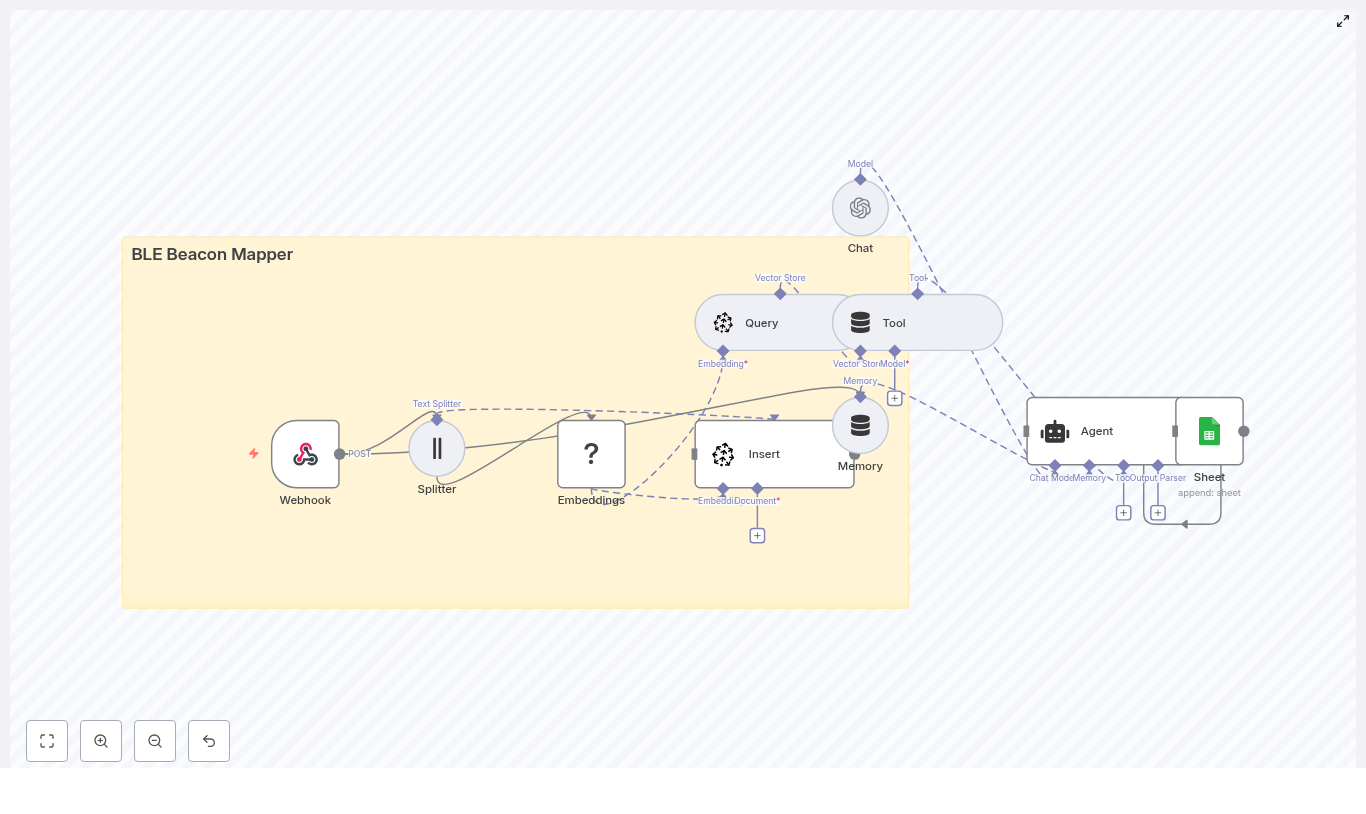
  1. Receive BLE telemetry through a webhook.
  2. Prepare and split the data into chunks.
  3. Generate embeddings using Hugging Face.
  4. Store vectors and metadata in a Pinecone index.
  5. Query Pinecone when you need context.
  6. Let an agent (OpenAI) reason over that context in natural language.
  7. Log events and outputs to Google Sheets for visibility.

Each step is handled by a dedicated n8n node, which you can configure, extend, and combine with your existing systems. Below, you will walk through the workflow stage by stage, so you can fully understand, customize, and build on it.


Stage 1: Ingesting BLE telemetry with a webhook

Webhook node: your gateway for beacon data

The journey starts with the Webhook node. This is your public endpoint where BLE gateways or aggregators send telemetry.

Key configuration:

  • httpMethod: POST
  • path: ble_beacon_mapper

Typical JSON payloads look like this:

{  "beacon_id": "beacon-123",  "rssi": -67,  "timestamp": "2025-08-31T12:34:56Z",  "gateway_id": "gw-01",  "metadata": { "floor": "2", "room": "A3" }
}

This is raw signal data. The workflow will turn it into something you can search and ask questions about.

Security tip: Protect this endpoint with an API key or signature verification on the gateway side, and ensure TLS is enforced. A secure webhook is a solid foundation for any production-grade automation.


Stage 2: Preparing data for embeddings

Splitter node: managing payload size intelligently

Once the webhook receives data, the Splitter node ensures that the payload is sized correctly for embedding. This becomes especially important when you ingest batched reports or telemetry with rich metadata.

Parameters used in the template:

  • chunkSize: 400
  • chunkOverlap: 40

For single-event messages, this node has minimal visible impact, but as your setup grows and you send larger batches, it helps you stay efficient and avoids hitting limits in downstream services.

Over time, you can tune these values to balance cost and recall, especially if you start embedding longer textual logs or enriched descriptions.


Stage 3: Turning telemetry into vectors

Embeddings (Hugging Face) node: creating a searchable representation

The Embeddings node is where your telemetry becomes machine-understandable. Each chunk of text is converted into a vector embedding using a Hugging Face model.

Key points:

  • The template uses the default Hugging Face model.
  • You can switch to a specialized or compact model optimized for short IoT telemetry.
  • Provide your Hugging Face API key using n8n credentials.

This step is what enables semantic search later. Instead of relying on exact string matches, you can find events that are similar in meaning or context, which is a huge step up from traditional log searches.

As your use case evolves, you can experiment with different models, measure search quality, and optimize for cost or performance. This is one of the easiest places to iterate and improve the workflow over time.


Stage 4: Persisting knowledge in Pinecone

Insert (Pinecone) node: building your vector index

After embeddings are generated, the Insert node writes them into a Pinecone index. In this template, the index is named ble_beacon_mapper.

Each document inserted into Pinecone should include rich metadata, such as:

  • beacon_id
  • timestamp
  • gateway_id
  • rssi
  • Location tags like floor, room, or asset type

This metadata unlocks powerful filtered queries. For example, you can search only for events on floor 2 or from a specific gateway, which keeps your results relevant and fast.

In n8n, you configure your Pinecone credentials and index details in the Insert node. Once this is set up, every incoming beacon event becomes part of a growing, searchable knowledge base.


Stage 5: Querying Pinecone and exposing it as a tool

Query node: retrieving relevant events

When you need context, the Query node reads from your Pinecone index. It can perform semantic nearest neighbor searches and apply metadata filters.

Typical usage includes:

  • Fetching the last N semantically similar events to a query.
  • Restricting results by location, gateway, or time window.
  • Providing a focused context set for the agent to reason over.

Tool node (Pinecone): connecting the agent to your data

The Tool node, named Pinecone in the template, wraps the vector store as an actionable tool for the agent. This means your conversational model can call the Pinecone tool when it needs more context, then use the retrieved events to craft a better answer.

Instead of a static chatbot, you get a context-aware agent that can reference your actual BLE telemetry in real time.


Stage 6: Conversational reasoning with memory

Memory, Chat, and Agent nodes: turning data into answers

This stage is where your automation becomes truly interactive. The combination of Memory, Chat, and Agent nodes allows an LLM (OpenAI in the template) to reason over the retrieved context and respond in natural language.

The agent can answer questions like:

  • “Where was beacon-123 most often detected this week?”
  • “Show me unusual signal patterns for gateway gw-01 today.”

The Memory node keeps short-term conversational context, so you can ask follow-up questions without repeating everything. This makes your beacon data accessible not just to engineers, but to anyone who can ask a question.

As you grow more comfortable, you can swap models, add guardrails, or extend the agent with additional tools, turning this into a powerful conversational analytics layer.


Stage 7: Logging to Google Sheets for visibility

Google Sheets (Sheet) node: creating a human-friendly log

To keep a simple, human-readable trail, the template includes a Google Sheets node that appends events or agent outputs to a spreadsheet.

Default configuration:

  • Sheet name: Log

This gives you:

  • A quick audit trail of processed events.
  • Fast reporting or sharing with non-technical stakeholders.
  • A place to store summaries generated by the agent alongside raw telemetry.

Over time, you can branch from this node to other destinations, such as BI tools, dashboards, or alerting systems, depending on how you want to grow your automation stack.


Deploying the BLE Beacon Mapper: step-by-step

Ready to make this workflow your own? Follow these steps to get the BLE Beacon Mapper running in your environment.

  1. Install n8n
    Use n8n Cloud, Docker, or a self-hosted installation, depending on your infrastructure and preferences.
  2. Import the workflow
    Load the supplied workflow JSON into your n8n instance. This gives you the complete BLE Beacon Mapper template.
  3. Configure credentials
    In n8n, set up the required credentials:
    • Hugging Face API key for the Embeddings node.
    • Pinecone API key and environment for the Insert and Query nodes.
    • OpenAI API key for the Chat node, or another supported LLM provider.
    • Google Sheets OAuth2 credentials for the Sheet node.
  4. Create your Pinecone index
    In Pinecone, create an index named ble_beacon_mapper with a dimension that matches your chosen embedding model.
  5. Expose and secure the webhook
    Ensure the webhook path is set to ble_beacon_mapper, secure it with API keys or signatures, and test connectivity using a sample POST request.
  6. Verify vector insertion and queries
    Monitor the Insert node to confirm that vectors are being written to Pinecone. Run test queries to validate that your index returns meaningful results.

Quick webhook test with curl

Use this command to verify your webhook is receiving data correctly:

curl -X POST https://your-n8n-instance/webhook/ble_beacon_mapper \  -H "Content-Type: application/json" \  -d '{"beacon_id":"beacon-123","rssi":-65,"timestamp":"2025-08-31T12:00:00Z","gateway_id":"gw-01","metadata":{"floor":"2"}}'

If everything is configured correctly, this event will flow through the workflow, be embedded, stored in Pinecone, and optionally logged to Google Sheets.


Tuning, best practices, and staying secure

Once the template is running, you can refine it so it fits your scale, budget, and security requirements. Think of this phase as iterating toward a workflow that truly matches how you work.

  • Chunk size
    For short telemetry, consider lowering chunkSize to 128-256 to reduce embedding cost. Increase it only if you start embedding longer textual logs.
  • Embedding model choice
    Use a compact Hugging Face model if cost or speed is a concern. Periodically evaluate recall and accuracy to ensure you are getting the insights you need.
  • Pinecone metadata filters
    Add metadata fields like floor, gateway, or asset type. This makes filtered queries faster and reduces irrelevant matches.
  • Retention strategy
    For high-volume telemetry, consider a TTL or regular pruning to keep index size manageable and costs predictable.
  • Webhook security
    Use HMAC or API keys, enforce TLS, and rate-limit the webhook to protect your n8n instance from abuse.
  • Observability
    Add logs or metrics, such as pushing counts to Prometheus or appending more details to Google Sheets, to help with troubleshooting and capacity planning.

Ideas to extend and evolve your workflow

The real power of n8n appears when you start customizing and extending templates. Once your BLE Beacon Mapper is live, you can gradually add new capabilities that align with your goals.

  • Geospatial visualization
    Map beacon IDs to coordinates, then feed that data into a mapping tool to visualize hotspots, traffic patterns, or asset locations.
  • Real-time alerts
    Combine this workflow with a rules engine to trigger notifications when a beacon enters or exits a zone, or when RSSI crosses a threshold.
  • Batch ingestion
    Accept batched telemetry from gateways and let the Splitter node intelligently chunk the data for embeddings and storage.
  • Model-assisted enrichment
    Use the Chat and Agent nodes to generate human-readable summaries of unusual beacon patterns and log those summaries automatically to Sheets or other systems.

Each small improvement compounds over time. Start with the core template, then let your real-world needs guide the next iteration.


Troubleshooting common issues

As you experiment, you might encounter a few common issues. Use these checks to get back on track quickly.

  • No vectors in Pinecone
    Confirm that the Embeddings node is returning vectors and that your Pinecone credentials and index name are correct.
  • Poor search results
    Try a different embedding model, adjust chunk size, or enrich your documents with more descriptive metadata.
  • Rate limits
    Stagger ingestion, use batching, or upgrade your API plans if you are consistently hitting provider limits.

Bringing it all together: your next step in automation

The BLE Beacon Mapper turns raw proximity events into a searchable knowledge base and a conversational interface. With n8n orchestrating Hugging Face embeddings, Pinecone vector search, and an OpenAI agent, you gain a flexible foundation for location-aware automation, analytics, and reporting that people can actually talk to.

This template is more than

Build a Fuel Price Monitor with n8n & Weaviate

Build a Fuel Price Monitor with n8n and Weaviate

Fuel pricing is highly dynamic and has a direct impact on logistics, fleet operations, retail margins, and end-customer costs. In environments where prices can change multiple times per day, manual monitoring is inefficient and error-prone. This guide explains how to implement a production-grade Fuel Price Monitor using n8n, Weaviate, Hugging Face embeddings, an Anthropic-powered agent, and Google Sheets for logging and auditability.

The workflow template described here provides an extensible, AI-driven pipeline that ingests fuel price updates, converts them into vector embeddings, stores them in Weaviate for semantic search, and uses an LLM-based agent to reason over historical data and trigger alerts.

Solution overview

The Fuel Price Monitor workflow in n8n is designed as a modular automation that can be integrated with existing data sources, monitoring tools, and reporting systems. At a high level, it:

  • Receives fuel price updates via a secure webhook
  • Splits and embeds text data using a Hugging Face model
  • Stores vectors and metadata in a Weaviate index for semantic retrieval
  • Exposes Weaviate as a tool to an Anthropic agent with memory
  • Evaluates price changes and anomalies, then logs outcomes to Google Sheets

This architecture provides a low-code, AI-enabled monitoring system that can be adapted to different fuel providers, geographies, and alerting rules.

Core components of the workflow

The template is built around several key n8n nodes and external services. Understanding their roles will help you customize the workflow for your own environment.

Webhook – ingestion layer

The Webhook node serves as the entry point for all fuel price updates. It is configured to accept POST requests with JSON payloads from scrapers, upstream APIs, or partner systems. A typical request body looks like:

{  "station": "Station A",  "fuel_type": "diesel",  "price": 1.239,  "timestamp": "2025-08-31T09:12:00Z",  "source": "provider-x"
}

Within the workflow, you should validate and normalize incoming fields so that downstream nodes receive consistent data types and formats. For example, standardize timestamps to ISO 8601 and enforce consistent naming for stations and fuel types.

Text Splitter – preparing content for embeddings

The Text Splitter node breaks long textual inputs into manageable chunks that can be embedded efficiently. This is especially useful if your payloads include additional descriptions, notes, or news-like content.

Recommended configuration:

  • Splitter type: character-based
  • Chunk size: for example, 400 characters
  • Chunk overlap: for example, 40 characters

Chunk overlap ensures that semantic context is preserved across boundaries while keeping embedding volumes and costs under control.

Embeddings (Hugging Face) – vectorization

Each text chunk is then passed to a Hugging Face Embeddings node. Using your Hugging Face API key, the node converts text into high-dimensional vectors that capture semantic meaning.

These embeddings are the foundation for semantic search and similarity queries in Weaviate. Choose an embedding model that aligns with your language and domain requirements to maximize retrieval quality.

Weaviate Insert – vector store and metadata

The Insert node writes vectors and associated metadata into a Weaviate index. In this template, the index (class) is named fuel_price_monitor.

For each record, store both the vector and structured attributes such as:

  • station
  • fuel_type
  • price
  • timestamp
  • source

This metadata enables precise filtering, aggregation, and analytics on top of semantic search results.

Weaviate Query and Tool – contextual retrieval

To support intelligent decision-making, the workflow uses a Query node that searches the Weaviate index and a Tool node that exposes these query capabilities to the agent.

Typical query patterns include:

  • Listing recent updates for a specific station and fuel type
  • Checking price changes over a defined time window
  • Comparing current prices to historical averages or thresholds

Example queries the agent might issue:

  • “Show me the last 10 diesel price updates near Station A.”
  • “Has diesel price at Station B changed by more than 5% in the last 24 hours?”

Memory and Agent (Anthropic) – reasoning layer

The workflow incorporates a Memory node connected to an Agent node configured with an Anthropic model (or another compatible LLM). The memory buffer stores recent interactions and relevant events, which gives the agent contextual awareness across multiple executions.

The agent uses:

  • Tool outputs from Weaviate queries
  • Conversation history or event history from the memory buffer
  • System and user prompts defining anomaly thresholds and actions

Based on this context, the agent can reason about trends, identify anomalies, and decide whether to trigger alerts or simply log the event.

Google Sheets – logging and audit trail

The final layer uses a Google Sheets node to append log entries to a sheet, for example a sheet named Log. Each row can capture:

  • Raw price update data
  • Derived metrics or anomaly flags
  • Agent decisions and explanations
  • Timestamps and identifiers for traceability

This provides a human-readable audit trail and a convenient data source for BI tools, dashboards, or further analysis.

Key benefits for automation professionals

  • Near real-time ingestion of fuel price changes via webhook-based integration.
  • Semantic search and retrieval using vector embeddings in Weaviate, enabling advanced historical analysis and anomaly detection.
  • AI-driven decision-making through an LLM agent with tools and memory, suitable for automated alerts and workflows.
  • Transparent logging in Google Sheets for compliance, reporting, and cross-team visibility.

Implementing the workflow in n8n

The sections below outline how to configure the main nodes in sequence and how they interact.

1. Configure the Webhook node

  1. Create a new workflow in n8n and add a Webhook node.
  2. Set the HTTP method to POST and define a path such as fuel_price_monitor.
  3. Optionally add authentication or IP restrictions to secure the endpoint.
  4. Implement basic validation or transformation to normalize fields (for example, ensure price is numeric, timestamp is ISO 8601, and source identifiers follow your internal conventions).

2. Add the Text Splitter node

  1. Connect the Webhook node to a Text Splitter node.
  2. Choose character-based splitting, with a chunk size near 400 characters and an overlap around 40 characters.
  3. Map the text field(s) you want to embed, such as combined descriptions or notes attached to the price update.

3. Generate embeddings with Hugging Face

  1. Add an Embeddings node configured to use a Hugging Face model.
  2. Provide your Hugging Face API key in the node credentials.
  3. Feed each chunk from the Text Splitter into the Embeddings node to produce vectors.

4. Insert vectors into Weaviate

  1. Add a Weaviate Insert node and connect it to the Embeddings node.
  2. Configure the Weaviate endpoint and authentication.
  3. Specify the index (class) name, for example fuel_price_monitor.
  4. Map the vector output from the Embeddings node and attach metadata such as station, fuel_type, price, timestamp, and source.

5. Configure Query and Tool nodes for retrieval

  1. Add a Weaviate Query node that can search the fuel_price_monitor index using filters and similarity search.
  2. Wrap the query in a Tool node so that the agent can invoke it dynamically during reasoning.
  3. Define parameters the agent can supply, such as station name, fuel type, time range, or maximum number of results.

6. Set up Memory and the Anthropic Agent

  1. Add a Memory node configured as a buffer for recent events or conversation context.
  2. Insert an Agent node configured with Anthropic as the LLM provider.
  3. Connect the Memory node to the Agent so the agent can read prior context.
  4. Attach the Tool node so the agent can call the Weaviate query as needed.
  5. Define a clear system prompt specifying:
    • What constitutes an anomaly (for example, a price change greater than 3 to 5 percent within 24 hours).
    • What actions are allowed (such as logging, alerting, or summarization).
    • Any constraints or safeguards, including when to escalate versus silently log.

7. Log outcomes to Google Sheets

  1. Add a Google Sheets node and connect it after the Agent node.
  2. Authenticate with your Google account and select the target spreadsheet.
  3. Use an operation such as “Append” and target a sheet called Log or similar.
  4. Map fields including the original payload, computed anomaly indicators, agent decisions, and timestamps.

Best practices for a reliable fuel price monitoring pipeline

Normalize and standardize payloads

Consistent data is critical for accurate retrieval and analysis. At ingestion time:

  • Normalize currency representation and units.
  • Use ISO 8601 timestamps across all sources.
  • Standardize station identifiers and fuel type labels to avoid duplicates or mismatches.

Optimize your embedding strategy

Model selection and chunking parameters influence both quality and cost:

  • Choose an embeddings model suited to your language and technical domain.
  • If your payloads are numeric-heavy, add short human-readable context around key values to improve semantic retrieval.
  • Avoid embedding trivial fields individually, and rely on metadata for structured filtering.

Manage vector store growth

Vector databases can grow quickly if every update is stored indefinitely. To manage scale and cost:

  • Set sensible chunk sizes and avoid excessive duplication across chunks.
  • Use Weaviate metadata filters such as fuel_type and station to narrow queries and reduce compute.
  • Periodically prune or aggregate older entries, for example keep monthly summaries instead of all raw events.

Design robust agent prompts

Prompt engineering is essential for predictable agent behavior:

  • Explicitly define anomaly thresholds and acceptable tolerance ranges.
  • List the exact actions the agent can perform, such as logging, alerting, or requesting more data.
  • Restrict write operations and always log the agent’s decisions and reasoning to Google Sheets.

Testing and validation

Before deploying the workflow to production, validate each stage end to end:

  1. Webhook and splitting Send sample payloads to the webhook and confirm that the Text Splitter produces the expected chunks.
  2. Embeddings and Weaviate storage Verify that embeddings are successfully generated and that records appear in the fuel_price_monitor index with correct metadata.
  3. Query relevance Execute sample queries against Weaviate and confirm that results align with the requested station, fuel type, and time frame.
  4. Agent behavior and logging Test scenarios with both normal and anomalous price changes. Ensure the agent’s decisions are sensible and that all events are logged correctly in Google Sheets.

Scaling and cost control

As ingestion volume grows, embedding and LLM usage can become significant cost drivers. To manage this:

  • Batch non-critical updates and process them during off-peak times.
  • Implement retention policies to remove low-value vectors or compress historical data into summaries.
  • Use cost-effective embedding models for routine indexing and reserve higher quality models for query-time refinement or critical analyses.

Security and compliance considerations

Fuel price data may be sensitive in competitive or regulated environments. To protect your pipeline:

  • Secure webhook endpoints with authentication tokens, API keys, or IP allowlists.
  • Encrypt sensitive fields before storing them in Weaviate if they could identify individuals or confidential business relationships.
  • Define clear audit and retention policies, and use Google Sheets logs as part of your compliance documentation.

Troubleshooting common issues

  • No vectors appearing in Weaviate Verify your Hugging Face API credentials, ensure the Embeddings node is producing outputs, and confirm that these outputs are mapped correctly into the Weaviate Insert node.
  • Poor or irrelevant search results Increase chunk overlap, experiment with different embedding models, or enrich the text with additional context. Also review your query filters and similarity thresholds.
  • Unstable or inconsistent agent decisions Refine the system prompt, add explicit examples of desired behavior, and adjust anomaly rules. Consider tightening the agent’s tool access or limiting its possible actions.

Potential extensions and enhancements

Once the core Fuel Price Monitor is running, you can extend it with additional automation and analytics capabilities:

  • Integrate Slack, Microsoft Teams, or SMS providers for real-time alerts to operations teams.
  • Incorporate geospatial metadata to identify and surface the nearest stations for a given location.
  • Train a lightweight classification model on historical data to flag suspicious entries or potential price manipulation.

Conclusion

By combining n8n, Weaviate, Hugging Face embeddings, and an Anthropic-based agent, you can build a sophisticated Fuel Price Monitor that delivers semantic search, intelligent anomaly detection, and comprehensive audit logs with minimal custom code.

Start from the template, plug in your Hugging Face, Weaviate, and Anthropic credentials, and send a sample payload to the webhook to validate the pipeline. From there, refine thresholds, prompts, and integrations to align with your operational requirements.

Ready to deploy your own Fuel Price Monitor? Clone the template into your n8n instance, connect your services, and begin tracking fuel price changes with an automation-first, AI-enhanced approach.

Get the Workflow Template

Automating Attachment Forwarding with n8n & LangChain

Automating Attachment Forwarding with n8n & LangChain

This guide walks you through an n8n workflow template that automatically forwards, indexes, and tracks attachments using LangChain components, OpenAI embeddings, Pinecone, Google Sheets, and Slack. You will learn not just how to install the template, but also how the logic works, why each tool is used, and how to adapt it for your own automation needs.

What you will learn

By the end of this tutorial, you will be able to:

  • Set up an n8n workflow that receives attachments or text through a webhook.
  • Split long documents into chunks that are suitable for embeddings.
  • Create OpenAI embeddings and store them in a Pinecone vector index.
  • Use a LangChain RAG Agent in n8n to retrieve relevant context and generate responses.
  • Log workflow activity to Google Sheets and send error alerts to Slack.
  • Apply best practices for chunking, metadata, cost control, and security.

Concept overview: How the workflow fits together

Why use this workflow?

This automation pattern is designed for teams that receive many attachments or text documents and want:

  • A searchable archive backed by vector search.
  • Automatic logging of what was processed and when.
  • Alerts when something goes wrong, without manual monitoring.

To achieve this, the workflow combines several specialized tools:

  • n8n Webhook to receive incoming files or text.
  • LangChain Text Splitter to normalize and chunk long content.
  • OpenAI embeddings (text-embedding-3-small) for semantic search.
  • Pinecone as a vector database for fast similarity search.
  • LangChain RAG Agent and a Chat Model for context-aware reasoning.
  • Google Sheets to log processing results.
  • Slack to send alerts when the workflow fails.

High-level architecture

Here is the core flow in simplified form:

  1. A Webhook Trigger node receives a POST request that contains attachments or raw text.
  2. A Text Splitter node chunks the content into manageable pieces.
  3. An Embeddings node sends each chunk to OpenAI using the text-embedding-3-small model.
  4. A Pinecone Insert node stores the resulting vectors and metadata in a Pinecone index called forward_attachments.
  5. A Pinecone Query node, wrapped by a Vector Tool, allows the RAG Agent to retrieve relevant chunks later.
  6. Window Memory provides short-term conversation memory to the agent.
  7. A Chat Model and RAG Agent generate outputs (such as summaries or classifications) using retrieved context and memory.
  8. An Append Sheet node logs the outcome in a Google Sheet named Log.
  9. A Slack Alert node posts to #alerts when the workflow encounters errors.

Prerequisites and credentials

Required accounts and keys

Before you configure the n8n template, make sure you have:

  • OpenAI API key for embeddings and the chat model.
  • Pinecone API key and environment with an index named forward_attachments.
  • Google Sheets OAuth2 credentials with edit access to the target spreadsheet (you will need its SHEET_ID).
  • Slack Bot token with permission to post messages to the alerts channel (for example #alerts).

Creating the Pinecone index

For Pinecone, ensure that:

  • The index is named forward_attachments.
  • The vector dimension matches the embedding model you use. For OpenAI models, check the official documentation for the correct dimensionality of text-embedding-3-small or any alternative you choose.
  • You select pod types and configuration that match your expected throughput and storage needs.

Step-by-step: Setting up the n8n workflow

Step 1: Import or create the workflow in n8n

You can either import the provided workflow JSON template into n8n or recreate it manually. Once imported, open the workflow to review and adjust the node configuration.

Step 2: Configure the Webhook Trigger

The webhook is the entry point for all incoming attachments or text.

  • Node: Webhook Trigger
  • HTTP Method: POST
  • Path: forward-attachments

When you send a POST request to this path, the payload (including attachments or text) will start the workflow.

Step 3: Set up the Text Splitter

The Text Splitter node breaks large content into smaller chunks so that embeddings and the context window remain efficient.

  • Node: Text Splitter
  • chunkSize: 400
  • chunkOverlap: 40

The template uses 400 tokens per chunk with 40 tokens overlap. This is a balance between:

  • Keeping enough context in each chunk.
  • Avoiding very long inputs that increase token usage.

You can adjust these values later based on the nature of your documents.

Step 4: Configure the Embeddings node

The Embeddings node sends each chunk to OpenAI to produce vector representations.

  • Node: Embeddings
  • Model: text-embedding-3-small (or another OpenAI embedding model)
  • Credentials: your OpenAI API key configured in n8n

Each chunk from the Text Splitter becomes a vector that can be stored and searched later.

Step 5: Insert vectors into Pinecone

Next, the workflow stores embeddings in Pinecone along with useful metadata.

  • Node: Pinecone Insert
  • Index name: forward_attachments

When configuring this node, add metadata fields to each record, for example:

  • filename
  • source (such as email, form, or system)
  • timestamp

This metadata allows you to filter and understand results when you query the index.

Step 6: Set up Pinecone Query and Vector Tool

To support retrieval-augmented generation (RAG), the agent needs a way to query Pinecone.

  • Node: Pinecone Query
  • Wrapper: Vector Tool (used by the RAG Agent)

The Vector Tool encapsulates the Pinecone Query node so the agent can request similar vectors based on a user query or internal reasoning. This is how the agent retrieves context relevant to a particular question or task.

Step 7: Configure Window Memory

Window Memory gives the agent short-term memory of recent messages or actions.

  • Node: Window Memory

Attach this memory to the agent so it can maintain continuity across multiple steps, while still staying within context limits.

Step 8: Set up the Chat Model and RAG Agent

The RAG Agent is the reasoning engine of the workflow. It combines:

  • The Chat Model (OpenAI or another supported model).
  • The Vector Tool for retrieval from Pinecone.
  • Window Memory for short-term context.

Key configuration details:

  • System message: You are an assistant for Forward Attachments
  • Tools: include the Vector Tool so the agent can fetch relevant chunks.
  • Memory: attach Window Memory for a short history of interactions.

The agent can then generate structured outputs such as summaries, classifications, or log entries based on the retrieved document chunks.

Step 9: Log results to Google Sheets

To keep a record of each processed attachment or text payload, the workflow logs to a Google Sheet.

  • Node: Append Sheet (Google Sheets)
  • Spreadsheet ID: SHEET_ID of your document
  • Sheet name: Log

Map the fields from your workflow to columns such as:

  • Status (for example, success or error)
  • Filename
  • ProcessedAt (timestamp)

This gives you an auditable history of all processed items.

Step 10: Configure Slack alerts for errors

Finally, the workflow includes a Slack node that notifies you when something fails.

  • Node: Slack Alert
  • Channel: #alerts (or another monitoring channel)
  • Message template: include the error details and any useful context, such as filename or timestamp.

In n8n, connect this node to your error paths so that any failure in the agent or other nodes triggers a Slack message.

How the processing flow works in practice

Once everything is configured, a typical request flows through the workflow like this:

  1. Receive input A client sends a POST request with attachments or text to the /forward-attachments webhook.
  2. Split content The Text Splitter node divides long documents into overlapping chunks to avoid context window issues and improve retrieval quality.
  3. Create embeddings Each chunk is passed to the Embeddings node, which calls OpenAI and returns a vector representation.
  4. Store in Pinecone The Pinecone Insert node stores vectors plus metadata such as filename, source, and timestamp in the forward_attachments index.
  5. Retrieve relevant context When the RAG Agent needs information, it uses the Vector Tool and Pinecone Query to fetch the most similar chunks.
  6. Generate output The agent calls the Chat Model with the retrieved context and Window Memory, then produces structured outputs (for example summaries, classifications, or other custom responses).
  7. Log and alert On success, the Append Sheet node writes a log entry to the Log sheet. If any error occurs, the Slack Alert node posts a message to #alerts with the error details.

Best practices and tuning tips

1. Text chunking

The choice of chunkSize and chunkOverlap has a direct impact on both cost and search quality.

  • Typical ranges: chunkSize between 200 and 800 tokens, chunkOverlap between 20 and 100 tokens.
  • Larger chunks: fewer vectors and lower storage cost, but less precise retrieval.
  • Smaller chunks: more precise retrieval, but more vectors and higher embedding costs.

Start with the template values (400/40) and adjust based on your document length and the type of questions you expect.

2. Metadata strategy

Good metadata makes your vector search results actionable. Consider including:

  • Source filename or document ID.
  • URL or origin system.
  • Uploader or user ID.
  • Timestamp or version.

Use these fields later to filter search results or to route documents by category or source.

3. Vector namespaces and index hygiene

For multi-tenant or multi-source environments:

  • Use namespaces in Pinecone to isolate data by team, client, or project.
  • Regularly remove stale vectors that are no longer needed.
  • If you change embedding models, consider reindexing your data to maintain consistency.

4. Rate limits and batching

To keep your workflow stable and cost effective:

  • Batch embedding calls where possible instead of sending one chunk at a time.
  • Observe OpenAI and Pinecone rate limits and add exponential backoff or retry logic on failures.
  • Monitor usage and adjust chunk sizes or processing frequency if you approach rate limits.

Security and compliance considerations

When processing attachments, especially those that may contain sensitive data, keep these points in mind:

  • Avoid logging raw secrets or sensitive content in plain text logs.
  • Use n8n credential stores and environment variables instead of hard coding keys.
  • Encrypt data in transit and at rest, especially if documents contain PII or confidential information.
  • Apply retention policies for both the vector store and original attachments.
  • Restrict access to the Google Sheet and Slack channel to authorized team members only.

Troubleshooting common issues

  • Blank vectors or strange embedding output Check that the model name is correct and that the returned vector dimension matches your Pinecone index dimension.
  • Pinecone insertion errors Verify the index name (forward_attachments), API key, region, and dimension. Mismatched dimensions are a frequent cause of errors.
  • Irrelevant RAG Agent responses Try increasing the number of retrieved chunks, adjusting chunkSize/chunkOverlap, or improving metadata filters. Verify that the correct namespace or index is being queried.
  • Workflow failures in n8n Ensure the Slack Alert node is enabled. Check the error message posted to #alerts and inspect the failing node in n8n for more details.

Cost management

Embedding, chat, and vector storage all have associated costs. To keep them under control:

  • Use smaller embedding models like text-embedding-3-small when quality is sufficient.
  • Avoid re-embedding unchanged data. Only re-embed when the content actually changes or when you intentionally switch models.
  • Apply retention policies, and delete old or unused vectors from Pinecone.

Extending and customizing the workflow

Once the base template is running, you can extend it to fit your specific use cases:

  • Add file parsing nodes to convert PDFs, images (with OCR), and Office documents into text before they reach the Text Splitter.
  • Use the Chat Model for advanced classification or tagging, and store labels back in Pinecone metadata or Google Sheets.
  • Expose a separate search endpoint that queries Pinecone, allowing users to search the indexed attachments directly.
  • Use role-based namespaces in Pinecone to separate data by team or permission level.

Quick reference: Sample node parameters

Automate Follow-up Emails with n8n & Weaviate

Automate Follow-up Emails with n8n & Weaviate

Consistent, high quality follow-up is central to effective sales, onboarding, and customer success. Doing this manually does not scale, is difficult to standardize, and is prone to delays or errors. This article presents a production-ready n8n workflow template that automates follow-up emails using embeddings, Weaviate as a vector database, and a Retrieval-Augmented Generation (RAG) agent.

You will see how the workflow is structured, how each n8n node is configured, and how to integrate external services such as OpenAI, Anthropic, Google Sheets, and Slack. The goal is to help automation professionals deploy a robust, auditable follow-up system that is both context-aware and scalable.

Why automate follow-ups with n8n, embeddings, and Weaviate

By combining n8n with semantic search and a vector database, you can move from generic follow-ups to context-rich, personalized outreach that is generated automatically. The core advantages of this approach are:

  • Context retention – Previous emails, meeting notes, and CRM data are stored as embeddings and can be retrieved later to inform new messages.
  • Relevant personalization at scale – Vector search in Weaviate identifies the most relevant historical context for each recipient, which feeds into the RAG agent.
  • Reliable orchestration – n8n coordinates triggers, transformations, and external API calls in a transparent and maintainable way.
  • End-to-end auditability – Activity is logged to Google Sheets, and Slack alerts notify the team about failures or issues.

This architecture is suitable for teams that handle large volumes of follow-ups and require consistent, traceable communication flows integrated with their existing tooling.

High-level workflow architecture

The n8n workflow follows a clear sequence from inbound request to generated email and logging:

  • Webhook Trigger – Accepts incoming follow-up requests.
  • Text Splitter – Chunks long context into manageable segments.
  • Embeddings (OpenAI) – Creates vector representations of each chunk.
  • Weaviate Insert – Stores embeddings and metadata in a vector index.
  • Weaviate Query + Vector Tool – Retrieves relevant context for a new follow-up.
  • Window Memory + Chat Model (Anthropic) – RAG agent generates the personalized follow-up email.
  • Append Sheet (Google Sheets) – Logs the generated email and status.
  • Slack Alert (onError) – Sends alerts on failures for rapid troubleshooting.

The remainder of this guide walks through these components in a logical sequence, with configuration guidance and best practices for each step.

Triggering the workflow: Webhook design

1. Webhook Trigger configuration

The entry point is an n8n Webhook node configured to accept HTTP POST requests, for example at:

POST /follow-up-emails

The webhook expects a JSON payload containing at least the following fields:

{  "recipient_email": "jane@example.com",  "name": "Jane",  "company": "Acme Inc",  "context": "Previous meeting notes, product interests, timeline",  "last_contacted": "2025-08-20"
}

Additional fields (such as internal IDs or CRM references) can be added as needed. To secure this endpoint, use one or more of the following:

  • Query parameters with API keys.
  • HMAC signatures validated in n8n.
  • n8n’s built-in authentication options.

Securing the webhook is essential when integrating with external CRMs or public forms.

Preparing context: chunking and embeddings

2. Text Splitter for context chunking

Before generating embeddings, the workflow splits the incoming context into smaller pieces. This improves retrieval quality and keeps embedding costs predictable. The Text Splitter node is configured with:

  • chunkSize: 400
  • chunkOverlap: 40

A 400-character chunk size with 40-character overlap is a practical baseline. It preserves local context across chunks while avoiding excessively large vectors. You can tune these parameters based on the type of content you process:

  • Long narrative emails can tolerate larger chunk sizes.
  • Short, structured notes may benefit from smaller chunks.

3. Generating embeddings with OpenAI

After splitting, each chunk is sent to an Embeddings node. The template uses OpenAI’s text-embedding-3-small model, which is cost-effective for high-volume use cases. Any compatible embedding provider can be substituted, as long as the output is compatible with Weaviate.

Key considerations:

  • Store the OpenAI API key in n8n’s credential manager, not in plain text.
  • Batch embedding requests when possible to reduce overhead and control costs.
  • Monitor usage to ensure the chosen model aligns with your budget and latency requirements.

Persisting and retrieving context with Weaviate

4. Storing embeddings in Weaviate

The next step is to persist the embeddings in Weaviate. The workflow uses a dedicated index, for example:

follow-up_emails

For each chunk, the Weaviate Insert node stores:

  • The embedding vector.
  • The original text content.
  • Metadata such as:
    • recipient_id or email.
    • source (CRM, meeting notes, call summary, etc.).
    • timestamp.
    • Optional tags or categories.

Rich metadata enables filtered queries, avoids noisy matches, and supports later analysis. As your index grows, this structure becomes critical for maintaining retrieval quality.

5. Querying Weaviate and exposing a Vector Tool

When a new follow-up is requested, the workflow generates an embedding for the new context and queries Weaviate for the most similar stored chunks. The Weaviate Query node typically retrieves the top-k results (for example, the top 5 or 10), which are then passed into a Vector Tool node.

The Vector Tool node exposes these retrieved chunks as tools or context items for the RAG agent. This pattern ensures that the language model does not rely solely on its internal knowledge but instead grounds its output in your specific historical data.

Key configuration points:

  • Set an appropriate top-k value to balance context richness with token usage.
  • Use metadata filters (for example, by recipient_id or company) to avoid cross-recipient leakage of context.
  • Regularly review query performance and refine metadata schema as needed.

Generating the follow-up: RAG agent and memory

6. Window Memory, Chat Model, and RAG orchestration

The core of the email generation is a RAG agent backed by a chat model. In this template, Anthropic is used as the Chat Model, but the pattern applies to other LLM providers as well.

The RAG pipeline in n8n typically includes:

  • Window Memory – Maintains short-term conversational state, which is useful if you extend the workflow to multi-turn interactions or iterative refinement.
  • Chat Model (Anthropic) – Receives:
    • A system instruction.
    • The retrieved context from Weaviate (via the Vector Tool).
    • A user prompt with recipient details and desired tone.

An example system prompt used in the workflow is:

System: You are an assistant for follow-up emails. Use the retrieved context to personalize the message. Keep it concise, clear, and action-oriented.

The user prompt then includes elements such as the recipient name, company, high-level context, and a clear call to action. This separation of system and user instructions helps ensure consistent behavior in production.

Prompt design for RAG-based follow-ups

Prompt structure has a direct impact on the quality and consistency of generated emails. A recommended pattern is:

  • Short, explicit system instruction that defines the role and constraints.
  • Bullet-pointed context extracted from Weaviate.
  • Recipient-specific metadata such as:
    • Name and company.
    • Last contacted date.
  • Desired tone and objective (for example, book a demo, confirm next steps).
System: You are an assistant for follow-up emails.
Context: • Follow-up note 1  • Meeting highlight: interested in feature X
Recipient: Jane from Acme Inc, last contacted 5 days ago
Tone: Friendly, professional
Goal: Ask for next steps and offer a short demo

Compose a 3-4 sentence follow-up with a clear call-to-action.

Keeping prompts structured and consistent simplifies debugging, improves reproducibility, and makes it easier to iterate on the workflow as requirements evolve.

Logging, monitoring, and error handling

7. Logging to Google Sheets

For visibility and non-technical review, the workflow logs each generated follow-up to a Google Sheet using the Append Sheet node. A sheet named Log can store:

  • Recipient email and name.
  • Generated email content.
  • Timestamp.
  • Status (for example, success, failed, retried).
  • Relevant metadata such as the source of the request.

This provides an accessible audit trail for sales, customer success, and operations teams, and supports quality review without requiring direct access to n8n or Weaviate.

8. Slack alerts on workflow errors

To ensure operational reliability, configure an onError branch from critical nodes (particularly the RAG agent and external API calls) to a Slack node. The Slack node should send a message to an appropriate team channel that includes:

  • A short description of the error.
  • The n8n execution URL for the failed run.
  • Key identifiers such as recipient email or request ID.

This pattern enables fast incident response and helps teams diagnose issues before they affect a large number of follow-ups.

Configuration best practices

To make this workflow robust and cost-effective in production, consider the following guidelines:

  • Security – Protect the webhook with HMAC validation, API keys, or n8n authentication. Avoid exposing unauthenticated endpoints to public traffic.
  • Embedding strategy – Adjust chunk size and overlap based on content type. Test retrieval quality with real data before scaling.
  • Index design – Add metadata fields in Weaviate such as recipient_id, source, and tags. Use these fields for filtered queries to reduce noise.
  • Cost control – Batch embedding requests, limit top-k retrieval results, and monitor token usage in the chat model. Align your configuration with expected volume and budget.
  • Monitoring – Combine Slack alerts with the Google Sheets log to track volume, failures, and content quality over time.
  • Testing – Use tools like Postman to simulate webhook payloads. Validate that the retrieved context is relevant and that the generated emails match your brand tone before going live.

Scaling and reliability considerations

As the number of follow-up requests and stored interactions grows, plan for scale at both the infrastructure and workflow levels:

  • Vector database scaling – Use autoscaled Weaviate hosting or a managed vector database to handle larger indexes and higher query throughput.
  • Rate limiting and retries – Implement rate limiting and retry strategies in n8n for external APIs such as OpenAI, Anthropic, and Slack to avoid transient failures.
  • Index maintenance – Periodically re-index or remove stale follow-up records that are no longer relevant. This can improve retrieval quality and control storage costs.

Example webhook request for testing

To validate your setup, you can issue a test request to the webhook endpoint after configuring the workflow:

POST https://your-n8n.example/webhook/follow-up-emails
Content-Type: application/json

{  "recipient_email": "jane@example.com",  "name": "Jane",  "company": "Acme Inc",  "context": "Spoke about timeline; she loved feature X and asked about integration options.",  "last_contacted": "2025-08-20"
}

Inspect the resulting n8n execution, verify that embeddings are stored in Weaviate, confirm that the generated email is logged to Google Sheets, and check that no Slack alerts are triggered for successful runs.

From template to production

This n8n and Weaviate pattern provides a resilient, context-aware follow-up automation framework that scales with your customer interactions and knowledge base. It helps teams deliver timely, relevant outreach without adding manual workload or sacrificing auditability.

To deploy this in your environment:

  1. Clone the n8n workflow template.
  2. Configure credentials for OpenAI, Anthropic (or your chosen LLM), Weaviate, Google Sheets, and Slack.
  3. Adapt metadata fields and prompts to your CRM schema and brand voice.
  4. Run test webhooks with representative data and iterate on configuration.

Call-to-action: Clone the template, connect your API keys, and run a set of test webhooks today. Once validated, integrate the webhook with your CRM or form system and subscribe for more n8n automation patterns and best practices.

Build a Flight Price Drop Alert with n8n

Build a Flight Price Drop Alert with n8n, Weaviate, and OpenAI

If you have ever refreshed a flight search page so many times that your browser started to feel judged, this guide is for you. Manually monitoring flight prices is the digital equivalent of watching paint dry, except the paint sometimes gets more expensive.

Instead of wasting hours checking fares, you can let an automated flight price drop alert do the boring work for you. In this walkthrough, you will use n8n, OpenAI embeddings, and a Weaviate vector store to build a workflow that:

  • Receives flight price updates from your scraper or API
  • Stores historical prices in a vector database
  • Uses a lightweight agent with memory to decide when a drop is worth shouting about
  • Logs everything to Google Sheets for easy auditing and trend analysis

You get the fun part (catching deals), and your workflow gets the repetitive part (staring at numbers all day).

Why bother with a flight price drop alert?

Whether you are a frequent flyer, a travel agency, or that friend who always finds suspiciously cheap flights, timing is everything. A good flight price monitoring system helps you:

  • Catch price drops fast so you can book before the deal disappears
  • Keep historical context and see how prices move over time
  • Automate notifications and logging instead of doing manual spreadsheet gymnastics
  • Avoid missed opportunities because you forgot to check prices for one day

In short, you trade in repetitive manual checks for a smart n8n workflow that quietly works in the background.

What this n8n workflow does (high-level overview)

This template uses n8n as the orchestrator that connects all the moving parts. Here is the basic architecture of your flight price drop alert:

  • Webhook – receives flight price updates via POST from your scraper or a third-party API
  • Text Splitter – breaks longer text into chunks that are easier to embed
  • OpenAI Embeddings – converts text into numeric vectors for similarity search
  • Weaviate Vector Store – stores and queries those vectors efficiently
  • Memory + Agent – maintains short-term context and decides when to trigger alerts
  • Google Sheets – logs alerts and events for auditing and analysis

This combo lets you quickly prototype a robust flight price monitoring workflow in n8n, then scale it later without changing the core logic.

Core automation flow in plain English

Here is what happens when a new price comes in:

  1. Your scraper or API sends a JSON payload with flight details to an n8n Webhook.
  2. The workflow normalizes and splits any longer text fields into chunks.
  3. Each chunk goes through OpenAI embeddings, turning text into vectors.
  4. The vectors get stored in Weaviate under an index like flight_price_drop_alert.
  5. The workflow queries Weaviate for similar past entries on the same route.
  6. An agent, using short-term memory and query results, decides if the new price counts as a meaningful drop.
  7. If yes, the workflow logs the alert in Google Sheets and can later be extended to send messages via email, SMS, Slack, and more.

You get an automated, data-backed decision system instead of guessing whether a $20 drop is actually a good deal.

Keywords to keep in mind

If you care about SEO or just like buzzwords, this workflow revolves around:

flight price drop alert, n8n workflow, Weaviate vector store, OpenAI embeddings, flight price monitoring, webhook automation, travel alerts

Step-by-step setup in n8n

Let us walk through the main steps to build this flight price alert n8n template. You will keep all the original logic but in a more human-friendly order.

Step 1 – Receive flight price updates via Webhook

First, you need a way to get flight data into n8n.

  1. Create a Webhook node in n8n.
  2. Set it to accept POST requests with JSON payloads.
  3. Configure your scraper or third-party API to send flight metadata to that webhook URL.

Your payload might look like this:

{  "origin": "JFK",  "destination": "LHR",  "departure": "2025-09-01",  "price": 432,  "currency": "USD",  "airline": "ExampleAir",  "url": "https://booking.example/flight/123"
}

This is the raw material that everything else in the workflow uses to detect price drops.

Step 2 – Normalize and split content for embeddings

Next, you prepare the data for vectorization. If your payload includes longer descriptions or extra metadata, you do not want to embed a giant blob of text in one go.

  • Add a Text Splitter node after the Webhook.
  • Configure it to break text into chunks, for example:
    • Chunk size: around 400 characters
    • Overlap: around 40 characters

This keeps enough overlap so context is preserved, while keeping vectors compact and efficient for the Weaviate vector store.

Step 3 – Generate OpenAI embeddings

Now you turn text into something your vector database can understand.

  • Add an OpenAI Embeddings node.
  • Pass each chunk from the splitter into this node.
  • Include key fields alongside the text, such as:
    • Route (origin and destination)
    • Price
    • Timestamp or departure date

The embeddings represent your text as vectors, which makes similarity search fast and flexible. This is the backbone of your flight price monitoring automation.

Step 4 – Insert and query data in Weaviate

With embeddings ready, you can now store and compare them using Weaviate.

  • Add an Insert operation to your Weaviate node.
  • Use an index name like flight_price_drop_alert to keep things organized.
  • Store:
    • The embedding vectors
    • Route identifiers
    • Timestamps
    • Raw prices and any other useful metadata

To figure out whether the latest price is a bargain or just mildly less disappointing, you:

  • Run a Query on the same Weaviate index.
  • Filter by route and a relevant time window, for example the last 30 days.
  • Retrieve similar historical records so you can compare current prices against past ones.

Weaviate returns similar entries quickly, which lets your agent make smarter decisions instead of just reacting to every tiny fluctuation.

Step 5 – Use short-term memory and an agent to decide when to alert

Now comes the brain of the operation. Instead of hard-coding every rule, you combine:

  • A small in-memory buffer that stores recent interactions and context
  • An agent (LM-driven) that uses:
    • Current price
    • Historical prices from Weaviate
    • Defined thresholds

The agent can apply logic such as:

  • Compare the current price with the average and minimum over the last 30 days
  • Only trigger an alert if the drop meets a minimum threshold, for example at least 10 percent lower
  • Enrich the alert message with route details and booking links

The result is a more intelligent n8n flight alert workflow that avoids spammy notifications and focuses on meaningful price drops.

Step 6 – Log alerts to Google Sheets

Once the agent decides that a price drop is worth celebrating, you log it for future reference.

  • Add a Google Sheets node.
  • Configure it to append a new row whenever an alert is triggered.

Your sheet might include columns such as:

  • Timestamp
  • Route (origin and destination)
  • Previous lowest price
  • Current price
  • Percent change
  • Booking link

This gives you a simple audit log and a handy resource for trend analysis without manually updating spreadsheets at odd hours.

Decision logic and best practices for fewer false alarms

Not every tiny drop deserves an alert. You do not want your workflow pinging you every time a fare moves by a few cents.

Use meaningful thresholds

Combine absolute and relative rules so your alert system behaves like a calm adult, not a panicked stock trader. For example:

  • Require at least a $50 drop
  • And at least a 10 percent lower price than the recent average

This reduces noise and ensures alerts highlight genuinely interesting deals.

Compare prices over time windows

Flight prices are seasonal and sometimes chaotic. To keep things realistic:

  • Compare prices across configurable windows, such as:
    • 7 days
    • 14 days
    • 30 days

This helps your flight price monitoring workflow adapt to normal fluctuations and typical fare swings.

Store rich metadata with vectors

When inserting data into Weaviate, do not store just the vectors. Include:

  • Route identifiers (origin, destination)
  • Timestamps or departure dates
  • Raw prices and currency

This makes filtering by route and date faster and keeps your queries flexible as you refine your alert logic.

Scaling your flight price monitoring workflow

If your use case grows from a few routes to a full-blown travel analytics system, the same architecture still works. You just need a few upgrades.

  • Batch insert embeddings and use asynchronous workers to handle large volumes of price updates
  • Shard vector indices by region or market to speed up lookups
  • Apply rate limiting and retries for upstream scrapers and APIs so you do not break anything during peak times
  • Use persistent storage like Postgres or S3 to keep raw payloads alongside your vector store

With these in place, your n8n flight price drop alert can comfortably handle larger workloads without falling apart.

Testing and validation before trusting the bot

Before you let automation loose on real bookings, you should test the workflow with controlled data.

  • Create synthetic price histories that include:
    • Clear price drops
    • Slow, gradual declines
    • Sudden spikes
  • Log intermediate outputs such as:
    • Similar records returned by Weaviate
    • Computed averages
    • Percent changes

This lets you verify that your thresholds and agent logic behave as expected before you rely on it for real travel decisions.

Security and cost considerations

Automation is great until someone pastes an API key into the wrong place. A few simple precautions go a long way:

  • Sanitize incoming webhook data so you do not process unexpected or malicious input
  • Store API keys securely using n8n credential stores or environment variables
  • Monitor OpenAI embedding usage and Weaviate storage so costs do not quietly creep up
  • Cache frequent queries if you notice repeated patterns in your searches

This keeps your flight price alert automation stable, secure, and budget friendly.

Example n8n node flow at a glance

If you like to see the big picture, here is how the main nodes line up in the template:

  • Webhook (POST) – receives incoming price updates
  • Splitter – chunks payload text for embeddings
  • Embeddings – converts text chunks into vectors with OpenAI
  • Insert – stores embeddings in Weaviate using the flight_price_drop_alert index
  • Query – searches recent similar vectors for the same route
  • Tool or Agent – uses memory and query results to decide whether to trigger an alert
  • Sheet – appends an audit row to Google Sheets when an alert fires

This is the full loop that turns raw price data into actionable alerts.

Example alert message

When the agent decides a price drop is worth your attention, it can generate a message like:

Price drop: JFK → LHR on 2025-09-01
Now: $432 (was $520, -17%)
Book: https://booking.example/flight/123

Short, clear, and straight to the point, so you can book quickly instead of decoding a cryptic log entry.

Next steps and customization ideas

Once you have the core n8n flight price drop alert workflow running, you can level it up with a few extras:

  • SMS or email notifications using Twilio or SendGrid so you get alerts on the go
  • Slack or Telegram integration for team travel deals and shared alerts
  • User preference management with custom thresholds per user or route
  • Dashboards and KPIs to visualize trends and monitor performance

The underlying architecture with n8n, OpenAI embeddings, and Weaviate is flexible, so you can keep extending it as your needs grow.

Wrapping up

By combining n8n, vector embeddings, and a Weaviate vector store, you get a powerful, extensible system for flight price drop alerts. The workflow balances fast similarity search with LM-driven decision making, which is ideal for catching fleeting fare opportunities without drowning in noise.

Ready to stop manually refreshing flight pages? Export the n8n workflow template, plug in your OpenAI and Weaviate credentials, and point your scraper to the webhook. In a short time, you will have a fully automated travel alert system quietly working in the background.

Call to action: Export the workflow, test it with around 50 synthetic entries, and fine tune your thresholds until the alerts feel just right. If you want a ready-made starter or hands-on help, reach out for a walkthrough or a custom integration.