Mike Weed: Expert Pest Control & Entomology

Mike Weed: Professional Pest Control for Home & Lawn

Protecting your home, family, and lawn from pests is much easier when you work with someone who truly understands insect biology and behavior. That is exactly what you get with Mike Weed, an Associate Certified Entomologist (A.C.E.) and pest control expert with more than 45 years of experience across Alabama, Florida, and Georgia.

This guide-style article will walk you through:

  • What it means to work with a certified entomologist
  • The types of pest control services Mike provides for homes and lawns
  • How the service process works from first contact to follow up
  • Where Mike is licensed and why local expertise matters
  • Common questions about safety, frequency, and termites
  • Simple steps you can take today to reduce pest pressure

Use this as a practical reference if you are deciding how to handle a current infestation or planning long term pest prevention.


Learning Goals: What You Will Understand By The End

By the time you finish reading, you should be able to:

  • Explain why an Associate Certified Entomologist offers a higher level of pest control expertise
  • Identify which of Mike’s services apply to your home, lawn, or specific pest problem
  • Know exactly what to expect when you schedule a pest control visit
  • Understand how licensing and regional knowledge improve treatment results
  • Apply basic prevention tips to reduce pests before and after professional service

Core Concept: Why Work With a Certified Entomologist?

Many pest control providers rely mainly on experience and standard treatment routines. Mike Weed combines that hands on experience with formal entomology training and the rare A.C.E. (Associate Certified Entomologist) credential, held by fewer than 2% of professionals in the industry.

What the A.C.E. Credential Means for You

Choosing an A.C.E. means you are working with someone who:

  • Understands insect biology such as life cycles, breeding habits, and how pests respond to environmental changes
  • Targets pests accurately instead of relying on trial and error or broad, heavy chemical use
  • Designs safer treatment plans that consider families, pets, and surrounding ecosystems

Mike’s Professional Background

  • 45+ years in pest control, including technician work, district management, and branch management
  • Experience with major companies like St. Regis Paper Company, Orkin, and Cook’s Pest Control
  • Independent pest control practice since 2009, focused on personalized, science based solutions

This blend of field experience and entomological knowledge results in science driven pest control that is both effective and responsible.


Overview of Services: Home, Lawn, and More

Mike offers comprehensive pest control services for residential properties and lawns. The goal is not just to remove visible pests, but to prevent future infestations by addressing the underlying causes.

Main Types of Pest Control Services

  • Home pest control: Treatment and prevention for ants, roaches, spiders, silverfish, and other common household pests.
  • Lawn & landscape pest control: Control of grubs and lawn damaging insects, plus perimeter treatments that help keep pests from entering your home from the yard.
  • Rodent control: Inspection to locate entry points, baiting when appropriate, and exclusion recommendations to keep rodents out long term.
  • Termite inspections & control: Professional inspections, detection of termite activity, and treatment plans designed to protect your home’s structure.
  • Mosquito & nuisance pest management: Seasonally timed services that reduce biting insects and other outdoor pests so you can enjoy your yard.

Whether you need a one time treatment for a specific issue or ongoing maintenance, services are tailored to your property and pest pressure.


How Mike’s Pest Control Service Works

The process is designed to be simple, transparent, and effective. Below is a step by step explanation so you know exactly what will happen when you reach out.

Step 1 – Contact and Scheduling

You start by describing your pest problem and scheduling a convenient time for an inspection.

Share details such as what pests you have seen, where you see them most often, and how long the issue has been going on. This helps Mike prepare for the on site visit.

Step 2 – Comprehensive Inspection

During the visit, a certified professional conducts a detailed inspection of your home and lawn. This includes:

  • Identifying the specific pest species involved
  • Locating entry points where pests are getting inside
  • Finding conducive conditions such as moisture problems, clutter, or landscaping issues that attract pests

The inspection is the foundation of the treatment plan. Accurate identification and understanding of the pest’s behavior allow for more precise control.

Step 3 – Customized Treatment Plan

After the inspection, you receive a clear, written treatment plan that explains:

  • Which pests will be treated
  • What methods and products will be used
  • How many visits are recommended
  • Pricing and scheduling options

The plan is designed around your home, your lawn, and your comfort level, not a one size fits all program.

Step 4 – Targeted Treatment

Once you approve the plan, Mike applies targeted treatments based on entomological principles and safety guidelines. The focus is on:

  • Using the least invasive methods that still achieve strong results
  • Placing treatments where pests live and travel, not just where they are visible
  • Minimizing unnecessary chemical use while maintaining effectiveness

Because the treatments are informed by pest biology and behavior, they are more efficient and often more sustainable over time.

Step 5 – Follow Up and Long Term Prevention

Effective pest control does not end with one visit. Mike provides:

  • Follow up checks when needed to confirm that treatments are working
  • Prevention advice so you can reduce conditions that attract pests
  • Options for quarterly or seasonal programs if your property needs ongoing protection

This combination of professional treatment and homeowner education helps maintain a pest resistant environment over the long term.


Service Area and Licensing

Licensing and local experience are critical in pest control because different regions face different pest pressures and regulations. Mike is fully certified and operates across the Gulf Coast region.

  • Certified in: Alabama, Florida, and Georgia
  • Local knowledge: Treatments are timed and tailored to coastal conditions, high humidity, and the seasonal patterns of local pests

Understanding how weather, climate, and regional ecosystems affect pest behavior allows for better timing of applications and more reliable results.


What Homeowners Say

Client feedback highlights the value of detailed inspections and science-based treatments. Here are examples of the type of comments Mike regularly receives:

“After years of trying DIY products, Mike’s inspection revealed the real issue and fixed it. Professional, courteous, and effective.” – Local homeowner

“Our lawn looks better and we haven’t had issues with ants inside since the service. Highly recommended.” – Repeat customer

These testimonials reflect the difference that trained entomology and careful inspection can make compared to generic store bought solutions.


Frequently Asked Questions

Is pest control safe for my pets and children?

Yes. Safety is a priority in every treatment. Products and methods are chosen with your household in mind. Mike explains any precautions before starting work, and many of the solutions used are low risk once they have dried or settled according to label directions.

How often should I schedule pest control service?

The ideal schedule depends on your property and pest pressure. Many homeowners choose quarterly or seasonal programs to stay ahead of issues. Others prefer one time targeted treatments for specific infestations. During your consultation, Mike can recommend a frequency based on what he finds.

Do you provide termite inspections and treatments?

Yes. Termite inspections and treatment plans are available to protect your home from structural damage. Using a biological and behavioral understanding of termites, Mike identifies the most efficient and appropriate treatment approach for your situation.


Practical Tips to Reduce Pest Pressure Yourself

Professional pest control is most effective when combined with simple prevention steps. Here are some actions you can take right away:

  • Trim vegetation so that bushes, shrubs, and tree branches do not touch your home’s foundation or walls. Plants can act as bridges for insects.
  • Seal gaps and cracks around doors, windows, and plumbing penetrations to block common entry points.
  • Eliminate standing water in gutters, birdbaths, and low areas in the yard to reduce mosquito breeding sites.
  • Store firewood properly by keeping it off the ground and away from the exterior walls of your home to lower the risk of termites and wood boring insects.

Following these tips alongside professional service helps keep your home and lawn healthier and less attractive to pests.


About Mike Weed

Over several decades, Mike has built a career that spans:

  • Technical roles and leadership positions at St. Regis Paper Company, Orkin, and Cook’s Pest Control
  • District and branch management responsibilities
  • Independent pest control practice since 2009, serving homeowners across Alabama, Florida, and Georgia

His combination of hands on fieldwork, management experience, and entomological certification makes him a trusted resource for anyone who wants informed, effective pest management instead of guesswork.


Ready to Protect Your Home and Lawn?

If you are dealing with an active infestation or want to set up a preventative pest control program, you can request a prompt, expert evaluation.

Call 850-712-0481 Email MikeWeed1958@gmail.com

You can also submit a service request with your name, phone number, email address, and a brief description of your pest issue. Expect a timely, professional response.


Stay Connected and Keep Learning

To stay ahead of seasonal pest problems and learn practical tips from an A.C.E. certified professional, follow Mike on:

Facebook, LinkedIn, Pinterest, Yelp, and YouTube.

Regular updates and educational content can help you recognize early signs of pest activity and know when it is time to call in a professional.


© 2024 Mike Weed. All rights reserved. Website by Gulf Coast Local.
Repurpose YouTube to Socials with n8n Template

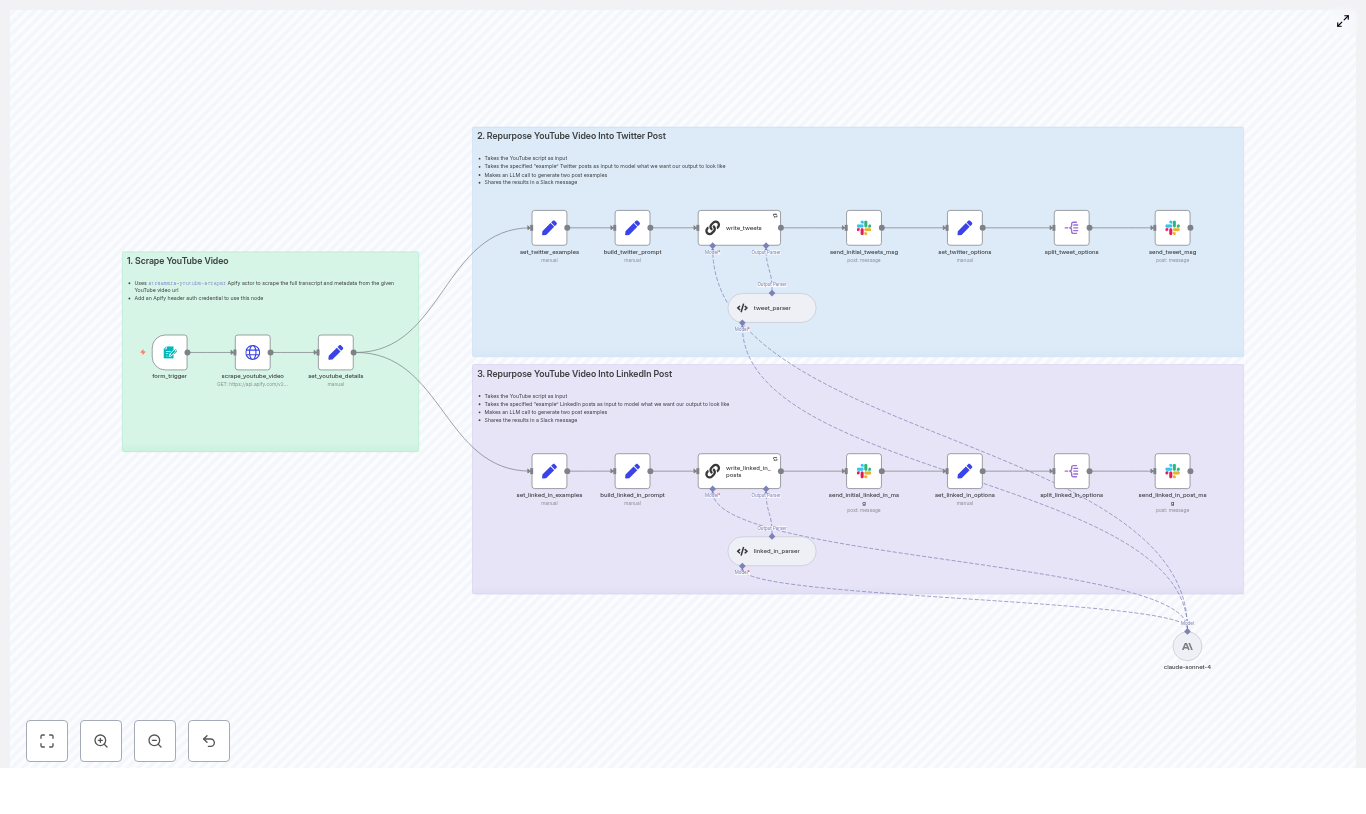
Long-form YouTube content is an exceptional source of high-value insights, yet converting a single video into platform-optimized posts for Twitter (X) and LinkedIn is typically a manual and repetitive task. This guide presents a refined overview of the “The Recap AI” n8n workflow template, which automates that entire process. The template uses Apify to scrape YouTube metadata and transcripts, then leverages an LLM to generate structured, on-brand social content. You will learn how the workflow is architected, which n8n nodes are involved, how to configure them, and how to adapt the automation to your own content operations.

Why automate YouTube content repurposing?

For most teams, video production is the most resource-intensive part of their content strategy. Repurposing a single YouTube video into multiple social assets significantly increases reach without increasing production time. With an automated n8n workflow, you can reliably transform one long-form video into:

  • Twitter (X) threads and standalone tweets
  • LinkedIn posts tailored to professional audiences
  • Additional short-form content or snippets with minimal extra effort

Automation ensures consistency in tone, structure, and formatting, while reducing manual copywriting and coordination overhead. It also allows non-technical stakeholders to trigger and review content without touching the underlying workflow.

Overview of the “Recap AI” n8n template

At a high level, the template implements the following flow:

  • Receives a YouTube URL via a simple form trigger.
  • Invokes an Apify actor to scrape the video’s metadata and subtitles.
  • Extracts and normalizes the transcript and key attributes such as title and URL.
  • Builds LLM prompts that combine the transcript with curated example posts.
  • Calls an LLM (for example, Anthropic Claude) to generate multiple Twitter and LinkedIn options.
  • Parses the model output into structured JSON fields.
  • Delivers the generated content to Slack for review, with the option to extend into full auto-publishing.

The result is a modular, extensible workflow that can be integrated into existing editorial pipelines or content operations platforms.

Architecture and key n8n components

1. Entry point: Form Trigger

The workflow starts with a Form Trigger node. This node exposes a simple web form where users paste a YouTube video URL and submit it to n8n. The design is intentionally lightweight so that marketers, content editors, or other non-technical team members can initiate the process without logging into n8n directly.

2. Data acquisition: Apify YouTube scraper

Once the URL is received, an HTTP Request node calls Apify’s streamers~youtube-scraper actor. This actor is responsible for:

  • Fetching the video’s subtitles (SRT or equivalent captions).
  • Retrieving key metadata such as title, URL, and other descriptive fields.

The template maps the SRT subtitles into a transcript variable that becomes the primary content source for the LLM. Standardizing this input at the workflow level ensures that every downstream node receives consistent, structured data, regardless of the specific video.

3. Prompt engineering: Set nodes for examples and templates

A set of Set nodes is used to define and manage the prompt strategy for the LLM. In particular:

  • set_twitter_examples stores a collection of high-performing Twitter/X examples that represent the desired voice, format, and structure for threads or single tweets.
  • set_linked_in_examples holds LinkedIn-specific examples, including preferred post length, narrative style, and call-to-action patterns.
  • Additional Set nodes combine the dynamic transcript data with these examples to build the final prompt payload that is sent to the LLM.

This approach allows teams to tune brand voice and messaging by updating example content in a single place, instead of rewriting prompts across multiple nodes.

4. Content generation: LLM node (Claude / Anthropic in template)

The core generation step is handled by an LLM node configured in a LangChain-style pattern. In the reference template, the model is set to claude-sonnet-4 from Anthropic, but the structure can be adapted to other providers such as OpenAI.

The prompt instructs the model to:

  • Analyze the transcript to identify the primary pain point, the core solution, and a quantifiable outcome.
  • Map these elements into proven social content frameworks suitable for Twitter threads and LinkedIn posts.
  • Produce three distinct tweet options and three LinkedIn post options, all aligned with the example patterns supplied earlier.

By clearly specifying the number of variants and the expected structure, the workflow increases the reliability and usefulness of the generated content.

5. Structuring the output: Parsing nodes

Once the LLM returns its response, Output Parser nodes convert the free-form text into machine-friendly JSON. These parsers extract:

  • tweet_options – an array of candidate tweets or thread components.
  • post_options – an array of LinkedIn post drafts.

Clean parsing at this stage is essential for downstream automation, such as automated scheduling, logging to a content calendar, or routing to different review channels.

6. Distribution and review: Slack integration

Finally, Slack nodes push the generated content into a designated Slack channel. The template is configured so that each tweet option and each LinkedIn option can be posted as separate messages, often using split nodes to iterate over the arrays. This makes it easy for editors to:

  • Review and compare multiple options.
  • Provide feedback directly in Slack.
  • Copy and paste approved content into scheduling tools.

For teams that want to go further, these Slack nodes can be replaced or augmented with email notifications, Google Sheets exports, or direct posting integrations.

Prerequisites and environment setup

Required accounts and services

  • n8n instance (cloud or self-hosted) with access to create workflows and credentials.
  • Apify account with an API token, used as an authenticated header for the HTTP Request node.
  • LLM provider account such as Anthropic Claude or OpenAI, with credentials configured for the LLM/LangChain node.
  • Optional: Slack app and OAuth credentials if you plan to push outputs to a Slack channel.

Configuration steps in n8n

  1. Import the template
    Load the “Recap AI” template into your n8n instance. Connect the Form Trigger node to a simple web form, either embedded on your website or made available via an internal dashboard.
  2. Configure Apify credentials
    In n8n, create an HTTP credential using your Apify API token. Attach this credential to the HTTP Request node that calls the streamers~youtube-scraper actor, and confirm that the startUrls field is correctly populated with the submitted YouTube URL.
  3. Set up the LLM provider
    Add your LLM API key or select the configured Anthropic/OpenAI credentials in the LLM node. Verify the model name (for example, claude-sonnet-4) and adjust the prompt format if your provider has specific requirements.
  4. Customize example posts
    Update the set_twitter_examples and set_linked_in_examples nodes with examples that reflect your brand voice, preferred structure, and typical calls to action. The quality and diversity of these examples significantly influence the final outputs.
  5. Integrate Slack or alternative destinations
    If using Slack, configure OAuth credentials and specify the target channel IDs in the Slack nodes. If you prefer another review mechanism, adapt the final nodes to send outputs via email, store them in Google Sheets, or log them to Airtable.
  6. Run a test and iterate
    Trigger the workflow with a public YouTube URL. Inspect the transcript, the LLM response, and the final Slack messages. Iterate on prompt wording, add or refine examples, and adjust the output parser rules until the JSON structure and content quality meet your standards.

Best practices for reliable, high-quality social content

  • Invest in strong examples
    The Set nodes that hold example posts are critical. Provide several high-performing threads and LinkedIn posts that demonstrate the exact formatting you want, including hooks, body structure, and CTAs.
  • Clean up transcripts when needed
    Auto-generated subtitles may contain filler words and transcription noise. Consider adding a lightweight preprocessing step to strip out repeated filler terms if they consistently degrade LLM output.
  • Specify structure in the prompt
    Use explicit instructions such as: “Produce 3 tweet options. Each option must include a short hook, a 4-line body, and a clear CTA asking users to reply with WORKFLOW.” Structural guidance significantly reduces inconsistent formatting.
  • Tune temperature and system messages
    Lower temperature values will yield more consistent, predictable posts. Higher values may generate more creative hooks but can also introduce variability. Adjust system instructions to reinforce tone, voice, and compliance requirements.
  • Maintain a human approval step
    Even with strong prompts, automated publishing without review can amplify mistakes. Keep at least one human-in-the-loop checkpoint for brand, legal, and factual validation before posts go live.

Practical use cases for content and growth teams

Teams using this template typically focus on scaling distribution of existing YouTube content. Common scenarios include:

  • Converting a single in-depth tutorial into a full week of social posts.
  • Generating Twitter/X threads that drive followers and DMs using comment-gated CTAs.
  • Producing LinkedIn posts that highlight thought leadership and direct readers back to the original YouTube video or a community.

Typical output patterns might look like:

  • Twitter: A concise hook, followed by a 5 to 6 step breakdown of the workflow, and a CTA such as “Follow, RT, and comment ‘WORKFLOW’ to get the template via DM.”
  • LinkedIn: A problem-to-solution narrative that quantifies the benefit (for example, “saves 5 hours per week”), includes a brief walkthrough, and ends with a CTA like “Comment WORKFLOW to get access.”

Troubleshooting and optimization

Missing transcript or subtitles

If no transcript is returned:

  • Verify that the startUrls parameter in the Apify request is correctly set to the YouTube URL.
  • Confirm that the video is not private, unlisted with restrictions, or age-restricted.
  • Check Apify settings to ensure auto-generated captions are enabled when available.

Unstructured or messy LLM output

If the JSON output is inconsistent or difficult to parse:

  • Strengthen the system prompt with explicit schema requirements.
  • Provide clearer examples in the Set nodes that show the exact JSON structure expected.
  • Refine the output parser node to validate and normalize the model’s text into a stable schema.

Slack messages not appearing

If Slack notifications fail:

  • Confirm that the Slack app has the correct OAuth scopes for posting messages.
  • Double-check the channel ID and any thread-related configuration. If thread_ts is invalid, messages may not post as expected.
  • Test the Slack node independently using simple sample text to isolate credential or permission issues.

Extending and customizing the workflow

The template is intentionally modular so it can evolve with your automation strategy. Common extensions include:

  • Auto-publishing to Twitter/X using the Twitter API or a connected social scheduling tool.
  • Short-form video generation for TikTok or Instagram Reels by adding a clip-splitting node and connecting to a rendering service.
  • Content calendar integration by writing generated posts to Google Sheets or Airtable for planning and analytics.
  • Approval workflows using Notion, Airtable, or email-based approval steps that must be completed before auto-posting is triggered.

Conclusion: Operationalizing YouTube-to-social at scale

Automating YouTube-to-social repurposing is one of the highest-leverage improvements content teams can make. The Recap AI n8n template provides a ready-made foundation that connects YouTube, Apify, LLMs, and Slack into a cohesive, reviewable workflow. With minimal configuration, you can turn every long-form video into a consistent stream of platform-optimized posts, without expanding your editorial team.

Next steps
Connect your Apify and LLM credentials, customize the example posts to match your brand, and start testing the template with your existing YouTube content. Iterate on prompts and parsing rules until the workflow reliably produces publish-ready drafts.

If you would like the exact prompt configurations referenced in this guide, you can comment “WORKFLOW” under the blog post or use the download option to access the n8n JSON and a full video walkthrough.

Want to see it in action with your own content? Paste a public YouTube URL and you can generate sample Twitter and LinkedIn outputs as a mockup.

Automate Zoom Meeting Summaries with n8n AI

Automate Zoom Meeting Summaries with n8n AI

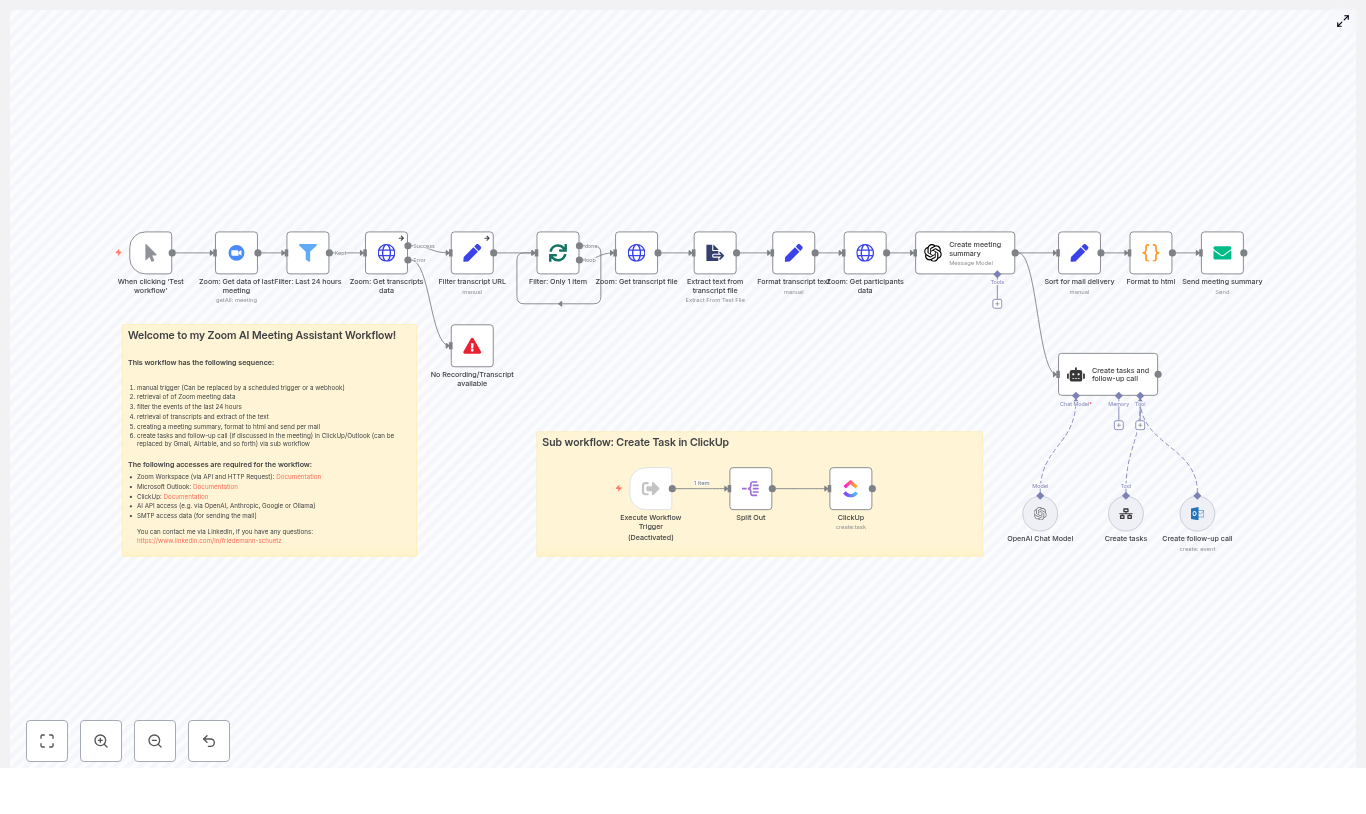
Still typing up meeting notes like it is 2004? This n8n workflow quietly stalks your Zoom recordings, grabs the transcript, asks an AI to summarize everything like a diligent assistant, creates tasks, schedules follow-ups, and emails everyone a clean recap – all while you move on with your life.

In this guide, you will see how to use a ready-to-import n8n workflow that connects Zoom, OpenAI, ClickUp, and Outlook so your meetings stop living and dying in recording archives.

Imagine this: another Zoom meeting, another pile of notes

You join a Zoom call, someone says “We will send out the minutes later,” and everyone silently knows that means “Never.” If you are lucky, someone copy-pastes a messy transcript into a doc and calls it a day.

Manual note-taking is:

  • Time-consuming
  • Easy to forget
  • Inconsistent from meeting to meeting
  • Suspiciously prone to missing the part where you got assigned five action items

This is where n8n and AI come in. Instead of spending your afternoon editing transcripts and chasing tasks, you can let a workflow do the boring parts for you.

What this n8n Zoom AI workflow actually does

This workflow is a linear pipeline you can run manually or on a schedule. It turns your Zoom cloud recordings into:

  • Clean, structured meeting minutes
  • Actionable tasks in ClickUp
  • Optional follow-up meetings in Outlook
  • HTML email summaries for participants

Behind the scenes, it:

  1. Looks for recent Zoom meetings from the last 24 hours
  2. Finds the recording transcript file
  3. Downloads and cleans the transcript text
  4. Pulls the participant list
  5. Feeds everything to an LLM (like OpenAI) with a structured prompt
  6. Generates minutes with participants, summary, tasks, and dates
  7. Sends the formatted summary by email
  8. Uses a sub-workflow to create ClickUp tasks and schedule Outlook follow-ups when needed

So yes, it is basically the colleague who always takes perfect notes, never forgets a task, and does not complain about back-to-back meetings.

What you need before you start

Before you import the workflow into n8n, you will need to set up a few credentials. The good news: you do this once, then enjoy ongoing laziness productivity.

Required integrations

  • Zoom (OAuth2) – to list past meetings and download cloud recordings and transcripts.
  • OpenAI (or another LLM provider) – for summarization, task extraction, and structured meeting minutes.
  • SMTP (or another mail provider) – to send HTML meeting summaries by email.
  • ClickUp (OAuth2) (optional) – to create tasks directly inside your ClickUp lists.
  • Microsoft Outlook (OAuth2) (optional) – to create follow-up calendar events.

For security and sanity, grant only what is needed: read recordings and participants in Zoom, send mail, create calendar events in Outlook, and create tasks in ClickUp.

Quick start: how to import and run the template

If you just want this thing working as fast as possible, here is the basic setup flow. You can tweak and nerd out later.

  1. Open your n8n instance and go to Workflows → Import.
  2. Paste or upload the JSON template and save it as a new workflow.
  3. Configure your credentials:
    • Zoom
    • OpenAI (or your preferred LLM)
    • SMTP or email provider
    • ClickUp (optional)
    • Outlook (optional)
  4. Test it with a recent Zoom meeting using the manual trigger.
  5. Fine tune prompts and filters so it matches your team’s style and process.

Once this is done, you can schedule the workflow to run automatically or just trigger it when needed.

How the workflow actually works, step by step

Now for the curious minds who want to know what is happening under the hood. Here is a node-by-node breakdown of the n8n Zoom meeting summary workflow.

1. Trigger and Zoom: grab recent meetings

The workflow starts with a trigger node. You can:

  • Run it manually after a meeting
  • Use a schedule to process meetings from the last 24 hours
  • Hook it to a webhook if you want something more advanced

It then calls the Zoom API to list recent meetings and filters them to only include those from the last 24 hours. This prevents reprocessing older meetings every time the workflow runs.

2. Fetch recordings and find the transcript file

Zoom’s recording endpoint returns multiple file types for each meeting, for example:

  • Video files
  • Audio-only files
  • Transcript files

The workflow looks for the file where file_type == "TRANSCRIPT" and grabs its download URL. If Zoom did not generate a transcript for that meeting, the workflow stops gracefully with an informative error node so you know the problem is with transcription, not n8n.

3. Download transcript and extract clean text

Next, an HTTP Request node downloads the transcript file. An extract-from-file node then converts it into plain text that is easier to work with.

The workflow also runs a quick cleanup step to strip out timestamps and speaker metadata. The idea is to give the AI a clean transcript rather than a cluttered wall of text full of timecodes, so you get better summaries and fewer weird outputs.

4. Get participants and prep the AI prompt

The workflow calls the Zoom participants endpoint to retrieve attendee names and emails. This information is used to:

  • List participants in the meeting minutes
  • Know who to email the summary to

Then the workflow builds a structured prompt for the LLM. The prompt instructs the model to produce clear sections such as:

  • Participants
  • Summary
  • Tasks
  • Important Dates

This structure is important because it makes later parsing and automation far less fragile and less “AI is being creative again.”

5. Create the meeting summary with OpenAI (or another LLM)

An AI node sends the cleaned transcript and the prompt to OpenAI or your chosen LLM provider. The model returns a formal meeting minutes document with clearly separated sections.

The workflow then:

  • Captures the AI output
  • Formats it into HTML
  • Prepares it for email delivery so it looks decent in most mail clients

The prompt is designed so the output is predictable, structured, and easy to reuse for task creation and scheduling.

6. Task creation and follow-up scheduling

A sub-workflow handles the “turn this into real work” part.

  • The AI output is parsed to extract action items.
  • Those tasks are passed to a ClickUp node, which creates corresponding tasks in your chosen list.
  • If the summary includes a next meeting date or time, the workflow uses that to create an Outlook calendar event.
  • If no specific follow-up date is mentioned, it can fall back to a reasonable default, for example next Tuesday at 10:00 AM.

This means your meeting outcomes do not just live in an email. They show up where work actually happens.

7. Email delivery of the meeting summary

Finally, the workflow sends out the HTML summary via your configured SMTP or mail provider. Recipients can be:

  • The meeting participants from Zoom
  • A specific distribution list
  • A designated owner who forwards or archives the minutes

The styling is intentionally minimal and professional so it looks clean across different email clients without breaking into weird layouts.

Prompt design tips and AI best practices

The quality of your meeting minutes depends heavily on the prompt you give the LLM. The template already includes a solid instruction block, but you can tune it for your team.

  • Limit output length so the minutes stay concise and readable.
  • Ask for tasks in a consistent JSON schema if you want to reliably create tasks programmatically in ClickUp or other tools.
  • Provide example outputs in the prompt so the model learns the exact formatting you expect.

Here is an example JSON-style instruction for tasks you can include in the prompt:

{  "tasks": [  {"title": "Prepare budget slides", "assignee": "Anna", "due_date": "2025-02-15", "priority": "High"}  ]
}

By being strict about structure, you avoid those moments where the AI decides that “Task list” is actually a poetic paragraph.

Customization ideas to fit your workflow

The template works out of the box, but n8n is all about bending things to your will. Here are some ways to customize the Zoom meeting summary automation.

  • Swap the LLM provider Replace OpenAI with Anthropic, Google models, or local models supported in n8n.
  • Adjust filters Process only meetings longer than a certain duration, or only meetings hosted by specific people or with specific topics.
  • Change transcript cleaning Keep or enhance speaker labels if you want more detailed attribution in the minutes.
  • Upgrade the email template Use a richer HTML and CSS layout to match your brand, including logos and colors.
  • Attach more context Include links to the original Zoom recording or attach files in the summary email.

Troubleshooting and common issues

1. No transcript found

If Zoom did not generate a transcript, the workflow will stop with a clear error message so you are not guessing what went wrong.

Check:

  • Zoom cloud recording settings
  • Whether transcription is enabled for your account
  • Whether that specific meeting had cloud recording and transcription turned on

2. Authentication and permission problems

OAuth tokens like to expire at the worst possible time. If the workflow suddenly fails when calling Zoom, ClickUp, Outlook, or your mail provider, verify that:

  • Credentials in n8n are still valid and refreshed
  • The connected apps have the right scopes for:
    • Recordings and participants in Zoom
    • Calendar events in Outlook
    • Task creation in ClickUp
    • Sending email via SMTP

3. AI output is messy or inconsistent

If the AI output looks different every time or breaks your parsing logic:

  • Tighten the prompt and clearly define expected sections and formats.
  • Use JSON or other strictly delimited formats for tasks and dates.
  • Add concrete examples of “good” output so the model has a template to follow.

Security and privacy considerations

Meeting transcripts often include sensitive information, so treat this workflow like it has access to your brain.

  • Limit storage Do not keep transcripts longer than necessary. Delete or archive them securely after processing.
  • Restrict access Control who can import, edit, and run this workflow in n8n.
  • Review third-party policies Check how Zoom, OpenAI, ClickUp, and Outlook handle and store your data.
  • Use organization-level API keys Combine this with audit logs so you know who did what and when.

Where to go from here

With this n8n Zoom AI Meeting Assistant, you can turn your pile of recordings into structured minutes, actionable tasks, and scheduled follow-ups without lifting a finger after the call ends.

Next steps:

  • Import the template into your n8n instance.
  • Connect Zoom, OpenAI, SMTP, ClickUp, and Outlook.
  • Run a manual test on a recent meeting.
  • Tweak prompts and filters until the summaries sound like your team.

If you want to integrate a different task manager or calendar, just clone the workflow and swap out the ClickUp or Outlook nodes for your preferred tools.

Need help customizing it? Reach out to the n8n community or your internal automation team and show them how you never want to write manual meeting minutes again.

Automate Orlen Invoices with n8n

Automate Orlen Invoices with n8n (So You Never Hunt Attachments Again)

Picture this: it is 23:45, you are ready to close your laptop, and then you remember you still have to dig through Gmail for Orlen invoices, download each PDF, drop them in the right Google Drive folder, mark the emails as read, and ping your team on Slack. Repetitive, boring, and just annoying enough to ruin your evening.

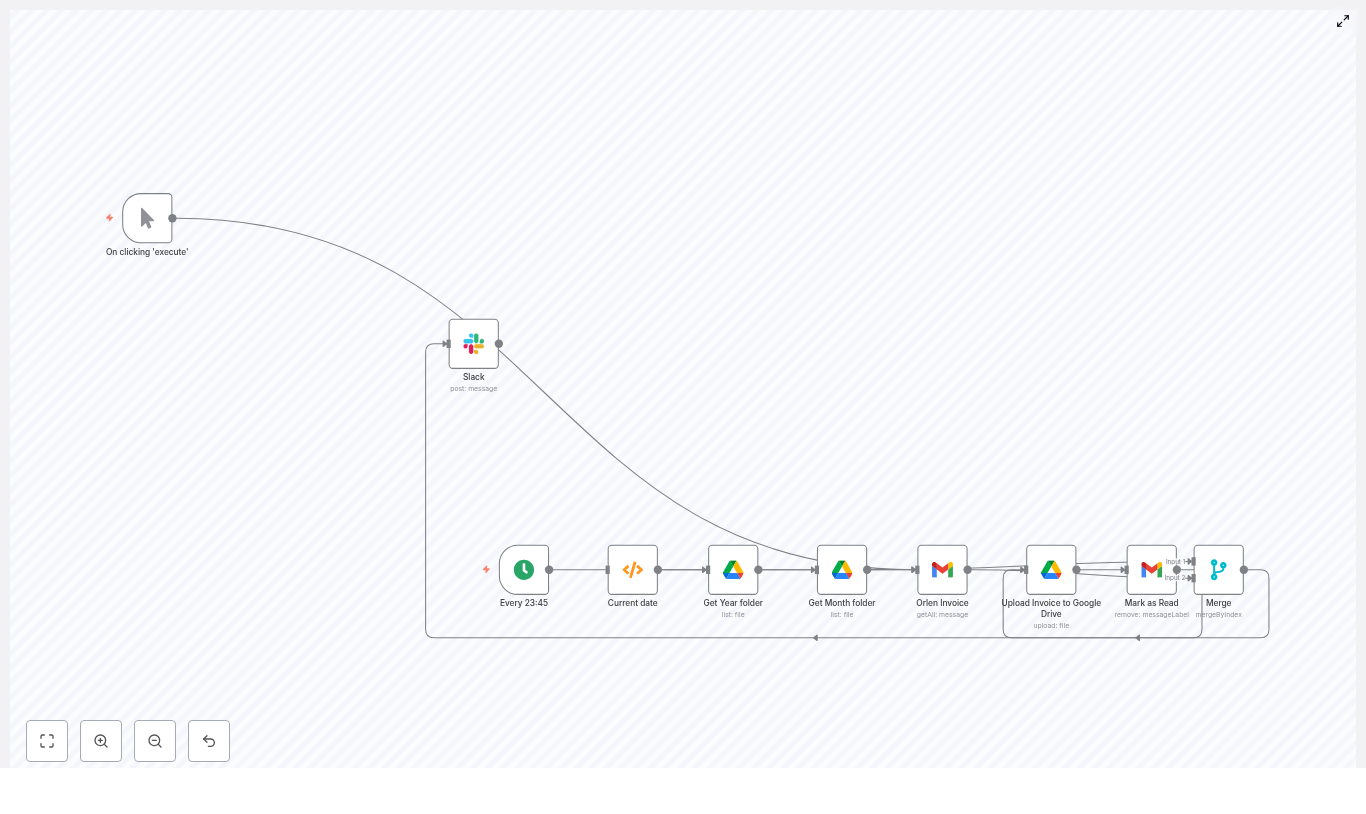
Now imagine all of that happening automatically while you are busy doing literally anything else. That is exactly what this n8n workflow template does. It scans Gmail for Orlen invoices, saves them into a tidy Year/Month folder structure in Google Drive, marks the emails as read, and sends a Slack notification so everyone stays in the loop.

Below you will find what the workflow does, how it works under the hood, and how to set it up step by step. Same technical details as the original guide, just with fewer yawns and more automation joy.

What this n8n workflow actually does

This template is built to handle incoming Orlen invoices from Gmail and keep everything clean and organized in Google Drive, with Slack notifications on top. In one run, the workflow will:

  • Trigger on a schedule (or manually when you feel like testing)
  • Figure out the current year and month for folder names
  • Find or reference the correct Year and Month folders in Google Drive
  • Search Gmail for unread Orlen invoices that have attachments
  • Upload the invoice attachment files into the right Google Drive folder
  • Mark the email as read so it is clear the invoice is handled
  • Post a Slack message so your team knows where the new invoice lives

All of this runs on n8n, a flexible, self-hosted automation platform that plays nicely with Gmail, Google Drive, and Slack. Ideal for turning a simple invoice pipeline into something that quietly runs in the background while you focus on work that is not copy-paste.

Why automate Orlen invoices at all?

Manually processing supplier invoices might feel manageable for a while, until the day you forget one, lose one, or spend 20 minutes trying to find “that one attachment from Orlen from last Tuesday.” Automation helps you:

  • Remove manual steps like downloading, renaming, and dragging files around
  • Reduce the risk of missed invoices since every unread Orlen email with an attachment is processed
  • Keep accounting files organized in a consistent Year/Month folder structure
  • Keep your team informed with automatic Slack notifications

Once this is in place, you get a repeatable, reliable invoice intake flow that does not depend on someone remembering “to do the thing.”

High-level workflow flow (so you know what is going on)

The workflow follows a simple, linear pattern. In n8n terms, it goes like this:

  1. Start with a trigger node (Cron or Manual)
  2. Use a Function node to get the current date (year, month, day)
  3. Look up the Year folder in Google Drive
  4. Look up the Month folder inside that Year folder
  5. Search Gmail for unread Orlen invoices with attachments
  6. Upload the attachment(s) to the right Month folder in Drive
  7. Mark the Gmail message as read
  8. Send a Slack notification with the file path

The template comes pre-wired so you can import it, connect your credentials, tweak a few details, and hit run.

Step-by-step: setting up the template in n8n

1. Choose how the workflow starts: Cron and Manual triggers

You get two ways to kick off the workflow:

  • Cron node – This is your “set it and forget it” option. In the template it is configured to run every day at 23:45 local time. You can adjust that to whatever time makes sense for your accounting routine.
  • Manual Trigger node – Perfect for testing or for those moments when you think “did I set this up right?” You can run it on demand from within n8n.

The workflow is wired so that either trigger can lead to the same processing path, which keeps things neat for both testing and production use.

2. Get the current date using a Function node

Next, the workflow needs to know where to put your invoices in Google Drive. To do that, it calculates the current year, month, and day using a simple JavaScript Function node.

Here is the exact code used in the template:

var today = new Date();
var year = today.getFullYear();
var month = today.getMonth() + 1;
var day = today.getDate();

if(month < 10) {  month = "0" + month;
}

items[0].json.year = year;
items[0].json.month = month;
items[0].json.day = day;

return items;

This fills the workflow data with year, month, and day, for example 2025 and 03, which are then used to find or create matching folders in Google Drive.

3. Locate the Year and Month folders in Google Drive

Now that the date is known, the workflow goes into Google Drive and looks for the correct folders. It uses two Google Drive nodes with the list operation:

  • Get Year folder – Searches for a folder with:
    • name = {{$json["year"]}}
    • mimeType = folder
  • Get Month folder – Looks for a child folder inside that Year folder using a query like:
    ='{{$json["id"]}}' in parents and name = '{{$node["Current date"].json["month"]}}'

If there is a chance the folders do not exist yet, you can add an If node or separate create-folder steps to build the Year and Month folders when needed. More on that in the enhancements section below.

4. Find Orlen invoice emails in Gmail

Time to go invoice hunting, but in a civilized, automated way. The workflow uses the Gmail getAll (messages) operation with a query that targets unread Orlen invoices with attachments:

from:(orlenpay@orlen.pl) has:attachment is:unread

Key configuration details:

  • Format set to resolved so n8n can access the attachment content
  • returnAll set to true if you expect multiple invoices in a single run

The template returns binary attachment data, so those files are ready to be sent straight to Google Drive without extra conversion steps.

5. Upload invoice attachments to Google Drive

Once the attachments are in hand, the workflow uses a Google Drive node with the upload-file operation and binaryData enabled. That way, it can take the binary attachment directly from Gmail and drop it into your Month folder.

An example file name expression used in the template is:

=Orlen {{$binary.attachment_0.directory}}.{{$binary.attachment_0.fileExtension}}

You can absolutely improve on this naming, for example by including:

  • Invoice number extracted from the email or PDF
  • Date of the invoice
  • Original filename

Make sure the parents parameter is set to the Month folder id, for example:

parents: [={{$node["Get Month folder"].json["id"]}}]

That keeps everything neatly sorted into Year/Month folders instead of piling up in some random Drive root.

6. Mark the Gmail message as read

After the attachment is safely in Google Drive, the workflow cleans up your inbox by marking the original email as read. This is done with another Gmail node using the remove messageLabel operation.

  • Set messageId to the id returned from the Gmail search step
  • Remove the UNREAD label

Result: you can visually see which invoices are already processed, and your inbox looks a little less like a to-do list.

7. Notify your team in Slack

Finally, the workflow lets your team know that a new invoice has arrived and where it is stored. The Slack node sends a message with the path to the file in Google Drive.

An example message expression used in the template is:

=Kapitanie!
Dodano fakturę {{$node["Orlen Invoice"].binary.attachment_0.directory}} do Firma/{{$node["Current date"].json["year"]}}/{{$node["Current date"].json["month"]}}

You can customize the Slack channel, language, and tone to match your team culture, whether that is playful, formal, or full of internal jokes about invoices.

Template-specific details you should know

  • Dual trigger path – The workflow merges nodes so that the same Slack notification logic runs whether you start it manually or via the scheduled Cron trigger. That makes it easy to test without maintaining two separate flows.
  • Binary attachment name – In this template, the Gmail node uses attachment_0 as the binary property name for the attachment. If you have more than one attachment per email, you will need to iterate through those binary keys or use a SplitInBatches node.
  • Credentials setup – The template expects:
    • OAuth2 credentials for Google Drive
    • OAuth2 credentials for Gmail
    • Slack OAuth2 credentials with permission to write to the target channel

    Make sure these are configured in n8n before you hit “Execute workflow.”

Recommended enhancements & best practices

Once the basic workflow is running, you can level it up with a few improvements.

Automatically create folders if they do not exist

If you are starting fresh or a new month has just begun, your Year or Month folder might not exist yet. To keep the workflow from failing, you can:

  • Add checks after the Get Year folder and Get Month folder nodes
  • When a folder is not found, use the Google Drive create operation to build it
  • Pass the newly created folder id to the following nodes so uploads still land in the right place

Handle multiple attachments like a pro

If Orlen or other suppliers start sending multiple files per email, you do not need to panic. You can:

  • Use a SplitInBatches node to loop over each binary attachment
  • Or implement a small loop that walks through all binary properties
  • Ensure each file gets a unique name, for example by prefixing with a timestamp or invoice number

Extract and use invoice metadata

For more advanced workflows, you can pull out structured data from the invoice:

  • Parse the email body for invoice number, date, or amount
  • Use OCR or a PDF parsing tool to read the invoice content
  • Include metadata in:
    • File names
    • Folder structure
    • Payloads sent to accounting or ERP systems

This turns your Google Drive from “file storage” into a more searchable and useful archive.

Set up retries and error handling

APIs sometimes have bad days. To keep your workflow resilient, consider:

  • Wrapping critical nodes in dedicated error-handling branches
  • Using Execute Workflow or webhook fallbacks to surface failures elsewhere
  • Enabling execution retries in n8n settings for transient errors like timeouts or rate limits

That way, a temporary hiccup in Gmail or Google Drive does not silently drop an invoice.

Security and permissions best practices

Invoices contain sensitive data, so treat this workflow like part of your finance stack:

  • Use dedicated service accounts for Google and Slack with limited scopes
  • Rotate OAuth credentials regularly
  • If you self-host n8n, place it behind your secure network and follow your organization’s security policies

Troubleshooting common issues

If something does not work quite as expected, these checks usually help:

  • No emails found – Copy the Gmail query:
    from:(orlenpay@orlen.pl) has:attachment is:unread

    and paste it into Gmail’s own search bar. If it returns nothing there, adjust the query or confirm the sender and labels.

  • Google Drive permission errors – Make sure your OAuth2 app has the right scopes, such as Drive.file or Drive.appdata depending on your setup.
  • Missing IDs or paths – Log intermediate outputs using a Set node or by inspecting execution data in n8n. Check folder ids coming from the Drive nodes and message ids from Gmail.

Ideas for future upgrades

Once the basic automation is saving you time, you can keep building on it:

  • Store invoice data in a database like Postgres or Airtable for reporting, dashboards, or reconciliation.
  • Send a daily summary email or Slack digest listing all invoices saved that day.
  • Verify file integrity by checking file size or checksum to make sure the uploaded file matches the email attachment.

Wrapping up: your new invoice autopilot

This n8n template gives you a simple but solid automation for handling Orlen invoices: Gmail in, Year/Month folders in Google Drive out, and a Slack message to keep everyone informed. No more hunting through emails, no more “where did I save that PDF,” and fewer chances to miss an important invoice.

With a few small enhancements like automatic folder creation, better multi-attachment handling, and invoice metadata extraction, you can turn this into a production-ready automation that quietly removes a chunk of manual bookkeeping from your life.

Call to action: Import the template into your n8n instance, hook it up to your Gmail, Google Drive, and Slack OAuth credentials, and run the workflow. If you would like help with customizations such as OCR, database storage, or smarter file naming, reach out to our team or subscribe for more advanced automation tutorials.

Automated Weather Alerts with n8n & SIGNL4

Automated Weather Alerts with n8n & SIGNL4

Introduction

Timely weather information is critical for operations, facilities management, and field teams. This guide explains how to implement a production-ready, no-code weather alert workflow in n8n that checks current conditions for a specific location on a defined schedule and escalates alerts via SIGNL4 whenever a temperature threshold is reached.

The workflow leverages OpenWeatherMap as the data source, n8n as the orchestration and logic layer, and SIGNL4 as the operational alerting channel. The resulting solution is robust, low maintenance, and suitable for professional on-call and incident response environments.

Use case overview

The template is designed for teams that need:

  • Automated temperature monitoring for a specific city or coordinates
  • Scheduled checks at fixed times or intervals
  • Conditional alerting when a threshold is crossed (for heat or cold)
  • Structured, location-aware notifications in SIGNL4
  • Simple manual testing and troubleshooting within n8n

Typical applications include facility heating or cooling monitoring, weather-dependent field operations, and safety-related temperature thresholds.

Core workflow behavior

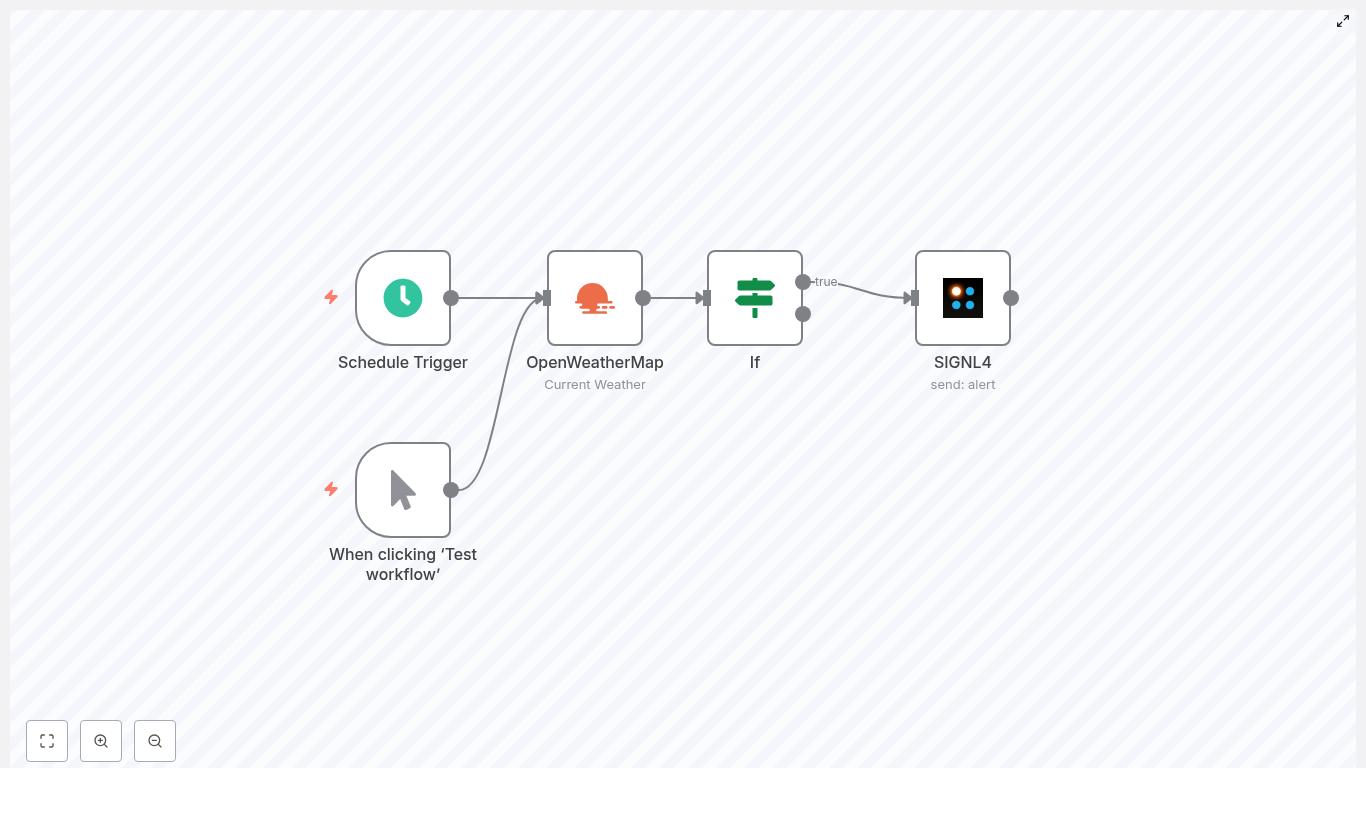
The n8n workflow performs the following actions:

  • Starts on a schedule, for example daily at 06:15
  • Calls the OpenWeatherMap API to retrieve current weather data for a configured city
  • Evaluates the current temperature against a numeric threshold
  • Triggers a SIGNL4 alert if the condition evaluates to true
  • Supports manual execution in n8n for development and testing

Why combine n8n, OpenWeatherMap and SIGNL4?

This integration pattern uses each platform for its strengths:

  • n8n – A visual, extensible automation platform that orchestrates APIs, logic, and data transformations without custom code for most use cases.
  • OpenWeatherMap – A widely used and reliable weather API that provides current conditions, including temperature and coordinates, with flexible units.
  • SIGNL4 – A specialized alerting and on-call tool that ensures critical notifications are delivered, acknowledged, and tracked by operational teams.

Together they form a scalable weather alerting solution that is easy to maintain, transparent to audit, and adaptable to evolving business requirements.

Workflow architecture

The template consists of four primary nodes. Understanding the role of each node is essential for reliable operation and future extensions.

1. Schedule Trigger node

The Schedule Trigger node initiates the workflow execution at defined times. In the template, it is configured to run every day at 06:15. You can adjust this to match your operational needs:

  • Daily checks at specific times (for example 06:15, 18:00)
  • Hourly or every N minutes
  • Custom cron expressions for more complex schedules

For production scenarios, align the schedule with your alerting requirements and API usage limits.

2. OpenWeatherMap (Current Weather) node

The OpenWeatherMap node retrieves the current weather data. In the template, the cityName parameter is set to Berlin, but any supported city or geographic coordinates can be used.

Key configuration aspects:

  • Units: Set to metric to receive temperature in Celsius. If omitted, OpenWeatherMap may return values in Kelvin, which can lead to incorrect comparisons.
  • Credentials: Store your OpenWeatherMap API key in n8n credentials and reference it from the node. Avoid hardcoding keys in node fields or sharing them in exported workflows.
  • Location: Use city name for simplicity or latitude/longitude for precise targeting, for example specific facilities or remote sites.

3. If node (temperature condition)

The If node evaluates whether the current temperature satisfies your alert criteria. In the template, the condition uses the temperature from the OpenWeatherMap response:

{{ $json.main.temp }} < 25

This expression is interpreted as: if the temperature is less than 25 degrees Celsius, follow the true branch. You can adapt this according to your use case:

  • Use < for cold alerts, for example below 0 or 5 degrees
  • Use > for heat alerts, for example above 30 degrees
  • Adjust the numeric threshold to your operational limits

Ensure that the field is treated as a numeric value and that the correct JSON path is used (main.temp in the OpenWeatherMap payload).

4. SIGNL4 node (alert delivery)

When the condition evaluates to true, the workflow passes control to the SIGNL4 node. This node is responsible for creating and sending an alert to your SIGNL4 team.

The template uses expressions to inject real-time data into the alert message and to attach location metadata. An example message configuration is:

Weather alert ❄️ Temperature: {{ $json.main.temp }} °C

Additionally, the node maps geographic coordinates from the OpenWeatherMap response to SIGNL4 fields for map-based visualization:

latitude: ={{ $json.coord.lat }}
longitude: ={{ $json.coord.lon }}

You can also configure:

  • Title for quick identification in the SIGNL4 app
  • externalId for deduplication or correlation of repeated events
  • Custom parameters for severity, category, or system identifiers

Step-by-step configuration guide

  1. Create and configure the Schedule Trigger
    Add a Schedule Trigger node as the entry point. Use the rule editor to define:
    • Basic schedule (time of day, day of week)
    • Or a cron expression for advanced timing requirements
  2. Set up the OpenWeatherMap node
    Add the OpenWeatherMap node and configure:
    • Location: city name or latitude/longitude
    • Units: set to metric for Celsius
    • Credentials: select your OpenWeatherMap API key from n8n credentials
  3. Insert the If node for threshold logic
    Place an If node after the OpenWeatherMap node and configure:
    • Left expression: {{ $json.main.temp }}
    • Operator: numeric comparison such as < or >
    • Right value: your numeric temperature threshold
  4. Connect the true branch to SIGNL4
    Add the SIGNL4 node to the true branch of the If node and:
    • Configure SIGNL4 credentials (API key or webhook)
    • Define the alert title and message body using expressions
    • Map latitude and longitude from $json.coord.lat and $json.coord.lon if you want location-aware alerts
    • Optionally set externalId for deduplication
  5. Test and activate the workflow
    Use n8n’s manual trigger execution mode to validate:
    • That weather data is retrieved correctly
    • That the condition behaves as expected
    • That SIGNL4 receives and displays the alert correctly

    Once validated, enable the workflow so it runs according to the configured schedule.

Expression usage and common pitfalls

Accurate expressions are crucial for consistent behavior. Consider the following best practices:

  • Unit consistency: Ensure OpenWeatherMap is configured with the expected unit system. If you receive Kelvin values, convert them explicitly, for example C = K - 273.15, before comparison.
  • Numeric comparisons: Avoid comparing numbers as strings. Use expressions like = {{ $json.main.temp }} to work with numeric values in the If node.
  • Correct JSON paths: OpenWeatherMap uses:
    • main.temp for temperature
    • coord.lat and coord.lon for coordinates

    Double check these paths in n8n’s execution preview if conditions do not behave as expected.

  • Manual testing: Use manual execution to iterate quickly during development instead of waiting for the scheduled run.

Security and operational best practices

For production deployments, follow these guidelines:

  • Credential management: Always store API keys in n8n credentials. Do not embed keys in node descriptions, environment variables visible to all users, or shared JSON exports.
  • Alert deduplication: Use externalId or similar mechanisms in SIGNL4 to avoid repeated alerts for the same condition, especially when the threshold is persistently exceeded.
  • Alert history and throttling: If you need historical records or wish to prevent frequent alerts, integrate a lightweight datastore such as Google Sheets, Airtable, or Postgres. Track the last alert timestamp and implement a cooldown period.
  • Rate limiting: Align the schedule with OpenWeatherMap API quotas and SIGNL4 alerting policies to avoid unnecessary load.

Advanced enhancements

Once the basic workflow is operational, you can extend it to support more complex operational scenarios.

  • Configurable thresholds: Store city-specific or team-specific thresholds in Google Sheets or Airtable and read them at runtime. This allows non-technical stakeholders to adjust alert levels.
  • Multi-criteria alerts: Combine temperature with other OpenWeatherMap fields, such as wind speed, precipitation probability, or severe weather codes, to drive different alert severities or channels.
  • Multi-channel notifications: Add additional nodes for Slack, SMS, Microsoft Teams, or email to complement SIGNL4 and provide broader visibility.
  • Error handling and retries: Implement error handling to catch failed OpenWeatherMap calls and either retry or raise a separate operational alert if the API is unavailable.

Troubleshooting checklist

If the workflow does not behave as expected, use this checklist:

  • No data from OpenWeatherMap: Verify API credentials, confirm that the city name or coordinates are valid, and check that your API quota has not been exceeded.
  • Unexpected temperature values: Confirm that the units are set to metric or convert from Kelvin if necessary.
  • No alerts in SIGNL4: Check SIGNL4 credentials, review externalId or deduplication settings, and inspect the SIGNL4 node execution logs in n8n.
  • If node never evaluates to true: Inspect the incoming JSON in the execution preview and confirm that $json.main.temp exists and is numeric. Adjust the expression or threshold if needed.

Useful expression examples

The following snippets can be used directly in n8n node fields:

  • Temperature value: {{ $json.main.temp }}
  • Latitude: = {{ $json.coord.lat }}
  • Longitude: = {{ $json.coord.lon }}
  • SIGNL4 message body: Weather alert ❄️ Temperature: {{ $json.main.temp }} °C

Conclusion and next steps

With a small number of well configured nodes, n8n enables a dependable, scalable weather alerting workflow that integrates seamlessly with SIGNL4. By importing the template, configuring OpenWeatherMap and SIGNL4 credentials, defining your temperature thresholds, and validating via manual execution, you can move quickly from concept to production-ready monitoring.

Once the workflow is active on a schedule, it will continuously monitor conditions and notify your teams without manual intervention. You can then iterate by adding additional channels, refining thresholds, or implementing cooldown and deduplication logic as your operational needs evolve.

To get started, import the template into your n8n instance, update the credentials, run a few manual tests, and then enable the schedule.

Subscribe to receive more n8n automation patterns, alerting workflows, and best practices for operations and on-call teams.

Build an AI Clothes Swapper with n8n & Fal.ai

Build an AI Clothes Swapper with n8n & Fal.ai

Imagine letting your users “try on” clothes online without ever stepping into a fitting room. No backend to build from scratch, no complex infrastructure, just a smart workflow that handles everything for you.

That is exactly what this AI clothes swapper template does. Using n8n for automation and Fal.ai for image-based virtual try-on, you can drop a powerful feature into your app with very little code. The workflow accepts images from your frontend, sends them to Fal.ai, waits for the AI magic to finish, then returns a final image URL ready to display in your UI.

Let’s walk through how it works, when to use it, and how to get the most out of it, step by step.

What this AI clothes swapper actually does

At a high level, this template creates a simple “virtual fitting room” backend. Your frontend or mobile app sends two image URLs to an n8n webhook:

  • personImage – the user or model photo
  • garmentImage – the clothing item you want to try on

From there, n8n takes over:

  • Calls the Fal.ai fashn try-on API with those images and some quality settings
  • Waits and polls for the processing status
  • Fetches the final generated image once it is ready
  • Responds to the original webhook request with the URL of the try-on result

You get a clean JSON response that your frontend can use to instantly show the user how the garment looks on them. No need to manage long-running jobs or queue systems yourself, because n8n and Fal.ai handle that for you.

Why use n8n + Fal.ai for virtual try-on

You might be wondering, why not just call Fal.ai directly from the frontend? A few good reasons:

  • Security – Your Fal.ai API key stays hidden on the server side, safely stored in n8n credentials.
  • Orchestration – n8n gives you visual control over polling, retries, error handling, and branching logic.
  • Scalability – You can adjust wait times, retry strategies, and even add caching or logging, all in a no-code interface.
  • Flexibility – Easy to extend later with analytics, user galleries, or e-commerce integrations.

Fal.ai, specifically the fashn/tryon/v1.5 endpoint, does the heavy lifting: realistic garment transfer, background preservation, face refinement, and high-quality output. n8n just makes sure the whole process runs smoothly and predictably.

How the workflow runs from start to finish

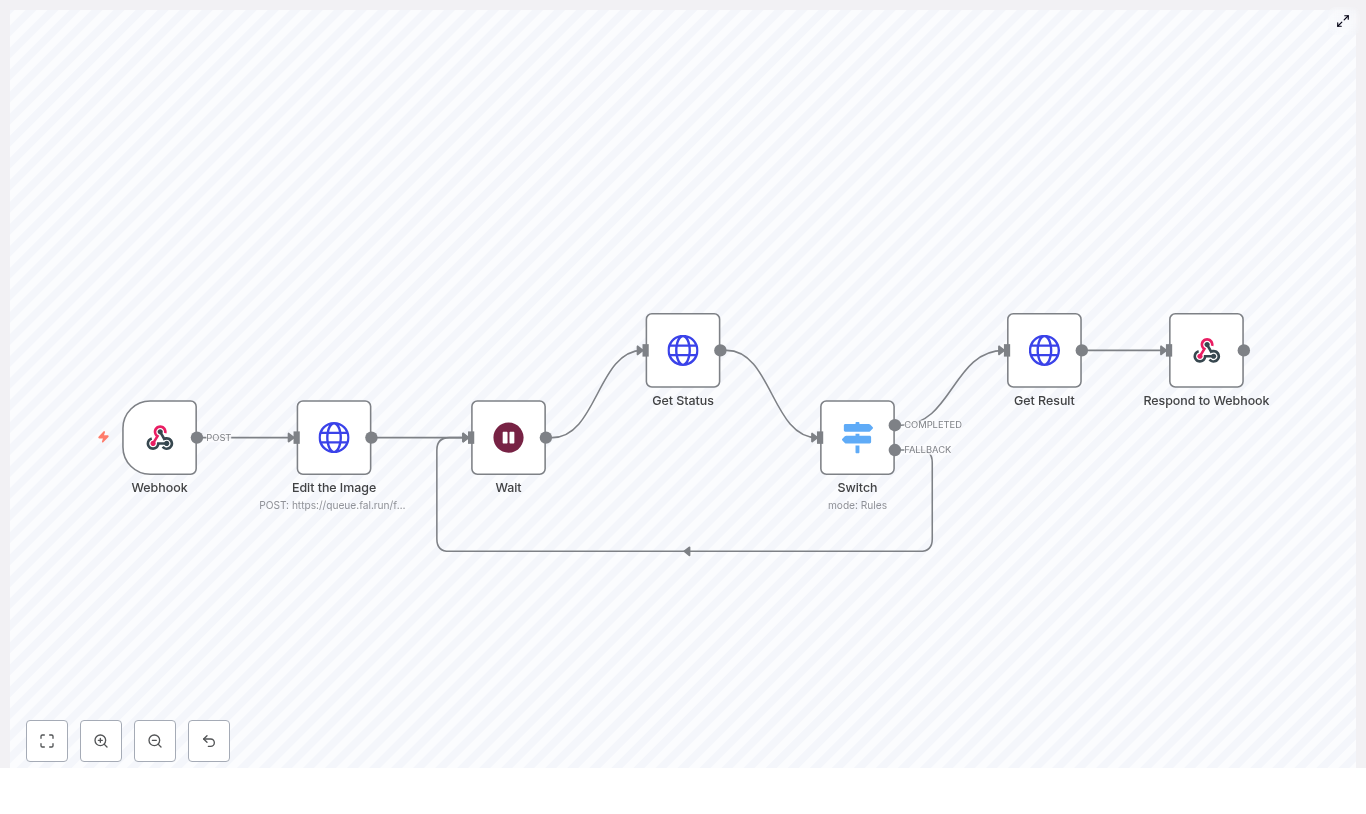
Here is the full journey in plain language, from the moment a user taps “Try on” to when they see their new outfit:

  1. The client app sends a POST request with image URLs to an n8n webhook.
  2. n8n sends those URLs to the Fal.ai try-on API and gets a request_id.
  3. The workflow waits a few seconds to avoid hammering the API.
  4. n8n polls the Fal.ai status endpoint until the job is completed.
  5. Once completed, n8n calls the Fal.ai result endpoint to get the final image.
  6. The workflow returns a JSON response to the original webhook call with the generated image URL.

Now let’s break that down node by node inside n8n.

Inside the n8n workflow: node-by-node tour

1. Webhook – your public entry point

Everything starts with the Webhook node. This is the URL your frontend or mobile app calls. It expects a JSON body like this:

{  "personImage": "https://example.com/user.jpg",  "garmentImage": "https://example.com/jacket.png"
}

In the node settings, you will:

  • Set the HTTP method to POST
  • Choose a webhook path (for example /webhook/ai-tryon)
  • Optionally add security checks, such as a secret token in a header or query parameter

This node simply receives the data and passes it to the rest of the workflow.

2. Edit the Image – sending the job to Fal.ai

Next up is an HTTP Request node that talks to Fal.ai’s try-on endpoint:

POST https://queue.fal.run/fal-ai/fashn/tryon/v1.5

Example headers:

Authorization: Key API-KEY
Content-Type: application/json

The request body includes all the important parameters. In this template, you will see fields like:

  • model_image – the personImage URL from the webhook
  • garment_image – the garmentImage URL
  • mode – set to quality (or speed if you prefer faster, cheaper results)
  • background_modepreserve to keep the original background
  • image_resolution – for example 1024
  • qualityultra for high-end outputs
  • blend – e.g. 0.85, controls how strongly the garment is blended with the person
  • refine_facestrue to improve facial details
  • upscale and enhance_detailstrue for post-processing polish

Fal.ai typically responds with a request_id. Store this in the workflow (for example in the default JSON output) so the next nodes can use it to check the job status.

3. Wait – giving Fal.ai a moment to work

After sending the request, the workflow moves into a Wait node. The idea is simple: do not poll the status endpoint constantly, that wastes credits and can slow everything down.

In the template, the flow goes from Edit the Image to Wait, then to Get Status. You can configure a delay like:

  • 3 to 8 seconds as a starting point, depending on your latency and cost preferences

You can always tweak this later if your users want faster feedback or if you need to reduce API calls.

4. Get Status – checking if the job is done

Next, another HTTP Request node polls the Fal.ai status endpoint:

GET https://queue.fal.run/fal-ai/fashn/requests/{{ request_id }}/status

Here, {{ request_id }} is the ID returned from the previous step. The response includes a status field. If the status is not COMPLETED, the workflow will loop back to the Wait node and try again later.

5. Switch – routing based on status

To handle different statuses neatly, the template uses a Switch node. It checks the value of $json.status and routes the workflow accordingly.

In this template you will see two main outputs:

  • COMPLETED – when $json.status == "=COMPLETED"
  • FALLBACK – any other status (pending, failed, etc.)

On the FALLBACK path, the workflow usually goes back to the Wait node to try polling again. You can also add logic here for:

  • Maximum retry counts
  • Exponential backoff
  • Alerts or logging when something looks wrong

This helps you avoid infinite loops or a flood of unnecessary API calls.

6. Get Result – fetching the final try-on image

Once the status is COMPLETED, the workflow moves to another HTTP Request node to grab the finished result:

GET https://queue.fal.run/fal-ai/fashn/requests/{{ request_id }}

The response usually includes an images array. The first image is often the one you want:

images[0].url

This URL points to the final PNG with the garment realistically placed on the person. You can pass this value along to the last step to send it back to your client.

7. Respond to Webhook – sending the image URL back

Finally, the Respond to Webhook node sends a JSON response back to the original client request. In the template, it looks like this:

{  "myField": "{{ $json.images[0].url }}"
}

You can rename myField to something more descriptive, like resultImageUrl, and you can also include extra metadata such as:

  • request_id
  • processing_time
  • Warnings or error messages if relevant

From the frontend perspective, it is just a simple JSON response that can be used to display the try-on image in your UI.

What a client request looks like

On the client side, calling this workflow is straightforward. Here is a typical request:

POST /webhook/1360d691-fed6-4bab-a7e2-97359125c177
Content-Type: application/json

{  "personImage": "https://cdn.example.com/users/123.jpg",  "garmentImage": "https://cdn.example.com/items/jacket.png"
}

Then, when n8n finishes the whole process, it responds with JSON that includes the generated image URL. Your app can simply parse the response and show the new image to the user.

When to use this virtual try-on workflow

This template is a good fit if you are building things like:

  • An e-commerce store that wants to offer “try before you buy” online
  • A fashion discovery app that lets users experiment with different outfits
  • An internal tool for stylists or marketing teams to generate try-on visuals quickly
  • A prototype or MVP to validate a virtual try-on concept without heavy engineering

If you want a managed, visual backend that you can adjust without redeploying code, n8n plus Fal.ai is a very comfortable setup.

Best practices: security, errors, privacy, and performance

Security tips for your webhook and API key

  • Protect your webhook by requiring a secret token in a header or query parameter, then validate it in n8n.
  • Store your Fal.ai API key in n8n credentials or environment variables. Never expose it on the frontend.
  • If this endpoint is public-facing, lock down CORS and whitelist only the domains that should call it.

Error handling and reliability

Things will fail occasionally, so it is worth planning for that:

  • Set retry limits on polling and log when requests fail repeatedly.
  • Record request_id values and final URLs for easier debugging.
  • Return clear, human-readable error messages to the client, such as:
    • "garment image invalid"
    • "person image not accessible"
    • "processing failed, please try again"

Privacy and consent for user images

If you are working with real people’s photos, treat them carefully:

  • Get proper consent and follow relevant privacy regulations like GDPR or CCPA.
  • Delete temporary or intermediate images if you do not need to store them long-term.
  • Consider masking or limiting any personally identifiable details if they are not essential.

Performance and cost management

High-quality AI images are not free, so it helps to be intentional:

  • Higher resolution and upscaling mean better visuals but higher compute costs.
  • Offer multiple tiers, for example:
    • Fast, lower-res preview
    • Slower, high-res final render
  • Cache popular garments or common combinations if your use case allows it.

Common pitfalls to avoid

Here are a few issues people often run into with try-on workflows:

  • Ignoring non-200 responses from Fal.ai. Always check status codes and any error fields in the response.
  • Polling too aggressively or too rarely. Too frequent polls waste credits, too infrequent polls frustrate users with slow results.
  • Not validating input image URLs. Make sure:
    • The file type is supported
    • The URL is accessible from Fal.ai’s servers
    • CORS or permissions are not blocking access

Ideas for extending this workflow

Once the core pipeline works, you can have some fun with it. For example, you could add:

  • A/B testing for blend values or quality settings to find the most realistic look for your audience.
  • A user gallery where people can save, revisit, or share their try-on images, with explicit opt-in.
  • E-commerce integration so each garment image is linked to a product ID or product page.
  • A UI step that lets users pick color or size before running the final render.

Because everything is in n8n, adding extra nodes for logging, analytics, or notifications is usually just a drag-and-drop away.

Testing checklist before going live

Before you launch this to real users, it is worth running through a quick test plan:

  • Try different body types and garment photos:
    • Transparent PNGs
    • Flat lay images
    • Model shots
  • Check edge cases:
    • Back-facing or side-facing models
    • Occlusions, like crossed arms or bags
    • Photos with multiple people
  • Verify that refine_faces and upscale do not introduce strange artifacts in your dataset.

Putting it all together

With this n8n + Fal.ai template, you get a complete, no-code-friendly backend for an AI clothes swapper or virtual try-on feature. The flow is simple:

  • Receive images via a webhook
  • Send them to

Gmail Agent for Lawn Care Automation

Gmail Agent for Lawn Care Automation: A Knowledge-Driven Workflow for Professional Email Handling

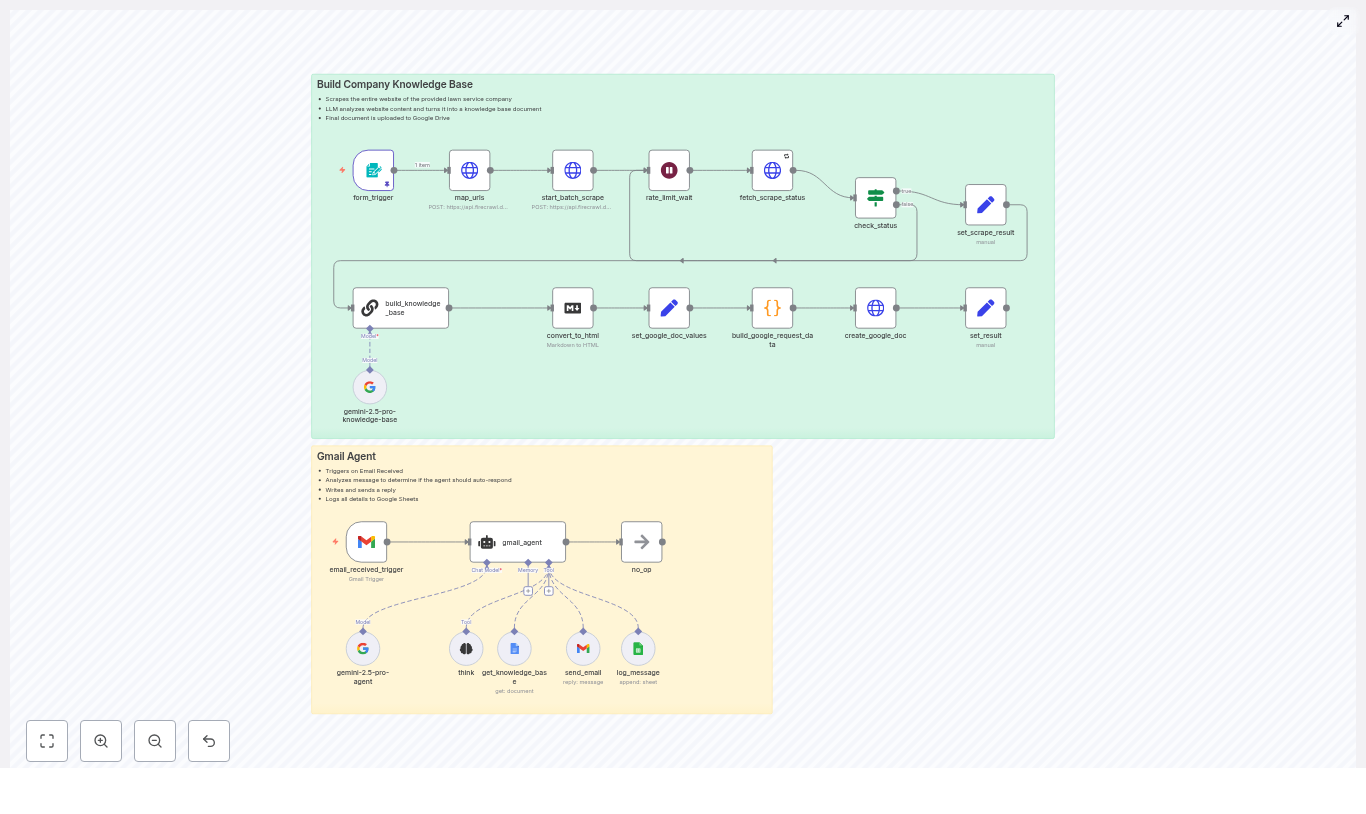
Lawn care businesses that rely on email for customer communication face a recurring challenge: a high volume of repetitive inquiries that demand fast, accurate, and consistent responses. The Recap AI “Gmail Agent” n8n template addresses this challenge by combining a website-derived knowledge base with an automated Gmail workflow and Google Drive logging. The result is a robust, auditable system that responds to common questions, qualifies leads, and records every interaction for later review.

This article provides an expert-level overview of the workflow architecture, key nodes, triggers, and integrations, along with deployment guidance and best practices tailored to lawn care operations.

Business Case: Why a Gmail Agent is Strategic for Lawn Care Providers

Small and mid-sized lawn care companies typically receive a steady stream of similar emails: service area checks, quote requests, scheduling questions, and policy clarifications. Handling these manually can create bottlenecks, inconsistent messaging, and missed opportunities.

Implementing a knowledge-driven Gmail Agent with n8n delivers several strategic advantages:

  • Consistent, brand-aligned communication based on a centralized, curated knowledge base rather than ad hoc replies.
  • Significantly faster response times, which directly improves lead conversion rates and customer satisfaction.
  • Automated compliance and quality logging through structured records of every interaction.
  • Scalable support capacity that absorbs routine queries without additional headcount.

Solution Architecture: Two Primary Flows in n8n

The template is structured as two complementary workflows that operate together inside an n8n-style automation environment:

  1. Knowledge Base Builder – Ingests and synthesizes website content into a structured “Business Knowledge Base”.
  2. Gmail Agent – Monitors a support mailbox, interprets incoming messages, consults the knowledge base, and replies or escalates accordingly.

These flows use a combination of scraping services, large language model (LLM) processing, and Google Workspace tools (Gmail, Google Drive, Google Sheets) to deliver an end-to-end automation.

Key Components and Integrations

1. Form Trigger for Knowledge Base Creation

The workflow begins with a Form Trigger node. An operator submits two core parameters:

  • The public website URL that contains your lawn care service information.
  • The Google Drive folder ID where the knowledge base document will be stored.

This trigger initiates the entire knowledge ingestion and synthesis process, and can be re-run anytime the website is updated.

2. URL Mapping and Scraping Layer

The next stage uses a combination of a site-mapping API and a batch scraper to:

  • Discover relevant URLs across the target website.
  • Fetch each page and extract content, typically normalized to markdown for consistency.

This layer ensures that service descriptions, coverage areas, policies, FAQs, and other text-based content are captured for downstream processing.

3. LLM-Based Knowledge Synthesis

An LLM synthesizer node processes the scraped content to create a single, consolidated “Business Knowledge Base”. Its responsibilities include:

  • Deduplicating repeated information across multiple pages.
  • Structuring content in a format that is usable by both agents and human staff.
  • Preserving or embedding source citations so that each fact can be traced back to its origin page.

This step is central to maintaining a reliable, single source of truth for all automated responses.

4. HTML Conversion and Google Docs Storage

After synthesis, the knowledge base is converted into a suitable format and uploaded to Google Drive:

  • An HTML converter node renders the generated knowledge base for document compatibility.
  • A Google Docs uploader node stores the document in the specified Drive folder.

Team members can review, annotate, or extend this document at any time, which supports ongoing refinement and training.

5. Gmail Trigger and Agent Logic

The operational side of the template is driven by a Gmail Trigger node:

  • The trigger listens for new incoming emails to a defined mailbox, for example support@company.com.
  • When a message arrives, the workflow launches a structured analysis sequence.

The Gmail Agent then:

  • Interprets the intent of the email using a multi-step reasoning process.
  • Retrieves the latest version of the knowledge base from Google Drive.
  • Re-analyzes the request in context of the knowledge base.
  • Decides whether it has sufficient information to respond confidently.

If the conditions are met, the agent generates a professional, policy-aligned reply based solely on the knowledge base. If not, it logs and optionally escalates the email for human handling.

6. Structured Logging to Google Sheets

Every processed email is logged through a Google Sheets integration. Typical fields include:

  • Timestamp of processing
  • Sender email address
  • Email subject
  • Decision taken (auto-responded, escalated, requested more info)
  • Any relevant metadata for audit or training

This structured log provides a comprehensive audit trail and a valuable dataset for continuous improvement.

End-to-End Workflow: High-Level Execution Path

The overall flow can be summarized as follows:

  1. Operator runs the Form Trigger with the website URL and Google Drive folder ID.
  2. The system maps URLs, scrapes content, and passes it to the LLM synthesizer.
  3. A single, deduplicated knowledge base document is generated and stored in Google Drive.
  4. The Gmail Trigger monitors the support mailbox and initiates the agent workflow on new emails.
  5. The agent consults the knowledge base, performs structured reasoning, and decides whether it can answer.
  6. When appropriate, the agent sends a fact-based reply and logs all details to Google Sheets.
  7. Emails that cannot be confidently resolved are logged and escalated for human review.

Design Principles for Safe and Reliable Automation

The template is built around several core design principles that are critical for safe deployment in production environments:

  • Single source of truth
    All responses are grounded exclusively in the synthesized knowledge base. This reduces the risk of hallucinations and inconsistent policy statements.
  • Traceability and verification
    The knowledge base preserves source references so staff can quickly verify any statement and correct underlying content if needed.
  • Conservative response policy
    The agent only replies when it can match the user’s request to reliable knowledge base content. Otherwise, it asks for clarification or routes the message to a human.
  • Human-in-the-loop controls
    With Google Docs and Google Sheets in the loop, it is straightforward for managers to review responses, refine the knowledge base, and adjust policies over time.

Operational Benefits for Lawn Care Teams

Once deployed, this n8n workflow yields tangible operational improvements for lawn care companies:

  • Faster handling of common inquiries, which increases perceived professionalism and improves the likelihood of winning new business.
  • Reduced onboarding and training time, since staff can rely on a shared knowledge base rather than informal tribal knowledge.
  • Better lead qualification, as the agent can collect missing details such as address, ZIP code, lawn size, and service type before escalation.
  • Clear, audit-ready history of email interactions, useful for dispute resolution, service history review, and compliance reporting.

Implementation Checklist for n8n Users

Pre-requisites

  • Administrative access to the company’s Google Drive and the Gmail account used for customer communications.
  • A publicly accessible website with relevant text content describing services, coverage, policies, and FAQs.
  • A dedicated Google Drive folder ID where the knowledge base documents will be stored and maintained.

Deployment Steps

  1. Import the Gmail Agent template into your n8n (or compatible) environment.
  2. Configure API credentials for the site-mapping and scraping services, as well as for the LLM provider.
  3. Run the Form Trigger with the target website URL and the designated Google Drive folder ID to generate the initial knowledge base.
  4. Open the generated Google Doc and verify accuracy. Add or adjust policies, edge cases, and clarifications as needed.
  5. Connect the Gmail Trigger to the appropriate support mailbox and define trigger conditions, such as specific labels or recipient addresses.
  6. Monitor the Google Sheets log during the initial rollout and periodically review sample responses for quality control.

Best Practices and Safety Recommendations

To maintain reliability and alignment with business policies, consider the following operational best practices:

  • Regular knowledge base refresh
    Schedule periodic re-scraping (for example monthly or after significant website updates) to keep the knowledge base synchronized with your current offerings and policies.
  • Explicit treatment of pricing and legal content
    If you include pricing in the knowledge base, ensure it is accurate and clearly time-bound. If you intentionally omit pricing, add instructions to the knowledge base that direct the agent to request a quote or schedule an estimate rather than guessing.
  • Clear escalation rules
    Define which topics must always be escalated, such as complaints, payment issues, or service failures. Encode these rules so the agent does not attempt to resolve sensitive matters autonomously.
  • Ongoing audit process
    Review a sample of automated replies each week. Use findings to refine the knowledge base, adjust prompts, and update escalation logic.

Typical Email Scenarios in Lawn Care Operations

Scenario 1: Service Area Verification

A prospective customer asks whether their ZIP code, for example 64111, is within your service area. The agent queries the knowledge base section that lists service coverage, returns a clear yes or no, and provides next steps such as a link or instructions to request a quote.

Scenario 2: Pricing and Quote Requests

When a user asks about pricing and explicit pricing details are not present in the knowledge base, the agent responds with a professional acknowledgement, requests key property details (address, lawn size, service frequency), and offers to schedule an on-site or virtual estimate instead of improvising a price.

Scenario 3: Complaints or Urgent Issues

Messages that indicate a complaint, service failure, or urgent problem are not resolved by the agent directly. Instead, the workflow logs the email in Google Sheets and flags it for human intervention, ensuring that a staff member follows up with appropriate judgment and authority.

Next Steps: Deploy the Gmail Agent in Your Automation Stack

For lawn care businesses looking to reduce inbox load and elevate customer communication, this Gmail Agent n8n template provides a practical, production-ready foundation. Start by building a knowledge base from your existing website, then connect a dedicated support mailbox and enable structured logging. Within a short time, you will see more consistent responses, faster handling of routine questions, and more capacity to focus on field operations.

Need assistance with deployment? Engage your internal automation specialist or request a guided setup session to review configuration, safety checks, and policy design tailored to your specific lawn care workflows.

Automated Lead Nurturing with n8n and OpenAI

Automated Lead Nurturing with n8n and OpenAI

Imagine this: a new lead fills out your form, you think “I’ll email them in a minute,” then you blink, it is three days later, and that lead is now happily chatting with your competitor. Ouch.

If you are tired of copy-pasting the same follow-up emails, guessing who is “hot” or “meh,” and pinging your team manually every time a form comes in, this workflow is your new favorite coworker. It uses n8n, Google Sheets, OpenAI, Gmail, and Slack to handle lead nurturing for you while you focus on actual conversations, not busywork.

Below you will find what this automation does, how the pieces fit together, and a friendly setup guide so you can go from “I should really follow up” to “it is already done” on autopilot.

Why bother automating lead nurturing?

Manual lead nurturing is like watering plants one drop at a time. It technically works, but it is painfully slow and you will forget some of them.

With a simple n8n lead nurturing workflow you can:

  • Respond faster – your workflow replies in minutes, not “whenever you remember.”
  • Scale personalization – OpenAI writes tailored emails that reference the lead’s own answers.
  • Prioritize the best leads – tags like High, Medium, Low, and Hot help your team know who to call first.
  • Keep everyone in the loop – Slack notifications and Google Sheets updates keep your sales team aligned without extra meetings.

In short, automation takes the repetitive stuff off your plate so you can spend more time on calls and less time wrestling spreadsheets and email drafts.

What this n8n workflow actually does

This template connects your form responses in Google Sheets to OpenAI, Gmail, and Slack, then quietly runs in the background like a very organized assistant. Here is the high-level flow:

  1. Google Sheets Trigger – wakes up when a new form response row is added.
  2. Wait – pauses briefly so any other automations can finish updating the row.
  3. Create Email & Tag (OpenAI) – generates a personalized subject line, email body, and a lead tag (High-Value, Medium-Value, Low-Value, or Hot).
  4. Send Email (Gmail) – delivers that customized email to the lead.
  5. Update Status (Google Sheets) – writes back the contact status, tag, and timestamp to the original row.
  6. Notify Team (Slack) – sends a short summary to your Slack channel so the team can jump on hot leads quickly.

The result: every new form response gets a timely, on-brand reply, a clear priority tag, and a Slack ping to your team, without you lifting a finger after the initial setup.

Quick start: how to set up the workflow in n8n

Let us walk through the setup from top to bottom. You will configure each node once, then let n8n do the repetitive work forever.

1. Google Sheets Trigger – listen for new form responses

First up is the Google Sheets Trigger node. This is what tells n8n, “Hey, a new lead just landed in the sheet.”

  • Set the trigger event to rowAdded so it fires whenever a new response is added.
  • Specify the Spreadsheet ID and the exact sheet/tab with your form data, for example Form Responses 1.
  • Use a Google account that has the right permissions to read and update that sheet.

Once configured, every new row becomes the starting point for your entire lead nurturing flow.

2. Wait node – give other automations a moment

Next, add a Wait node. It might feel odd to add a pause on purpose, but it helps avoid weird race conditions if you have multiple tools touching the same sheet.

  • Set a short delay, for example 1 minute.
  • This ensures any parallel integrations or updates have time to complete before you start composing emails and tagging leads.

Think of it as a tiny coffee break for your data so everything is in place before AI jumps in.

3. Create Email & Tag (OpenAI) – your AI copywriter and lead scorer

Now for the fun part. This node sends your form data to OpenAI with a carefully designed prompt so the model returns three things:

  • Subject – must begin with ABC Corp: to keep your subject lines consistent.
  • Body – a personalized email that references the lead’s answers, such as services they are interested in, their timeline, budget, and any comments.
  • Tag – one of High-Value, Medium-Value, Low-Value, or Hot, based on your lead criteria.

To make this reliable, you will want a solid system prompt. It should describe:

  • How the form fields map to the email content and tagging logic.
  • The exact tagging criteria, for example budget ranges, services requested, and timeline.
  • The required output keys: Subject, Body, and Tag, so n8n can parse the response without guesswork.

Prompt best practices for consistent OpenAI output

A good prompt turns OpenAI from “creative chaos” into a dependable teammate. When configuring the node, keep these tips in mind:

  • Be explicit about format – ask for JSON-like output or clear key/value pairs so you can easily map fields in n8n.
  • Include tagging examples – show what High-Value, Medium-Value, Low-Value, and Hot leads look like and why they get that label.
  • No placeholders – tell the model never to use fake text like “{{name}}” and instead always fill in real values from the inputs.
  • Lock in tone and signer – specify a consistent voice, for example “Pam, customer service at ABC Corp,” so every email feels on-brand.

Once this is in place, OpenAI becomes your always-on copywriter that never forgets to follow up.

4. Send Email (Gmail) – deliver the personalized follow-up

With the subject and body in hand, the Send Email (Gmail) node takes over.

  • Map the To field to the lead’s email address from the Google Sheets row.
  • Insert the Subject and Body from the OpenAI node output.
  • Use a Gmail OAuth2 credential, ideally from a dedicated sending account, to keep deliverability and tracking consistent.

Now every lead gets a tailored email that feels manually written, even though you did not touch a keyboard.

5. Update Status (Google Sheets) – keep your sheet in sync

Next, you want your spreadsheet to tell the truth about what happened. The Update Status node writes everything back to the original row.

  • Mark that the lead was contacted or similar status.
  • Store the Tag value from OpenAI, for example High-Value or Hot.
  • Add a timestamp for when the email was sent.

This closes the loop so anyone looking at the sheet can see who was contacted, when, and how important they are.

6. Notify Team (Slack) – surface leads where your team lives

Finally, the Notify Team (Slack) node makes sure your sales or success team sees new leads in real time, right inside Slack.

  • Send a short message to a chosen Slack channel.
  • Include key details like lead name, service interest, budget, and a direct link to the Google Sheets row.
  • Use the Tag value to help triage, for example highlight Hot or High-Value leads so they get immediate attention.

Instead of your team asking, “Any new leads today?” they will just see them appear, nicely summarized, ready for follow-up.

How the lead tagging logic works

Good tagging is what turns a messy list of contacts into a clear priority queue. This template uses simple but effective rules for lead scoring based on budget, services, and timeline.

  • High-Value Lead – Budget over $10,000, interest in premium services such as Consulting or a Premium Package, or a timeline marked as Immediate.
  • Medium-Value Lead – Budget between $5,000 and $10,000, or interest in standard services with a timeline within about 1 month.
  • Low-Value Lead – Budget under $5,000, or interest in basic packages with a more flexible or long-term timeline.
  • Hot Lead – Timeline set to Immediate or language that screams urgency, such as “ASAP”, “urgent”, or “start immediately.”
    Note: Hot can overlap with other tags. Think of it as a bright red flag that says “call this person first.”

These rules are baked into the OpenAI prompt so the model can consistently assign the correct tag for each new lead.

Sample email your workflow might send

To give you a sense of the tone and structure, here is an example email that fits this automation:

Subject: ABC Corp: Quick next steps for your AI consulting request

Body:

Hi Maria,

Thanks for reaching out and sharing details about your interest in AI consulting. I reviewed your notes about a three-month timeline and your $15,000 budget. Based on that, we can propose a tailored pilot that focuses on rapid value delivery in the first 4-6 weeks and a roadmap for full implementation.

If you want, we can schedule a 30-minute discovery call to walk through our approach and timing. Are you available tomorrow between 10-12 PM or Thursday afternoon?

Best regards,
Pam
Customer Service, ABC Corp

Your actual emails will be generated dynamically by OpenAI, but this gives you a template for style and structure.

Testing your n8n lead nurturing workflow

Before you unleash this on real leads, take a few minutes to test and validate. It is much nicer to catch issues in a test sheet than in someone’s inbox.

  • Use a staging Google Sheet and run the entire automation on a few test rows.
  • Inspect the input and output of each node in n8n to confirm fields are mapped correctly.
  • Check that OpenAI always returns consistent keys: Subject, Body, and Tag.
  • Preview how emails render in Gmail, especially line breaks, formatting, and signatures.
  • Verify that Slack notifications include the right context and a correct link back to the Google Sheets row.

A little testing now saves you from awkward “sorry about that weird email” messages later.

Security and compliance tips

Even though this workflow is friendly and helpful, you still want it to behave like a responsible system.

  • Use OAuth credentials for Google and Slack with the least privilege necessary.
  • Avoid sending sensitive personal data in Slack messages, or mask it where possible.
  • Rate-limit OpenAI calls and consider caching repeated prompts to keep costs predictable.
  • Make sure your Gmail sending account has proper DKIM and SPF configured to improve email deliverability.

Advanced tweaks to level up your automation

Once the basic flow is running smoothly, you can get fancy. Here are some ideas built into the template as options:

  • Add an error handling branch to retry failed API calls and alert an admin if problems keep happening.
  • Include extra scoring criteria, such as company size or domain, to refine your tags beyond just budget and timeline.
  • Provide a calendar booking link in the OpenAI prompt so the email can include a direct call-to-action with availability.
  • Log data to a separate sheet or database for analytics, conversion tracking, and reporting.

These enhancements help you turn a simple lead follow-up flow into a lightweight, custom CRM assistant.

From “I should follow up” to “it is already done”

This n8n lead nurturing workflow takes leads from form submission to personalized outreach, tagging, and team notification with almost no manual effort.

It combines:

  • Speed – fast, automated responses.
  • Personalization – OpenAI-crafted emails tailored to each lead’s answers.
  • Visibility – Slack alerts and updated Google Sheets rows so your team always knows what is happening.

If you want to skip the manual setup and jump straight to a working automation, you can import the ready-made template or get help tailoring it to your CRM and lead-scoring rules.

Schedule a demo | Contact our team

n8n + OpenRouter: Build Gemini Image Preview Workflow

n8n + OpenRouter: Turn Any Chat Prompt Into a Gemini Image Preview Workflow

Imagine a world where a simple chat message can spark a visual idea, generate a preview image, and send it exactly where it needs to go – all without you lifting a finger after the first prompt. That is the power of combining n8n with OpenRouter and Gemini.

In this guide you will walk through a compact yet powerful n8n workflow that sends a chat prompt to OpenRouter’s Gemini 2.5 Flash image-preview model, receives a base64 image back, and converts it into a usable file you can save, attach, or feed into any part of your automation stack.

Think of this workflow as a stepping stone. Once you have it running, you can expand it into full image pipelines, automated content systems, or interactive chatbots that feel almost magical to your users.

The Problem: Great Ideas, Manual Image Work

You already know the feeling. A user sends a prompt. A teammate asks for a quick visual. Your chatbot needs to reply with an image, not just text. The ideas flow quickly, but the images do not.

Without automation, you might:

  • Copy prompts into an external AI tool manually
  • Download images, rename them, and upload them again to Slack, email, or cloud storage
  • Break your focus jumping between apps and tasks

All of that context switching slows you down and distracts from higher value work. The real opportunity is to turn those moments into automated flows that quietly handle the busywork in the background.

The Possibility: A Mindset Shift Toward Automation

Every time you repeat a step by hand, you are looking at a potential automation. This workflow is not just about generating a single image. It represents a mindset shift:

  • From manual copy paste to seamless n8n workflows
  • From one-off experiments to reusable templates
  • From reactive work to proactive systems that support your creativity and business growth

By connecting n8n with OpenRouter’s Gemini image preview model, you can turn any chat input into a visual output in seconds. No more exporting, converting, or downloading files manually. You design the flow once, then let it run as often as you need.

What This n8n + OpenRouter Workflow Gives You

This specific workflow is ideal when you need a fast, automated way to turn a user prompt into a downloadable preview image. It fits perfectly into:

  • Prototypes and MVPs that need quick image previews
  • Chatbots and chat UIs that respond with visuals
  • Image generation pipelines that require an intermediate file
  • Content systems that attach images to emails, Slack messages, or cloud storage

By the end, you will have a workflow that:

  • Receives a chat prompt via webhook or chat trigger
  • Sends that prompt to OpenRouter using the Gemini 2.5 Flash image-preview model
  • Extracts and normalizes the base64 image from the API response
  • Converts the base64 data into a real file n8n can pass to any other node

From there, you are free to attach, upload, save, or transform the file in any way your process requires.

Before You Start: What You Need in Place

To follow along and get this working in your own environment, make sure you have:

  • An n8n instance (cloud or self-hosted)
  • An OpenRouter API key, stored as credentials in n8n
  • Basic familiarity with JSON and simple JavaScript in the n8n Code node

With these pieces ready, you are set to build a workflow that can save you time every time you or your users need an image preview.

The Journey: From Chat Prompt To Image File

Let us walk through the workflow as a story. A user sends a prompt, your system calls Gemini through OpenRouter, the image comes back as base64, and n8n quietly turns it into a file ready for whatever comes next.

Step 1 – Capture the Idea: Chat Trigger or Webhook

Every automation needs an entry point. In this case, your workflow begins when a chat message or HTTP request arrives.

Configure a chat trigger or webhook node in n8n that:

  • Receives the user input (for example, from a chat UI or a custom frontend)
  • Stores the prompt in a field such as chatInput
  • Passes that prompt along as part of the JSON data to the next node

For example, you might reference the user prompt as {{$json.chatInput}} in later nodes. This node is your starting line, the moment an idea enters your system.

Step 2 – Ask Gemini: HTTP Request To OpenRouter

Next you connect that user prompt to OpenRouter so Gemini can generate an image preview.

Add an HTTP Request node and configure it to:

  • Use the POST method
  • Call OpenRouter’s chat completions endpoint
  • Send a JSON body that specifies the Gemini 2.5 Flash image-preview model
  • Use your OpenRouter credentials stored in n8n

An example request body looks like this:

{  "model": "google/gemini-2.5-flash-image-preview:free",  "messages": [  {  "role": "user",  "content": [  {  "type": "text",  "text": "{{ $json.chatInput }}"  }  ]  }  ]
}

In this setup, the user’s prompt flows directly from the trigger node into the HTTP Request node. The response from OpenRouter is expected to contain an images array inside choices[0].message, which will hold the image data as a URL or data URI with base64 content.

This is the turning point where your idea becomes a visual asset.

Step 3 – Clean The Data: Code Node For Base64 Extraction

Gemini, through OpenRouter, often returns the image as:

  • A data URI such as data:image/png;base64,..., or
  • An object with a URL that embeds base64 data

To use this in n8n’s file nodes, you want a clean base64 string without any prefixes. A Code node is perfect for this transformation.

Add a Code node and use JavaScript similar to the following:

// Get the base64 string from the response path
let base64String = $input.first().json.choices[0].message.images[0].image_url.url;

// Remove the data URI prefix if it exists
if (typeof base64String === 'string' && base64String.startsWith('data:image/')) {  const commaIndex = base64String.indexOf(',');  if (commaIndex !== -1) {  base64String = base64String.substring(commaIndex + 1);  }
}

return [{ json: { base64_data: base64String } }];

Helpful notes while you work:

  • If OpenRouter returns a slightly different structure, inspect the raw JSON in the n8n node preview and adjust the response path accordingly.
  • Consider validating that base64String is defined and long enough before returning it. If not, you can add error handling or retries.

This step is where your workflow becomes robust. Instead of relying on fragile manual copy paste, you normalize the response automatically so the next node always receives clean data.

Step 4 – Create The Asset: Convert To File

Now it is time to turn that base64 string into a real file that other tools understand.

Add a Convert to File node and configure it as follows:

  • Operation: toBinary
  • Source property: base64_data
  • Filename: something like generated_image.png (you can also build this dynamically from the prompt)
  • MIME type: image/png

The node will output a binary file that n8n can pass to any downstream node. From here you can:

  • Attach it to an email
  • Upload it to AWS S3 or Google Cloud Storage
  • Send it to Slack or another chat platform
  • Save it locally for later processing

At this point, your entire path from chat prompt to downloadable image is automated.

Keeping It Reliable: Error Handling and Practical Tips

As you start to rely on this workflow, a few safeguards will help it run smoothly in production.

  • Rate limits: Monitor your OpenRouter usage. For 429 responses, add retries with backoff or a Wait node.
  • Large responses: If images get large, ensure your n8n instance has enough memory and adjust payload limits if you are self-hosting.
  • Security: Store your OpenRouter API key in n8n credentials, not in plain text inside nodes. If your webhook is public, consider restricting access or adding authentication.
  • Validation: Before the Convert to File node, you can insert a Conditional node that checks if the base64 data is present to avoid runtime errors.

These small steps turn your workflow from a quick experiment into a dependable part of your automation toolkit.

Leveling Up: Advanced Improvements To Explore

Once your basic flow is stable, you can start to shape it around your specific needs. Here are some ideas to evolve this into a more powerful system:

  • Dynamic filenames: Include timestamps or a sanitized version of the user prompt in the filename for easier tracking.
  • Cloud storage integration: Store generated images in S3 or Google Cloud Storage using n8n’s storage nodes instead of keeping files in memory.
  • Multiple images: If the API returns several images, iterate over the images array with an Item Lists node or IF loop, and run Convert to File for each image.
  • Logging and analytics: Push metadata to a database or logging service so you can analyze prompts, image usage, and performance over time.

Each enhancement you add makes the workflow more aligned with your real-world processes and brings you closer to a fully automated image pipeline.

Troubleshooting: When Things Do Not Look Right

As you experiment, you might run into a few common issues. Here is how to quickly diagnose and fix them:

  • No image in the response: Double-check the model name and request body format. Inspect the raw response from the HTTP Request node to confirm where the image data lives.
  • Base64 decode errors: Make sure you removed the data URI prefix and that the base64 string length is valid (typically a multiple of 4). If it is truncated, you may need to pad with =.
  • 401 or permission denied: Verify that your OpenRouter API key is correct, stored as credentials, and correctly selected in the HTTP Request node.

Treat these moments as learning opportunities. Each fix deepens your understanding of how n8n and OpenRouter work together.

Big Picture: How The Full n8n Flow Fits Together

To recap, here is the complete journey your data takes:

  1. A chat trigger or webhook receives the user prompt.
  2. An HTTP Request node sends that prompt to OpenRouter’s Gemini 2.5 Flash image-preview model.
  3. A Code node extracts and normalizes the base64 image data from the response.
  4. A Convert to File node turns the base64 into a binary file ready for any downstream use.

From there, you are free to extend the workflow in any direction: notifications, storage, additional processing, or integration with other tools.

Taking Action: Your Next Step Toward Smarter Automation

This n8n + OpenRouter pattern is deliberately simple, yet it unlocks a powerful new habit: letting automation handle the repetitive steps between idea and outcome.

Whether you are:

  • Prototyping a chatbot that returns images alongside text
  • Building content previews for marketing or product teams
  • Automating image uploads and file handling in your backend

this workflow gives you a repeatable way to turn AI image output into a usable file in just a few nodes.

You do not have to build it all from scratch. You can start from a ready-to-use template, customize it, and grow it over time.

Try it now:

  • Clone the workflow template in n8n.
  • Add your OpenRouter API key in the n8n credentials section.
  • Trigger the webhook with a prompt such as "A minimalistic flat icon of a rocket in blue and white."

Watch the workflow run, see the image file appear, and then ask yourself: where else could I let automation do the work for me?

If you want a preconfigured template or guidance on adapting this flow for Slack, email attachments, or cloud storage, keep exploring, reach out for help, or subscribe for more automation-focused tutorials. Every small workflow you build is another step toward a more focused, creative, and scalable way of working.

Automate ActiveCampaign Contacts with n8n

Automate ActiveCampaign Contacts with n8n

On a gray Tuesday afternoon, Maya stared at her ActiveCampaign dashboard and sighed.

As the marketing lead at a growing SaaS startup, she lived inside spreadsheets, CRMs, and form tools. Every new lead that came in through a landing page, webinar, or demo request had to end up in ActiveCampaign. In theory, this would keep her email campaigns sharp and her sales team happy.

In reality, it meant endless copy-paste work, duplicate contacts, and a constant fear that an important lead had slipped through the cracks.

One missed contact might mean one lost customer. And Maya knew she could not afford that.

The problem: manual chaos in a world that should be automated

Maya’s workflows looked something like this:

  • Export CSVs from form tools several times a week
  • Manually import them into ActiveCampaign
  • Try to remember which contacts were already there and which were new
  • Keep track of tags, lists, and custom fields by hand

She had already run into a few painful issues:

  • Duplicate contacts when someone filled out multiple forms
  • Leads missing from lists because she forgot to import a CSV
  • Wrong or missing custom field values for important segments

Her team had started to ask uncomfortable questions. Why did some leads not get welcome emails? Why were some prospects not tagged with the right interests? Why did the data in ActiveCampaign feel out of sync with the rest of their tools?

Maya knew she needed automation, not more spreadsheets. That is when she discovered n8n.

The discovery: a template that could change everything

Maya had heard about n8n before: a flexible, node-based automation platform that could connect to dozens of tools. She had used it once to send Slack alerts, but never for anything as central as contact management.

While browsing for solutions, she found an n8n workflow template designed to automate ActiveCampaign contacts. The promise was simple but powerful:

  • Automatically create or update contacts in ActiveCampaign
  • Use a trigger (manual, webhook, or Cron) instead of manual imports
  • Map fields dynamically from real data sources
  • Handle lists, tags, and custom fields programmatically

If this worked, she could turn her messy, manual process into a reliable, automated pipeline. No more guessing whether a lead had made it into ActiveCampaign. No more copy-paste marathons.

She decided to try the template and adapt it to her needs.

Setting the scene: what Maya needed to get started

Before she could build anything, Maya gathered the basics:

  • An n8n instance, hosted in the cloud
  • An ActiveCampaign account with her API URL and API key
  • Her existing knowledge of n8n nodes and credentials

That was enough to follow the template and start small. Her plan was to begin with a test workflow, then slowly move to production.

Rising action: building the first working workflow

Maya opened her n8n workspace and began with a minimal version of the template. The idea was to create a simple workflow that she could trigger manually, just to see a contact appear in ActiveCampaign.

The basic structure looked like this:

{  "nodes": [  {"name": "On clicking 'execute'", "type": "n8n-nodes-base.manualTrigger"},  {  "name": "ActiveCampaign",  "type": "n8n-nodes-base.activeCampaign",  "parameters": {  "email": "",  "updateIfExists": true,  "additionalFields": {  "firstName": "",  "lastName": ""  }  }  }  ]
}

It was simple, but it captured the core logic she needed: a trigger and an ActiveCampaign node that could create or update a contact.

Maya’s first step: choosing the right trigger

For her first experiment, she did not want to worry about webhooks or external tools. She just needed a reliable way to run the workflow.

So she started with the Manual Trigger node.

In her mind, she already knew where this would go next: in production, she would replace the manual trigger with one of these options:

  • A Webhook node to receive live form submissions
  • An HTTP Request node to pull data from another service
  • A Cron node to run scheduled imports from a CSV or database

But for now, all she needed was a button to click: “Execute.”

Adding the ActiveCampaign node: where the magic happens

Next, Maya dropped an ActiveCampaign node onto the canvas and began to configure it carefully.

  1. She searched for the ActiveCampaign node in n8n and added it to the workflow.
  2. She set the operation to create (in her version of n8n it appeared as “create: contact”).
  3. She filled in the email field. At first she used a test email, but she knew she would later map it dynamically using expressions like {{$json["email"]}}.
  4. She enabled updateIfExists, so that if a contact with that email already existed, it would be updated instead of duplicated.
  5. Under Additional Fields, she set values for firstName and lastName, and noted that she could later add phone, tags, and custom field values there too.

This node would become the heart of her automation. If it worked correctly, every incoming lead would be created or updated in ActiveCampaign with the right data.

Connecting the accounts: credentials that unlock everything

Of course, none of this would work unless n8n could talk to ActiveCampaign securely.

Maya opened the Credentials section in n8n and created a new ActiveCampaign credential. She switched to her ActiveCampaign account, navigated to Settings > Developer, and copied the:

  • API URL
  • API key

She pasted them into n8n, double-checked there were no extra spaces, and saved the credential. Then she linked this credential to her ActiveCampaign node.

Her workflow was now connected end to end, at least in theory.

The turning point: the first successful test

This was the moment of truth.

Maya clicked on the Manual Trigger node and hit Execute. The workflow ran, the ActiveCampaign node lit up, and she watched as the output appeared in n8n.

To confirm it really worked, she went back to ActiveCampaign and searched for the test email address.

There it was, a new contact, created automatically.

She ran it again with the same email but different first and last names. This time, instead of creating a duplicate, the contact was updated. The updateIfExists setting was doing exactly what she needed.

The manual chaos that had haunted her spreadsheets suddenly felt optional.

Leveling up: mapping real data and handling complexity

With the basics working, Maya turned to the next challenge: feeding the workflow with real data from forms and other sources.

Dynamic field mapping with n8n expressions

Her forms were sending payloads with nested JSON fields like formData.email, formData.first_name, and formData.last_name. She needed to map these into the ActiveCampaign node fields.

She updated her node like this:

email: {{$json["formData"]["email"]}}
firstName: {{$json["formData"]["first_name"]}}
lastName: {{$json["formData"]["last_name"]}}

For more complex payloads, she experimented with the Set node to normalize incoming data, and sometimes a Function node when she needed custom logic. This let her reshape inconsistent form submissions into a clean structure before they reached the ActiveCampaign node.

Her workflow was no longer just a test. It was starting to look like a real, production-ready automation.

Facing reality: troubleshooting when things go wrong

As Maya expanded her workflow, she discovered that not everything would be smooth all the time. A few early tests surfaced common problems she had to solve.

  • Authentication errors When she accidentally pasted an API key with a trailing space, the workflow failed. The fix was simple: re-check the API URL and API key in the credentials and ensure there were no hidden spaces.
  • Duplicate contacts In one test, she forgot to enable updateIfExists and ended up with multiple entries for the same person. She learned to always verify that the email mapping was correct and that updateIfExists was turned on.
  • Missing custom fields Some of her segments relied on custom fields in ActiveCampaign. She discovered that these fields often required specific field IDs or exact slugs. She took time to map them carefully in the Additional Fields section.
  • Rate limits and timeouts When she tried to push a large batch of historical contacts, she hit rate limits. The solution was to batch the imports and apply throttling or retry logic where needed.

Each problem made her workflow stronger. Instead of giving up, she refined the automation step by step.

From test to production: turning a simple flow into a system

Once the core contact creation and update logic worked reliably, Maya shifted her focus. It was time to transform this simple workflow into a robust, production-ready system that could run 24/7.

Replacing the Manual Trigger with Webhook or Cron

Her first big change was the trigger.

For live form submissions, she added a Webhook node. She copied its URL and plugged it into her form handler so that every new submission would instantly hit n8n.

The flow now looked like this:

  1. Webhook node receives form data
  2. Optional Set or Function nodes normalize the payload
  3. ActiveCampaign node creates or updates the contact

For periodic imports from internal systems, she also experimented with a Cron node that ran on a schedule, pulling data from a CSV or database, then passing it through the same ActiveCampaign logic.

Adding error handling so nothing gets lost

Maya knew that in production, silent failures were not acceptable. If a contact could not be created or updated, she needed to know about it.

She added error handling in two ways:

  • Using the Error Trigger node to catch workflow failures globally
  • Connecting the error output of key nodes (like ActiveCampaign) to notification nodes

For notifications, she used Slack and email, so that if something went wrong she would see it quickly. She also logged failed records to a Google Sheet, which made it easy to review and fix issues later.

Using batching for large imports

For big historical data imports, she turned to the SplitInBatches node. Instead of sending thousands of contacts at once, she processed them in smaller groups.

This helped her:

  • Stay within ActiveCampaign’s rate limits
  • Reduce the chance of timeouts
  • Handle errors more gracefully, batch by batch

Her contact automation was no longer fragile. It was resilient.

Going advanced: tags, lists, custom fields, and logic

With the core workflow stable, Maya started to think like a strategist again. It was not enough to simply get contacts into ActiveCampaign. She wanted them enriched, segmented, and ready for targeted campaigns.

  • Applying tags for segmentation She used the ActiveCampaign node to apply tags based on the source or behavior of the lead. For example, “webinar-registrant,” “ebook-download,” or “pricing-page-visitor.” These tags powered highly targeted automations inside ActiveCampaign.
  • Managing list membership When creating contacts, she configured the node to add them directly to the appropriate lists. This ensured they received the correct campaigns from day one.
  • Mapping custom fields For important attributes like “plan interest” or “company size,” she mapped values to custom fields using the correct field keys or IDs inside Additional Fields.
  • Adding conditional logic Using IF nodes, she set rules such as “only create a contact if email is present” or “apply specific tags only if a certain form field is true.” This gave her fine-grained control over how each lead was handled.

At this point, her workflow no longer felt like a simple connector. It felt like an intelligent entry point into her entire marketing system.

Security and privacy: protecting real people’s data

As the workflow grew, Maya remained conscious of one important reality: she was handling personal data. Names, email addresses, and other PII needed to be treated carefully.

She followed key security and privacy practices:

  • Using encrypted storage for n8n credentials
  • Restricting access to both her n8n instance and her ActiveCampaign account
  • Ensuring compliance with GDPR and CCPA by:
    • Obtaining consent before adding people to marketing lists
    • Respecting unsubscribe preferences and suppression lists

Automation did not mean ignoring responsibility. It meant handling data consistently and securely.

A new normal: from firefighting to focus

Weeks later, the difference in Maya’s workday was obvious.

New contacts flowed into ActiveCampaign automatically from forms, internal tools, and imports. Each one was created or updated with the right fields, tags, and list memberships. Errors were caught and reported. Large imports were batched. Custom fields were consistent.

Instead of spending hours on manual imports, she could finally focus on strategy: better campaigns, smarter segments, and new experiments.

Her team’s questions changed too. Instead of “Why is this lead missing?” they were asking “What else can we automate?”

Where you fit in: your next step with n8n and ActiveCampaign

Maya’s story is not unique. If you are a marketer, founder, or developer struggling with manual contact management, the same n8n-to-ActiveCampaign automation can transform your workflow.

You can follow the same path:

  1. Start with a Manual Trigger and a simple ActiveCampaign node to create or update contacts.
  2. Configure credentials using your API URL and key.
  3. Test with a few sample contacts and confirm they appear in ActiveCampaign.
  4. Introduce dynamic field mapping with expressions.
  5. Replace the Manual Trigger with a Webhook or Cron for real-world data.
  6. Add error handling, batching, and conditional logic as you move into production.