


Comprehensive Guide to Advanced SEO Keyword Research
This guide explains an advanced, automation-ready workflow for SEO keyword research that you can implement and adapt in tools like n8n or similar automation platforms. It focuses on how to systematically collect, enrich, and analyze keyword data using APIs, structured processing steps, and repeatable logic. The goal is to move from initial seed keywords to a consolidated dataset that covers keyword ideas, search volume trends, SERP features, local results, and backlink insights.
1. Workflow Overview
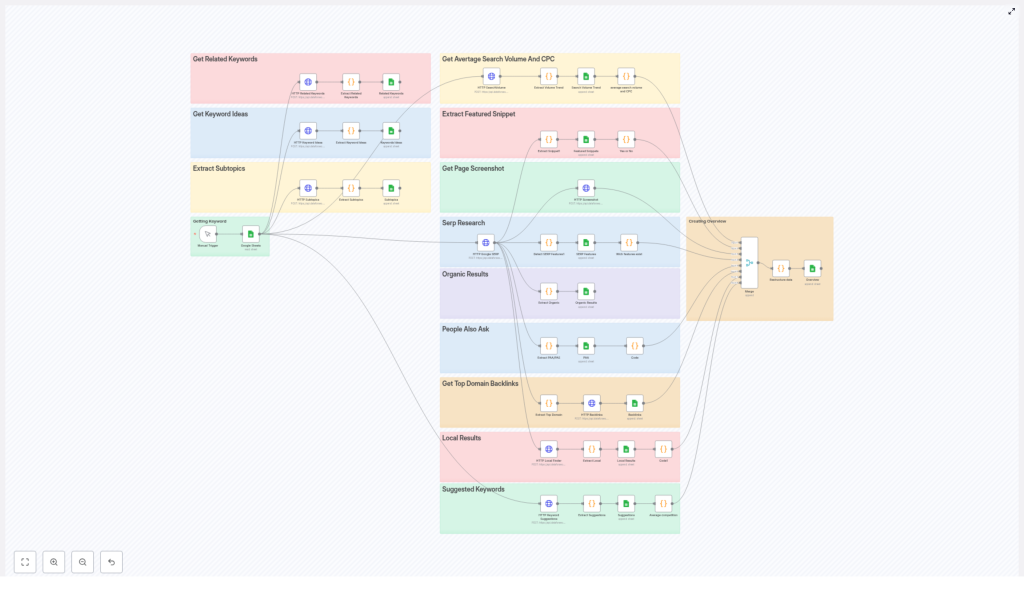
The advanced SEO keyword research workflow is designed as a multi-step pipeline that starts with basic keyword inputs and ends with a structured report suitable for strategic decision-making. At a high level, the workflow:
- Ingests one or more seed keywords or existing keyword lists
- Expands those seeds into related keywords and keyword ideas using external APIs
- Retrieves search volume, CPC, and competition metrics for each keyword
- Analyzes SERP features such as featured snippets, People Also Ask, and rich media
- Extracts organic and local search results for both global and local SEO insights
- Collects backlink data for top-ranking domains to inform link-building strategies
- Integrates all collected data into a single, structured report for analysis
Each phase can be implemented as a separate segment of an automation workflow. Data typically flows from one segment to the next in a tabular or JSON format, which is then aggregated at the end into a final report.
2. Architecture and Data Flow
The architecture of this keyword research process can be viewed as a sequence of distinct stages. While the original content does not specify concrete n8n nodes, the logic maps cleanly to common node types such as HTTP Request, Function (for transformation), and data aggregation nodes.
2.1 High-Level Stages
- Input & Seed Collection – Load seed keywords from existing datasets or manual input.
- Keyword Expansion – Query APIs for related keywords and keyword ideas.
- Search Volume & Competition Analysis – Request metrics like search volume, CPC, and competition level.
- SERP Feature Analysis – Inspect SERPs for special features that influence click-through rate.
- Organic & Local Results Analysis – Parse organic rankings and local pack results.
- Backlink Insights – Analyze backlink profiles of high-ranking domains.
- Data Integration & Reporting – Merge all intermediate outputs into a single structured report.
Each stage operates on the output of the previous one. For example, the keyword expansion stage outputs a list of candidate keywords, which then becomes the input for the search volume and competition stage.
2.2 API Integration Layer
The workflow relies on HTTP-based APIs to retrieve keyword data, search metrics, SERP information, and backlink details. Typical characteristics of this layer:
- Use of
HTTP Request-style operations to call external keyword research and SEO APIs - JSON response parsing to extract relevant fields such as keyword text, volume, CPC, SERP features, and URLs
- Filtering and normalization of API output into a consistent internal structure for downstream processing
In practice, each API endpoint is treated as a separate step. Authentication and query parameters must be configured per provider, but the general pattern remains the same across the workflow.
3. Node-by-Node / Step-by-Step Logic
The following sections describe the functional steps of the workflow in detail, mirroring how you might implement them in an automation platform. Each step corresponds to one or more nodes or actions.
3.1 Step 1 – Gathering Initial Keywords
The workflow begins by collecting seed keywords. These can originate from:
- Existing datasets such as analytics exports, ad campaigns, or prior keyword lists
- Manual input where you define a set of core topics or primary keywords
In an automation context, you might:
- Load a CSV or database table of existing keywords as the initial input
- Use a manual trigger or a simple input node to define a few seed terms
These seed keywords act as the foundation for all subsequent expansion and analysis. Ensuring they are clean, de-duplicated, and relevant will improve the quality of results downstream.
3.2 Step 2 – Expanding Keywords with Related Terms and Ideas
Once you have seed keywords, the next step is to broaden your keyword universe by querying external APIs for related keywords and keyword ideas.
3.2.1 Related Keywords
Related keywords are semantically connected terms that users often search along with or instead of your main keywords. In this step:
- Each seed keyword is sent to an API endpoint that returns related queries
- The response is parsed to extract terms that share topical relevance or user intent
- Duplicate or irrelevant terms can be filtered out based on thresholds or rules
3.2.2 Keyword Ideas
Keyword ideas extend beyond direct variations and include new concepts generated from popular searches and query patterns. The workflow:
- Calls API endpoints that provide keyword suggestions and ideas for each seed keyword
- Aggregates ideas that show promising search interest or align with your content strategy
- Normalizes the resulting list into a single dataset of candidate keywords
3.2.3 Tools and Techniques for Expansion
The integration layer uses HTTP requests to interact with external providers. Typical operations include:
- Sending GET or POST requests with the seed keyword as a query parameter
- Parsing JSON responses to extract fields like
keyword,suggestion, orrelated_term - Saving the extracted results into a structured format, for example a table or JSON array, for subsequent analysis
At this stage, it is important to maintain a unified schema for all keywords, regardless of their origin (seed, related, or idea). This simplifies later aggregation and reporting.
3.3 Step 3 – Analyzing Search Volume Trends and Competition
With an expanded keyword list in place, the workflow proceeds to retrieve quantitative metrics that help prioritize which terms to target. The main metrics are:
- Search Volume Trends – Monthly search volume data that reveals seasonality, long-term growth, or decline
- Average CPC (Cost Per Click) – Typical cost in paid campaigns, which signals commercial intent and value
- Competition Levels – An index or score indicating how difficult it is to rank for the keyword
Implementation details typically include:
- For each keyword, calling an API endpoint that returns volume, CPC, and competition
- Aggregating monthly volumes to detect trends, such as rising or highly seasonal queries
- Storing these metrics alongside the keyword text for later filtering and ranking
Edge case handling at this step often involves:
- Dealing with missing or zero-volume keywords by excluding them or flagging them as low priority
- Normalizing competition metrics when different providers use different scales
3.4 Step 4 – SERP Feature Detection and Analysis
Modern search results are not limited to simple blue links. This step inspects SERPs for each keyword to identify special features that influence click-through rate and content strategy.
The workflow focuses on detecting:
- Featured Snippets – Position-zero results that summarize answers directly on the SERP
- People Also Ask (PAA) – Question boxes that reveal related user questions and subtopics
- Rich Media – Presence of videos, images, or shopping ads that signal visual or transactional intent
Typical operations include:
- Querying a SERP or SEO API for each keyword
- Inspecting the returned SERP structure for flags or objects that represent snippets, PAA, video carousels, image packs, or shopping blocks
- Recording which SERP features are present for each keyword
This information helps you decide how to optimize content. For example, if a keyword consistently triggers featured snippets, you may prioritize structured, concise answers. If video results dominate, video content might be necessary to compete.
3.5 Step 5 – Organic and Local Results Analysis
Beyond SERP features, the workflow also gathers detailed information about organic rankings and local results. This is essential for both global SEO and local SEO strategies.
3.5.1 Organic Results
The workflow retrieves and analyzes standard organic search results for each keyword:
- Extracts top-ranking domains and their URLs
- Captures content snippets or meta descriptions
- Identifies the types of pages that rank (blogs, product pages, category pages, etc.)
This provides insight into the current competitive landscape and the content formats that perform well for the keyword.
3.5.2 Local Pack and Local SEO Data
For location-specific or local-intent keywords, the workflow inspects local pack results. It may collect:
- Local business names and domains appearing in the local pack
- Location-related details that can guide local SEO optimization
This information is useful when planning local landing pages, Google Business Profiles, or geographically targeted content.
3.6 Step 6 – Backlink Insights
Backlinks remain a core ranking factor. To understand why certain domains rank well, the workflow includes a backlink analysis stage.
In this step, the automation:
- Identifies top domains associated with your target keywords from the organic results
- Queries backlink or SEO APIs for those domains
- Collects backlink-related metrics that indicate domain authority and link-building potential
The resulting backlink insights can help you:
- Estimate the link profile strength required to compete for specific keywords
- Discover potential outreach or partnership opportunities for link acquisition
3.7 Step 7 – Data Integration and Report Creation
The final stage merges all collected data into a comprehensive report. At this point, each keyword may have associated:
- Average search volume and search volume trends
- Average CPC and competition metrics
- Detected SERP features, including featured snippets and PAA
- Organic ranking domains and content snippets
- Local business data for local-intent keywords
- Backlink metrics for top-ranking domains
- Lists of suggested or related keywords with aggregated competition values
Typical integration operations include:
- Joining datasets by keyword or domain as the key
- Calculating averages or summary statistics, such as average CPC per keyword group
- Exporting the final report in a structured format, such as CSV, spreadsheet, or database table
The report then becomes a central reference for content planning, PPC campaigns, and broader SEO strategy.
4. Configuration Notes and Practical Considerations
Although the original description is tool-agnostic, the following notes help when configuring this process in an automation platform or similar environment.
4.1 API Credentials and Access
- Set up API keys or OAuth credentials for each SEO or keyword research provider you use.
- Store credentials securely and reference them in your HTTP request configuration to avoid exposing secrets in plain text.
- Monitor rate limits and usage quotas. If you process large keyword lists, you may need batching or throttling.
4.2 Parameters and Query Construction
- Ensure each HTTP request includes required query parameters such as keyword, language, location, or device type, depending on the API.
- Use consistent locale and search engine parameters so that results are comparable across keywords.
- For trend analysis, request time-series data where available, not just a single aggregate volume figure.
4.3 Data Cleaning and Error Handling
Robust workflows must handle imperfect data and occasional API errors:
- Implement basic retry logic for transient HTTP errors or timeouts.
- Skip or flag keywords when the API returns incomplete or invalid data rather than failing the entire run.
- Normalize inconsistent fields, such as competition metrics that use different scales across providers.
- De-duplicate keywords that appear from multiple sources (seed, related, ideas) before final aggregation.
4.4 Performance and Scaling
- Batch keyword requests where the API supports it to reduce the number of calls.
- Paginate through large SERP or backlink datasets when only a subset is needed for decision-making.
- Consider running the workflow in scheduled batches (for example, weekly) to keep data current without overloading APIs.
5. Advanced Customization Possibilities
The described workflow is modular, so you can adapt or extend it based on your SEO strategy and technical requirements.
5.1 Custom Prioritization Rules
- Introduce scoring formulas that combine search volume, CPC, and competition to rank keywords by opportunity.
- Apply filters to focus only on keywords that meet minimum thresholds for volume or commercial value.
5.2 Content Mapping and Clustering
- Group related keywords into clusters that map to single pages or topic hubs.
- Use SERP and PAA data to build content outlines that cover primary and secondary queries.
5.3 Local vs Global Strategy Splits
- Separate reports for globally relevant keywords and location-specific keywords using local pack data.
- Adjust keyword selection or content strategy depending on whether local businesses dominate the SERP.
5.4 Backlink Strategy Integration
- Use backlink metrics to segment keywords into those requiring strong link-building efforts and those achievable with on-page optimization alone.
- Feed top referring domains into outreach or CRM workflows for link-building campaigns.
6. Conclusion
A structured, automation-friendly workflow for advanced SEO keyword research allows you to move far beyond simple keyword lists. By integrating keyword expansion, search volume trends, SERP feature detection, organic and local result analysis, and backlink insights into a single process, you gain a comprehensive view of your search landscape.
With a robust, repeatable workflow that pulls from multiple data sources and consolidates everything into a unified report, you can make more informed decisions about which keywords to target, what content to create, and where to invest in link-building or local SEO.
Ready to enhance your SEO strategy? Start applying a fully integrated keyword research workflow today to support smarter content planning and stronger search performance.
