


Service Page SEO Blueprint: Competitor-Driven Workflow
Use this n8n workflow template to build a repeatable, analysis-driven SEO blueprint for service pages that align with user intent, mirror competitive patterns, and maximize conversions.
Overview: A Systematic Workflow for Service Page SEO
High-performing service pages rarely succeed by accident. They rank because they accurately reflect search intent, cover the right topics with sufficient depth, and guide visitors toward clear conversion actions. This n8n workflow operationalizes that process.
Instead of relying on intuition, the workflow ingests competitor service pages, performs structured heading and metadata analysis, evaluates user intent for a target keyword, and synthesizes these inputs into a concrete SEO blueprint. The output includes a prioritized outline, topic coverage requirements, and UX plus conversion recommendations that can be handed directly to content, design, and development teams.
What the Workflow Delivers
By the end of a run, this n8n template produces a complete service page blueprint that includes:
- A hierarchical H1-H4 outline aligned with user intent and search expectations
- A list of essential topics and sections that must be included to be competitive
- Identified content and UX gaps that competitors are not addressing
- Recommendations for CTAs, trust signals, and conversion elements
- Copy guidance that can be used directly by writers and page builders
The result is a data-backed framework that balances ranking potential with conversion optimization, suitable for teams that want to standardize their service page production process.
Core Analysis Capabilities
The workflow focuses on turning unstructured competitor and keyword data into structured guidance. It analyzes:
- Top competitor service pages, including headings, meta tags, and schema
- Heading n-grams that reveal recurring concepts and topic clusters
- Page layout patterns, trust signals, CTAs, and conversion mechanisms
- Explicit user intent for the target query, including primary and secondary intent
- Gaps between user expectations and competitor coverage
Key Benefits for SEO and Automation Teams
- Evidence-based structure: Page outlines that reflect what searchers and search engines expect to see
- Table stakes clarity: A definitive list of topics and sections that must be present to be credible in the SERP
- Differentiation opportunities: Gaps and missed angles that can be used to stand out from competitors
- Conversion-oriented UX: Specific guidance on CTAs, trust elements, and risk reversal for the chosen query
- Operational efficiency: Ready-to-implement H1-H4 structure and copy prompts that reduce revision cycles
Prerequisites and Required Tools
To execute this workflow effectively, you will need:
- An n8n instance (self-hosted or cloud) to orchestrate the automation
- A web text extraction service such as Jina Reader for parsing competitor pages
- An LLM provider for analysis, for example Google Gemini or PaLM
- Up to five competitor service page URLs relevant to your target keyword
- Your brand name and a concise description of the services you offer
Limiting the input to a maximum of five competitor URLs keeps the analysis focused on the most relevant patterns in your specific niche.
Workflow Architecture in n8n
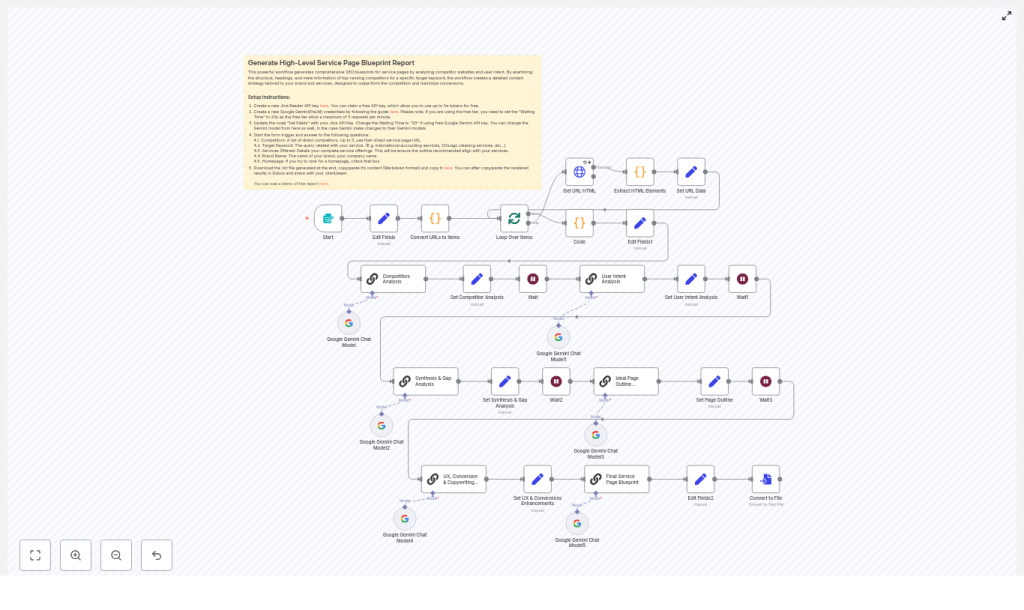
The template is structured as a series of coordinated nodes that handle data collection, transformation, and analysis. At a high level, the workflow includes:
- Input and configuration nodes to capture URLs, brand data, and the target keyword
- HTTP Request or integration nodes to fetch competitor HTML
- Parsing nodes for extracting headings, metadata, and schema
- Code or Function nodes to compute heading n-grams and aggregate patterns
- LLM nodes to run competitor analysis, user intent assessment, synthesis, and outline generation
- Output nodes to format the final blueprint in a form suitable for documentation or direct use
Step-by-Step Execution Flow
1. Input Collection
The workflow begins with an input step where you define the analysis parameters:
- Up to five competitor service page URLs
- The primary target keyword
- A short list of your core services
- Your brand name
This information is typically supplied through a manual trigger, form, or n8n UI input node. These variables are stored and passed to subsequent nodes for contextual analysis.
2. Fetching and Parsing Competitor Pages
Next, the workflow retrieves each competitor URL and processes the raw HTML. Using a web text extraction service such as Jina Reader, it isolates the key on-page elements required for SEO analysis:
- Headings (H1 through H6) in their original order
- Meta title and meta description tags
- JSON-LD or other schema markup blocks
- Other recurring structural elements relevant to service pages
This parsing step transforms unstructured HTML into structured data that can be evaluated programmatically and by the LLM.
3. Heading N-gram Computation
Once headings are extracted, a processing step computes frequent 2-word, 3-word, and 4-word sequences. These heading n-grams highlight:
- Concepts and phrases that competitors repeatedly emphasize
- Topical clusters that signal relevance to the target keyword
- Patterns that can inform your own heading and section naming strategy
This quantitative layer complements the qualitative LLM analysis that follows.
4. Competitor Analysis Report via LLM
The workflow then passes the structured competitor data and n-gram results to an LLM node. The model acts as an automated SEO analyst and produces a structured report covering:
- Meta title and description patterns, including CTA styles and positioning
- Common outline sections such as process, pricing, FAQs, and guarantees
- The most prominent heading concepts derived from the n-gram analysis
- Typical content depth, structure, and the presence of trust-building elements
This report is formatted so that it can be reused in later synthesis steps and easily interpreted by humans.
5. User Intent Analysis for the Target Keyword
Independently of the competitor review, the workflow prompts the LLM to analyze the target keyword itself. The model is instructed to determine:
- Primary and secondary search intent types
- Likely searcher personas and buying stage
- Information, proof, and UX elements a user expects on a satisfying page
This ensures that the final blueprint is not purely competitor-driven but also grounded in explicit user intent.
6. Synthesis and Gap Analysis
The next node combines the competitor report with the user intent analysis. The LLM is directed to identify and classify:
- Table stakes: Topics and sections that are both expected by users and consistently covered by competitors
- Gaps: Clear user needs or questions that competitors do not fully address
- Priority keywords and semantic themes: Concepts that should be emphasized within headings and body copy
This synthesis step is where the workflow moves from raw data to strategic recommendations.
7. Generation of the Ideal Page Outline
Using the synthesized insights, the LLM generates a complete hierarchical outline for your service page. The output typically includes:
- A recommended H1 that aligns with the target keyword and user intent
- H2 sections that map to major user concerns and decision points
- H3 and H4 subheadings that organize supporting details and proof
The outline is structured to place high-impact information and persuasive elements in an order that supports both SEO and conversion goals.
8. UX, Copy, and Conversion Recommendations
Finally, the workflow produces a set of actionable UX and copy guidelines tailored to the target query, including:
- CTA messaging, placement, and frequency
- Trust signals such as testimonials, case studies, certifications, and logos
- Risk reversal mechanisms, for example guarantees or free consultations
- Tone of voice guidelines and readability rules
- Visual or layout suggestions that support clarity and scannability
This output can be exported, documented, or directly shared with stakeholders responsible for implementing the page.
Applying the Blueprint in Practice
Once the workflow has generated your service page blueprint, the implementation process typically follows these steps:
- Validate table stakes: Confirm that every essential section identified by the workflow is present in your page plan and covered concisely.
- Adopt the outline: Use the suggested H1 and H2 headings where appropriate. They are designed to align with both search intent and competitive norms.
- Implement UX guidance: Place primary CTAs above the fold, and introduce secondary CTAs after key proof points, pricing sections, or case studies.
- Integrate trust elements: Add case studies, client logos, testimonials, and guarantees in locations where they address the main objections and risks perceived by the user.
- Measure and iterate: Monitor traffic, rankings, click-through rate, time on page, and conversion rate. Feed learnings back into the workflow and refine as needed.
Best Practices for Service Page SEO and UX
- Keep copy clear and scannable with short paragraphs, descriptive headings, and bullet lists.
- Use keywords naturally in headings without over-optimization. Prioritize clarity and benefits to the user.
- Implement schema markup such as FAQ, Service, and LocalBusiness where relevant to enhance SERP visibility and eligibility for rich results.
- Address objections proactively through sections like “Why Choose Us” or “Common Questions” that speak directly to decision friction.
- Track engagement metrics such as CTR, scroll depth, time on page, and conversion rate to validate improvements and guide further optimization.
Example Scenario: Local Service Optimization
Consider a business targeting the query “commercial cleaning services Chicago”. When you run this workflow with relevant competitor URLs, the analysis may reveal that leading pages consistently highlight:
- Pricing tiers for different service levels
- Detailed service area coverage within the Chicago region
- Health and safety protocols, for example COVID-safe procedures
The synthesis might also uncover gaps such as the absence of transparent pricing calculators or a lack of concise, quantified case studies. The resulting blueprint could therefore recommend:
- A simple pricing calculator to provide upfront cost expectations
- A visual map or clear description of neighborhoods and districts served
- Short case studies with measurable outcomes, such as reduced complaints or improved cleanliness scores
- A strong satisfaction guarantee or similar risk reversal aimed at price-sensitive commercial buyers
This illustrates how the workflow converts raw competitive and intent data into a differentiated, conversion-focused page plan.
Conclusion and Next Steps
This competitor-driven SEO blueprint workflow for service pages gives teams a structured, repeatable way to design pages that both rank and convert. By combining automated data extraction, n-gram analysis, and LLM-driven synthesis within n8n, it reduces guesswork and provides a single source of truth for strategists, writers, and designers.
If you want to standardize high-performing service page creation, you can deploy this workflow in your n8n environment, adapt it to your stack, and use the outputs as the foundation for every new or redesigned service page.
