Automate LinkedIn Job Data Scraping to Google Sheets

Automate LinkedIn Job Data Scraping to Google Sheets with n8n and Bright Data

Overview

This n8n workflow template automates the full pipeline of collecting live LinkedIn job postings, transforming the data, and persisting it into Google Sheets. It uses Bright Data’s Dataset API to extract active job listings based on user-defined filters, then cleans and normalizes the response before appending structured records into a Google Sheets template.

The automation is suitable for technical users, recruiters, sales teams, and growth professionals who need a repeatable, parameterized way to query LinkedIn jobs by location, keyword, and other filters, then work with the results in a spreadsheet for analysis or outreach.

Workflow Architecture

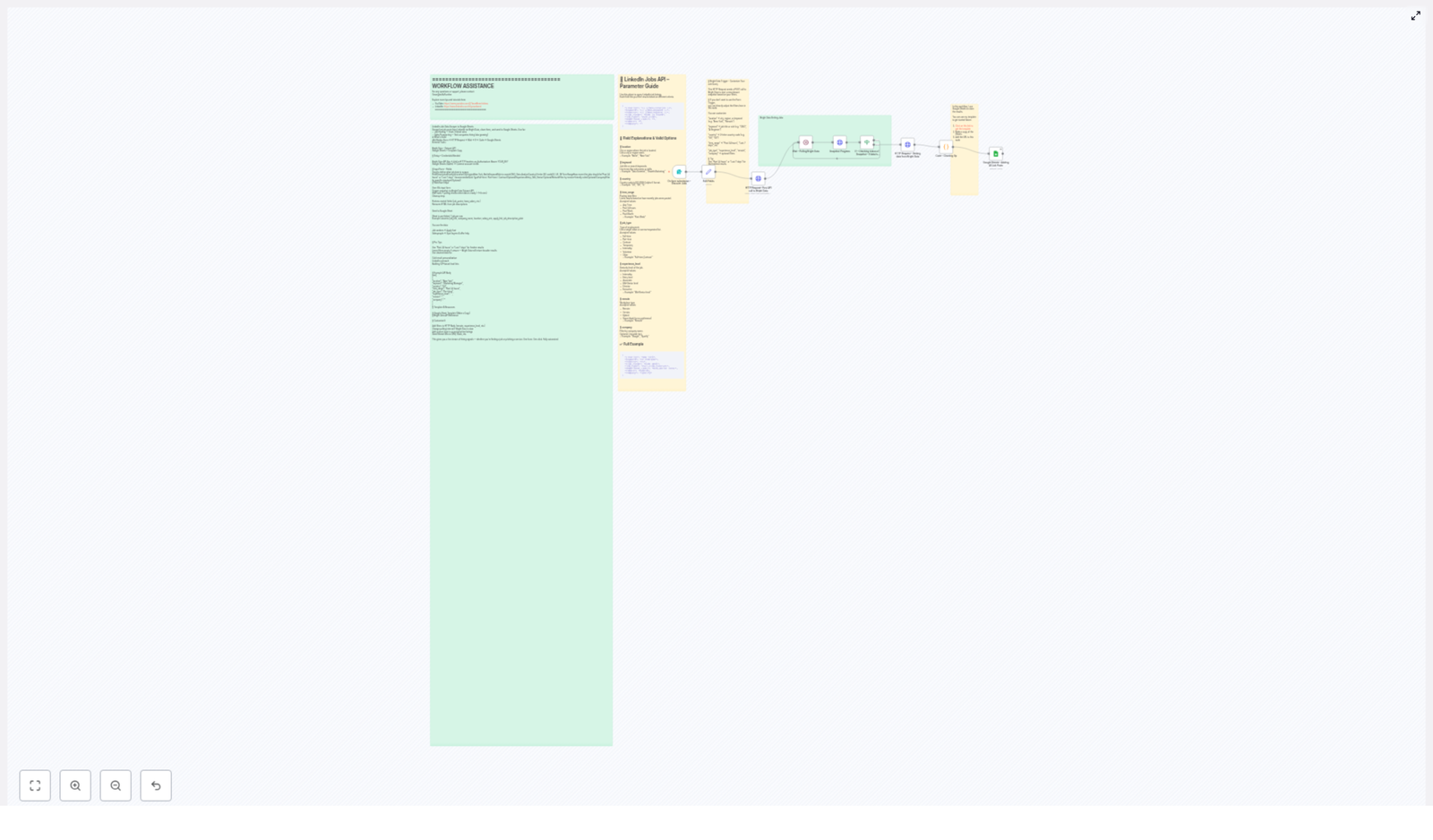
At a high level, the workflow follows this sequence:

  1. Form Trigger collects search parameters from the user.
  2. HTTP Request node sends those parameters to Bright Data to initiate a LinkedIn jobs snapshot.
  3. Wait and If nodes implement a polling loop until the snapshot is ready.
  4. HTTP Request node retrieves the completed dataset from Bright Data.
  5. Code node cleans, flattens, and normalizes the job records.
  6. Google Sheets node appends the cleaned data to a predefined spreadsheet template.

Primary Components

  • n8n Nodes: Form Trigger, HTTP Request, Wait, If, Code, Google Sheets
  • External Services:
    • Bright Data Dataset API for LinkedIn job snapshots
    • Google Sheets Template for structured storage and analysis

Node-by-Node Breakdown

1. Form Trigger – Collecting User Input

The workflow begins with a Form Trigger node. This node exposes a web form where users define the parameters of the LinkedIn job search. The form acts as the primary input layer for the automation and controls what Bright Data will scrape.

Required Form Fields

  • Location: City or region to target (for example, “Berlin”, “San Francisco Bay Area”).
  • Keyword: Search term such as job title or core skill (for example, “Data Engineer”, “Salesforce”).
  • Country Code: ISO format country code (for example, “US”, “DE”, “GB”).

Optional Filters

The form can also expose optional inputs that map directly to Bright Data’s LinkedIn jobs filters:

  • Time range (for example, “Past 24 hours”, “Last 7 days”) to restrict results to recently posted jobs.
  • Job type (for example, full-time, part-time, contract, internship).
  • Experience level (for example, entry-level, mid-senior, director).
  • Remote flag to distinguish between on-site, hybrid, and remote roles.
  • Company name to focus the search on specific employers.

If optional fields are left blank, the workflow passes more general search criteria to Bright Data, resulting in a broader dataset.

2. HTTP Request – Triggering a Bright Data Snapshot

The next step is an HTTP Request node configured with a POST method. This node sends the form inputs to the Bright Data Dataset API to start a LinkedIn jobs snapshot.

Key Configuration Points

  • Method: POST
  • URL: Bright Data Dataset API endpoint for LinkedIn jobs snapshots.
  • Authentication: Bright Data API credentials configured in n8n (API key or token).
  • Body:
    • Includes fields such as location, keyword, country, and any optional filters provided by the user.
    • Maps form fields to the Bright Data LinkedIn jobs schema.

The Bright Data API responds with metadata for the snapshot request. Most importantly, it returns an identifier or reference that is later used to poll for completion and retrieve the dataset once it is ready.

3. Wait & If – Polling for Snapshot Completion

Bright Data does not return the final dataset immediately. Instead, it creates a snapshot job that typically completes in 1 to 3 minutes. To handle this asynchronous process, the workflow uses a combination of:

  • Wait node to pause execution for a defined interval.
  • If node to check whether the snapshot is ready.

Polling Logic

  1. The workflow waits for a short time window (for example, 30 to 60 seconds) using the Wait node.
  2. After the wait period, an HTTP Request node (configured with GET) checks the snapshot status using the identifier returned in step 2.
  3. An If node evaluates the status field in the response:
    • If status indicates completed, the workflow proceeds to data retrieval.
    • If status indicates pending or processing, execution loops back through another Wait period and status check.

Edge Cases & Practical Notes

  • In normal conditions, the snapshot completes within 1 to 3 minutes. If Bright Data takes longer, the polling loop continues until the completion condition is met.
  • You can adjust the Wait interval and maximum number of polling attempts in n8n to balance responsiveness with API usage.
  • If the API returns an error status, the workflow can be configured to fail, send a notification, or branch into a custom error-handling path (for example, logging or alerting), depending on your n8n setup.

4. HTTP Request – Retrieving and Cleaning the Dataset

Once the snapshot is marked as complete, another HTTP Request node is used to fetch the actual job data.

Data Retrieval

  • Method: GET
  • URL: Bright Data dataset URL for the completed snapshot.
  • Authentication: Same Bright Data credentials as the initial POST request.

The response contains the raw LinkedIn job postings, often with nested structures and HTML content that are not directly suitable for spreadsheet usage.

Code Node – Data Cleaning & Normalization

A Code node processes the retrieved records and prepares them for Google Sheets. The logic typically includes:

  • Flattening nested properties so that multi-level JSON fields become simple key-value pairs.
  • Removing HTML tags from job descriptions and other text fields to improve readability.
  • Normalizing field names and formats so that each job record matches the Google Sheets column structure.

Common transformations might include:

  • Extracting text-only job descriptions from HTML content.
  • Converting nested company or location objects into simple strings.
  • Ensuring that URLs, salary information, and application links are in consistent formats.

The output of the Code node is a clean, uniform array of job records, each ready to be appended as a row in the spreadsheet.

5. Google Sheets Node – Persisting Data

The final step uses the Google Sheets node to append the cleaned job data to a pre-configured spreadsheet template.

Google Sheets Configuration

  • Authentication: Google Sheets credentials set up in n8n.
  • Mode: Append mode to add new rows at the bottom of the sheet.
  • Spreadsheet: The provided Google Sheets template (see link below) or a custom sheet with the same column structure.
  • Columns (typical fields):
    • Job title
    • Company
    • Location
    • Salary (if available)
    • Application link
    • Additional metadata from Bright Data, as mapped in the Code node

Each cleaned job listing becomes a single row in the sheet. Over time, the sheet accumulates a structured history of LinkedIn job postings that match your search criteria.

LinkedIn Jobs API Field Reference (via Bright Data)

The workflow relies on Bright Data’s LinkedIn jobs dataset, which supports several key filter parameters. These are mapped from the form input to the API request body.

Core Filter Fields

  • location – City or region where the job is based.
  • keyword – Primary search term, typically a job title or skill.
  • country – ISO format country code (for example, US, DE).

Additional Filter Fields

  • time_range – Time window for when jobs were posted (for example, “Past 24 hours”, “Last 7 days”).
  • job_type – Nature of employment (for example, full-time, part-time, contract).
  • experience_level – Seniority level (for example, entry-level, associate, mid-senior).
  • remote – Remote work setting, depending on Bright Data’s schema (for example, remote only vs on-site).
  • company – Specific company name to narrow the results.

By combining these filters, you can tightly tailor the dataset to your use case, whether that is focused job hunting, competitive intelligence, or identifying hiring signals for sales outreach.

Use Cases & Benefits

  • Real-time hiring insights – Continuously capture fresh job postings that match your criteria.
  • Prospecting lists – Identify companies that are actively hiring and build targeted lead lists.
  • Outreach personalization – Use job details such as role, location, and requirements to craft highly relevant cold emails or LinkedIn messages.
  • Automated lead generation – Convert hiring activity into sales signals without manual research.

Configuration Tips & Best Practices

Filtering Strategy

  • Use time filters like “Past 24 hours” or “Last 7 days” to keep the dataset focused on the most recent opportunities.
  • Leave optional filters blank if you want to run broader discovery queries and then refine later in Google Sheets.
  • Combine keyword with location and country for more relevant and geographically consistent results.

Data Quality & Outreach

  • Leverage the cleaned job descriptions and company fields to segment your sheet by industry, seniority, or tech stack.
  • Personalize outreach messages using specific role requirements and responsibilities extracted from the job data.

Operational Considerations

  • Monitor Bright Data API usage and rate limits when running the workflow frequently or at scale.
  • Consider scheduling the workflow in n8n (for example, daily or hourly) around your prospecting or job search cadence.
  • Handle potential API errors or timeouts by configuring n8n error workflows or notifications, especially in production scenarios.

Getting Started

To implement this automated LinkedIn job scraping pipeline:

  1. Import the n8n workflow template linked below.
  2. Configure your Bright Data credentials in the HTTP Request nodes.
  3. Set up your Google Sheets credentials and connect the Google Sheets node to the provided template or your own copy.
  4. Adjust the form fields, filters, and Code node mappings as needed for your specific use case.

Use this Google Sheets template as a starting point and adapt the columns to your data model:

Get the Google Sheets Template

Advanced Customization

More advanced users can extend or adapt the workflow in several ways:

  • Additional processing nodes – Insert extra Code or Function nodes to enrich data, categorize roles, or score leads.
  • Multi-destination outputs – In addition to Google Sheets, send the cleaned data to CRMs, databases, or messaging tools.
  • Conditional branching – Use If nodes to route different job types or seniority levels into separate sheets or pipelines.
  • Notification hooks – Add email, Slack, or other notification nodes to alert you when new high-priority roles appear.

Support & Further Learning

If you need help configuring or extending this n8n workflow, you can reach out directly:

Email: Yaron@nofluff.online
Tutorials and walkthroughs: YouTube | LinkedIn

Template Access

Load the ready-made n8n template to accelerate setup and adapt it to your environment:

Summary

This n8n workflow, powered by Bright Data’s LinkedIn jobs dataset and integrated with Google Sheets, delivers a continuous, filterable stream of live job postings. By automating scraping, cleaning, and storage, it reduces manual research and provides a reliable foundation for job search, recruiting, and sales prospecting workflows with minimal ongoing effort.
How to Sync Bubble Objects with n8n Automation

From Manual Busywork to Confident Automation

If you are building on Bubble.io, you already know how quickly small tasks can pile up. Creating records, updating fields, checking that everything is in sync – it all adds up. Every manual step steals a bit of focus from what really matters: growing your product, serving your users, and shipping features that move the needle.

Automation with n8n gives you a different path. Instead of reacting to tasks one by one, you can design a system that does the work for you. The workflow template in this article is a simple example, yet it represents something bigger: a repeatable way to sync Bubble objects automatically, so you can reclaim time, reduce errors, and build a more scalable foundation for your app.

We will walk through how to sync Bubble objects with n8n, not just as a technical tutorial, but as a small but powerful step toward a more automated, focused way of working.

Imagining a Better Workflow with n8n and Bubble

Imagine this: a new request comes into your system. Instead of logging into Bubble, manually creating an object, updating it, then checking if everything is correct, an automated workflow quietly handles it all in the background. Your Bubble app stays in sync, your data stays consistent, and you stay focused on the bigger picture.

That is exactly what this n8n workflow template helps you do. It connects Bubble.io with n8n using webhooks and Bubble’s API so that objects are created, updated, and retrieved automatically. You can start simple, then expand and customize it as your needs grow.

This is not just a one-off trick. It is a reusable pattern you can copy, adapt, and build on to automate more and more of your Bubble operations.

What This n8n – Bubble Workflow Does

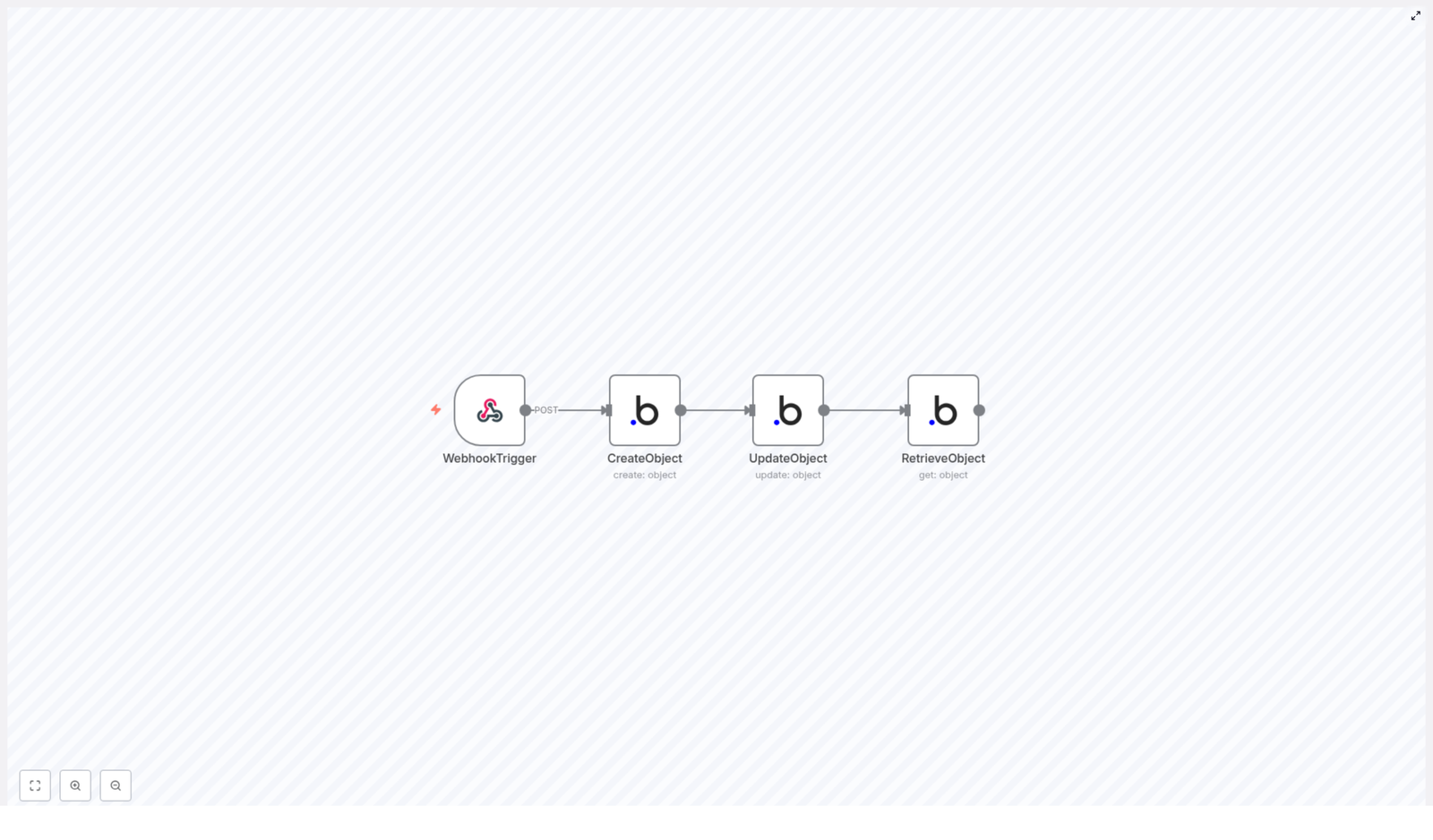
The template is built around a clear and practical flow for synchronizing Bubble objects of type Doc. It consists of four core nodes that work together to handle the full lifecycle of a single object:

  • Webhook Trigger – Listens for an incoming HTTP POST request and starts the workflow.
  • Create Object – Creates a new Bubble object of type Doc with an initial property.
  • Update Object – Updates the Name field of the object that was just created.
  • Retrieve Object – Fetches the updated object from Bubble so you can verify and use the final data.

On the surface, it is a simple create-update-retrieve sequence. In practice, it is a template you can extend to handle more complex logic, additional fields, and other object types as your automation skills grow.

The Journey: From Trigger to Synced Bubble Object

1. Starting the Flow with a Webhook Trigger

Every great automation needs a clear starting point. In this template, that starting point is an n8n Webhook node. It is configured to listen for a POST request at the path /bubble-webhook.

Whenever your system, another app, or even a testing tool sends data to this URL, n8n wakes up and runs the workflow. That means you can connect this trigger to forms, external services, internal tools, or any part of your stack that can send an HTTP request.

This is the moment where you move from manual action to automated response. Instead of you reacting, your workflow reacts for you.

2. Creating a Bubble Object of Type Doc

Once the webhook fires, the next step is to create a Bubble object. The workflow uses the Bubble node in n8n to send a request to Bubble’s API and create a new record in the Doc data type.

In this template, the Name property is initially set to "Bubble". This is just a starting value, but it shows how you can pass structured data into Bubble automatically, without opening the Bubble editor or clicking through the UI.

As soon as this node runs, Bubble returns an object ID. That ID is critical, because it becomes the link between the object you just created and the updates you will apply next.

3. Updating the Newly Created Bubble Object

Automation really starts to shine when steps build on each other. Immediately after the object is created, the workflow uses the returned object ID to update the same record.

The Update Object step modifies the Name property from "Bubble" to "Bubble node". This demonstrates a powerful pattern you can reuse:

  • Create a Bubble object.
  • Capture the ID in n8n.
  • Use that ID to apply further changes or logic.

You can extend this idea to update multiple fields, apply conditional logic, or sync data from other services, all driven by the same object ID.

4. Retrieving the Updated Object for Verification and Use

The final step in this journey is to make sure everything worked as expected. The workflow uses another Bubble node to retrieve the updated object using the same ID.

This retrieval confirms that the Name field was successfully updated and gives you access to the final version of the data. From here, you can:

  • Log the result for debugging or analytics.
  • Send the data to another app or database.
  • Trigger additional workflows based on the updated object.

With this final step, you close the loop. A single POST request leads to a fully automated create-update-retrieve cycle in Bubble, all handled by n8n.

Why This Integration Matters for Your Growth

At first glance, this workflow might look small. Yet, it represents a powerful shift in how you build and operate your Bubble app. By automating object sync with n8n, you unlock several key benefits:

  • Automation – Bubble and n8n work together to handle object creation, updates, and retrieval without manual intervention. Your app becomes more responsive and more reliable.
  • Efficiency – Chaining actions in a single workflow reduces repetitive tasks and minimizes human error. You save time and mental energy that can be invested in strategy and innovation.
  • Scalability – The same pattern can be adapted to different Bubble data types, more properties, and more complex logic as your app grows. You are building a foundation that can scale with your business.

Every automated workflow like this frees up a little more space for creative work, better user experiences, and faster iteration.

Using the Template: A Practical Starting Point

This n8n workflow template is designed to be easy to adopt, even if you are just beginning your automation journey. Here is how to start using it in your own environment:

  1. Import the JSON workflow into your n8n instance. This gives you the complete sequence of nodes that handle the webhook, object creation, update, and retrieval.
  2. Configure your Bubble API credentials in n8n so that the Bubble nodes can connect to your Bubble application securely. Make sure your API keys and app URL are correct.
  3. Deploy the webhook and send a test POST request to /bubble-webhook. You can use tools like Postman, curl, or another app to trigger the workflow.
  4. Monitor the execution inside n8n to verify each step. Confirm that the object is created in Bubble, the Name property is updated from "Bubble" to "Bubble node", and the final retrieval returns the updated object.

Once everything runs smoothly, you have a working automation that you can trust. From there, you can start iterating and improving.

Taking It Further: Experiment, Adapt, and Grow

This template is not the finish line, it is the starting point. Here are a few ideas for how you can expand on it:

  • Add more fields to the Doc object and map them from your webhook payload.
  • Apply conditional logic in n8n to decide when to create, update, or skip an object.
  • Connect additional services so that Bubble objects sync with CRMs, email tools, or analytics platforms.
  • Reuse the same pattern for other Bubble data types, turning this into a standard way you sync data across your stack.

Each small improvement compounds over time. As you experiment with templates like this, you build confidence, speed, and a more automated business or product.

Start Your Next Automation Step Today

If you are ready to move beyond manual Bubble operations, this workflow template is a simple, practical step forward. It shows how n8n and Bubble can work together to keep your objects in sync, reduce repetitive tasks, and give you more time to focus on what matters most.

Import the template, connect your Bubble app, and watch your first fully automated object sync come to life. Then, keep going. Use this as a foundation to design more workflows, automate more processes, and build a more powerful, scalable system around your Bubble application.

Maritime Vessel Tracking with AIS API & Automated Alerts

Maritime Vessel Tracking with AIS API & Automated Alerts

From Constant Monitoring To Calm Control

If you are responsible for vessels, cargo, or maritime operations, you already know how much energy goes into simply keeping an eye on what is happening at sea. Refreshing dashboards, checking speeds, watching for anomalies, and making sure the right people hear about issues in time can quietly consume hours of focus every week.

Now imagine a different reality. Instead of chasing data, you receive clear, timely alerts. Instead of manually checking vessel status, you rely on a workflow that does it for you every minute, without fail. Your time is freed up for higher level decisions, planning, and growth.

This is where an automated n8n workflow built around AIS vessel tracking, AWS SQS, and Slack alerts becomes more than just a technical setup. It becomes a foundation for a calmer, more focused way of working.

Shifting Your Mindset: Let Automation Watch The Water

Modern AIS APIs give you real-time access to vessel positions, speeds, and courses. The data is already there, updating constantly. The real opportunity is in how you choose to use it.

Instead of treating vessel tracking as a task you must constantly perform, you can treat it as a process that runs on its own. Your role then becomes designing the rules, deciding what matters, and letting automation handle the repetitive work.

The n8n workflow template described here is a practical example of this mindset. It checks vessel data every minute, evaluates conditions like abnormal speed, and routes information to the right place automatically. Once it is running, you gain a reliable digital assistant that never gets tired, never forgets, and never misses a minute.

What This n8n AIS Workflow Helps You Achieve

This workflow is designed to:

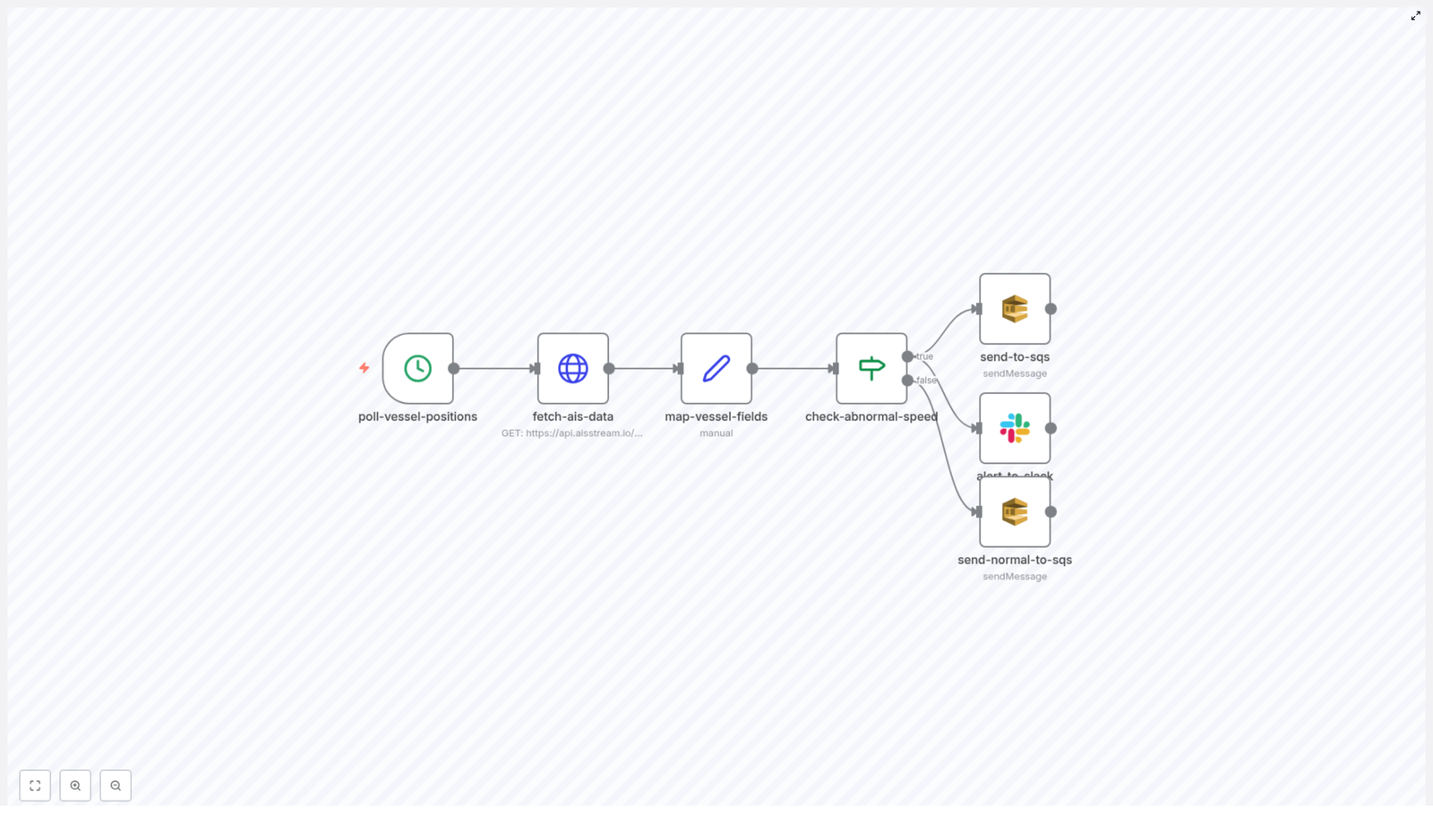
  • Continuously poll AIS vessel data in real time
  • Detect abnormal speed (over 25 knots) automatically
  • Send alerts to Slack when something looks off
  • Route data into AWS SQS queues for scalable processing and logging

It is a simple, focused setup, yet it opens the door to much more. Once you have this running, you can extend it with additional checks, analytics, or integrations. It becomes a stepping stone to a more automated maritime operations stack.

The Journey Of The Workflow: From Data To Decision

Let us walk through the path your data takes in this n8n automation. Understanding this flow will help you adapt, customize, and build on top of it with confidence.

1. A Cron Trigger That Never Sleeps

The workflow begins with a Cron node configured to run every minute. This is your heartbeat. It ensures your system is always up to date with the latest vessel positions and conditions.

Instead of relying on manual refreshes or occasional checks, you gain a predictable, continuous rhythm of data collection. Every minute, the workflow wakes up and moves to the next step.

2. Fetching AIS Data With HTTP Request

Next, an HTTP Request node calls the AIS API endpoint:

https://api.aisstream.io/v0/vessels/367123450

Your API key is passed securely in the request headers for authentication, and the response is returned in JSON format. This response contains detailed AIS information about the vessel, including position and movement data.

At this stage, you have raw power: rich AIS data arriving automatically every minute, ready to be shaped into something meaningful.

3. Mapping Vessel Fields For Clarity

Raw JSON is useful, but not always easy to act on. To turn this data into something clean and focused, the workflow uses a Set node to map and extract only the fields that matter most.

Typical fields you will map include:

  • MMSI
  • Vessel name
  • Latitude
  • Longitude
  • Speed
  • Course
  • Timestamp

This step simplifies downstream logic. Instead of working with a complex response, your workflow now handles a clean, structured set of vessel details that are easy to evaluate, store, and send to other systems.

4. Evaluating Vessel Speed With An If Node

With the key fields mapped, the next step is to check for unusual behavior. An If node evaluates the vessel’s speed. The condition is simple and powerful:

  • If the speed is greater than 25 knots, the vessel is flagged as having abnormal speed.
  • If the speed is 25 knots or below, it is treated as normal movement.

This is where your expertise can grow the workflow. You can keep this threshold as is, or later adjust it based on your own risk tolerance, vessel type, or route conditions. The template gives you a solid starting rule that you can evolve over time.

5. Intelligent Routing: AWS SQS & Slack Alerts

Once the speed check is complete, the workflow branches into two clear paths, each designed to support a different operational need.

Abnormal Speed: Alert & Escalate

If the If node condition is true (speed over 25 knots), the workflow treats this as a potential issue that requires attention:

  • The vessel data is sent to a dedicated AWS SQS queue for abnormal speed events. This lets you process, analyze, or archive these events in a scalable, reliable way.
  • At the same time, the workflow posts a detailed alert message to a Slack channel. Your operations team sees the alert where they already work and communicate, which speeds up awareness and response.

Instead of hoping someone notices an issue in time, you build a system that proactively tells your team when something does not look right.

Normal Speed: Log & Learn

If the condition is false (speed at or below 25 knots), the workflow still treats the data as valuable:

  • The vessel information is sent to a separate AWS SQS queue for regular position logging or any other downstream processing you choose.

Over time, this steady stream of normal data becomes a rich resource for historical analysis, performance tracking, or feeding into other automated workflows and dashboards.

Why This Approach Elevates Your Operations

This n8n AIS automation template is more than just a technical example. It gives you a repeatable pattern for turning raw data into actionable signals.

  • Real-time monitoring – Continuous polling every minute keeps your vessel information fresh and reliable.
  • Automated alerts – High speed or abnormal conditions are detected and surfaced automatically, so you can respond faster.
  • Scalable messaging with AWS SQS – Queues handle both normal and abnormal events, making it easier to scale processing, integrate other systems, or store data long term.
  • Seamless Slack integration – Alerts arrive where your team already collaborates, which keeps everyone aligned without adding extra tools to check.

Most importantly, you gain back time and mental bandwidth. The workflow quietly looks after the repetitive work, while you focus on strategy, safety, and growth.

What You Need To Build Your Own Setup

You can start using this automation with a few core components in place. Each one is straightforward to configure, and together they create a powerful tracking and alerting system.

  • AIS API access with a valid API key from your provider.
  • AWS account with SQS queues configured for:
    • Abnormal speed events
    • Normal position logging or general vessel data
  • Slack workspace with:
    • A dedicated channel for alerts
    • Slack OAuth2 credentials so n8n can post messages on your behalf
  • n8n as your automation platform, where you will:
    • Set up the Cron, HTTP Request, Set, If, AWS SQS, and Slack nodes
    • Configure the AIS API URL and headers
    • Define your speed thresholds and alert text

Once these pieces are in place, the template gives you a ready made workflow that you can import, adapt, and extend.

Using The Template As A Launchpad For Further Automation

Think of this AIS tracking workflow as a starting point, not a finished product. It solves a clear problem: monitoring vessel speed and routing alerts automatically. From here, you can grow it in many directions.

Ideas for next steps include:

  • Adding more conditions, such as geofencing or route deviations
  • Forwarding processed data into dashboards or BI tools
  • Triggering follow up workflows for incident management or reporting
  • Integrating with other maritime systems or internal APIs

Each improvement you make compounds the value of your automation. Over time, you move from single workflows to a connected ecosystem that supports your entire maritime operation.

Start Your Automation Journey Today

Automating maritime vessel tracking with AIS APIs, AWS SQS, and Slack alerts is not just about technology. It is about reclaiming time, reducing stress, and building a more resilient way of working.

Whether you focus on logistics, fleet management, or maritime safety, this n8n workflow template gives you a practical, ready to use path toward smarter monitoring and faster response. From here, every new automation you add becomes easier.

If you are ready to shift from constant checking to confident oversight, start with this AIS API automation workflow and make it your own.

Automate Twitter Sentiment Analysis with n8n Workflow

Automate Twitter Sentiment Analysis with n8n Workflow

Why Bother With Twitter Sentiment In The First Place?

If your brand, product, or project lives on the internet, people are probably talking about it on Twitter. Some of those conversations are glowing, some are not so flattering, and some are pure gold for insights. The tricky part is keeping up without spending hours scrolling your feed.

That is where a Twitter Sentiment ETL workflow in n8n comes in. It quietly runs in the background, pulls in tweets, analyzes how people feel about them, saves everything neatly in your databases, and pings you when something important pops up. No manual checking, no copy-pasting, no “I’ll do it later”.

In this guide, we will walk through a ready-made n8n workflow template that automates Twitter sentiment analysis using MongoDB, PostgreSQL, Google Cloud Natural Language, Slack, and email. We will look at what it does, when to use it, and how each step works so you can confidently tweak it for your own needs.

What This n8n Twitter Sentiment Workflow Actually Does

Let us start with the big picture. Once you plug in your credentials and turn it on, this workflow will:

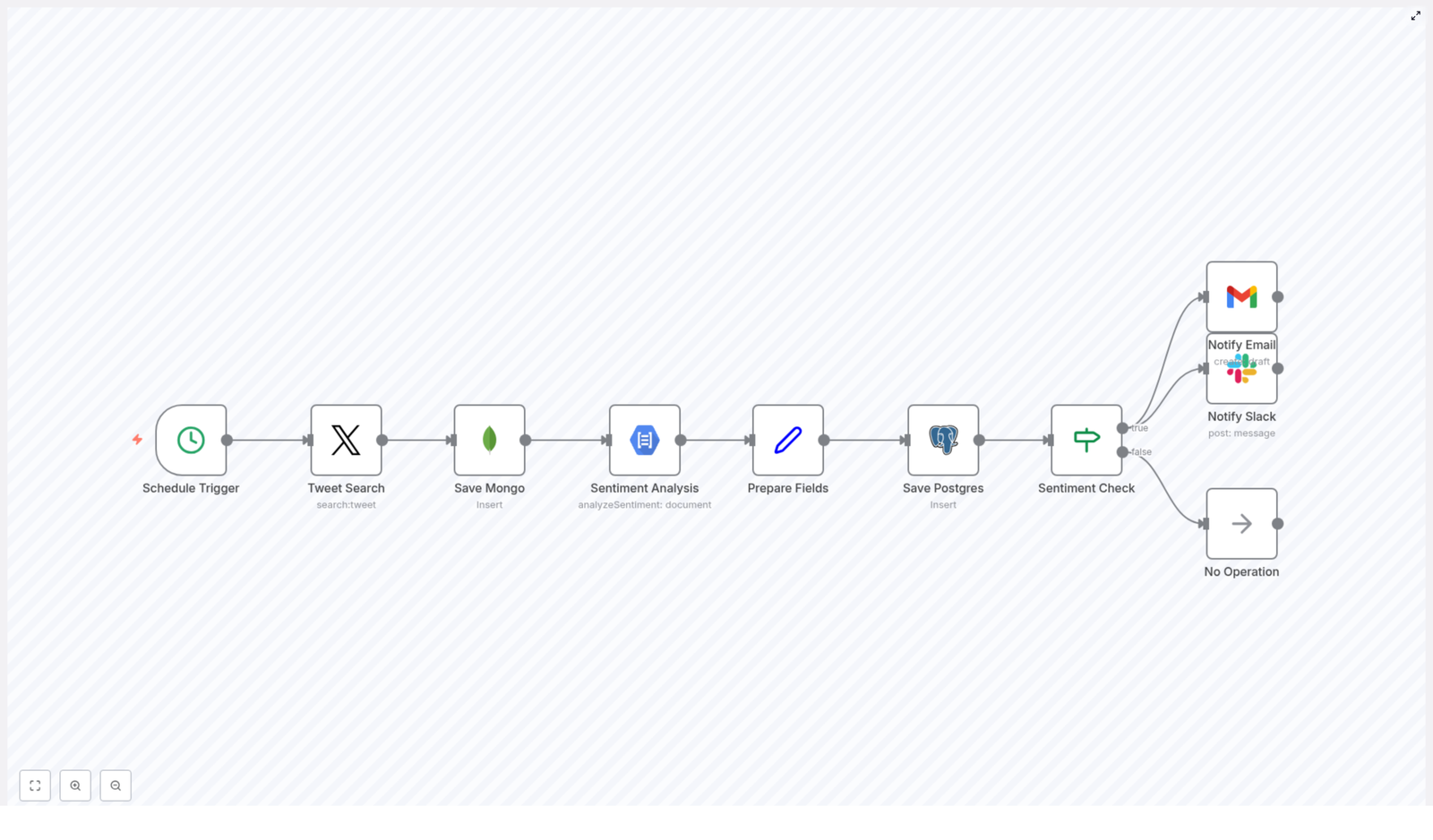
  • Run automatically every morning at a scheduled time.
  • Search Twitter for recent tweets containing the hashtag #OnThisDay.
  • Archive raw tweets in MongoDB for historical reference.
  • Analyze tweet sentiment using Google Cloud Natural Language API.
  • Prepare clean, structured data ready for reporting and dashboards.
  • Store processed sentiment data in PostgreSQL for querying and analysis.
  • Check if the sentiment passes a threshold so you only get alerted when it matters.
  • Send alerts to Slack and email for tweets with notable sentiment.
  • Quietly exit if nothing meets the criteria, so you are not spammed with noise.

In short, it is a neat little ETL pipeline: Extract tweets, Transform them with sentiment analysis, and Load them into databases, with smart notifications on top.

When Should You Use This Workflow?

This template is handy anytime you care about how people feel about something on Twitter and you do not want to monitor it manually. Some great use cases include:

  • Brand reputation monitoring – Keep an eye on how people talk about your company or product.
  • Event sentiment tracking – Track reactions to conferences, campaigns, or special days using a consistent hashtag.
  • Market research – Understand public opinion around topics, competitors, or trends.
  • Real-time alerts for PR teams – Get notified quickly when sentiment spikes up or down so you can respond.

Even though the template uses the #OnThisDay hashtag by default, you can easily adapt it to your own brand or campaign hashtags.

Why Use n8n For Twitter Sentiment Analysis?

You could cobble this together with separate scripts, cron jobs, and custom code, but n8n gives you a few big advantages:

  • Fully automated and scheduled – Once set up, it runs by itself at the time you choose.
  • Visual workflow builder – You can see every step, change nodes, and debug without digging through code.
  • Multiple storage options – Use MongoDB for raw archives and PostgreSQL for structured analytics.
  • Real-time sentiment insights – Google Cloud Natural Language gives you precise sentiment scores and magnitudes.
  • Multi-channel alerts – Notify your team in Slack and via email so no one misses important tweets.
  • Easy to extend – Want to add dashboards, other APIs, or extra filters? Just drop in more nodes.

Step-by-Step: How The Workflow Runs

Let us walk through each node in the workflow so you know exactly what is happening under the hood.

1. Schedule Trigger – Start The Day Automatically

The workflow kicks off with a Schedule Trigger node. It is configured to run every day at 6 AM. That means:

  • No manual start required.
  • Fresh sentiment data every morning.
  • A predictable routine you can plan reporting around.

You can easily adjust the time or frequency in the node settings if you prefer a different schedule.

2. Tweet Search Node – Pull In Relevant Tweets

Next up is the Tweet Search node. Using your Twitter OAuth credentials, it searches for tweets that match a specific query. In this template, it looks for tweets containing the hashtag #OnThisDay.

By default, the node:

  • Fetches up to 3 recent tweets.
  • Filters based on the hashtag #OnThisDay.

That small limit keeps the workflow lightweight and fast, which is perfect for a daily sentiment sample. If you want more coverage, you can simply bump up the limit in the node configuration.

3. Save Mongo – Archive Raw Tweets In MongoDB

Once the tweets are fetched, the workflow passes them into a MongoDB node, often labeled something like Save Mongo.

Here is what this step does:

  • Saves the raw tweet data into a MongoDB collection.
  • Creates a historical archive you can go back to later.
  • Makes debugging easier if you ever want to see the unprocessed tweets.

Think of MongoDB as your long-term, flexible “just in case” storage for the original tweet payloads.

4. Sentiment Analysis – Use Google Cloud Natural Language

Now comes the fun part. A Google Cloud Natural Language node runs sentiment analysis on each tweet text stored in MongoDB.

This node returns two key metrics for each tweet:

  • score – A value between -1.0 and 1.0 that shows how negative or positive the text is.
  • magnitude – A value that reflects how strong or intense the sentiment is, regardless of being positive or negative.

So, for example, a tweet with a high positive score and high magnitude is very enthusiastic, while a negative score with high magnitude might signal a serious complaint or frustration.

5. Prepare Fields – Clean Up Data For Storage

After the sentiment analysis is done, the workflow uses a Set node (often named something like Prepare Fields) to organize the data.

This step:

  • Extracts the sentiment score and magnitude.
  • Grabs the original tweet text.
  • Formats everything into a clean structure that is ready to be stored in a relational database.

It is basically the “tidy up” step, making sure the data is consistent and easy to work with later.

6. Save Postgres – Store Processed Data In PostgreSQL

Next, the workflow inserts the prepared data into a PostgreSQL table, typically named tweets.

This table stores at least:

  • The tweet text.
  • The sentiment score.
  • The sentiment magnitude.

Why PostgreSQL? Because it is great for:

  • Running advanced SQL queries.
  • Building reports and dashboards.
  • Joining sentiment data with other business data you might already have in Postgres.

7. Sentiment Check – Decide If An Alert Is Needed

With everything stored, the workflow uses an If node to decide what happens next. This is your simple but powerful filter.

The node checks whether the sentiment score is greater than 0, which means:

  • Score > 0 – The tweet is considered positive or at least more positive than negative.
  • Score ≤ 0 – The tweet is neutral or negative.

You can adjust this threshold if you want to only alert on strongly positive tweets or even flip the logic to focus on negative sentiment instead.

8. Notify Slack & Email – Alert The Right People

If the sentiment passes the threshold (score > 0 in this template), the workflow branches into two notification paths:

  • Slack Notification
    • A Slack node posts a message to a channel named tweets.
    • The message includes the tweet text and its sentiment score.
    • Your team can see positive mentions right in Slack without checking any dashboards.
  • Email Notification
    • An Email node sends an alert to alerts@example.com.
    • The email contains the tweet details plus the sentiment metrics.
    • Perfect for people who prefer email over Slack or for archiving alerts.

9. No Operation – Quietly Finish When Nothing Matches

If the sentiment score does not meet the threshold, the workflow reaches a No Operation node. This node simply ends the run without doing anything else.

The benefit is simple: you are not flooded with alerts for every neutral or negative tweet. Only the tweets that match your criteria trigger Slack or email notifications.

Putting It All Together: A Simple, Powerful ETL Pipeline

So to recap, here is what this n8n Twitter Sentiment ETL workflow gives you out of the box:

  • Automated daily schedule so you never forget to check Twitter.
  • Integration with Twitter, MongoDB, PostgreSQL, Google Cloud NLP, Slack, and email.
  • Raw data archive in MongoDB for historical and debugging purposes.
  • Structured sentiment dataset in PostgreSQL for analysis, reporting, and dashboards.
  • Smart alerts only when sentiment crosses your defined threshold.
  • Flexibility to customize hashtags, thresholds, channels, and schedule as your needs evolve.

Ready To Try It Yourself?

If you have been thinking about automating your social media monitoring, this workflow template is a great place to start. You get a complete, working pipeline that you can adapt to your own hashtags, brands, or events without writing everything from scratch.

Want to see it in action? Load the template in n8n, plug in your credentials, and let it handle the daily sentiment checks for you.

Automate Reports: N8N JSON-to-HTML Workflow

Automate Reports: N8N JSON-to-HTML Workflow

Ever spent your afternoon copy-pasting data from JSON into a “nice looking” report, only to realize you still have 7 more to go and your coffee is already cold? This n8n JSON-to-HTML workflow is here to save your sanity, your time, and possibly your keyboard.

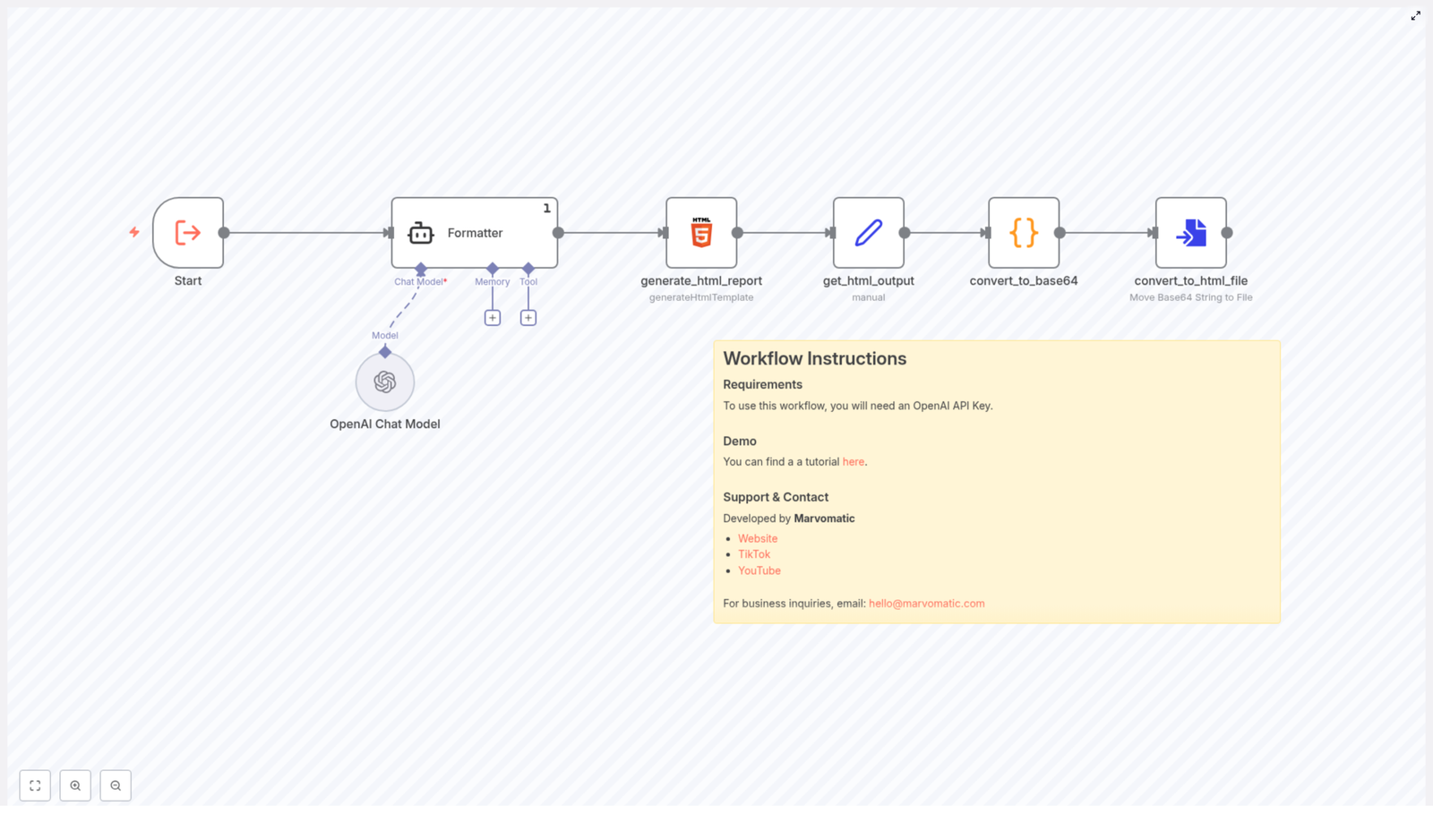
In this guide, we will walk through what this workflow does, how it helps you turn raw JSON into polished HTML reports, and how to get everything running with minimal effort. You bring the data, n8n and OpenAI handle the formatting.

What This n8n JSON-to-HTML Workflow Actually Does

At its core, this workflow takes structured JSON data and transforms it into a clean, readable HTML report. No more manual formatting, no more fiddling with tags, and no more “why is this list suddenly a giant paragraph” moments.

Here is the basic idea:

  • You feed the workflow JSON data (for example, analytics, summaries, logs, or reports).
  • n8n processes that data and uses OpenAI to help generate well-structured, human-friendly content.
  • The workflow converts everything into HTML so you can easily display it on a web page, email it, or store it as a report.

The result is a repeatable, automated reporting system that runs in the background while you focus on more interesting things than formatting bullet points.

Why Automate JSON-to-HTML Reports With n8n?

Manually turning JSON into something readable is the digital equivalent of sorting rice grains by hand. Technically possible, deeply unfun.

This workflow helps you:

  • Save time by generating reports automatically from your existing data sources.
  • Stay consistent with the same structure and style every time.
  • Reduce errors that creep in when you copy, paste, and format by hand.
  • Scale easily if you need to generate many reports, not just one or two.

If you are already using n8n for automation, this template plugs right into your workflow and turns reporting from a chore into something you barely think about.

What You Need Before You Start

Good news, the requirements list is short and painless:

Required

To use this workflow, you will need:

  • An OpenAI API Key so the workflow can use OpenAI to help generate and format the content.

That is it. Once your OpenAI API key is ready, you are set to plug it into the template and start automating.

Quick Setup Guide: From JSON to HTML in n8n

Let us walk through how to get this JSON-to-HTML workflow template up and running in n8n. No advanced wizardry required.

1. Open the n8n Workflow Template

Start by opening the ready-made template:

View the n8n JSON-to-HTML template

This template is preconfigured so you do not have to build everything from scratch. You simply customize it for your data and use case.

2. Add Your OpenAI API Key

Inside n8n, create or select your OpenAI credentials and paste in your OpenAI API Key. The workflow uses this key to call OpenAI and help generate structured, readable report content from your JSON data.

3. Connect Your JSON Data Source

Next, plug your JSON data into the workflow. This might come from:

  • Another n8n node that fetches data from an API
  • A database query that returns JSON
  • A file, webhook, or any other source you already use in n8n

The workflow will use this JSON as the raw material for your HTML report.

4. Generate the HTML Report

Once your data and OpenAI credentials are set, run the workflow. n8n and OpenAI will:

  • Interpret and organize your JSON data
  • Generate structured content using OpenAI
  • Convert that content into a clean HTML report

You can then send this HTML via email, store it, display it in a dashboard, or pipe it into any other part of your automation.

See It in Action: Video Demo

Prefer watching instead of reading? There is a tutorial that walks you through the process step by step.

Check out the demo on YouTube: Marvomatic YouTube Channel

It is a great way to see how the n8n JSON-to-HTML workflow behaves with real data and how you can adapt it to your own setup.

Tips, Ideas, and Next Steps

Once you have the basic JSON-to-HTML automation running, you can start getting creative with it.

Ways You Might Use This Workflow

  • Automatically generate daily, weekly, or monthly performance reports.
  • Turn API responses into readable summaries for clients or teammates.
  • Create internal dashboards that pull HTML reports from your data pipelines.
  • Send formatted HTML reports via email using other n8n nodes.

Make Your Reports Even Better

  • Tweak the prompts or settings used with OpenAI to match your brand voice or preferred style.
  • Add extra nodes in n8n to filter, sort, or enrich your JSON before it becomes HTML.
  • Combine this workflow with scheduling triggers so reports arrive automatically at set times.

The more you automate, the fewer repetitive tasks you have to do by hand, and the more your future self will thank you.

Support, Contact, and Creator Info

This JSON-to-HTML workflow template is developed by Marvomatic.

You can find more resources, content, and automation ideas here:

For business inquiries or collaboration ideas, feel free to reach out via email: hello@marvomatic.com

Automate Custom Presentation Creation from CSV Leads

Automate Custom Presentation Creation from CSV Leads

What You Will Learn

In this guide, you will learn how to use an n8n workflow template to automatically turn new CSV or XLSX lead lists into personalized Google Slides presentations. By the end, you will understand how the workflow:

  • Detects new lead files in Google Drive
  • Reads and structures lead data in Google Sheets
  • Creates a new presentation from a Google Slides template for each lead
  • Replaces placeholders with real lead data
  • Links each lead to its presentation inside a Google Sheet

This is ideal for sales teams that receive lead lists regularly and want to automate the creation of custom sales decks without manual copy-paste work.

Concept Overview: How the n8n Workflow Works

Before jumping into the step-by-step breakdown, it helps to understand the main building blocks of this n8n automation. The workflow connects three main Google services:

  • Google Drive – to detect and manage incoming CSV or XLSX lead files
  • Google Sheets – to store and organize lead data in a tabular format
  • Google Slides – to generate and customize presentations automatically

At a high level, the workflow follows this sequence:

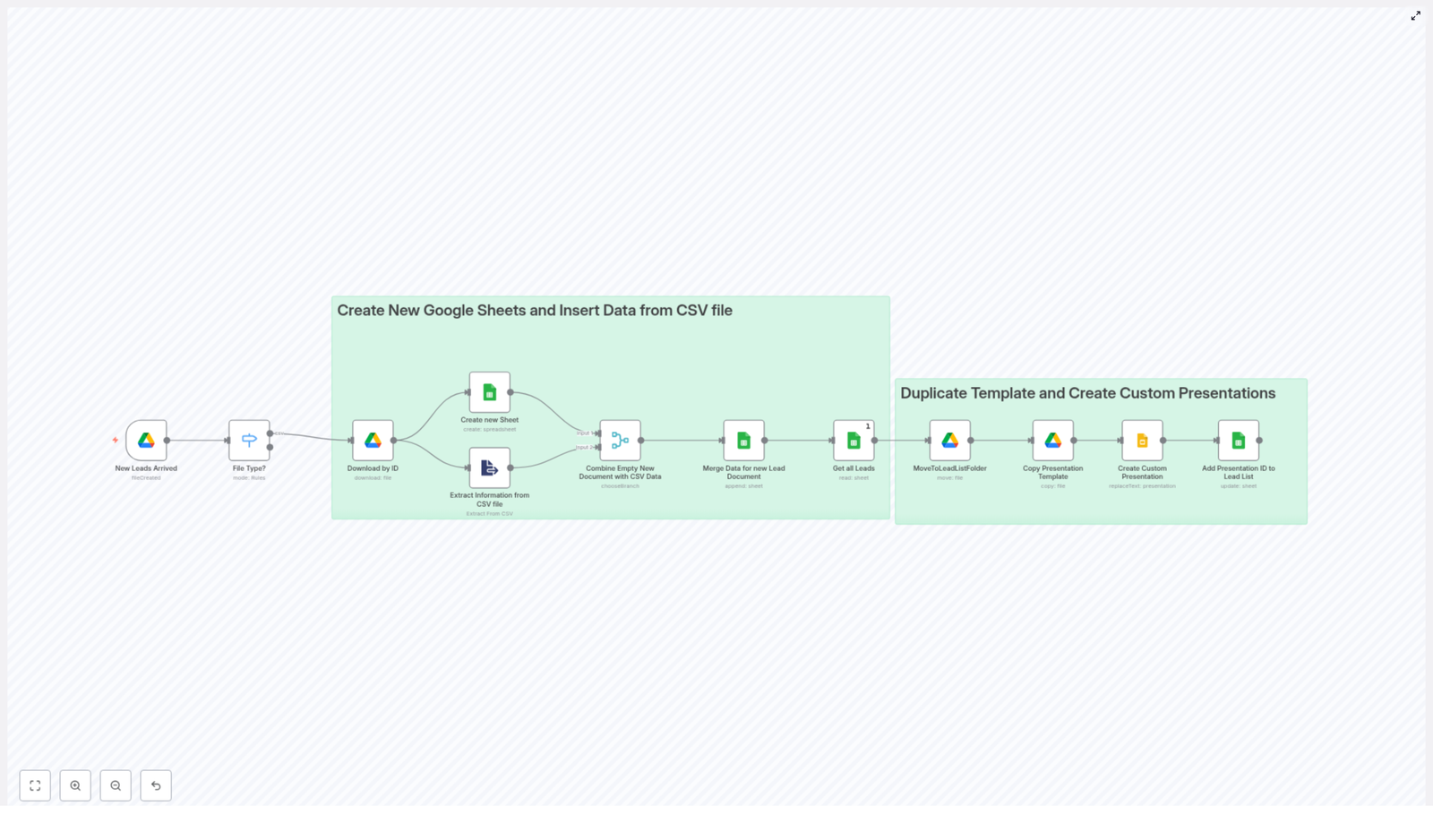
  1. Watch a specific Google Drive folder for new lead files
  2. Download the file and extract the data
  3. Create a new Google Sheet and append the leads
  4. Read each lead from the sheet
  5. Copy a master presentation template for every lead
  6. Replace placeholders in each presentation with lead-specific values
  7. Store the generated presentation ID back in the sheet

Now let us walk through each part in detail so you can clearly see how the template operates inside n8n.

Step-by-Step: Inside the n8n Workflow Template

Step 1 – Detect New Lead Files in Google Drive

The workflow starts with a Google Drive Trigger node. This node is configured to:

  • Watch a specific folder in your Google Drive where you or your team drop new lead files
  • React whenever a new file is added

As soon as a file appears in that folder, the trigger passes information about the file into the workflow. The next logic checks the file type to ensure it is either a CSV or XLSX file, since those are the formats that contain the lead list.

Step 2 – Download and Parse Lead Data

Once a valid file is detected, the workflow uses its file ID to download the content from Google Drive. From here, the template usually splits into two branches that run in parallel:

  • Create a new Google Sheet to host the lead data
  • Extract the CSV data into structured rows

Create a New Google Sheet

One branch uses a Google Sheets node to create a fresh spreadsheet. The sheet:

  • Is given a timestamped title so you can identify when the leads were imported
  • Starts empty, ready to receive the parsed lead rows

Extract and Structure CSV Content

The other branch focuses on parsing the file data. For CSV files, the workflow:

  • Reads the file content
  • Splits it into rows
  • Uses the first row as headers (for example, Company Name, Contact, Email, etc.)
  • Builds a set of records where each row corresponds to one lead

This structured data is what will eventually be written into the Google Sheet and later used to personalize each presentation.

Step 3 – Merge Parsed Leads into the New Google Sheet

After the CSV data is parsed, the workflow brings the two branches back together. At this point, you have:

  • A new, empty Google Sheet
  • A collection of lead rows extracted from the CSV file

The workflow then uses a Google Sheets append operation to:

  • Write the header row (if needed)
  • Append all lead rows into the sheet

The result is a master list of leads stored in a dedicated Google Sheet that corresponds to the uploaded file.

Step 4 – Prepare Data and Organize Files

With the lead data safely stored, the workflow moves into the preparation phase. Here, it performs two main actions:

  1. Read all lead entries from the newly created Google Sheet
  2. Move the original CSV file for better organization

Read Lead Data from Google Sheets

A Google Sheets node is used to fetch all rows from the sheet. Each row includes the full set of fields for one lead, such as company name, contact name, and other details that will be inserted into the presentation.

Move the Source File to a “Lead List” Folder

To keep your Google Drive organized, the workflow then moves the original CSV (or XLSX) file into a specific folder, often named something like “Lead List”. This helps you:

  • Avoid clutter in the incoming folder
  • Maintain a clear archive of processed lead files

Step 5 – Duplicate the Master Presentation Template

Now that the workflow has a list of leads, it can start generating presentations. For each lead row read from the sheet, the workflow:

  • Takes a master Google Slides presentation template
  • Creates a copy of that template
  • Renames the copy based on the lead’s data

Typically, the file name includes the company name and the current date, for example:

Acme Corp - Sales Deck - 2025-06-01

This ensures every lead gets an individual presentation file that can be easily identified and shared.

Step 6 – Personalize the Presentation Content

Once the template is copied for a specific lead, the workflow updates the content inside the slides. It does this by:

  • Scanning the presentation for text placeholders
  • Replacing those placeholders with values from the lead’s row

For example, if your template uses a placeholder like {COMPANYNAME}, the workflow replaces it with the actual company name from the sheet, such as Acme Corp. You can use similar placeholders for other fields, such as:

  • {CONTACTNAME}
  • {INDUSTRY}
  • {LOCATION}

This step is what turns a generic template into a fully personalized sales presentation tailored to each lead.

Step 7 – Store the Presentation ID Back in the Lead List

To complete the loop, the workflow records information about the generated presentations back into the Google Sheet. For each lead, it:

  • Takes the Google Slides file ID of the newly created presentation
  • Writes that ID into the corresponding row in the sheet

This creates a direct link between each lead and its custom presentation. You or your team can later use that ID to:

  • Open the presentation directly
  • Share it with colleagues or prospects
  • Use it in further automations or reporting

Why Use This n8n Workflow Template?

This n8n template is designed to remove repetitive manual work from your sales process. When set up with Google Drive, Sheets, and Slides, it provides several key benefits.

Time and Effort Savings

  • Automated data entry from CSV or XLSX into Google Sheets
  • No manual copying of lead information into presentations
  • Automatic file handling and organization in Google Drive

Personalized Sales Materials at Scale

  • Create tailored presentations for each lead using placeholders
  • Ensure every deck reflects the lead’s company name and other key details
  • Improve lead engagement with customized content

Clean and Organized Lead Management

  • All lead lists are stored in structured Google Sheets
  • Original CSV files are moved into a dedicated “Lead List” folder
  • Each lead row contains a direct reference to its presentation

How to Start Using This Template

To implement this automated solution, you will need:

  • An n8n instance (self-hosted or cloud)
  • Access to Google Drive, Google Sheets, and Google Slides
  • A Slides presentation template with placeholders like {COMPANYNAME}
  • A dedicated folder in Google Drive where new lead files will be uploaded

Once your accounts and folders are ready, you can import the template into n8n and connect your Google credentials. Then customize:

  • The Drive folder to watch
  • The target “Lead List” folder
  • The ID of your master Slides template
  • The placeholder names that match your lead fields

Quick FAQ

Can this workflow handle both CSV and XLSX files?

Yes. The workflow checks the file type when a new file is added to the folder and only proceeds if it is a CSV or XLSX file.

Do I need to change my Google Slides template?

You need to make sure your template contains text placeholders that match the fields in your lead data, such as {COMPANYNAME}. The workflow then replaces these with real values.

Where are the generated presentations stored?

Each personalized presentation is created in Google Drive. The exact location depends on how the template is configured, and the presentation ID is saved back into the corresponding row in the Google Sheet.

What happens to the original CSV file?

After the data is processed, the workflow moves the original file to a designated “Lead List” folder in Google Drive. This keeps your incoming folder clean and maintains an archive of processed files.

Recap

This n8n workflow template gives you a complete, automated pipeline:

  1. Detect new CSV or XLSX lead files in Google Drive
  2. Download and parse the lead data
  3. Create a new Google Sheet and append all leads
  4. Organize the original file into a “Lead List” folder
  5. Copy a master Google Slides template for each lead
  6. Replace text placeholders with actual lead information
  7. Record each presentation ID back into the lead sheet

With this setup, your sales team can go from raw lead lists to ready-to-use custom presentations in a fully automated way.

Try the n8n Template

If you are ready to streamline your sales workflow and generate customized presentations automatically, start by exploring this n8n workflow template and connecting it to your Google Drive, Sheets, and Slides.

You can review and install the template here:

Automate Pitch Deck Analysis with AI and Airtable

Automate Pitch Deck Analysis with AI and Airtable

Overview

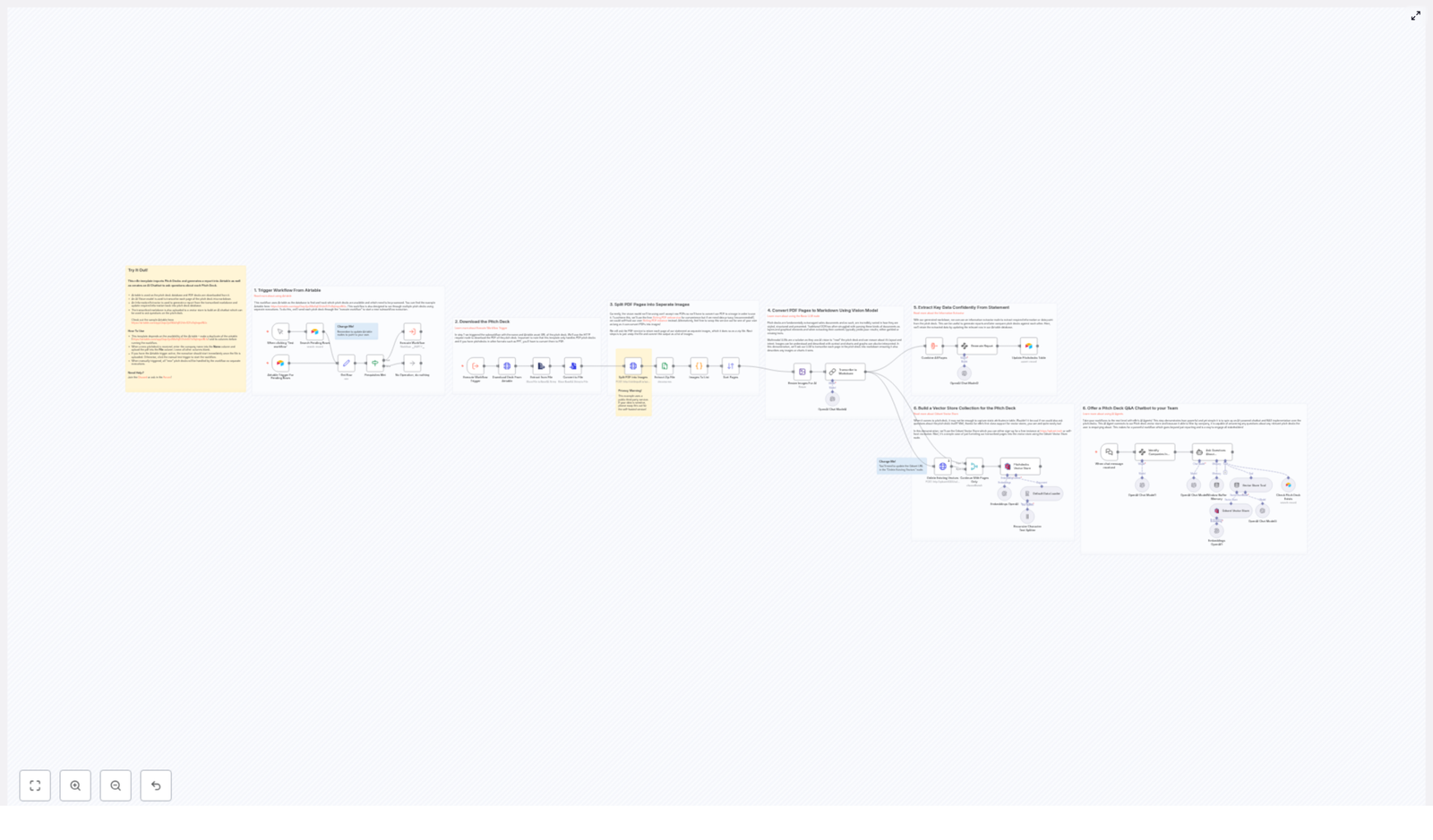
This n8n workflow template automates the end-to-end analysis of PDF pitch decks stored in Airtable. It is designed for venture capital teams, startup accelerators, and investors who need a scalable, repeatable process for extracting structured insights from pitch materials.

The automation performs the following high-level tasks:

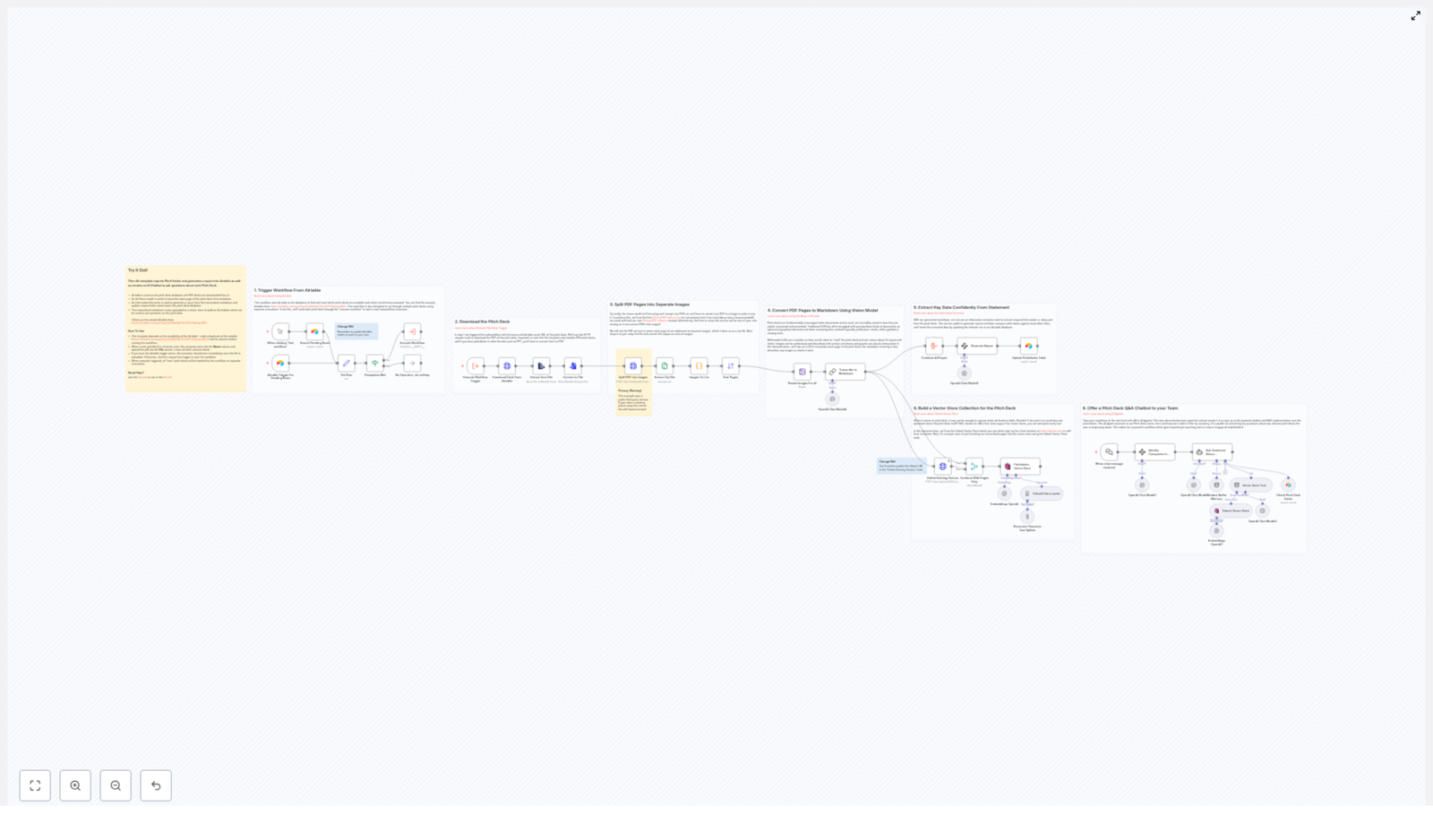
  • Polls Airtable for new pitch deck records with attached PDF files
  • Downloads and converts each PDF into page-level images
  • Transcribes the visual content into markdown using an AI vision model
  • Extracts key investment-relevant data points using an AI information extractor
  • Writes structured results and summaries back into Airtable
  • Indexes the content in a Qdrant vector store for semantic search
  • Exposes the indexed content via an AI chatbot using n8n AI Agents

This document-style guide explains the workflow architecture, node-by-node behavior, configuration requirements, and practical considerations for running this automation reliably in production.

Workflow Architecture

At a high level, the workflow can be divided into four main phases:

  1. Ingestion – Detect and download new pitch deck PDFs from Airtable.
  2. Document preparation – Convert PDFs into images, then into markdown text.
  3. Analysis and enrichment – Use AI to extract structured data and summaries, then persist results to Airtable.
  4. Knowledge access – Build a vector store and expose a Q&A chatbot interface over the processed pitch decks.

Each phase is implemented as a series of n8n nodes that pass data through the workflow using the standard items[] structure. The workflow is designed to handle multiple pitch decks asynchronously, so each Airtable record is processed independently as a separate execution path.

Node-by-Node Breakdown

1. Airtable Trigger – Detect New Pitch Decks

Role: Entry point that identifies which Airtable records are ready for processing.

Typical configuration:

  • Trigger type: Polling or event-based trigger for Airtable (depending on your n8n setup).
  • Table: The table that stores pitch decks, typically with columns such as Name and File.
  • Filter: Only records that have:
    • A non-empty Name field, and
    • An attached PDF file in the designated attachment column (for example, File).

The trigger node periodically polls Airtable and outputs items representing each qualifying record. Each item typically contains:

  • The Airtable record ID
  • Company name or pitch deck name
  • Attachment metadata, including the public file URL for the PDF

Scalability note: Since this is a modular polling-based design, you can safely process multiple pitch decks in parallel, subject to your n8n instance’s concurrency limits and Airtable rate limits.

2. HTTP Request – Download the Pitch Deck PDF

Role: Retrieve the PDF file from the URL stored in Airtable.

Typical configuration:

  • Method: GET
  • URL: The file URL from the Airtable attachment field (for example, {{$json["fields"]["File"][0]["url"]}}).
  • Response format: Binary data

The node downloads the pitch deck as binary content and attaches it to the current item. This binary data is passed to downstream nodes for further processing.

Format limitation: The workflow is designed to handle PDF files only. If a deck is uploaded as PPT, PPTX, or another format, it must be converted to PDF before this workflow runs. Non-PDF files can cause conversion failures in later steps.

3. External Conversion – Split PDF into Page Images

Role: Convert the PDF into one image file per page, suitable for processing by an AI vision model.

The workflow uses an external service, such as Stirling PDF, to convert the PDF into a series of high-resolution JPEG images. This service:

  • Accepts the PDF as input
  • Splits it into individual pages
  • Renders each page as a JPEG image
  • Returns all images bundled as a ZIP archive

An n8n node (typically an HTTP Request or a custom integration) sends the binary PDF to the Stirling PDF endpoint and receives the ZIP file as binary output.

Next, a separate node is used to:

  • Extract the ZIP archive
  • Expose each JPEG file as a separate binary item or as an array of binaries on the item

These image files represent the individual pages of the pitch deck, which are then passed to the vision model.

Privacy warning: The conversion service described here is publicly hosted. If you are working with confidential or sensitive pitch decks, you should:

  • Self-host Stirling PDF or an equivalent PDF-to-image service in your own infrastructure, or
  • Use a secure, compliant document conversion solution under your control.

Sending sensitive content to a public third-party service can violate confidentiality or data protection requirements.

4. Vision AI Node – Convert Page Images to Markdown

Role: Perform OCR and layout-aware transcription of each pitch deck page, outputting markdown text.

Each JPEG page is forwarded to an AI vision model node. The node processes the image and returns a markdown representation of the content. The resulting markdown aims to preserve:

  • Headings and section structure
  • Bullet lists and numbered lists
  • Tables, represented as markdown tables
  • Charts and graphics, described in text form where possible
  • Key visual elements that are relevant for understanding the pitch

Depending on how you configure the workflow, the markdown can be:

  • Stored per page (one markdown block per image), or
  • Concatenated into a single markdown document representing the entire pitch deck.

This markdown text becomes the canonical textual representation used in all downstream AI and indexing steps.

5. AI Information Extractor – Derive Key Investment Data

Role: Analyze the markdown transcription and extract structured, investment-focused insights.

An AI information extraction node is configured to behave like an experienced venture capitalist. It receives the full markdown representation of the pitch deck as input and outputs:

  • Key company attributes, such as:
    • Founding year
    • Team size
    • Market traction and key metrics
    • Funding stage
    • Other relevant attributes present in the deck
  • A concise but detailed executive summary of the pitch
  • Flags, caveats, or fact-check indicators where the model is uncertain or data is missing

The output is structured so it can be mapped directly to Airtable fields. For example, you might have columns such as Founding Year, Team Size, Stage, Traction Summary, and AI Summary.

Edge cases:

  • If a specific data point is not present in the deck, the extractor may return an empty value or a clearly marked “unknown” or “not specified” value.
  • Ambiguous or conflicting information can be surfaced via fact-check flags or notes so that analysts can review manually.

6. Airtable Node – Update Record With AI-Generated Report

Role: Persist the extracted data and summary back into the original Airtable record.

Using the Airtable record ID from the trigger step, an Airtable node performs an Update operation on the corresponding record. Typical field mappings include:

  • Executive summary: The narrative summary generated by the AI extractor
  • Founding year: Parsed numeric or text value
  • Team size: Numeric or categorical value
  • Funding stage: Seed, Series A, etc., based on the deck content
  • Traction / metrics: Text or structured fields, depending on your base design
  • Flags / notes: Any fact-check or uncertainty indicators

Once this step completes, Airtable effectively becomes a structured, searchable database of your pitch decks, enriched with AI-generated insights.

7. Qdrant Node – Build a Vector Store for Semantic Search

Role: Index the pitch deck content to enable semantic search and question answering.

The markdown transcription produced earlier is now passed into a Qdrant node. The node:

  • Embeds the markdown text into vector representations using a configured embedding model
  • Writes these vectors into a Qdrant collection
  • Links each vector back to the corresponding pitch deck (for example via record ID or company name)

This vector store enables:

  • Semantic search across all decks, not limited to keyword matching
  • Context retrieval for question answering and AI agents

You can store:

  • One vector per page, or
  • A single vector per deck, or
  • Chunked segments of the markdown for more granular retrieval

The template uses Qdrant to maintain a dedicated collection for pitch decks, which can be queried later by the chatbot or other workflows.

8. AI Agent / Chatbot Node – Pitch Deck Q&A Interface

Role: Provide a conversational interface that allows your team to query any pitch deck in natural language.

Using n8n’s AI Agents, the workflow sets up a chatbot that:

  • Accepts user questions about a specific pitch deck or across multiple decks
  • Uses the Qdrant collection to retrieve semantically relevant content
  • Generates answers grounded in the indexed markdown content

Typical use cases include:

  • “What is the company’s business model?”
  • “How large is their current customer base?”
  • “What are the main risks identified in this deck?”

The chatbot can be exposed to your internal team via an n8n webhook, a UI integration, or other interfaces supported by your n8n setup.

Configuration Notes

Airtable Setup

Before running the template, prepare your Airtable base:

  • Duplicate the provided sample Airtable base referenced by the template.
  • Ensure the table contains at minimum:
    • A Name column for the company or deck name.
    • A File column (attachment type) where you upload the pitch deck PDFs.
  • Add any additional fields you want to populate, such as:
    • Founding Year
    • Team Size
    • Funding Stage
    • Traction
    • AI Summary
    • Flags / Notes

Configure Airtable credentials in n8n and verify that the workflow can read and update records in the relevant table.

File Handling and Formats

  • Upload only PDF pitch decks into the File column. Other formats must be converted manually or via a separate workflow before this template runs.
  • If a record has multiple attachments, ensure you define how the workflow selects the correct file (for example, using the first attachment or a specific naming convention).

External Conversion Service

  • Configure the endpoint URL and parameters for Stirling PDF or your chosen PDF-to-image service.
  • Validate that the service returns a ZIP archive containing JPEG images for each page.
  • Ensure that the ZIP extraction node correctly exposes all pages to the vision model.

For sensitive pitch decks, plan a self-hosted or private deployment of the conversion service to avoid sending documents to a public instance.

AI Model Configuration

  • Vision model: Confirm that the model supports image input and returns markdown output. Configure temperature, max tokens, and any instruction prompts to prioritize faithful transcription.
  • Information extractor: Provide clear instructions to the model to act as a VC-style analyst and return structured JSON or key-value pairs that map cleanly to Airtable fields.
  • Embedding model (for Qdrant): Choose an embedding model that is compatible with Qdrant and suitable for long-form business content.

Error Handling and Edge Cases

While the template focuses on the happy path, you should consider:

  • Missing or invalid files: If the Airtable record has no file or a non-PDF file, the workflow should skip processing or log an error.
  • Conversion failures: If the PDF-to-image service fails, capture the error and optionally write a status field back to Airtable for manual follow-up.
  • AI timeouts or rate limits: For large decks or high throughput, implement retry logic or throttling where necessary.
  • Partial data extraction: If some fields cannot be extracted, ensure the workflow does not fail the entire record update. Instead, store what is available and optionally mark missing fields.

How to Use This n8n Template

  1. Duplicate the sample Airtable base and configure your tables and fields as described above.
  2. Upload your PDF pitch decks into the File column and set company names in the Name column.
  3. Import and configure the n8n template, including Airtable credentials, external PDF conversion endpoint, AI model credentials, and Qdrant connection details.
  4. Trigger the workflow:
    • Manually, for initial testing or batch processing, or
    • Automatically, by enabling the Airtable trigger to listen for new or updated records.
  5. Monitor workflow executions in n8n and verify that:
    • Airtable records are updated with AI-generated summaries and structured data.
    • The Qdrant vector store is populated with entries for each processed pitch deck.
  6. Use the configured Q&A chatbot to interactively query your pitch decks, test typical investor questions, and refine prompts or settings as needed.

Advanced Customization Ideas

  • Additional fields: Extend the information extractor prompt to capture more metrics, such as revenue, growth rate, or sector classification, then map them to new Airtable columns.
  • Multi-stage review: Add nodes that route decks to different reviewers based on stage, geography, or sector extracted from the content.
  • Alerting: Integrate email or Slack notifications when a new deck is processed or when certain criteria are met (for example, “Series B, ARR > $5M”).
  • Versioning: Track multiple versions of a pitch deck by adding a version field and indexing each version separately in Qdrant.

Automate Pitch Deck Analysis with AI and Airtable

Automate Pitch Deck Analysis with AI and Airtable: A Founder’s Story

When Pitch Decks Become a Problem

By the time Lena opened her laptop on Monday morning, her Airtable base already looked like a battlefield.

As an associate at a busy VC fund, she was responsible for the first pass on every incoming startup pitch deck. Dozens of founders sent PDFs each week. Some were polished, some were messy, and all of them demanded attention.

Her process was painfully familiar. Download each PDF. Skim 20 to 30 slides. Manually note the founding year, team size, funding stage, revenue, social links, and a rough summary. Copy key points into Airtable. Repeat. By the time she finished a batch, new decks had already arrived.

She knew she was missing good opportunities, not because the startups were bad, but because she simply did not have enough hours to read every slide with care.

That was the day she decided to try something different. A colleague mentioned an n8n workflow template that automates pitch deck analysis with AI and Airtable. Instead of manually reading every slide, she could let automation and AI do the heavy lifting, then focus on actual decision-making.

Discovering an Automated Pitch Deck Workflow

Lena’s vision was simple. She wanted to drop a PDF pitch deck into Airtable and have everything else just happen:

  • Download and process the PDF automatically
  • Turn slides into readable text, including charts and visuals
  • Extract key startup data into structured Airtable fields
  • Enable an AI chatbot so the team could ask questions about any deck

The n8n template she found did exactly that. It connected Airtable, a PDF-to-image service, AI vision models, an information extractor, and a Qdrant vector store into a single automated pipeline.

She decided to wire it into her existing Airtable base and run it on a few test decks. What followed completely changed how her team handled deal flow.

Rising Action: Turning Airtable Into a Trigger

The first piece of the puzzle was getting n8n to know when a pitch deck was ready for analysis.

Triggering the Workflow From Airtable

Lena configured the workflow so everything started with Airtable. Her base already had a table where founders submitted their decks, including a File field for the PDF and several empty fields for analysis and executive summaries.

The n8n Airtable trigger searched this table for entries that matched a simple rule:

  • A pitch deck PDF had been uploaded
  • No executive summary or analysis existed yet

Whenever it found a row that met those conditions, the workflow automatically fired. No more manual “start processing” button, no need to track which decks were pending. Airtable itself became the queue.

The Technical Journey Behind the Scenes

Once the trigger found a new deck, the real magic began. Lena watched the first test run in n8n’s execution logs and followed each step, slide by slide.

Step 1: Downloading the Pitch Deck PDF

The workflow started by grabbing the file URL from Airtable. Using an HTTP request node, it downloaded the pitch deck as a PDF.

There was one important limitation. The workflow only supports PDFs. Some founders still sent PPT files, but Lena simply added a reminder in her submission instructions: “Please upload your pitch deck as a PDF.” If a deck arrived in PPT format, they converted it first.

Step 2: Splitting the PDF Into Page Images

Next, Lena saw why the workflow needed a PDF-to-image step. The chosen AI vision model could not read PDFs directly. It needed images.

The workflow sent the PDF to the Stirling PDF webservice. That service split the document into separate pages and converted each page into a JPEG image at 300 dpi. All page images were bundled into a ZIP file.

n8n then:

  • Extracted the ZIP archive
  • Turned the list of images into a structured collection
  • Prepared those images for the next AI step

Privacy Note

As Lena dug deeper, she realized the example template used a public third-party PDF conversion service. That was fine for test decks, but some investor data was sensitive.

For production, the team decided they would eventually self-host the PDF conversion service. That way, all pitch deck pages would stay within their own infrastructure. It was a small but important step to protect founders’ confidential information.

Step 3: Transcribing Slides With an AI Vision Model

Once the images were ready, the workflow resized them and passed them into an AI multimodal language model. This model could interpret both text and visual elements on each slide.

Instead of basic OCR, which often fails on complex layouts, the model produced a clean markdown transcription for every page. It captured:

  • Headings and section titles
  • Body text and bullet points
  • Tables and charts with descriptions
  • Image captions and visual context where relevant

For Lena, this was the turning point. What used to be a static PDF was now a structured markdown document that an AI could understand, search, and summarize.

Step 4: Extracting Key Startup Data Automatically

With the markdown ready, the workflow passed it to an AI Information Extractor. This component was configured to look for specific data points that Lena’s team cared about, such as:

  • Company founding year
  • Team size
  • Funding stage
  • Revenue or traction metrics
  • Social media and website links
  • Other relevant structured fields

The extractor analyzed the markdown and returned a structured dataset. n8n then used this output to update the corresponding Airtable row automatically. Fields that Lena once filled in by hand were now populated within minutes of upload.

No more copying numbers from slide 14 into a spreadsheet. No more missing key metrics because she was tired or distracted.

Step 5: Building a Vector Store for Each Pitch Deck

At this point, the workflow had already saved Lena hours. But the template went one step further.

To enable rich semantic search, the markdown content for each pitch deck was uploaded into a Qdrant vector store. This created an embedding-based representation of the deck, enabling the system to understand meaning rather than just keywords.

Instead of searching for exact phrases, the team could now ask complex questions about the content of any deck.

Step 6: Connecting an AI Chatbot for Pitch Deck Q&A

The final piece was the part Lena’s partners loved most.

The n8n workflow template included an AI chatbot interface that connected directly to the Qdrant vector store. This chatbot could answer natural language questions using only the embedded knowledge from a given pitch deck.

In practice, that meant anyone on the team could ask things like:

  • “What is the startup’s current revenue model?”
  • “How large is their team and where are they based?”
  • “What problem are they solving and who is the target customer?”

The chatbot responded with informed, context-aware answers grounded in the actual slides, not in generic assumptions. It became a shared tool for investors, analysts, and even interns who needed to ramp up quickly on a new company.

The Turning Point: From Manual Chaos to Automated Clarity

After a week of testing, Lena compared her old workflow to the new one powered by n8n, AI, and Airtable.

Before:

  • Download every PDF manually
  • Skim 20 to 30 slides per deck
  • Type key data into Airtable fields
  • Write short summaries from memory
  • Answer partner questions by reopening PDFs

After:

  • Founders upload PDF pitch decks directly into Airtable
  • n8n triggers automatically when a new deck is ready
  • PDFs are converted to images at 300 dpi and transcribed to markdown via an AI vision model
  • An AI Information Extractor pulls out key metrics and updates Airtable
  • The deck’s content is stored in a Qdrant vector database
  • The team uses an AI chatbot to query any deck in natural language

What used to take hours now happened in the background while Lena focused on higher value tasks like founder calls and deep-dive analysis.

How Lena Set Everything Up

Although the workflow felt advanced, getting started was surprisingly straightforward. Here is how she implemented the template in her own environment.

Getting Started With the n8n Template

  • She duplicated the sample Airtable base that matched the template’s structure.
  • She configured her Airtable API keys and other credentials inside n8n.
  • She made sure new pitch decks were uploaded as PDFs into the Airtable File field.
  • She enabled the Airtable trigger so the workflow would run automatically, but also kept the option to run it manually for testing.
  • She viewed the executive summaries and extracted data directly within Airtable, without opening the original PDFs.
  • She shared the AI chatbot interface with her team so they could quickly interact with pitch decks and get deeper insights.

Why This n8n Template Became Essential

As more decks flowed through the system, Lena’s team began to treat the workflow as a core part of their investment process. The benefits were hard to ignore.

  • Automated data extraction removed tedious manual transcription and reduced errors.
  • Structured, AI-enriched data in Airtable made it easier to compare startups and make data-driven decisions.
  • An AI-powered conversational interface gave everyone instant access to pitch deck knowledge without hunting through slides.
  • Open and extendable services like Stirling PDF, OpenAI models, and Qdrant meant the workflow could evolve as their needs changed.
  • Scalability allowed the team to handle many pitch decks asynchronously without overwhelming analysts.

Privacy and Security in the Real World

As the fund grew, so did their responsibility to protect sensitive company information. Lena worked with their technical team to review the workflow’s privacy profile.

The default template uses a third party PDF to image service, which may not be ideal for confidential investor data or stealth startups. For long-term use, they explored:

  • Self-hosting the PDF conversion service so pitch decks never left their environment
  • Locking down API keys and credentials in secure secret managers
  • Defining clear internal policies for how AI outputs were stored and shared

With those safeguards in place, they felt confident using the workflow for real deal flow, not just experiments.

Resolution: A New Standard for Pitch Deck Review

In a few weeks, what started as an experiment became the new default. Lena no longer dreaded Monday mornings. Instead of opening a folder full of PDFs, she opened Airtable and saw neatly structured records, executive summaries, and a chatbot ready to answer questions about any deck.

The n8n workflow template that automates pitch deck analysis with AI and Airtable transformed her role. She spent less time on manual transcription and more time thinking, debating, and deciding. The partners noticed. Founders appreciated faster feedback. The entire deal flow became more efficient.

Whether you are a VC firm, accelerator, angel syndicate, or startup scout, this template offers a practical way to combine low-code automation and advanced AI into a single, repeatable process that scales with your pipeline.

Ready to Transform Your Pitch Deck Processing?

You can follow the same path Lena did:

  • Duplicate the workflow and sample Airtable base
  • Configure your API keys and credentials securely
  • Upload your next batch of pitch decks as PDFs
  • Let n8n, AI vision models, and Qdrant handle the heavy lifting

Then spend your time where it matters most: evaluating the startups, not wrestling with their slides.

Automate E-commerce Post-Purchase Support with SMS Alerts

Automate E-commerce Post-Purchase Support with SMS Alerts

What You Will Learn

In this guide, you will learn how to use an n8n workflow template to automate your e-commerce post-purchase support process. By the end, you will understand how to:

  • Trigger an automation whenever a customer replies to a post-purchase follow-up email.
  • Automatically extract customer and order details from the reply.
  • Create a structured support ticket in Zendesk.
  • Prepare and send an urgent SMS alert to your support team using Twilio.
  • Improve response times, centralize communication, and keep your SLAs on track.

Why Automate Post-Purchase Support?

After a customer completes a purchase, your follow-up communication is critical. Customers may reply with questions about delivery, returns, product usage, or billing. If these replies are missed or delayed, it can quickly impact customer satisfaction.

With an n8n automation workflow, you can:

  • Capture every reply from your post-purchase campaigns.
  • Turn those replies into actionable Zendesk tickets.
  • Alert your support team by SMS when urgent attention is needed.

This creates a reliable, scalable system where no customer query is overlooked.

Overview of the n8n Workflow

The workflow connects four key elements:

  1. Emelia campaigns for post-purchase follow-up emails.
  2. An n8n trigger that listens for customer replies.
  3. Zendesk for ticket creation and tracking.
  4. Twilio for sending SMS alerts to your support team.

At a high level, the automation works like this:

  1. A customer replies to a post-purchase follow-up email.
  2. n8n captures the reply and extracts customer and order information.
  3. A new support ticket is created in Zendesk with full context.
  4. The workflow formats the key ticket details for SMS.
  5. An urgent SMS is sent to the support team, including a direct link to the Zendesk ticket.

Key Concepts Before You Start

Emelia Trigger in n8n

The emelia-trigger node listens for customer replies to your Emelia campaigns. In this workflow, it is configured to react specifically to replies from post-purchase follow-up campaigns. This ensures the automation only runs when a customer responds to those targeted emails.

Data Extraction for Contextual Support

Good support relies on context. The workflow includes a node that pulls structured data from the customer reply and related records, such as:

  • Customer full name
  • Email address
  • Company name
  • Order ID
  • Purchase date
  • Product name

This data is then passed into Zendesk so your agents see everything they need in one place.

Zendesk Ticket Creation

The create-zendesk-ticket node uses the extracted information to automatically open a new ticket. The ticket includes:

  • A clear subject line that identifies the customer and order.
  • A detailed description with order details and the customer reply.
  • Tags, priority, and routing to the correct support group.
  • Custom fields for better categorization and reporting.

SMS Alerts via Twilio

Once the ticket is created, the workflow prepares a concise summary of the most important details, such as:

  • Zendesk ticket ID
  • Customer name
  • Order ID

This summary is used by the send-sms-alert node, which sends a real-time SMS notification to your support team’s phone number using Twilio. The SMS includes a direct link to the Zendesk ticket so the team can respond quickly.

Step-by-Step: How the n8n Workflow Template Works

Step 1 – Capture Customer Replies with the Emelia Trigger

The workflow starts with the emelia-trigger node.

  • It listens for incoming replies from customers who received your post-purchase follow-up email.
  • Whenever a reply is detected, the node passes the message content and metadata into the next step in n8n.

This ensures that every customer response is automatically captured and processed without manual checking of inboxes.

Step 2 – Extract Customer and Order Data

Next, the workflow moves to the extract-customer-data node.

This node gathers all the crucial information needed for support, for example:

  • Customer identity: full name, email address, and company.
  • Order details: order ID, purchase date, and product name.

By structuring this data, the workflow makes it easy to populate the Zendesk ticket fields and provide agents with immediate context.

Step 3 – Automatically Create a Zendesk Ticket

With the customer and order data ready, the workflow triggers the create-zendesk-ticket node.

This node:

  • Creates a new ticket in Zendesk using the extracted customer information.
  • Builds a clear subject line that includes the customer name and order reference.
  • Generates a detailed description that combines:
    • Order information (order ID, purchase date, product name).
    • The content of the customer’s reply.
  • Sets the ticket priority to urgent so it stands out in the queue.
  • Routes the ticket to the correct support group and applies relevant tags and custom fields for efficient handling.

The result is a fully prepared ticket that your support team can act on immediately, without any manual data entry.

Step 4 – Prepare Data for the SMS Notification

After the Zendesk ticket is created, the workflow uses the prepare-sms-data node.

This node formats the key details your team needs to see in an SMS, such as:

  • New ticket ID from Zendesk.
  • Customer name.
  • Order ID or reference.

By preparing this data first, the SMS message stays short, clear, and immediately actionable.

Step 5 – Send an SMS Alert to the Support Team

Finally, the send-sms-alert node sends a real-time text message using Twilio.

The SMS typically includes:

  • The customer’s name and order reference.
  • The Zendesk ticket ID.
  • A direct link to open the ticket in Zendesk.

This alert goes to your support team’s designated phone number, helping them quickly identify urgent post-purchase issues and respond without delay.

Benefits of This n8n Automation Workflow

  • Improved Response Times
    Automated triggers and SMS alerts ensure your support team is notified as soon as a customer replies, which reduces waiting time and increases customer satisfaction.
  • Centralized Ticket Management
    Integration with Zendesk means all customer replies are converted into tickets and stored in a single, organized system that is easy to track and manage.
  • Contextual and Personalized Support
    Detailed extraction of customer and order information gives agents the full context they need, allowing them to provide informed, personalized responses rather than asking the customer to repeat details.
  • Better SLA Compliance
    Marking tickets as urgent and sending SMS escalation alerts helps your team meet service level agreements and maintain consistent response quality.

Quick Recap

To summarize, this n8n workflow template helps you:

  1. Listen for post-purchase email replies with the emelia-trigger node.
  2. Extract key customer and order details using extract-customer-data.
  3. Create a fully detailed, urgent Zendesk ticket via create-zendesk-ticket.
  4. Format ticket and customer information for SMS in prepare-sms-data.
  5. Send an urgent SMS alert to your support team using send-sms-alert with Twilio.

With this setup, you automate the entire path from customer reply to agent notification, which significantly improves the reliability and speed of your post-purchase support.

FAQ

Do I need to know how to code to use this workflow?

No. The workflow is built as an n8n template, so you primarily configure nodes, connect your Emelia, Zendesk, and Twilio accounts, and adjust fields as needed. Most of the logic is already set up for you.

Can I customize the SMS content?

Yes. In the prepare-sms-data and send-sms-alert nodes, you can edit the message format, include additional fields, or change the tone of the alert while still keeping the core details like ticket ID and order ID.

What if I want different priorities for different types of replies?

You can extend the workflow by adding conditions in n8n. For example, you could check for certain keywords in the customer reply and adjust the Zendesk ticket priority or tags accordingly.

Is this workflow scalable?

Yes. The workflow is designed to handle replies at scale. As your number of post-purchase campaigns and customers grows, the automation continues to process each reply and create tickets consistently.

Get Started With the Template

Implementing this end-to-end post-purchase support automation can significantly improve your customer service efficiency and satisfaction. If you want to streamline your e-commerce support workflows with reliable automation and real-time alerts, this n8n workflow template is a powerful starting point.

Ready to automate your post-purchase support? Contact us today to get started and plug this template into your n8n setup.

Automate E-commerce Post-Purchase Support with Zendesk & Twilio

Automate E-commerce Post-Purchase Support with Zendesk & Twilio

Why Post-Purchase Automation Matters

If you run an online store, you already know the sale doesn’t end at checkout. The real relationship with your customer starts after they buy. That is where post-purchase support comes in, and it can make or break whether someone buys from you again.

The problem is, responding to every single reply manually takes time, especially when your campaigns scale. That is where a smart automation workflow using Emelia, Zendesk, Twilio, and n8n steps in. It listens for customer replies, turns them into support tickets, and pings your team instantly so nothing slips through the cracks.

Let us walk through what this template does, when you should use it, and how it makes your life a lot easier.

What This n8n Workflow Template Actually Does

This automated post-purchase support workflow is built to take over the repetitive stuff you should not be doing by hand. In simple terms, it:

  • Listens for customer replies to your post-purchase campaigns in Emelia
  • Pulls out key customer and order details from the reply
  • Creates a fully detailed support ticket in Zendesk
  • Prepares a short, actionable summary for your team
  • Sends an urgent SMS alert via Twilio with a direct ticket link

The result is a support process that feels fast and personal for your customers, without you having to watch your inbox 24/7.

When To Use This Automation

This workflow is perfect if you:

  • Run post-purchase email campaigns with Emelia and get replies like “I have a question about my order”
  • Use Zendesk to manage support conversations
  • Rely on Twilio to send SMS alerts to your team
  • Want to make sure urgent customer messages get seen and handled quickly

If your support team is juggling multiple tools or missing messages because they are buried in email threads, this automation will feel like a breath of fresh air.

How the Workflow Works, Step by Step

Let us break down the main pieces of the template so you can see exactly what is going on behind the scenes.

Step 1 – Trigger on Customer Reply via Emelia

Everything starts the moment a customer replies to your post-purchase campaign in Emelia.

The workflow uses the emelia-trigger node, which is configured to listen for “replied” events from a specific campaign. As soon as Emelia detects that reply, n8n kicks the workflow into action automatically. No inbox refreshing, no manual copy-paste.

Step 2 – Extract Customer and Order Data

Once the trigger fires, the workflow needs context. Who is the customer? What did they buy? What are they asking?

That is where the extract-customer-data node comes in. It pulls out all the important information, such as:

  • Customer full name
  • Email address
  • Company name (if available)
  • Reply content
  • Order ID
  • Purchase date
  • Product name

All of this is turned into structured data that can be passed cleanly into Zendesk. Your support team does not have to guess what the customer is talking about or dig through emails to find the order.

Step 3 – Create a Zendesk Support Ticket

Next, the workflow creates a proper support ticket in Zendesk using the create-zendesk-ticket node.

The ticket is not just a blank shell. It includes a detailed description that bundles together:

  • Customer details, like name and email
  • Order metadata, including order ID, purchase date, and product
  • The original reply text from the customer

This gives your support agents everything they need to respond quickly and professionally. No extra digging, no switching between tools to piece the story together.

Step 4 – Prepare SMS Notification Data

Now that the ticket exists, the workflow gets ready to alert your team.

The prepare-sms-data node gathers and formats the most relevant details for a short, actionable SMS, such as:

  • Zendesk ticket ID
  • Ticket URL
  • Customer name
  • Order ID

This step is all about turning a full support ticket into a quick snapshot that makes sense in a text message.

Step 5 – Send SMS Alert via Twilio

Finally, it is time to nudge your team.

Using the send-sms-alert node connected to Twilio, the workflow sends an urgent SMS to your support team. The message highlights that a new post-purchase reply has come in, includes the ticket link, and signals that it needs prompt attention.

Your team gets an instant heads-up, even if they are away from their desk, which is especially helpful for high-priority customers or time-sensitive issues.

Why This Workflow Makes Your Life Easier

So what do you actually gain from putting this in place? Quite a lot.

  • Speed: Manual ticket creation is gone. Replies turn into tickets automatically, which cuts response times significantly.
  • Accuracy: Customer and order details are extracted and passed along directly, which reduces typos and missing information.
  • Proactivity: SMS alerts make sure urgent messages are noticed quickly, even outside the inbox.
  • Scalability: As your store grows, this workflow handles more replies without you needing to grow the team at the same pace.

In short, you get a smoother process for your team and a faster, more reliable experience for your customers.

Implementing This Automation in Your Stack

This template is a great fit for e-commerce businesses that want to keep their customer service sharp without drowning in manual work. By connecting:

  • Emelia for post-purchase campaign replies
  • Zendesk for structured ticket management
  • Twilio for instant SMS notifications
  • n8n as the no-code automation layer tying it all together

you end up with a seamless, proactive support system that runs quietly in the background.

Once set up, your team gets real-time visibility into customer replies, and you can respond faster, keep customers happier, and protect your brand reputation without adding more tools or complexity.

Wrapping Up

Automating your post-purchase support with this n8n workflow is a simple way to boost both customer satisfaction and internal efficiency. Your customers feel heard quickly, your team spends less time on repetitive tasks, and your support operations become more consistent and reliable.

Instead of worrying about missed emails or delayed responses, you can focus on improving your products and growing your business, knowing that your support process is under control.

Ready To Try It Out?

If you are ready to upgrade your post-purchase experience, this template is a great place to start. Connect Emelia, Zendesk, and Twilio through n8n, plug this workflow into your e-commerce setup, and let automation handle the heavy lifting.

You can work with your platform consultant to get everything connected or explore n8n integrations yourself and customize the flow as needed.