


JSON Architect: Dynamic JSON Output for AI Agents
Overview
JSON Architect is an advanced n8n workflow template designed to generate, validate, and refine structured JSON output formats based on any AI agent’s input context. It automates the full lifecycle of JSON schema creation, from initial design through validation and real-world testing, so that downstream AI agents receive predictable, machine-consumable data with minimal manual intervention.
This template is particularly suited for automation professionals, solution architects, and AI engineers who need robust, context-aware JSON structures for complex AI workflows, tools, and agents.
Primary Objective and Use Case
The core goal of JSON Architect is to produce reliable JSON schemas that align precisely with a given scenario or prompt, then verify that those schemas are usable in practice. Rather than manually designing formats for every new AI task, this workflow dynamically derives the appropriate structure and validates it in an automated loop.
For instance, consider an AI use case in which two characters are speaking at night about their magical capabilities. One character can foresee the future, while the other practices alchemy. JSON Architect can automatically construct a JSON schema that captures:
- Contextual metadata such as time of day and location
- Character profiles, including magical abilities and attributes
- Dialogue structure and exchanges between the characters
The resulting JSON is shaped specifically for AI consumption, so that agents can reliably parse, analyze, or extend the scene without ambiguity or ad hoc parsing logic.
Architecture and Workflow Design
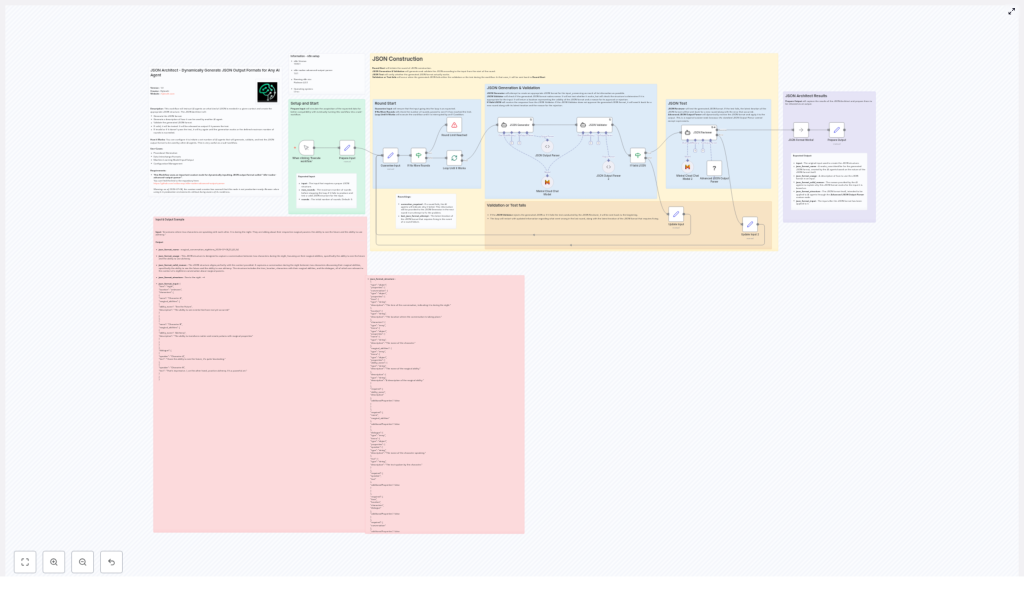
The JSON Architect template is built as a multi-stage workflow in n8n. Each stage focuses on a single responsibility and feeds into the next, forming a controlled feedback loop that ensures JSON quality and applicability.
1. Prepare Input
In the initial stage, the workflow defines the context or scenario that requires JSON structuring. This can include:
- High-level task description or AI prompt
- Domain-specific constraints or required fields
- Any metadata that should be represented in the final JSON
Clear, well-scoped input at this step significantly improves the quality of the generated schema and is considered an automation best practice.
2. Guarantee Input
Before schema generation begins, the workflow validates the incoming data. The Guarantee Input phase ensures that:
- Required fields are present and properly formatted
- Input values fall within expected ranges or types
- Critical context is not missing or ambiguous
This pre-validation reduces failure rates in later stages and avoids propagating malformed context into the JSON generation logic.
3. JSON Generator
Once the context is validated, the JSON Generator node (or group of nodes) creates an initial JSON format. This stage:
- Interprets the input scenario and requirements
- Proposes a JSON schema or structured output format
- Defines keys, nested objects, and arrays aligned with the AI use case
For the earlier example of two characters discussing magic at night, this step would define objects for characters, dialogue turns, setting details, and any additional attributes that should be machine-readable.
4. JSON Validator
The JSON Validator stage examines the generated schema to confirm that it is structurally sound and suitable for the intended purpose. Typical checks include:
- JSON syntax correctness
- Consistency in field naming and nesting
- Alignment with required constraints or schema patterns
If the JSON fails validation, the workflow does not proceed to real-data testing. Instead, it feeds back into refinement logic.
5. JSON Reviewer and Practical Testing
Validation alone is not sufficient for production-grade AI workflows. The JSON Reviewer stage tests the JSON format by attempting to fit actual input data into the schema. This is where practical applicability is verified:
- Sample or real data is mapped into the generated structure
- Incompatibilities, missing fields, or impractical constraints are detected
- The schema is assessed for real-world usability, not just syntactic validity
This step effectively closes the gap between theoretical schema design and operational usage in AI agents.
6. Iterative Improvement: Loop Until It Works
A key feature of JSON Architect is its iterative validation loop. If either the JSON Validator or JSON Reviewer stages detect issues, the workflow:
- Enters an improvement loop that adjusts the schema
- Repeats validation and review steps
- Continues until a valid, usable schema is achieved or a configured maximum number of rounds is reached
This controlled iteration is essential for complex or ambiguous contexts, where a single-pass generation is often insufficient. It also incorporates safety and retry mechanisms to prevent infinite loops and to handle invalid outputs gracefully.
7. Prepare Output
Once the JSON format has passed both structural validation and practical testing, the workflow enters the Prepare Output phase. This final stage:
- Outputs the approved JSON structure
- Includes metadata describing how and when to use the schema
- Documents the validation status and any relevant constraints
The result is a ready-to-use JSON format that can be integrated directly into AI pipelines, tools, or agents with confidence.
Key Technical Elements
JSON Architect leverages several advanced techniques and nodes to deliver robust, context-aware JSON outputs.
Iterative Validation Loops
The architecture is built around iterative validation loops that ensure accuracy and reliability. Instead of assuming the first generated schema is correct, the workflow:
- Continuously evaluates the JSON against structural and practical criteria
- Refines the schema until it meets predefined quality thresholds
- Prevents deployment of partially valid or brittle formats
Advanced JSON Parsing
To handle complex and dynamic structures, the workflow utilizes custom components such as the Advanced JSON Output Parser. This node extends beyond typical parsers by:
- Supporting more flexible and nuanced JSON patterns
- Handling edge cases that arise from AI-generated content
- Providing better error reporting for debugging and refinement
Safety, Error Handling, and Retries
Automation reliability is a central design principle. JSON Architect includes:
- Safety mechanisms to catch invalid JSON outputs early
- Retry logic for transient failures or inconsistent AI responses
- Guardrails to stop processing when a maximum iteration count is reached
These measures ensure that the workflow degrades gracefully, preserving system stability even when upstream inputs are noisy or unpredictable.
Benefits for AI and Automation Workflows
Adopting JSON Architect in your n8n environment provides several strategic advantages.
- Automated schema generation: Eliminate manual design of JSON structures for each new AI scenario by letting the workflow derive schemas from context.
- Reduced human error: Rigorous validation and testing stages minimize the risk of malformed or incomplete JSON formats entering production.
- High adaptability: The iterative design and advanced parsing allow the template to support a wide variety of AI workflows, from conversational agents to complex data pipelines.
- Standardized outputs: Consistent, well-documented JSON formats improve interoperability between different AI agents, tools, and services.
- Improved maintainability: Centralizing schema generation logic in a reusable n8n template simplifies long-term maintenance and evolution of your automation stack.
Strategic Impact and Best Practices
By integrating JSON Architect into your AI infrastructure, you move from ad hoc JSON handling to a disciplined, automated approach. This shift:
- Streamlines data interchange between AI components
- Improves reliability of model interactions and tool calls
- Supports configuration management through predictable, versionable JSON formats
For best results, automation professionals should:
- Provide clear, detailed input contexts during the Prepare Input phase
- Define explicit validation rules and quality thresholds
- Monitor iteration counts and error logs to refine prompts or constraints over time
Conclusion
JSON Architect closes the feedback loop between JSON generation and real-world applicability in AI workflows. By combining context-aware schema creation, iterative validation, and advanced parsing, it enables developers, data engineers, and automation experts to deliver robust, standardized JSON outputs at scale.
If you are building or maintaining AI-driven systems in n8n, this template provides a strong foundation for reliable data exchange and agent interoperability.
Get Started
Integrate JSON Architect into your n8n environment to accelerate schema design, reduce manual work, and increase the robustness of your AI data handling pipelines.
